
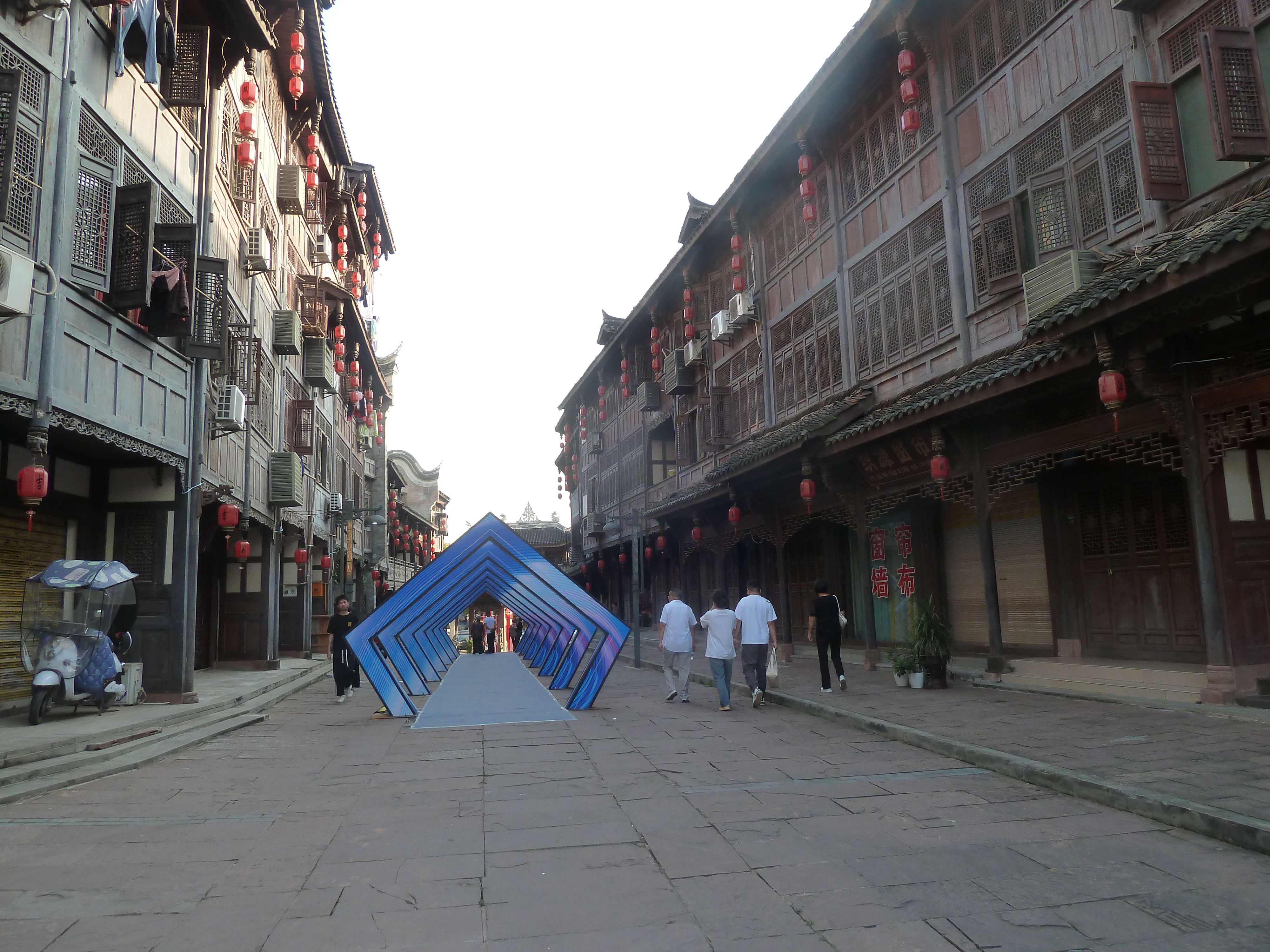
Shuangjiang rewards visitors who enjoy looking closely: the shape of a gateway, the space behind a doorway and the way several lanes join. Our recommendation is to give it a dedicated half-day in Tongnan, with the journey from central Chongqing planned separately. A rushed photo stop misses the relationship between the streets and the houses.
Why this town is worth the detour
Shuangjiang (双江古镇) is in Tongnan District, northwest of Chongqing’s urban core. The Local Chronicles Office dates its beginnings to the late Ming–early Qing period and records its inclusion in the first national group of historic cultural towns in 2003. The Civil Affairs account explains its name through two streams and describes a network of nine streets. This is a town to explore through connected lanes rather than one straight shopping street. Historical overview; place-name research.
Our editorial view: choose it for domestic architecture and local history. If your priority is simply an easy old-street outing during a short central-Chongqing stay, compare the transfer burden before committing a day. No claim of guaranteed quietness or an “untouched” town is warranted; shops, residents and tourism coexist.
Chongqing Daily’s 29 April 2026 report separately described architectural-learning activities planned for 1–3 May inside Yang Family Residence and programming at Yang Shangkun’s former residence. This supports their continuing cultural role in 2026 and the distinction between the sites. Those May activities have ended; do not treat the report as an October event listing.
Three stops, three different ways to look
Yuwang Palace: start with the public face
Search for 禹王宫 双江 潼南, including the town and district to avoid similarly named buildings elsewhere. The historical description identifies a carved entrance and a theatre-facing courtyard. Look at the contrast between the elaborate gateway and the spaces beyond it; entry depends on the day’s arrangements. Architectural record.

Yang Family Residence: read the thresholds
杨氏民宅, also described as the Tianba compound, is not interchangeable with every attraction bearing the Yang surname. The 2026 archive feature records construction beginning in 1878 and lasting twelve years, with courtyards nested inside courtyards. Rather than trying to count rooms, compare how doors frame the next space and how carved screens filter the view. That is our suggested way of reading the building, not a guided-tour script. Tongnan Archives feature.

Yang Angong’s former residence: allow reading time
杨闇公旧居 adds the history of the early Communist movement to the architecture visit. The archives also connects the town with the 1928 Shuangjiang uprising. Treat exhibition material as historical interpretation that deserves reading time, rather than another façade to tick off. Observe any photography restrictions and do not block other visitors. Historical context.

Yang Shangkun’s former residence (杨尚昆故居) is another distinct destination. The 2021 account places the Changtanzi compound roughly one kilometre west of the town. That historical distance is not a verified present walking route. Confirm its entrance and access before adding it. Site distinction.
Choose a route that fits the day
These are our planning allowances, not measured walking times or official tours. Follow current signs and adjust the sequence to which interiors are open.
- About 90 minutes, mostly outdoors: save your arrival point, walk a small loop through the old streets, inspect the Yuwang Palace exterior and stop for one snack. Leave deeper house visits for another occasion.
- About three hours, heritage-focused: explore the lanes, choose one or two open interiors from the stops above, then take a seated food break. Spend longer at fewer sites instead of racing between every Yang residence.
- Longer visit: add Yang Shangkun’s former residence only after confirming access and the transfer. A separate Dafo Temple visit also needs its own transport and opening checks; it is not part of the ancient-town walking loop.

Getting there without a fragile connection
Compare a bookable train to 潼南 (Tongnan) plus a local transfer with a prearranged road journey. Check the actual departure station, arrival point and return departure before paying. A fast rail leg does not include reaching the station, waiting or travelling onward to the town. Save 双江古镇,重庆市潼南区 for the driver and agree a recognisable pickup location.
A district Culture and Tourism Commission reply dated 7 May 2026 lists bus 108 or a Tongnan–Shuangjiang passenger coach from Tongnan’s urban area. It does not establish today’s boarding stop, frequency, last departure or fare. Ask locally before relying on either, and leave enough margin for the return connection. The same reply discusses a dedicated Dafo–Shuangjiang shuttle as something to explore, not an already guaranteed service. Official transport context.
Our practical choice: use public transport when you can confirm both ends and tolerate waiting; consider a prearranged car when time or walking tolerance matters more. Ask whether waiting, tolls and the return journey are included in the quote. No current transfer price or journey duration has been verified for this guide.
Food, comfort and respectful visiting
The archive feature names liangfen, mahua twists, spiced peanuts and ciba among local foods. Choose one or two to try rather than treating every shop as an endorsed recommendation. Ask the portion price before ordering and check sauces or fillings if you have allergies or dietary restrictions. Local food context.
Wear shoes with grip for stone paving; after rain, shorten the route if surfaces feel slick. Historic thresholds and uneven paving mean step-free access must be checked building by building. For a wheelchair or stroller, ask specifically about the entrance, courtyard surface and toilet route. Bring water, a charged phone and the written destination. Stay out of closed courtyards, ask before photographing residents, and never touch carvings or climb barriers for a picture.
Before travelling, confirm the opening and last-entry times of your chosen interiors, any separate ticket or reservation requirements, and how a foreign passport is handled if registration is requested. Do not assume a walkable street means every building is free or open. Festival performances mentioned in older articles are not a daily programme.
The memorial operator’s homepage publishes a baseline of 09:00–17:00, year-round. Its undated visitor information describes free admission after registration with valid documents. Keep the scope narrow: this is information for the operator-managed memorial attractions, not a blanket promise for every street, shop or heritage interior in Shuangjiang. It does not confirm that Yuwang Palace’s interior, or any particular building, will admit you on your October visit.
Use 023-44860569, the operator’s published contact, to ask about your exact building, date, last entry and any booking requirement. Ask specifically how a foreign passport is handled; the available information does not establish passport acceptance. The operator’s 19 May 2024 reservation guide says venues are booked separately and their hours, sessions and quotas may change. It describes an identity-card-based entry process, so do not assume the same procedure works with your passport.
The visitor-page text is undated and not wholly current, so treat it as a lead to confirm rather than a live access guarantee. Guided interpretation is separate from admission; a dated fee notice changed the guiding arrangements from January 2026. Ask for the applicable price and booking terms instead of relying on an old quoted rate. No October slot availability was checked.
What was checked
Original desk research and image-license checks were recorded on 4 October 2026 UTC. The source and licensing records were rechecked on 5 October 2026 UTC, with access limitations retained. The 2021 and 2024 accounts establish history, the January 2026 archive feature supplies local context, the May official reply supplies dated transport information, and the operator pages provide a qualified starting point for access questions. The April newspaper report concerns past May activities. No live admission inventory, confirmed October entry, step-free audit, on-site visit or human review is claimed. All four photographs date from 30 September 2023.
Frequently asked questions
Q: Is Shuangjiang Ancient Town in central Chongqing?
A: No. It is in Tongnan District. Treat the journey as a regional outing and check the complete outward and return trip, including local transfers.
Q: Are Yang Family Residence and the two former residences the same place?
A: No. 杨氏民宅, 杨闇公旧居 and 杨尚昆故居 refer to different sites. Save each exact Chinese name and confirm the correct entrance.
Q: Is entry free, and what are the opening hours?
A: The memorial operator publishes a 09:00–17:00 year-round baseline and registered free admission for its managed memorial attractions. This is not a guarantee for every Shuangjiang building or an October visit. Confirm the exact venue, last entry, booking rules and foreign-passport handling at 023-44860569.
Q: Can I take a direct shuttle from Dafo Temple?
A: Do not assume so. The official reply dated 7 May 2026 discusses exploring an inter-attraction shuttle. Confirm any operating service for your travel date.
Q: How much time should I allow, and is it step-free?
A: Our allowance is about 90 minutes for an exterior sampler or three hours for lanes, selected interiors and a break, excluding transport. Step-free access is unverified; check thresholds, paving and toilets for your needs.
Traveler comments
Share a recent experience or ask a practical question about this guide.