

Cover illustration: AI illustration based on a historical photograph. Hong'an riverfront tiled houses and stone steps at blue hour; night opening is not confirmed. Scene, terrain and architectural details are approximate; not a current photograph, access confirmation or navigation guide.
Historical reference only; original photograph not republished or licensed for reuse: iChongqing / Bridging News / Hu Dawei / Visual Chongqing
This guide contains four explicitly labeled AI scene illustrations from historical photo references and one original localized planning diagram. Photograph capture dates and current access are not established by the page update dates. No independent review is claimed.
Hong'an in Xiushan makes a literary and riverside stop in 2026 when its geography is kept clear. A description hosted on Hunan's government site identifies Biancheng, formerly Chadong; Chongqing's Hong'an is a distinct town. Plan the Chongqing-side old streets first, then decide separately whether a river crossing or evening production fits your visit.
Save 重庆秀山洪安古镇 for the Chongqing side and 湖南花垣边城茶峒 for the Hunan side. The place-name distinction is more useful than the broad English label “Border Town,” which may describe a novel, the surrounding landscape, a town or a tourism product.
This is a researched visitor guide, not an account of a walk or ferry ride by the editorial team. Its suggested sequence is conditional on the routes and crossings open when you arrive. Fares, showtimes, boat operations and a step-free route were not verified on 1 October 2026.
Put two towns on the map before booking
A contributor's caption hosted on Hunan's government site identifies Biancheng as the former Chadong in Huayuan County. Xinhua's March 2025 photo reporting explicitly labels Hong'an in Chongqing and Biancheng in Hunan on opposite sides of the Qingshui River. The same report places the wider community network at the junction with Guizhou.
Use this information to make a small personal map with separate pins for your lodging, your arrival or pickup point and the places you want to see. A room sold under a “Biancheng” label may be on a different side from the driver meeting point you selected. Resolve that before checking in, especially if you will arrive after dark.
The familiar three-province slogan is a useful clue to the area's connected geography, not a complete navigation instruction. Chongqing is a municipality, while Hunan and Guizhou are provinces. Do not describe every nearby landmark as being in Chongqing simply because the outing started in Hong'an.

AI illustration based on a historical photograph. Hong'an grey rooftops and old-street axis backed by wooded mountains; no current street access is implied. Scene, terrain and architectural details are approximate; not a current photograph, access confirmation or navigation guide.
Historical reference only; original photograph not republished or licensed for reuse: Xinhua via Sina / 王全超 / Xinhua
Bring the novel as a way of looking
Both the Hunan-hosted caption and Chongqing's 2024 reporting connect the area with Shen Congwen's Border Town. That shared literary association is a reason to read across the two banks rather than trying to assign the whole imaginative landscape to one present-day ticketed site.
A useful literary visit asks how crossing, waiting, trade and river life shape a place. Notice where paths approach the water, how buildings face it and where people pause. Those observations can enrich a reading without asserting that a particular doorway belonged to a fictional character.
Modern statues, named routes and staged scenes may interpret the book. Treat them as interpretation unless a reliable source establishes a different historical claim. A scenic label is not evidence that a fictional person lived in an identifiable building, and a modern performance is not a documentary reconstruction of daily life.
You do not have to finish the novel to enjoy the town. Knowing its association gives a starting point; the old streets and cross-river geography offer their own subjects. If you do read it beforehand, keep your impressions separate from what local signs claim about a named object or site.
Begin with Hong'an's public old streets
Xinhua's April 2023 photo essay identifies wood-frame stilt-house forms, tiled roofs, projecting eaves and lattice windows along Hong'an's old streets. Those details suggest an attentive architectural walk, while the date reminds us that individual shopfronts and access arrangements can change.
Start by establishing the public approach and return point. Then choose a manageable stretch of street rather than assuming every attractive lane joins a loop. Look at the transition between building and water, the way an upper floor is supported and how a roof or corridor shelters the frontage. Photograph from places where you are allowed to stand.
A lived street requires different manners from an empty architectural model. Give deliveries and residents room to pass. Do not enter a courtyard, climb a stair or lean across a balcony rail merely to improve an angle. Ask before photographing private interiors or making a close portrait.
If traveling with someone who prefers fewer steps, scout a short section together before the group spreads out. Check the surface, gradient and turnaround point in person. An old-town label does not tell you whether a particular route is suitable for a wheelchair, stroller or walking aid.

AI illustration based on a historical photograph. Covered wooden boats moored at a Hong'an-area landing; they are not verified cable ferries or evidence of current service. Scene, terrain and architectural details are approximate; not a current photograph, access confirmation or navigation guide.
Historical reference only; original photograph not republished or licensed for reuse: Xinhua via Sina / 王全超 / Xinhua
Make the ferry a conditional addition
The cable ferry known as 拉拉渡 appears in Chongqing's report of activity on 24 October 2024. A hosted creator visit reported in March 2025 also describes a crossing. These establish the experience's place in recent tourism, not its operating status for your visit.
Before buying a crossing, identify the landing at each end, the service's actual purpose, the price and the return arrangement. A sightseeing boat and a cross-river ferry need not be the same product. Ask how the boarding works if anyone needs assistance, and follow the operator's instructions and safety equipment requirements.
Allow the river to remain part of the visit even if no crossing is available. A permitted bank-side view can explain the town's relationship to its neighbour. Do not let one missed activity turn into pressure to board an unsuitable boat or seek an unofficial crossing.
If you do cross, keep the return decision explicit. Know whether your accommodation and transport pickup are on the side you are leaving, and what verified alternative applies if the return ferry stops. Do not assume a bridge visible in a photograph supplies a short, suitable pedestrian route back to your exact meeting point.
Separate the old town from newer performance products
Xinhua's 4 May 2026 report makes a useful distinction. It describes Yujian Biancheng, 遇见边城, using settings in the old town, and separately describes productions in nearby Biancheng Fengqing Xiaozhen, 边城风情小镇. The article reports holiday activity rather than a permanent schedule.
If a performance is central to your plans, obtain the exact product name, venue pin, entry time, duration, ticket conditions and any transfer requirement. Check whether the experience is seated or involves moving between scenes. Ask what language the performance uses and whether enough visual context is available for your party to enjoy it.
Decide whether you want a quiet literary walk, an evening entertainment outing or both. There is no need to treat them as interchangeable. A modern production can be enjoyed on its own terms without being presented as an unchanged historical ritual.
Do not assume that a hotel package includes every attraction shown in its photographs. Get the inclusions in writing and keep the venue's booking confirmation. A May holiday news story cannot confirm what will run on an ordinary evening later in the year.

AI illustration based on a historical photograph. Waterfront facing the river beside Hong'an; this bank is not verified as Chongqing-side Hong'an. Scene, terrain and architectural details are approximate; not a current photograph, access confirmation or navigation guide.
Historical reference only; original photograph not republished or licensed for reuse: Xinhua via Sina / 黄伟 / Xinhua
Give food and craft stops a clear location
The 2024 municipal report mentions sour-pickled-vegetable tofu fish in Hong'an. Use that as a regional dish to ask about, not a promise about a named restaurant's recipe or availability. Confirm the portion, price basis and ingredients before ordering, particularly if fish is priced by weight.
For dietary needs, name what you avoid rather than relying on a dish's short English translation. Tofu in a dish name does not establish that the dish is vegetarian. Ask about broth, cooking fat and additions, using a written note if necessary. Our vegetarian and vegan ordering guide gives a broader preparation framework.
Cultural reports also combine places across Xiushan. The 2025 hosted creator story identifies its craft exhibition venue in the county town's West Street, not in a Hong'an riverside lane. Do not turn that account into a claim that the same workshop is beside the ferry.
If a maker's demonstration interests you, obtain its present address and booking requirements. For an object you might buy, ask who made it and where. A useful souvenir conversation is specific; broad claims of regional tradition do not establish the provenance of every item on a shelf.
Plan the regional arrival and the correct return bank
The 2026 Xinhua report places Hong'an's current tourism in Xiushan County. Treat it as a regional journey when arranging your wider Chongqing trip. This guide does not endorse a fixed road time or supply a bus departure because current date-specific services were not verified.
For transport, check three things together: the exact arrival point, any local onward connection and your return pickup. Give the driver or accommodation the complete Chinese destination rather than “Border Town.” If arriving from Hunan or continuing into another province, keep each leg explicit in the plan.
For an overnight stay, ask which side of the river the property is on, how luggage reaches it and whether steps separate the vehicle approach from the entrance. If you plan to see an evening show, confirm the route back to that actual address afterward. The hotel check-in guide helps international visitors prepare questions without promising a particular property's arrangements.
A brief first visit can focus on Hong'an alone. Add the other bank, a history venue or a show when its confirmed access and transport leave useful time, rather than treating the number of places crossed as the measure of success.
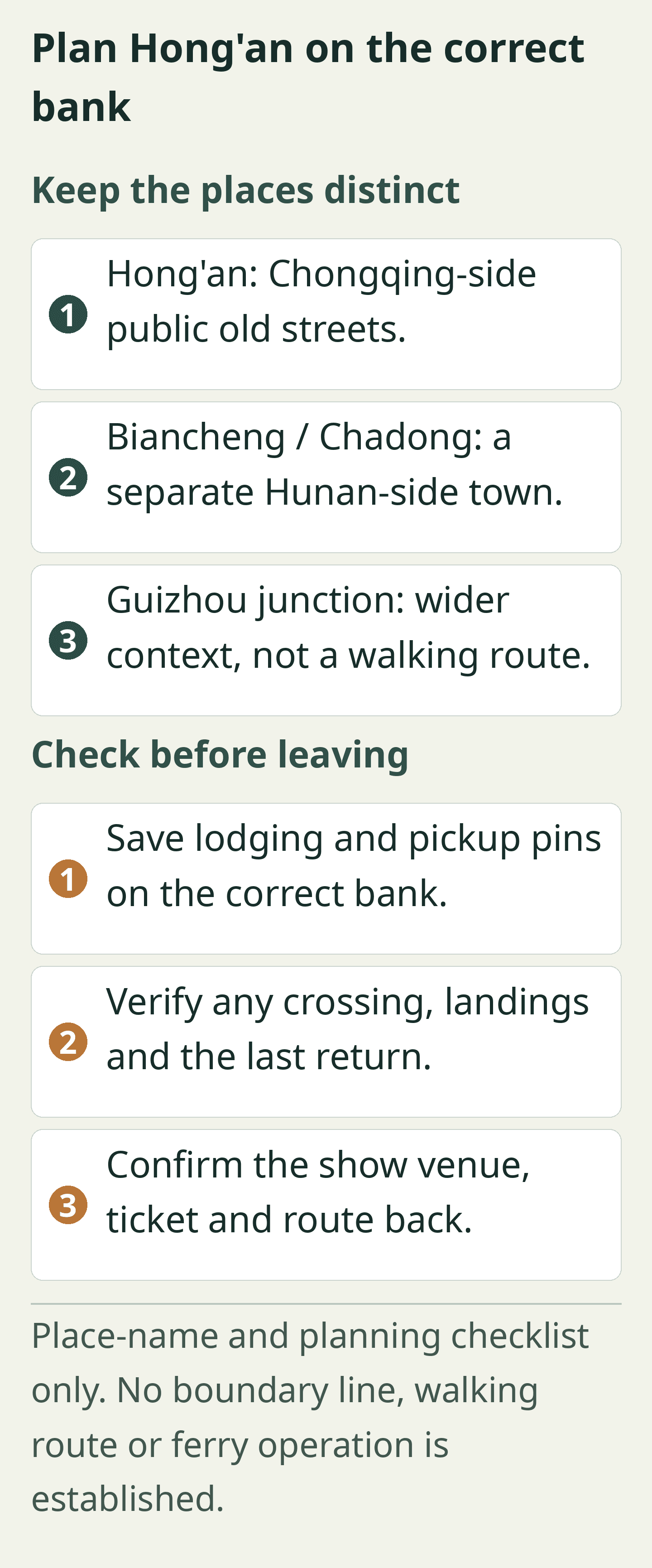
Original planning card; all labels also appear as selectable text below. Place-name and planning checklist only. No boundary line, walking route or ferry operation is established.
Original editorial planning diagram based on this article; not a photograph or geographic map.
Plan Hong'an on the correct bank
Keep the places distinct:
- Hong'an: Chongqing-side public old streets.
- Biancheng / Chadong: a separate Hunan-side town.
- Guizhou junction: wider context, not a walking route.
Check before leaving:
- Save lodging and pickup pins on the correct bank.
- Verify any crossing, landings and the last return.
- Confirm the show venue, ticket and route back.
Place-name and planning checklist only. No boundary line, walking route or ferry operation is established.
About This Guide
Six topic pages across four root domains were read on 1 October 2026. Government-hosted descriptions and Xinhua reporting underpin the geography; the hosted creator account is identified as such and used cautiously. No independent first-person visit, current ferry timetable or same-day performance confirmation is claimed.
Before departure, verify the intended bank, the accommodation or pickup pin, any crossing, the specific show and the return. Use the maps and navigation guide to prepare saved Chinese names. Keep the literary setting expansive while making the practical itinerary precise.
Frequently Asked Questions
Q: Are Hong'an and Chadong the same town? A: No. Hong'an is in Xiushan, Chongqing; Chadong is the former name of Biancheng in Huayuan, Hunan. The neighbouring towns share the river landscape associated with Border Town.
Q: Can I ride the cable ferry today? A: Current operation was not verified. Reporting from 2024 and 2025 describes the Hong'an ferry, but you should check the actual landing, service, safety instructions and return before relying on it.
Q: Do I need to cross into Hunan to enjoy Hong'an? A: No. A Chongqing-side visit can focus on Hong'an's public old streets and river setting; the crossing is a separate choice once its arrangements are confirmed.
Q: Is the evening show included with an old-town visit? A: Do not assume that it is. The May 2026 report distinguishes old-town interpretation from productions in nearby Biancheng Fengqing Xiaozhen, so confirm the exact venue and ticket inclusions.
Q: Is every Border Town landmark a surviving place from the novel? A: No. Around Hong'an and Biancheng, contemporary tourism features may interpret Shen Congwen's fiction; a statue, performance or scenic name is not proof that a fictional character lived there.

Traveler comments
Share a recent experience or ask a practical question about this guide.