
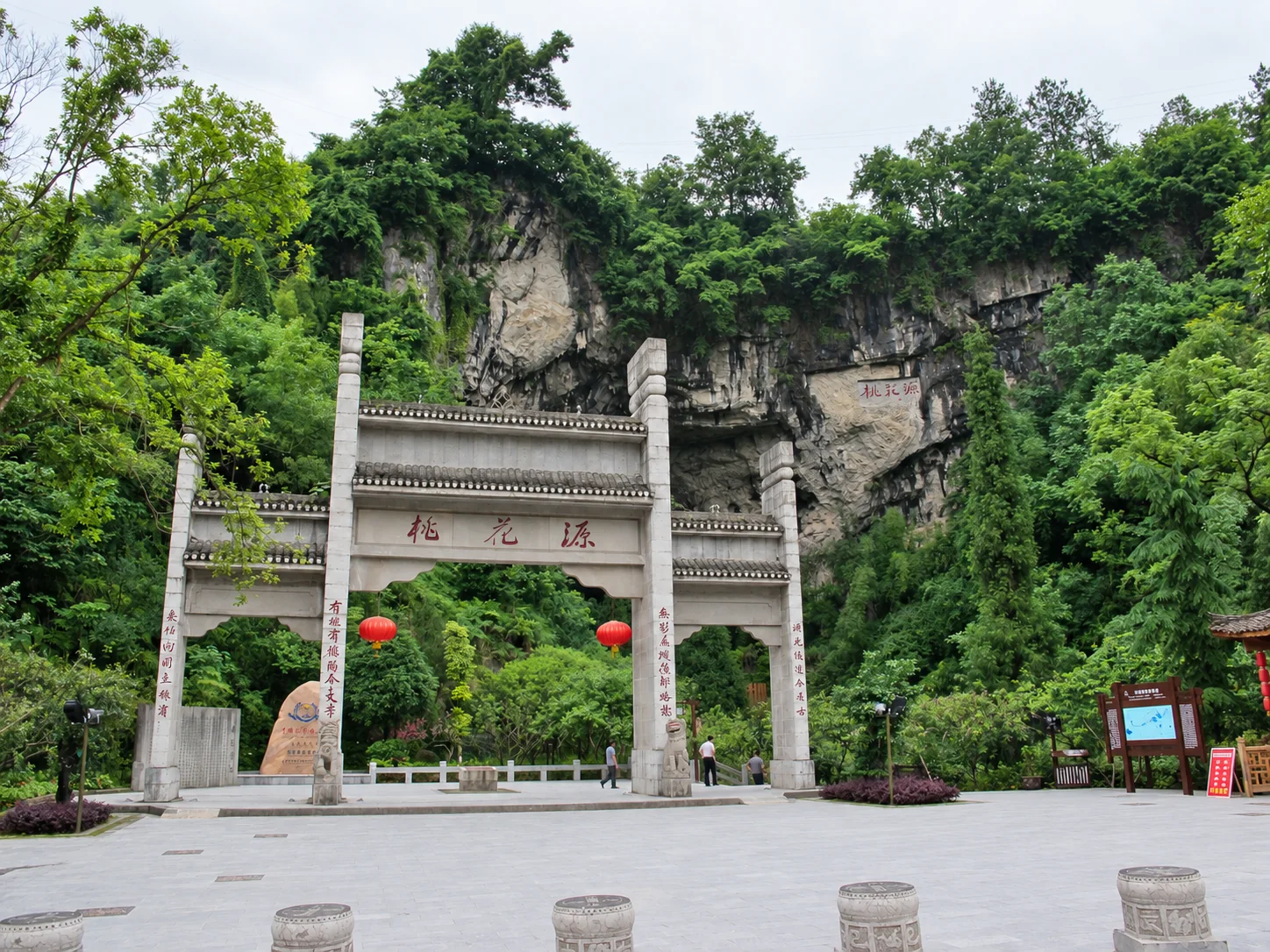

Cover image: AI-generated rendering of the Youyang Taohuayuan entrance, based on a photograph taken by Nyx Ning on 12 June 2012. It does not show current site conditions. Creator: AI-generated for Chongqing Travel Editorial; reference photograph by Nyx Ning; Source: 重庆市 酉阳-桃花源 - panoramio.jpg; License: CC BY-SA 3.0; Changes: AI-generated from the licensed historical reference photograph, then converted to WebP with the full composition retained; not a camera photograph. Reference photograph and this derived rendering are offered under CC BY-SA 3.0.
Youyang Taohuayuan in 2026 suits travelers who want a literary landscape, karst scenery and time beyond central Chongqing. The municipal tourism description identifies eight parts within the wider scenic area. We suggest considering one overnight stay, with the main visit and regional transport arranged separately rather than squeezed around a city sightseeing day.
Save the destination as 酉阳桃花源, Youyang Taohuayuan. “Peach Blossom Spring” appears in English translations, but the name is also used for other destinations. Confirm Youyang County, Chongqing, on every ticket, hotel and transfer. A photograph labelled Taohuayuan is not enough to establish the place.

The Taohuayuan entrance arch in Youyang, photographed on 12 June 2012. The destination name is visible; current entrances, meeting points and access arrangements must be confirmed separately. Creator: Nyx Ning; Source: 重庆市 酉阳-桃花源 - panoramio.jpg; License: CC BY-SA 3.0; Changes: EXIF auto-orientation, proportional resizing and WebP conversion; full composition retained and EXIF removed. No crop, retouch, scene synthesis or watermark removal. Adapted photographic material is offered under the same CC BY-SA version linked above.
This is a desk-researched guide. Its two-day outline is an editorial planning option, not a measured walking route or an account of a personal visit. It works by choosing the experience first, then checking the actual entrance, exit and local connection.
Approach the story as an interpretation of landscape
The municipal description published on 11 June 2026 connects Youyang with Tao Yuanming's Peach Blossom Spring. It describes karst features, cultivated landscapes and a local tradition identifying this setting with the literary work. That is a useful interpretive frame; it does not prove that the story records a single recoverable geographical location.
Read a translation of the short work before the trip. Then choose two ideas to look for: the transition between an enclosed approach and an open landscape, and the contrast between ordinary work and an imagined refuge. Looking for those relationships can make a visit more interesting than comparing every scene with a promotional photograph.

The cave threshold at Youyang Taohuayuan, photographed on 12 June 2012. The enclosed approach and open landscape support the literary reading; the image is not a current access report. Creator: Nyx Ning; Source: 重庆市 酉阳-进桃花源的洞口 - panoramio.jpg; License: CC BY-SA 3.0; Changes: EXIF auto-orientation, proportional resizing and WebP conversion; full composition retained and EXIF removed. No crop, retouch, scene synthesis or watermark removal. Adapted photographic material is offered under the same CC BY-SA version linked above.
Keep literary association separate from the age of visible structures. A landscape presented through Qin- or Jin-period imagery is not, by that fact alone, a surviving settlement from those periods. Ask what is geological, what is a reconstruction and what has a documented historical date.
Nor should “Peach Blossom Spring” become a promise of flowering trees whenever you arrive. If blossom is your main purpose, request a dated view of the relevant area close to your visit. A name, an undated gallery and a spring photograph establish different things.
Separate the main visit from the wider scenic-area name
The same municipal page lists eight components, including Ancient Peach Blossom Spring, a cave component, Youzhou Ancient Town, forest-park and performance-related areas. Treat this list as the shape of a destination, not as the contents of one ticket or a route that everyone must finish.
There is also a naming problem worth resolving before purchase. The English introduction lists Taigu Cave, then discusses Fuxi Cave later in the page. This guide does not assume that every seller uses the names consistently or that both descriptions imply the same entrance-to-exit experience. Ask the seller to show the Chinese name of the cave and the actual route included.

A cave exterior at Youyang Taohuayuan, identified by the photographer as Fuxi Cave, 12 June 2012. This historical view does not resolve present-day ticket names or included cave routes. Creator: Nyx Ning; Source: 重庆市 酉阳-桃花源伏義洞 - panoramio.jpg; License: CC BY-SA 3.0; Changes: EXIF auto-orientation, proportional resizing and WebP conversion; full composition retained and EXIF removed. No crop, retouch, scene synthesis or watermark removal. Adapted photographic material is offered under the same CC BY-SA version linked above.
A useful booking question is: “Does this product include the garden, a cave, transport and a performance, or do I choose these separately?” Have the answer written against the product you are considering. Screenshots of two differently named packages are more useful than a general assurance that you will “see Taohuayuan.”
If someone in the group dislikes enclosed spaces or prolonged walking, settle that choice before committing to a combined package. A shorter visit built around the landscape may suit the group better than purchasing every component and negotiating the route at the entrance.
Use the official ticket baseline without mistaking it for live availability
The Youyang county attraction directory dated 9 January 2026 lists Taohuayuan admission at CNY 100 and an opening window of 08:00–17:30. It gives 023-75532359 as the contact number. These are dated official reference points, not a confirmed quote or final-entry time for your travel date.
Before paying, check the specific visit date, inclusions, entry cutoff and any separate cave cutoff. An attraction's closing time does not tell you when a longer route stops admitting visitors. Ask how much of the chosen route can reasonably be completed before operations end.
Check the document type accepted by the booking channel if you will use a foreign passport. Do not select an unrelated identity category merely to force an online form through. If the channel cannot handle your document, ask the attraction which supported booking or ticket-counter procedure to use.
Save the booking confirmation and the cancellation conditions. An overnight plan gives you more room to adjust, but it does not automatically make tickets transferable or refundable. Likewise, a listed reservation channel does not establish English-language support throughout the visit.
Design a walk around a clear exit
The public Trip.com listing includes a July 2025 review discussing walking and exit connections. That is a dated visitor account rather than current route instruction. Its useful lesson is to ask where the selected route finishes, not to copy the reviewer's timings.
Before entering, locate the visitor map and establish three points: your entrance, the furthest section you actually intend to reach, and the exit used by that route. Ask whether there is a permitted shorter return if someone wants to stop. Do not assume that completing a cave brings you back to the place where a driver dropped you.

The fish-viewing pond at Youyang Taohuayuan on 12 June 2012. A pond scene gives landscape context without establishing a continuous or step-free walking route. Creator: Nyx Ning; Source: 重庆市 酉阳-桃花源观鱼池 - panoramio.jpg; License: CC BY-SA 3.0; Changes: EXIF auto-orientation, proportional resizing and WebP conversion; full composition retained and EXIF removed. No crop, retouch, scene synthesis or watermark removal. Adapted photographic material is offered under the same CC BY-SA version linked above.
For a cave-inclusive option, ask about stairs, lighting, slippery surfaces and whether the route is one-way. If a stroller or wheelchair is involved, request details for the whole chain, including gates, cave sections and the final transfer. A broad “family-friendly” label does not answer those questions.
Carry what you can comfortably keep with you. Luggage storage, internal vehicles and assistance need confirming rather than assuming. A compact bag makes it easier to pause, handle changing conditions and leave space for other people on a narrow path.
Give the overnight stay a practical job
We would use one overnight stay to separate arrival from the main attraction visit. That is the central benefit of this plan. It should reduce pressure around the regional journey, rather than serve as an excuse to add another long transfer before dinner.
On the first day, arrive at the accommodation with enough flexibility to deal with check-in and find the next day's departure point. If arrival is late, keep the evening to a meal and preparation. If there is time and energy, consider a modest visit to Youzhou after confirming what is accessible that evening.
On the second day, make Taohuayuan the main commitment. Choose the confirmed route, then leave enough margin for its exit connection, collecting luggage and your onward journey. Do not reserve the latest plausible onward departure before the local transfer is understood.
For choosing a base, compare the property's actual address with the arrival terminal and attraction entrance. Ask about luggage handling, stairs between vehicle access and the room, breakfast arrangements and the planned departure time. Our foreign-passport hotel check-in guide helps frame the document questions; it does not certify an individual Youyang property.
Treat Youzhou and an evening performance as different choices
The municipal source describes Youzhou Ancient Town as extending for 1.3 kilometres and identifies a separate Taoyuan Grand Stage. Neither fact establishes an evening programme for your date. A street visit and a ticketed production deserve separate decisions.
For Youzhou, the interest can be in the relationship between slope, roofline and street frontage. Choose a short section and look closely rather than trying to complete a prescribed photo checklist. Where there are shops or workshops, ask before taking close photographs of people or their work.
If an evening performance matters to you, verify the venue, programme name, start and finish, ticket scope and return transport before booking the night around it. A description of an established production is not proof that it runs every evening, throughout the year or in unsuitable weather.
The source discusses Tujia cultural forms, including hand-waving dance and Xilankapu brocade. Use the specific name of an activity when you can establish it. A staged visitor presentation is one encounter with cultural expression; it should not become a claim about how every local family lives.
Work backward from the regional return journey
Start with two complete journeys: getting to your Youyang base and leaving it. Within each, distinguish the long-distance service from the local transfer. An arrival at a place bearing the county name does not mean the attraction entrance or your hotel is beside the platform.
Use date-specific transport information and keep the precise Chinese station or terminal name. Our Chongqing railway-stations guide explains why station names matter; it should not be treated as a Youyang shuttle timetable. This research did not establish a current local bus schedule or reliable door-to-door journey time.
For a booked transfer, agree on the meeting point, whether waiting is included and what happens if the attraction route finishes at another exit. Share the destination pin and entrance name, not an attractive photograph of the place. The maps and road-levels guide has a useful meeting-point checking method.
If weather or access reduces the visit, keep the transport plan workable. You do not need to compensate for a missed cave or show with an unverified detour. A manageable regional trip is more satisfying than spending the final part of it trying to recover a connection.
About This Guide
Research completed on 1 October 2026 used the county's January directory, the municipality's June tourism description and the public Trip.com page. Conflicting cave terminology, older visitor reports and wrong-place material about Hunan were kept separate. The practical sequence is editorial advice. No on-site inspection, local interview or confirmed day-of-travel operating status is claimed.
Frequently Asked Questions
Q: Is this the Taohuayuan in Hunan? A: No. This guide concerns 酉阳桃花源 in Youyang County, Chongqing. Check the county and municipality on every booking because English names and social feeds can mix destinations.
Q: Do I need to stay overnight? A: One night is a planning option when it separates the regional journey from the main visit. A same-day trip depends on confirmed transport and the route you choose, rather than a universal travel time.
Q: Does a Taohuayuan ticket include every cave and a show? A: Do not assume so. The municipal description covers eight parts of the wider destination; ask for the exact Chinese names and inclusions of your product.
Q: Will the peach trees be flowering when I visit? A: The destination name does not promise blossom. Request dated information from Youyang Taohuayuan if flowering trees are the reason for your trip.
Q: What price should I use when planning? A: The county directory of 9 January 2026 lists CNY 100 for Taohuayuan. Confirm the current product, concessions, additional components and opening arrangements before purchase.

Traveler comments
Share a recent experience or ask a practical question about this guide.