
AI disclosure: This guide was generated with AI from the cited sources. It is not a record of a personal visit or independent human verification. The editorial diagrams were created programmatically; the historical photographs are source-attributed photographs, not AI-synthesized scenes.

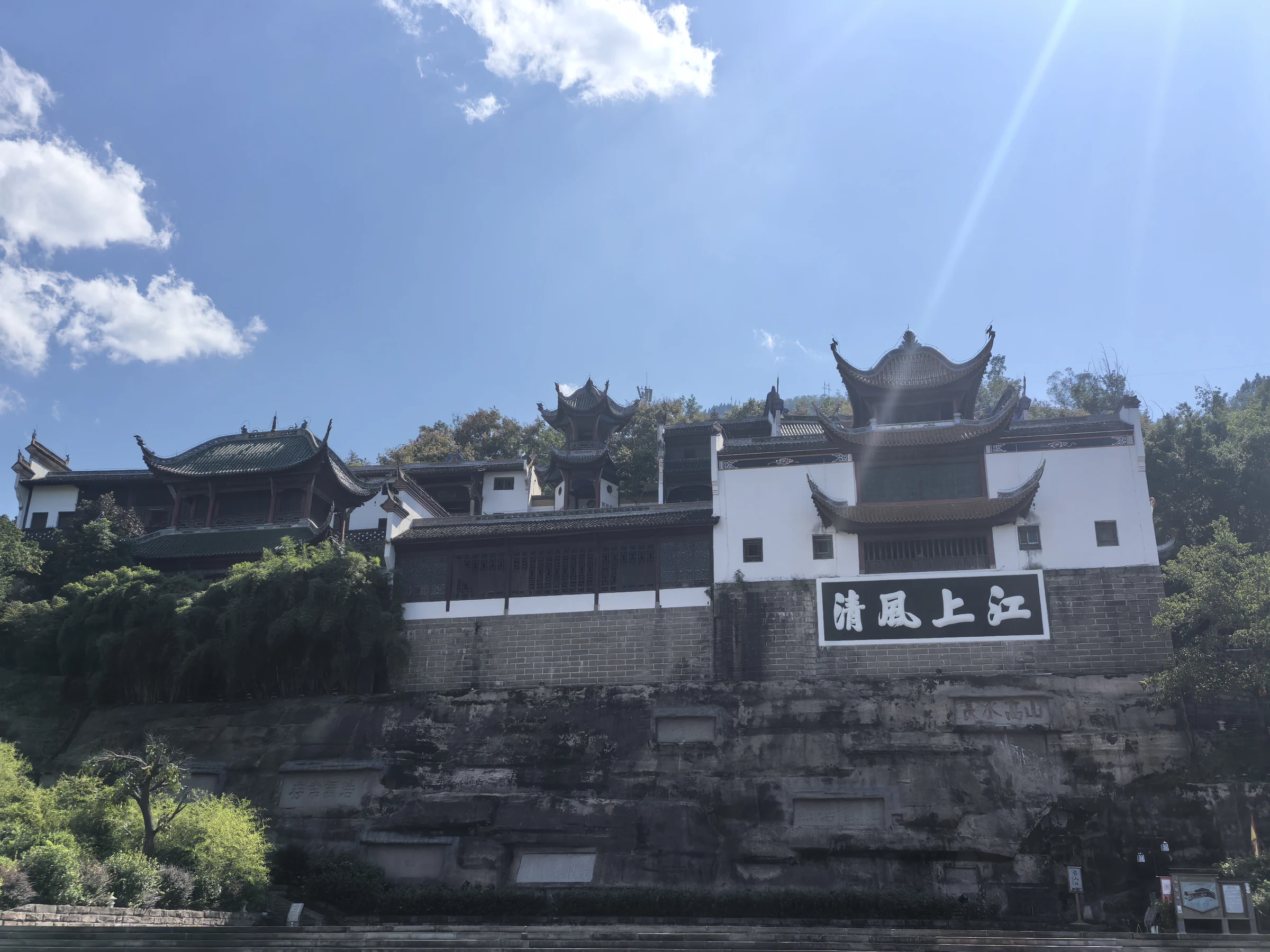
The relocated Zhang Fei Temple in Yunyang, photographed on 9 October 2025. This wider exterior view shows the stepped arrangement against its hillside setting. Creator: STW932; Source: File:Zhang Fei Temple 04.jpg; License: CC0; Recorded capture date: 2025-10-09 13:23:42; Changes: EXIF-based auto-orientation; proportional full-frame downsize without enlargement; WebP re-encoding; embedded metadata stripped. No crop, generative fill, scene retouch, recolouring, added caption, or removal of original date imprint.
Yunyang Zhang Fei Temple in 2026 is a visit to relocated river heritage, with architecture, inscriptions and literary memory to explore. Chongqing's tourism authority dates its closure for dismantling to October 2002 and reopening to July 2003. Visit the present Yunyang site while distinguishing older material, later rebuilding and a changed setting.
Search for 云阳张飞庙 or 云阳张桓侯庙. Adding 云阳 is important because the general and his commemorative tradition are associated with more than one place. Do not choose a transport destination from an English “Zhang Fei Temple” result without checking the county.
This guide was researched from cultural-tourism material, local reporting, UNESCO and a conservation study. It does not claim an editorial visit or a definitive judgement on every object's authenticity. Its aim is to make the site's different historical layers understandable before you encounter the interpretation.
Locate the present temple, not its former shoreline
A 2024 Yunyang county media feature places the relocated temple in 龙安社区, Longan Community, within 盘龙街道, Panlong Subdistrict, on the Yangtze's south bank. An older photograph or a description of Feifeng Hill can refer to the former setting rather than today's visitor entrance.
Save 2 pieces of information for a local transfer: the full temple name with Yunyang, and the current entrance pin supplied by the operator or your accommodation. If a guidebook uses an older administrative name, ask for the modern destination rather than assuming the driver will interpret it the same way.
Relocation is part of the experience, not a minor footnote to hide. You are looking at a heritage complex whose relationship with the river and town was deliberately re-established in another place. A photograph of the original site can deepen that understanding if its date and location are clear; it cannot establish current access or the view from a present-day path.

The stepped entrance to Yunyang Zhang Fei Temple, photographed on 9 October 2025. Follow current signs and staff instructions; this photograph does not prove continuous step-free access. Creator: STW932; Source: File:Zhang Fei Temple 02.jpg; License: CC0; Recorded capture date: 2025-10-09 12:39:38; Changes: EXIF-based auto-orientation; proportional full-frame downsize without enlargement; WebP re-encoding; embedded metadata stripped. No crop, generative fill, scene retouch, recolouring, added caption, or removal of original date imprint.
Use two dates to understand one relocation process
The municipal cultural-tourism profile states that dismantling followed closure in October 2002 and the rebuilt temple opened in July 2003. A county page referring broadly to relocation in 2002 and a later article saying 2003 need not describe competing events; they can refer to different stages.
The reason given is the Three Gorges reservoir project. For a visitor, the productive questions are what was documented before removal, which material travelled, and how the buildings were reassembled. Look for an explanation of the process rather than expecting a single date to settle every question about age.
If a display has photographs of numbering, dismantling or rebuilding, read their captions in sequence. Distinguish a planning image from a construction image and a completed-site image. The sequence can make conservation work tangible without treating restoration as either a complete erasure of history or proof that nothing changed.
Separate the founding tradition from surviving fabric
Zhu Yu-Hua's conservation paper in the 2003 ACCU Nara proceedings makes a valuable distinction: the foundation date is uncertain, a Song-period inscription supports earlier existence, and much of the surviving complex belongs to later Qing rebuilding. The paper also records rebuilding after the 1870 flood.
Tourism descriptions sometimes summarise the temple through an origin in the Three Kingdoms tradition. That is not a reason to label every beam, roof tile or statue as nearly two millennia old. There are at least 3 different ages to ask about: the commemorative tradition, the physical object and the present assembly of the site.
Read a building label before transferring the age of the institution to the building in front of you. A repaired or relocated element may still carry historical value, but the wording should identify what survived and what was replaced when evidence is available. “Old”, “original” and “restored” are not interchangeable captions.
For a thoughtful visit, this distinction is more useful than collecting the largest age claim printed on a promotional sign.
Look at the architecture as a river-facing arrangement
The 2024 local feature names 7 main buildings or pavilions, including the main hall, Jieyi Tower, Wangyun Pavilion, Zhufeng Pavilion, Deyue Pavilion and Dujuan Pavilion. It also describes a stepped approach and a compact, connected arrangement of halls and passages.
Rather than trying to remember every translated name, follow how the buildings relate to the slope and river. Notice where a courtyard opens, where the route turns and where a view is deliberately framed. These are suggested observation questions, not claims about an unverified current visitor circuit.

Yunyang county seat across the Yangtze, photographed on 9 October 2025. The creator’s recorded camera position is near the relocated Zhang Fei Temple on the opposite bank; this image shows its river-facing context, not the temple building or former site. Creator: STW932; Source: File:Yunyang county seat skyline 2025 (02).jpg; License: CC0; Recorded capture date: 2025-10-09 13:02:32; Changes: EXIF auto-orientation, proportional full-frame downsize to at most 2400 pixels without upscaling, WebP encoding and embedded metadata removal only. No crop, scene synthesis or retouch.
The temple's appeal can lie in such relationships as much as in an isolated façade. A close-up of carved timber means more when you understand whether it belongs to a hall, a passage or a roof edge. Keep the building name with your photographs so that details do not lose their context afterward.
Use the designated route and do not enter a closed stair or lean over a barrier for a symmetrical photograph. A heritage building's visual complexity is not permission to explore beyond visitor access.
Meet Zhang Fei as history, devotion and storytelling
The county government's introduction explicitly presents the story of the general's head reaching Yunyang as a legend. That language should remain attached to it. The existence of a commemorative temple does not by itself verify every detail of the tale.
Inside the cultural interpretation, ask which layer a scene represents: the historical figure, a later literary episode, local devotion or a modern display. A sculpture may be designed to convey loyalty or courage rather than document an event exactly as it occurred. Reading it that way allows the story to matter without confusing art with proof.
The municipal profile identifies a sworn-brotherhood group in Jieyi Tower and scenes associated with Zhang Fei in the main hall. Choose 1 episode to understand rather than attempting to recognise every representation. If you know the story from television or a novel, compare that memory with the display's actual explanation instead of assuming they are identical.
Give Du Fu a place in the visit
Zhang Fei's name dominates the attraction, but the local heritage feature explains that Deyue Pavilion and Dujuan Pavilion commemorate the poet Du Fu. This combination makes the site more than a single-figure military memorial.
Take 2 complementary questions into these spaces. What does a pavilion commemorate about a poet's connection to the area, and what does its present setting invite a visitor to look at? Do not assume that a memorial structure is a surviving house occupied by the person it honours.
If an inscription contains poetry, note the title and an attributed translation rather than relying on a photograph alone. A literal phone translation can help identify names, but it may miss an allusion or the force of a line. A short, properly explained poem can provide a stronger memory of the visit than a long list of untranslated quotations.
This literary dimension also offers an alternative focus for someone less interested in battles and heroic stories. Companions can follow different interpretive threads while still visiting the same compact heritage complex.
Read inscriptions in layers
The municipal description highlights calligraphy, stone inscriptions and carved wood. It is tempting to treat a celebrated author's name as the date of the material you see, but a text, handwriting model and later carved object can have different histories.
For 1 selected piece, record four elements if the label supplies them: the text's author, the calligraphic attribution, the carver or production date, and any information about repair or relocation. If one element is missing, leave it unknown. Do not silently turn a later reproduction of an earlier work into an original manuscript.
The local feature discusses the collection associated with Zhuge Liang's memorials traditionally attributed in calligraphic form to Yue Fei. Such layered attributions are a reason to read closely and ask questions, not to promise that every visitor will see a particular original object on display.
Follow restrictions on touching and photography. Rubbings, tracing and close contact with an inscribed surface require permission; they are not ordinary sightseeing activities. A clear note about what the label claims can be more useful than an intrusive attempt to capture every mark.

The national heritage-protection marker for Zhang Huanhou Temple in Yunyang, photographed on 9 October 2025. This is a modern designation marker, not an ancient calligraphic object. Creator: STW932; Source: File:Zhang Fei Temple 01.jpg; License: CC0; Recorded capture date: 2025-10-09 12:34:14; Changes: EXIF-based auto-orientation; proportional full-frame downsize without enlargement; WebP re-encoding; embedded metadata stripped. No crop, generative fill, scene retouch, recolouring, added caption, or removal of original date imprint.
Ask what relocation preserves, and what it changes
The 2003 conservation study discusses moving the complex roughly 32 kilometres upriver and considers the relationship between authenticity and historical setting. Its value for a visitor is the question it raises: saving building material and preserving a place's original environment are connected but different goals.
Use that question while comparing photographs or interpretation. Which building relationships were retained? How is the river-facing arrangement explained? What was documented because it could not remain in place? You need not settle a professional conservation debate to see that “moved intact” is a shorthand requiring detail.
Avoid the opposite simplification too: relocation does not make every historic object newly manufactured. Seek object-level information and let the evidence distinguish preserved material, repairs, replacements and reconstructed surroundings.
The result can be a richer visit than an unqualified search for an untouched ancient temple. It draws attention to the people who recorded, moved and interpreted the heritage, and to the choices that allowed it to remain visible in a changed river landscape.
Fit the temple into a Yunyang visit realistically
UNESCO's Yunyang profile includes Zhangfei Temple within the wider geopark's cultural heritage and records the geopark's designation in 2025. That connection can help frame a regional journey; it does not establish a shared ticket or a short walk to Longgang's sinkhole.
Choose whether this is a focused cultural outing or one stop in a broader regional itinerary. In either case, confirm current entry hours, last admission, ticket rules and the return transfer. The public temple website was unavailable during part of this research, so this guide does not promote an unverified live price or schedule from a third-party listing.
Ask about guide or interpretation options before arrival if language matters to your visit. The 2024 local feature described QR-based explanations, but that is not a guarantee of current operation, available languages or mobile connectivity. Save the core names and background beforehand so that a failed scan does not reduce the whole visit to unexplained statues.
Plan the steps and choose related context
The local description of the temple's stepped approach is a reason to ask about the whole route, not to declare it unsuitable for everyone with a particular need. Request details for 3 stages: entrance to selected buildings, movement between them, and return to the pickup point. No continuous step-free visit was verified.
If the group wants a shorter outing, ask staff which interpretation can be reached without committing to every level. Agree on a place to regroup, and do not promise someone that a distant photograph shows all the walking involved. Use the navigation guide to prepare the correct Yunyang pin and Chinese name.
For context elsewhere in Chongqing, the Three Gorges Museum guide offers a separate museum visit. The Huguang Guild Hall guide provides another architectural and cultural comparison. These are independent destinations, not facilities inside Zhang Fei Temple or automatic same-day additions.

The municipal profile dates closure and dismantling to October 2002 and reopening to July 2003. These relocation dates do not establish the age of every building. Creator: Original editorial diagram; Source: Original editorial diagram; License: No separate public reuse license has been assigned; Recorded capture date: Not a photograph; Changes: Original programmatic SVG layout rendered to WebP; no photographic reference or image synthesis
About This Guide
Research was completed on 1 October 2026 using municipal and county sources, Yunyang local reporting, UNESCO and the ACCU Nara conservation proceedings. This automated original guide claims no editorial visit, interview or human field review. Historical disagreements are retained where meaningful; current operational details remain unverified and should be confirmed before travel.
Frequently Asked Questions
Q: Is this the Zhang Fei Temple in Langzhong? A: No. This guide concerns 云阳张飞庙 in Chongqing's Yunyang County. Include Yunyang when searching or arranging a transfer.
Q: Was the temple moved in 2002 or 2003? A: Both years belong to the process. The municipal profile dates closure and dismantling to October 2002 and reopening after reconstruction to July 2003.
Q: Are all its buildings from the Three Kingdoms period? A: No. The conservation study distinguishes an uncertain foundation date from later surviving fabric, including substantial Qing rebuilding.
Q: Why does Du Fu appear at a temple named for Zhang Fei? A: Local interpretation identifies Deyue and Dujuan pavilions as commemorations of Du Fu's connection to the area. The site combines military and literary remembrance.
Q: Does the geopark connection include Longgang in the same ticket? A: No shared admission was established. Yunyang's wider geopark contains different places; check each attraction's current access, ticket and transport separately.
Traveler comments
Share a recent experience or ask a practical question about this guide.