
AI disclosure: This guide was generated with AI from the cited sources. It is not a record of a personal visit or independent human verification. The historical photographs are source-attributed photographs, not AI-synthesized scenes.
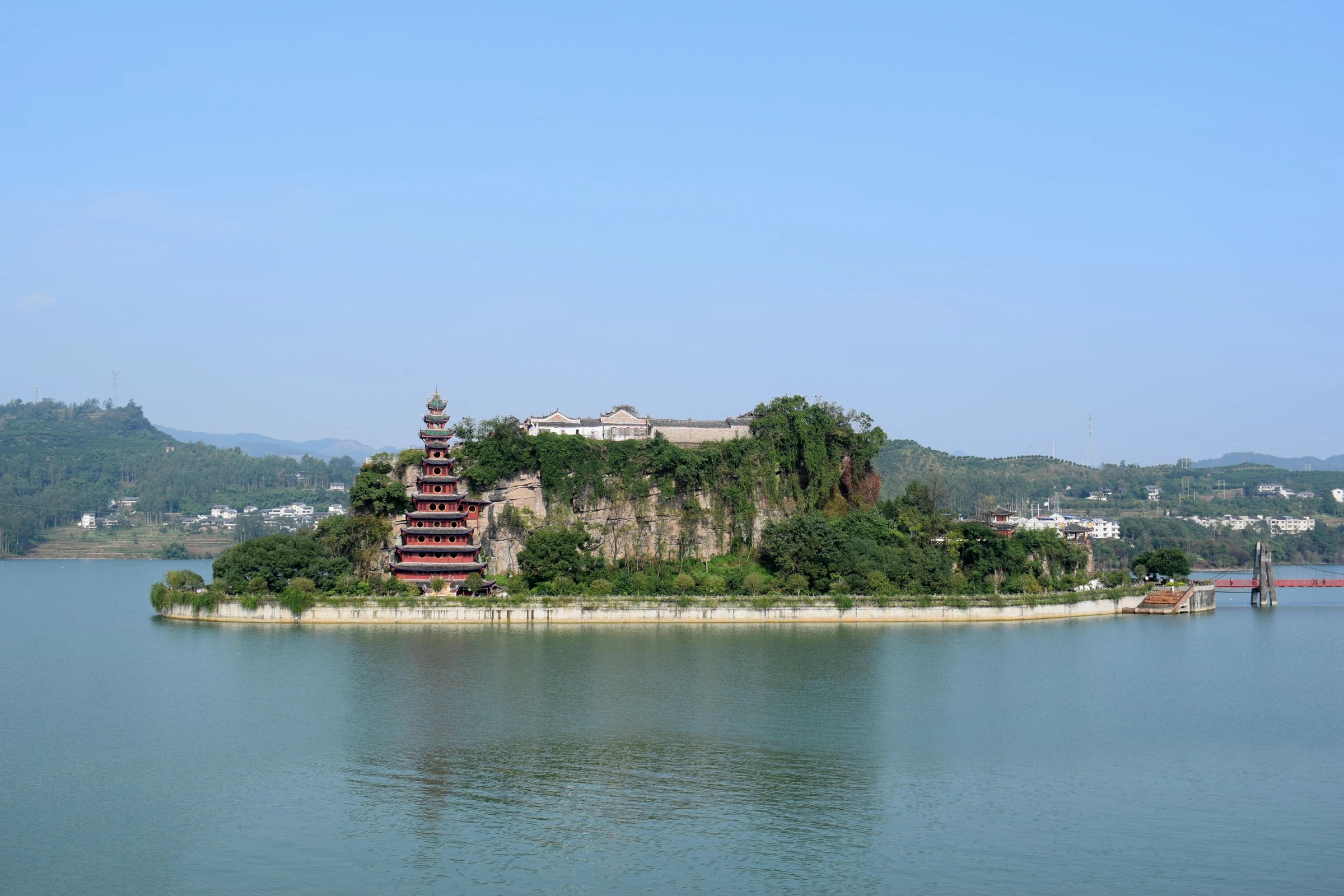
Shibaozhai in its protected reservoir setting, photographed on 15 November 2017. The water level and visitor arrangements are historical. Shibaozhai island 2017.jpg — Dreizung; CC BY-SA 4.0. Source: https://commons.wikimedia.org/wiki/File:Shibaozhai_island_2017.jpg. Licence: https://creativecommons.org/licenses/by-sa/4.0. EXIF orientation normalized where applicable; entire image resized without cropping and encoded as WebP. No generative editing or scene alteration.
Shibaozhai is a wooden-tower and river-landscape outing in Zhongxian for 2026. Chongqing’s government describes its tower as 12 storeys and 56 metres high. The useful planning decision is whether you want to climb or appreciate the exterior: confirm the permitted route, bridge approach and return transport before committing to either.
The destination name to save is 石宝寨, pronounced approximately Shi-bao-zhai. It is also translated as Precious Stone Fortress. Do not let “fortress” create expectations of a broad, level castle courtyard. The main architectural subject is a tall pavilion attached to a rock face, with a temple complex above it.
This guide is based on published sources, including September 2026 reporting. It does not describe a walk undertaken by our editorial team. The proposed choices are intended to make a visit easier to assess, especially for groups with different climbing abilities.
Start with the building and the rock together
The municipal introduction to Zhongxian identifies five elements in the complex: the approach, entrance gate, ascending tower, Kuixing Pavilion and Tianzi Hall. The same source gives the tower’s height as 56 metres over 12 storeys. Reading the surrounding elements alongside that vertical structure helps explain the whole site.
From an authorised viewing position, look at where the pavilion meets the rock. Compare the repeated roofs with the much less regular natural surface behind them. The construction is interesting because it responds to that particular vertical setting; a cropped photograph that removes the cliff also removes much of the explanation.
Look for changes in scale between the entrance and the upper structure. A distant view makes the layered silhouette legible, while a closer view can reveal the relationship between windows, eaves and supporting members. Neither requires an unsupported claim that this is the oldest or tallest wooden building in the world.

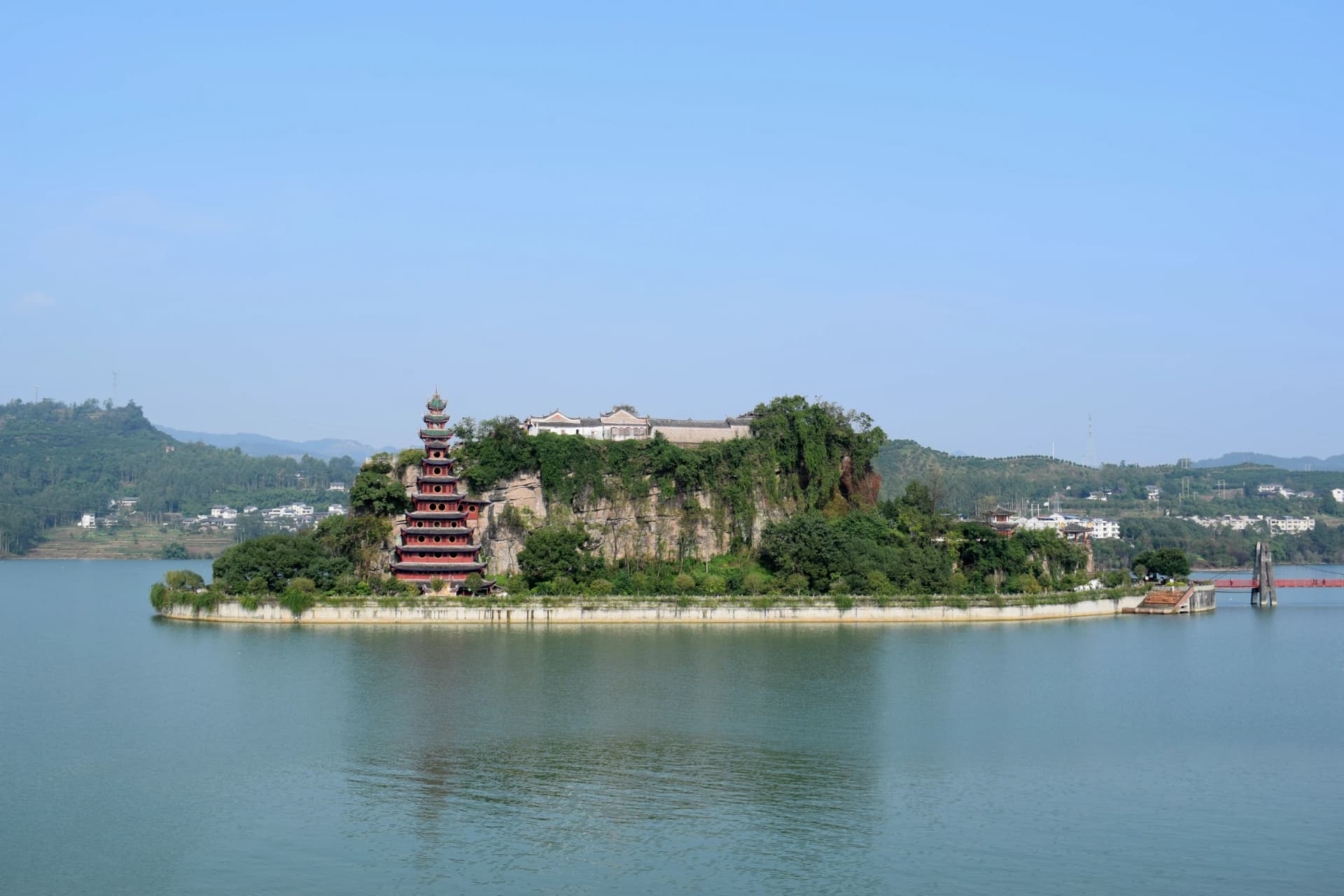
Shibaozhai’s pavilion and rock face, photographed on 1 October 2016. The image does not establish present climbing access. Shibaozhai 2016 1.jpg — Fredlyfish4; CC BY-SA 4.0. Source: https://commons.wikimedia.org/wiki/File:Shibaozhai_2016_1.jpg. Licence: https://creativecommons.org/licenses/by-sa/4.0. EXIF orientation normalized where applicable; entire image resized without cropping and encoded as WebP. No generative editing or scene alteration.
Separate the age of the site from the age of its parts
There are at least two historical questions: when the complex began and when a particular part took its present form. The municipal source places the complex’s origins in the Ming Wanli period. That does not date every visible piece of timber, every upper level or every visitor facility to the same period.
The architectural account from iChongqing describes nine lower levels beside the cliff and three upper levels. It also identifies wooden ladders inside. Use that description to understand the arrangement, while asking on site which sections belong to which construction or restoration phase.
Online summaries give different details about early construction and the rock’s height. This guide avoids combining them into a single precise chronology. If a guide or interpretation panel gives a date, notice whether it refers to the temple, the pavilion, an extension or a repair. These distinctions are more informative than a slogan about a structure being centuries old.
A small notebook can help architecture enthusiasts: record the feature, its stated date and the source of the explanation. Photograph a public interpretation panel when allowed, then check its translation later. Do not rub inscriptions or touch painted surfaces to inspect them.

A decorated entrance at Shibaozhai, photographed on 1 October 2016. No single construction date is assigned to every visible part. Shibaozhai 2016 2.jpg — Fredlyfish4; CC BY-SA 4.0. Source: https://commons.wikimedia.org/wiki/File:Shibaozhai_2016_2.jpg. Licence: https://creativecommons.org/licenses/by-sa/4.0. EXIF orientation normalized where applicable; entire image resized without cropping and encoded as WebP. No generative editing or scene alteration.
The surrounding water tells a modern conservation story
Shibaozhai’s setting changed with the Three Gorges reservoir. Chongqing Daily’s September 2026 reporting, quoting a local heritage official, explains that the in-situ protection project began in 2005 and was completed in 2009. A retaining embankment protected the site, and a pedestrian suspension bridge provided island access.
That means the water, protective structure and bridge are part of the story visitors encounter today. They should not be confused with the original relationship between the tower and the riverbank. Nor does the island-like appearance mean the historic building was simply moved to a newly chosen location.
For photographs, keep the date visible when comparing old and newer views. A pre-reservoir image can explain change, but it cannot serve as a current arrival diagram. A later photograph can show the protected setting without proving a particular water level, bridge condition or route is available on your visit date.

Shibaozhai in a source-dated 2 July 2004 photograph, before the 2005–2009 protection project described in this guide. The riverbank differs markedly from the 2017 cover view. Shibaozhai leaning red pavilion and temple.jpg — Richardelainechambers; CC BY-SA 3.0. Source: https://commons.wikimedia.org/wiki/File:Shibaozhai_leaning_red_pavilion_and_temple.jpg. Licence: http://creativecommons.org/licenses/by-sa/3.0/. EXIF orientation normalized where applicable; entire image resized without cropping and encoded as WebP. No generative editing or scene alteration.
Decide about climbing before joining the flow of visitors
The architectural description distinguishes nine lower levels from three upper levels and identifies wooden ladders inside. Separate the decision to reach Shibaozhai from the decision to climb within it. It does not provide an accessibility audit, current stair dimensions or a promise that every upper section is open.
Before entry, ask what the permitted ascent and descent involve. Are visitors using the same stairs in both directions? Which upper sections are accessible? Where can someone stop without obstructing others? What happens if a person decides against continuing? A staff answer about the actual route is more useful than counting storeys from a photograph.
For anyone uncomfortable with steep stairs, enclosed climbing spaces or heights, an exterior-focused visit may be the more suitable aim. However, do not assume the exterior approach is step-free. Ask about the whole journey from drop-off or landing point, including the bridge and any changes of level.
Travel light enough to keep your hands available. Avoid taking a large suitcase into a climbing route, and do not rely on a luggage-storage service that has not been confirmed. For families, decide who accompanies anyone who stops early; avoid an improvised split at a narrow staircase.
Do not turn old access descriptions into instructions
The architectural feature also describes a chain-side route and a door at an upper level. That is historical or descriptive source material, not this guide’s recommendation for an alternative ascent. No current permission or condition check for that route was established in this research.
Use one simple rule: follow the attraction’s present visitor route and barriers. An older photograph, a map pin or a traveller’s account does not authorise a shortcut. Do not go looking for a cliff-side path because it sounds like a way to avoid the tower’s stairs.
The same caution applies to the protective embankment. Its appearance in a panoramic photograph does not establish that the whole perimeter is a public walkway. Ask which viewing positions are open, and accept a shorter visit if maintenance or crowd control changes the available circulation.
This distinction protects the quality of the visit as well as safety. When the purpose is understanding the architecture, spending more time at one permitted viewpoint can be more rewarding than searching for an uncertain route around the back.
Plan arrival and a manageable visit
The September 2026 heritage report describes the pedestrian suspension bridge connecting the protected site with the shore. Confirm how your road or cruise arrival reaches that pedestrian approach; arrival in Zhongxian or at a landing is not the same as reaching the tower.

Looking back toward the town and river from the Shibaozhai footbridge area in October 2016. The source supplies 9 October and the embedded file-modification timestamp also records 9 October, while embedded GPS records 1 October; the exact capture day is unresolved. Shibaozhai 2016 3.jpg — Fredlyfish4; CC BY-SA 4.0. Source: https://commons.wikimedia.org/wiki/File:Shibaozhai_2016_3.jpg. Licence: https://creativecommons.org/licenses/by-sa/4.0. EXIF orientation normalized where applicable; entire image resized without cropping and encoded as WebP. No generative editing or scene alteration. Date: October 2016; exact capture day unresolved because recorded source and embedded GPS dates conflict.
If you arrive on a cruise, the ship’s actual itinerary controls
A photograph taken from a Yangtze cruise proves a viewpoint existed at that moment; it does not prove your sailing will stop. Confirm Shibaozhai by name in the itinerary for your exact vessel and departure date. Ask whether the excursion is included, optional or subject to substitution.
There are three useful questions for the cruise organiser: what is the landing and walking approach, how much climbing is involved, and what is the meeting point for returning? Request a written answer if a mobility limitation determines whether you can participate. “Suitable for sightseeing” is not a description of stairs.
Keep the ship’s contact details and return instructions with you. If the group divides between climbing and an exterior visit, arrange a meeting location that both groups can reach. Do not change the return time because a different online cruise review describes a longer stop.
A river cruise and a road trip create different constraints. A ship passenger needs to work backwards from the organised return; a road visitor needs to arrange their own onward journey. Avoid borrowing the apparent convenience of one model when planning the other.
For a road visit, save the attraction entrance rather than a county pin
Shibaozhai is in Zhongxian, but reaching the county and reaching the visitor entrance are separate tasks. The public Mafengwo Zhongxian overview identifies the attraction as a riverside destination outside the county’s central visitor cluster. Its general distance description is not a door-to-door route calculation.
Confirm two addresses: the attraction’s current passenger drop-off and your return destination. If arranging a car, establish whether the service includes waiting, an agreed return pickup or a one-way transfer. Do not assume an outward ride creates an available return vehicle.
Build your plan around a current map and the driver’s permitted stopping point. The bridge itself is a pedestrian approach, so “take us to the tower” may not be a useful vehicle instruction. Ask which entrance name to use in Chinese and save the response before leaving a reliable connection.
This guide does not supply a bus timetable, driving duration or current ticket tariff. None was sufficiently established for a visit-date promise. The absence of a precise number is a reason to confirm logistics, not to add a guessed estimate to an itinerary.
Make a shorter visit feel deliberate
Choose one principal question for the outing. It might be how the pavilion uses the cliff, how the reservoir changed the setting, or how conservation kept the building in place. This creates a coherent visit even if you do not climb to the top.
For an exterior-focused plan, ask staff which public viewpoint gives a useful view of both tower and rock. Spend time reading any accessible interpretation and comparing the silhouette with a dated historical image. Then return by the permitted approach rather than trying to compensate for a missed climb with an unofficial detour.
For a climbing-focused plan, leave room to pause before starting. Assess the actual stairs, the group’s energy and the exit arrangement. Reaching an upper level is an option within the visit, not a test that every traveller has to complete.
A guide can add value when they explain visible details and clearly distinguish documented history from folklore. Ask which stories are legends. A lively traditional account can be enjoyable without being presented as an archaeological finding.
Plan for weather without promising a season
Check the forecast and current attraction notices for the specific day. Rain can affect exposed approaches and how comfortable a climbing visit feels; sunshine does not establish that every route is open. This research did not verify a seasonal closure pattern, so none is asserted here.
Have two acceptable outcomes in mind: a manageable permitted visit or postponement. A prepaid journey does not make an unsuitable stair route more manageable. If a cruise organiser changes a landing or the attraction restricts access, use the revised official instructions rather than trying to reproduce a photograph.
For preparation, the heat and stairs guide discusses pacing, and the navigation guide explains entrance and road-level checks. The Three Gorges Museum guide offers a central-city way to place the reservoir’s heritage story in a wider context.
About This Guide
Researched on 1 October 2026 from municipal information, architectural reporting, public travel material and recent heritage reporting. This is an automated English guide, with no site visit or human review claimed. Current access and commercial arrangements require reconfirmation.
Frequently Asked Questions
Q: Is Shibaozhai in central Chongqing? A: No. It is in Zhongxian, and a visit needs its own road or cruise arrangement rather than a central-city walking connection.
Q: How tall is the Shibaozhai tower? A: Chongqing’s municipal introduction describes 12 storeys and a height of 56 metres. Those figures do not establish which floors are currently accessible.
Q: Do I have to climb the tower? A: You can plan a Shibaozhai visit around the exterior and river setting, but confirm the permitted approach and viewing areas. Neither bridge access nor the exterior route is certified step-free here.
Q: Was the building moved because of the Three Gorges reservoir? A: The cited heritage reporting describes in-situ protection, with works from 2005 to 2009. The surrounding embankment and pedestrian bridge explain the changed river setting.
Q: Will my Yangtze cruise stop at Shibaozhai? A: Check that Shibaozhai is named in your exact vessel and departure itinerary. A general cruise description or a historical river photograph cannot confirm your stop.
Traveler comments
Share a recent experience or ask a practical question about this guide.