
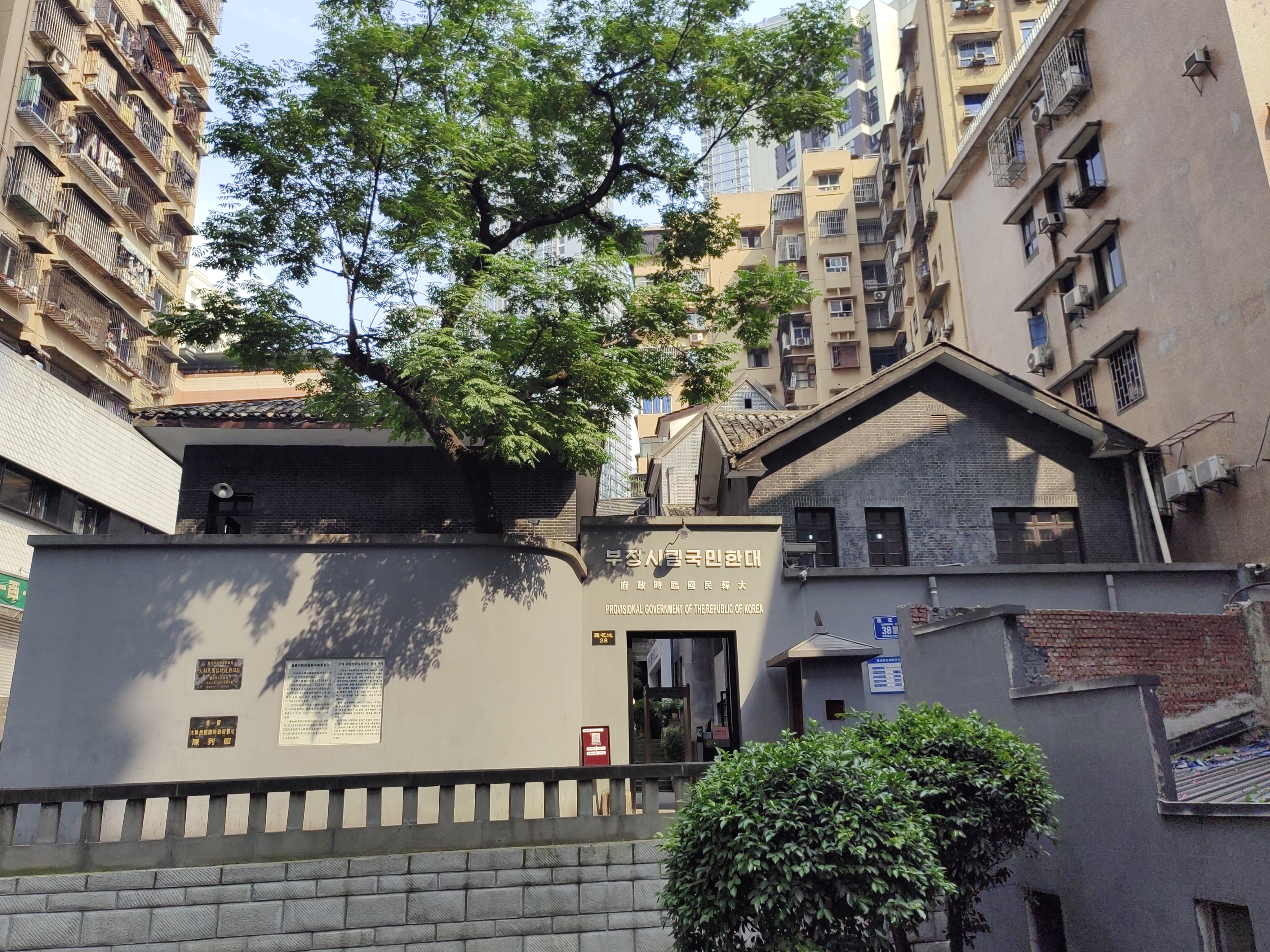
The Korean Provisional Government Site Museum in Chongqing offers free admission at 38 Lianhuachi in Yuzhong District. For a 2026 visit, start with the museum's published information: save its Chinese name and address, check the day's opening arrangements, and leave time to read an exhibition about Korea's independence movement. Official visitor information

The Korean Provisional Government Site Museum exterior in May 2025. Photo: Yumeto / Wikimedia Commons, CC BY-SA 4.0. Original image, unedited.
The museum's full Chinese name is 重庆大韩民国临时政府旧址陈列馆. Keep that name together with 渝中区莲花池38号 on your phone. An English search result can help you discover the place; the Chinese name and numbered address help you confirm that a map or driver has found the intended destination.
What the visit helps you understand
The site preserves premises associated with the Korean Provisional Government in exile. Its importance extends beyond one building: it offers a way to explore how an independence movement continued its work outside the country it sought to represent, and how that history intersects with wartime Chongqing.
The National Library of Korea places the provisional government's Chongqing period within its wider history in China. It also records the restoration of the Chongqing premises and their opening to the public on 11 August 1995. That museum opening is a different event from the government's historical use of the building. National Library of Korea historical introduction
The National Institute of Korean History's site description identifies 38 Lianhuachi and connects this location with January to November 1945. Use that as a prompt to look carefully at the exhibition's chronology: the history of the organization, its time in Chongqing and the period linked to this address have different boundaries. This guide does not resolve every variation between historical accounts of earlier Chongqing premises. National Institute of Korean History site record
Published hours and choosing a day
The museum's visitor page and homepage list Tuesday to Sunday opening from 09:00 to 17:00, with entry stopping at 16:30. It closes on Mondays, except when a Monday falls on a national statutory holiday. These are published standing arrangements checked on 8 October 2026; consult the official website for temporary notices before travelling. Museum opening information
Keep last entry and closing time as separate points in your plan. Arriving before 17:00 alone is insufficient when entry ends at 16:30. A morning or early-afternoon arrival gives you more flexibility if your journey takes longer than expected or you want to examine a section closely. This is planning advice, rather than a prediction about queues or the time every visitor will need.
If the museum is a priority, place it before sightseeing that can continue later. For a Monday visit during a holiday, check the relevant notice instead of assuming that every holiday schedule is identical. Save any current notice you rely on, along with the date you checked it.
Getting to the correct address
The museum's transport page lists Qixinggang, 七星岗站, on Metro Lines 1 and 10, and Jiaochangkou, 较场口站, on Lines 1 and 2. It does not name an exit or give a walking time. Compare the current route from your accommodation to the full museum address before selecting your station. Official transport information
Check the walking portion as carefully as the rail journey. A station that fits your line may still require an approach you prefer to avoid. Read the map's directions, inspect any available information about steps and crossings, and keep the destination pin visible until you reach the public entrance. Neither station should be treated as a guaranteed step-free route to the museum.
For a taxi or booked car, show both the museum name and address rather than only the English title. Confirm the destination displayed in the booking app before accepting the journey. On arrival, follow venue signs; a nearby doorway or a map pin is not evidence that an entrance is open to visitors.
Questions to settle before you leave
Free admission answers the cost of entry described on the visitor page. It does not, by itself, confirm whether a particular visit needs a reservation, identification, group arrangements or another check. Contact the museum if any of those details will affect your plans. The published enquiry number is 023-63820752, and the visitor rules direct requests for interpretation or other assistance to the reception service.
Useful questions to save are “需要预约吗?” for “Is a reservation required?” and “需要出示什么证件?” for “What identification must I show?” Include your intended date and whether you are visiting independently or with a group. Ask about arrangements for your circumstances instead of assuming that a rule mentioned by another traveller applies to you.
If someone is helping you make a call, prepare the questions in advance and note the answers separately from the standing website information. An answer about one date or group should not become a general promise for future visitors.
A reading plan for the exhibition
Begin with the introductory panel or displayed chronology, following the venue's indicated order. Identify the subject of each section before reading individual labels. A useful personal note has three columns: the date, the person or organization, and what happened. This makes it easier to connect details without trying to remember every name immediately.
Separate material about the provisional government's wider activities from information specifically attached to the building. Ask yourself whether a label describes something done at this address, an event elsewhere, or a later act of commemoration. The distinctions make a historic-site visit more informative than simply collecting dates.
When a display includes an object or document, read its label before interpreting its appearance. Look for who made or used it, the date assigned to it and why the exhibition includes it. Do not assume that every item is original, that every room has been preserved unchanged, or that a familiar name explains an unfamiliar event.
At the end, revisit one question that interested you most. A focused question gives any further reading a direction, whether it concerns life in exile, the work of the provisional government or the preservation of the site. You can leave with a clearer understanding without treating every panel as an examination.
Visiting across a language barrier
English-language tours and interpretation availability were not confirmed in the information checked for this guide. Ask the reception service about the languages, format and availability of any explanation you need. “有英文讲解吗?” means “Is English interpretation available?” It is a question to use, rather than a promise about the service.
A translation app can help with unfamiliar vocabulary. Download any language resources you expect to need before leaving your accommodation, and keep enough phone battery for the return journey. Translate a heading or short passage first, then read the surrounding context. Names, institutional titles and dates deserve particular care because an automatic translation may make them look more familiar than they are.
Before using a camera translation feature, check the venue's photography rules. Taking a picture for translation is still taking a picture. If camera use is restricted, ask for help or type a short phrase instead.
Access needs and family visits
Step-free access was not confirmed in the sources read for this guide. If steps, standing time or mobility needs determine whether you can visit, ask specifically about the approach, public entrance and exhibition route. “入口有台阶吗?” means “Are there steps at the entrance?” A general statement about an entrance would still leave questions about the interior, so describe the assistance you need.
For children or visitors new to the subject, choose one question before entering: why the government was working outside Korea, or why this address is preserved. Let the displays supply the answer. Take turns reading a short section, and pause when attention begins to fade. Avoid assigning a fixed amount of reading to everyone in the group.
Respectful behaviour and photographs
The visitor rules ask people not to touch exhibits, to keep noise down, to care for public facilities and to follow staff directions during an incident. Keep conversations quiet enough for other people to read. Leave room around labels rather than blocking them while discussing a translation. Museum visitor rules
Follow the signs and staff guidance for photographs, recording and permitted areas. If photography is allowed, make the label and its context part of your private notes so that an image remains understandable later. Ask before including other visitors prominently in a picture. Do not move objects or cross a barrier to obtain a clearer view.
Continuing your day
Keep your next stop flexible until you know how much attention you want to give this visit. Before leaving, reopen the map from your actual location and check the route to the next destination. You do not have to return through the station you used on arrival, but any alternative should follow current directions.
If you plan several historic sites, keep a separate note for each address, its purpose and the dates linked to it. Compare them after the visits rather than merging their stories on the way. A break for food or rest can also help you absorb what you have read before starting another exhibition.
About This Guide
This guide draws on public sources read on 8 October 2026. Its planning suggestions are not an on-site visit record. Check the museum's latest notices before travelling.
Frequently Asked Questions
Q: Is admission free?
A: Yes. The museum's official visitor information says it is open to the public free of charge. Check any separate requirements for your visit; free entry does not establish reservation or identification rules.
Q: Can I visit on Monday?
A: The published rule is Monday closure, with an exception for national statutory holidays. Check current notices for your intended date, especially when a holiday affects the normal week.
Q: Which metro exit should I use?
A: The official page lists Qixinggang on Lines 1 and 10 and Jiaochangkou on Lines 1 and 2, but specifies no exit. Use current pedestrian directions to 渝中区莲花池38号 and assess the approach you need.
Q: Is an English tour guaranteed?
A: No English tour was verified for this guide. Contact the museum at 023-63820752 or ask reception about language services. Prepare a translation method that respects the venue's camera rules.
Q: How long should I allow?
A: No standard visit duration was verified. Choose an arrival well before last entry, leave the following stop flexible and adjust your pace to how much you want to read. Groups may prefer different amounts of time.
Traveler comments
Share a recent experience or ask a practical question about this guide.