
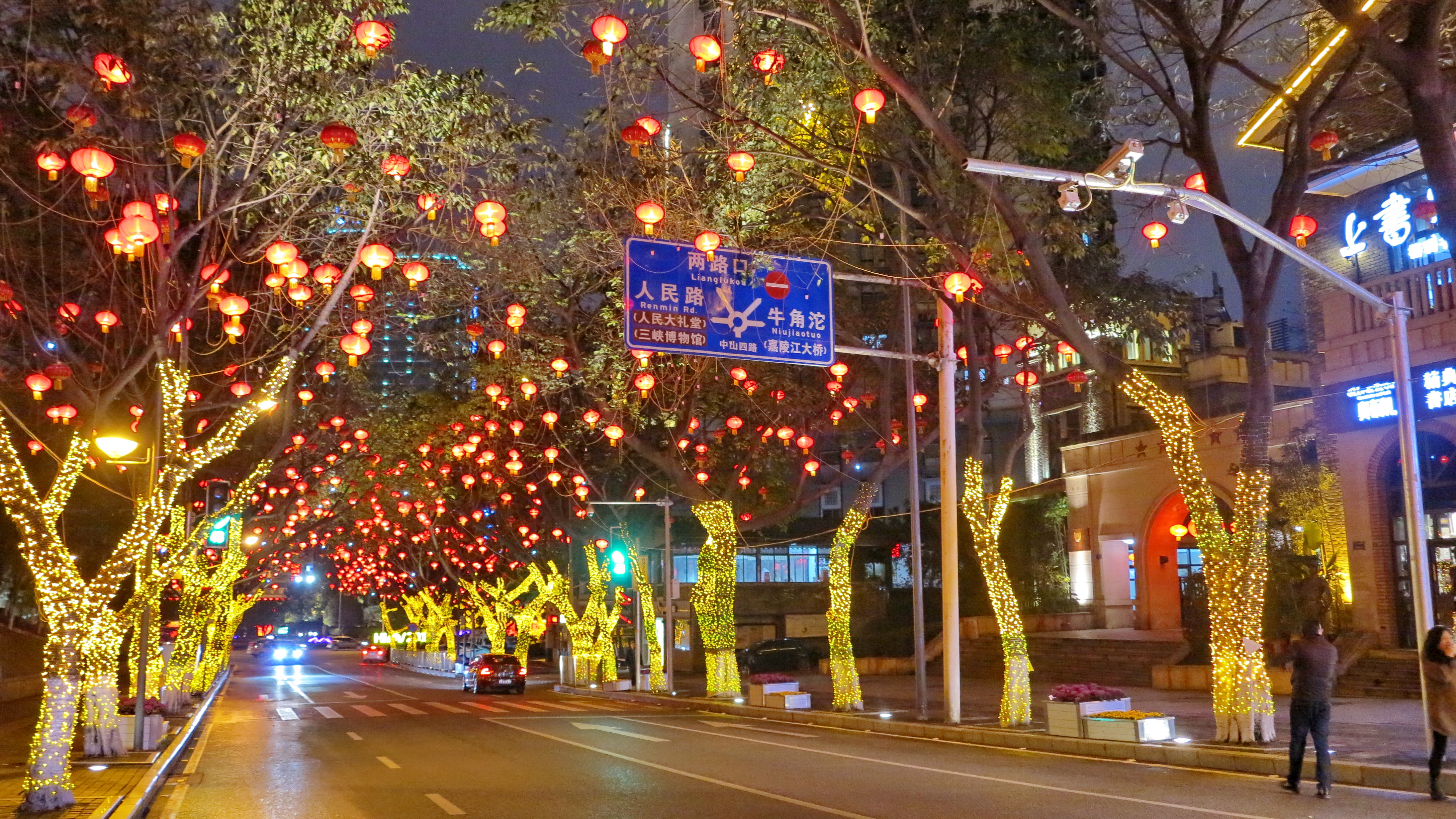
For a 2026 visit to Zhongshan Fourth Road, plan a history walk around Guiyuan and Zhou Residence, with museum entry checked separately. Yuzhong's district introduction describes a street of roughly one kilometre. Start with one historical subject that interests you, then use the street to connect the buildings and their stories. Yuzhong street introduction

Zhongshan Fourth Road in Chongqing at night in February 2016. Photo: Nyx Ning / Wikimedia Commons, CC BY-SA 3.0. Original image, unedited.
What the walk offers
Zhongshan Fourth Road is in Yuzhong District. The district introduction describes its extent from the Shangqingsi roundabout to the square with the Zhou Enlai commemorative statue, and identifies Guiyuan and Zhou Residence among its historical sites. These give a first visitor two distinct subjects to follow: the 1945 Chongqing negotiations at Guiyuan and the history associated with Zhou Enlai at Zhou Residence.
I suggest treating the road as a framework for reading the city's history. Decide which building you want to understand, rather than trying to collect every name along the way. At each site, establish who used it, for what purpose and during which period. Keeping those questions separate makes the displays easier to follow, particularly when several familiar historical figures appear in different buildings.
The approximate one-kilometre figure describes the street, not your complete outing. Your journey also includes the approach from transport, crossings, any detour to an entrance and time inside exhibitions. A short street can support a substantial visit if you want to read carefully. Avoid converting that distance into a promised completion time.
Save three map names before leaving
I would save three destinations individually: the road, Guiyuan and Zhou Residence. A general street pin is useful for orientation, while a full museum address is more useful when you need the correct entrance. Keep the Chinese names available even if your map interface uses English.
| Place | Chinese name or address to save | Purpose |
|---|---|---|
| Zhongshan Fourth Road | 中山四路 | Recognise the street and check the walking route |
| Guiyuan | 桂园,渝中区中山四路65号 | Match the historic residence to its address |
| Zhou Residence | 周公馆,曾家岩50号 | Distinguish the intended residence from similar search results |
- Place
- Zhongshan Fourth Road
- Chinese name or address to save
- 中山四路
- Purpose
- Recognise the street and check the walking route
- Place
- Guiyuan
- Chinese name or address to save
- 桂园,渝中区中山四路65号
- Purpose
- Match the historic residence to its address
- Place
- Zhou Residence
- Chinese name or address to save
- 周公馆,曾家岩50号
- Purpose
- Distinguish the intended residence from similar search results
Check that each result is in Chongqing. Read the address before accepting a suggested destination, particularly for Guiyuan, whose English name can appear in searches for other places. Show the full Chinese destination when asking for help; a screenshot of an English landmark name may leave an avoidable ambiguity.
Make Guiyuan your anchor for the 1945 negotiations
Guiyuan is at 65 Zhongshan Fourth Road. Chongqing's municipal culture and tourism authority identifies it as Zhang Zhizhong's former residence and an important location of the 1945 Chongqing negotiations, including the signing of the Double Tenth Agreement. Those facts provide a focused reason to enter if its current visiting arrangements work for your day. Official Guiyuan introduction
I would begin with the introductory chronology and look for the explanation of the building's role during those negotiations. Follow the exhibition's account of events before concentrating on individual rooms. This helps distinguish the residence's earlier use from its historical role in 1945, without assuming that every room or object tells the same story.
If you use a translation app, work with a short label at a time. Names of people, institutions and agreements can become confusing when an app translates several panels together. Keep a note with the original Chinese term alongside its English equivalent so you can recognise it again. Photograph labels for translation when the venue permits it, and follow any restrictions on photography or equipment.
Confirm entry arrangements before setting out. This guide does not establish current Guiyuan hours, fees, reservation rules or accepted registration documents. An older description of its history provides useful context, but it cannot answer whether you can enter on your chosen date.
Give Zhou Residence its own historical context
Zhou Residence is identified in the municipal visitor introduction at 50 Zengjiayan. The iChongqing tourism feature places it at the eastern end of Zhongshan Fourth Road and explains its connection with Zhou Enlai and the Communist Party's Southern Bureau. Keep this building's purpose separate from Guiyuan's role in the 1945 negotiations. iChongqing historical street feature
I suggest reading the residence's introductory explanation before comparing it with anything you have just seen at Guiyuan. The useful question is how this particular address was used. That approach helps avoid compressing several chapters of Chongqing's modern history into a single general impression of old buildings.
Choose this as your main interior if its subject is the reason for your visit. Check current access directly through the venue's visitor information before fixing the rest of the walk. No old weekly timetable is reproduced here. If you need an English explanation, guided visit or assistance with entry, establish whether it is available rather than assuming a historical museum automatically offers it.
Build a walk that can change
For a first visit, I would use a three-stage plan: confirm your main interior, connect the saved places on a current pedestrian map, then decide whether to add the second interior. This is a planning sequence, not a surveyed route with fixed timings.
Start with the confirmed visit
Choose the end of the road that makes sense for your confirmed museum entry and your journey from accommodation. If a venue has an appointment requirement, let that determine the order. Leave room between arrival and any entry deadline so an unfamiliar junction or a queue does not make the whole plan fragile.
Walk between named destinations
After the main visit, follow current pedestrian directions toward the other saved place. Pause at public historical markers when they interest you. Check the displayed route at crossings instead of treating a straight line between map pins as permission to walk through a compound. The district introduction describes government premises as well as cultural sites; use the public entrances and respect signs or staff directions.
Add the second interior when it fits
If the other venue is open, entry is available and you still want to read, add it. Otherwise, keep the street portion and finish at a convenient verified onward connection. A closed door changes the plan; it does not require searching for an alternative entrance through neighbouring premises.
Arrange arrival and departure separately
I suggest checking two routes before leaving accommodation: how to reach your first destination, and how to leave from your intended finish. The station or pickup point that works for arrival may be inconvenient after you have walked along the road. Use current map directions and transport information for the actual date, including the pedestrian approach.
No specific metro exit, bus line, fare or station-to-museum walking time is verified in this guide. Choose transport after establishing your destination, rather than selecting a station name first and assuming its nearest exit leads to the entrance. If you need to minimise stairs, review the entire approach and ask about the venue entrance as well as the station.
For a taxi or ride-hailing journey, save the Chinese address and check where a vehicle can legally stop. For the return, identify a practical pickup location before requesting the car. Do not arrange a pickup from a doorway simply because it is the landmark you have just visited.
Keep your next activity flexible until you know when you will finish. A longer exhibition visit may make a meal or another museum more suitable than a distant attraction with an entry deadline.
Prepare for reading, weather and language
My suggested preparation has three parts: comfortable walking shoes, a charged phone with your saved names, and weather protection suited to the day's forecast. Carry water and allow yourself breaks. The street's published length does not establish a step-free outing, and museum access needs its own check if stairs or standing are difficult for you.
If you need help confirming a visit, short questions can be easier to translate than a long itinerary. Keep these available:
- 今天开放吗? — Is it open today?
- 需要预约吗? — Is a reservation required?
- 用护照可以登记吗? — Can I register with a passport?
These are questions to ask, not statements of either venue's rules. Add your intended date and the full Chinese venue name when enquiring. If English interpretation or particular access assistance matters to you, raise it explicitly before travelling.
Frequently asked questions
Q: What is Zhongshan Fourth Road known for?
A: It is a history-focused street in Chongqing's Yuzhong District. Guiyuan and Zhou Residence offer two useful anchors for understanding different events and uses of historic premises. Decide which subject interests you, then check that venue's access separately from the street walk.
Q: How long is the walk?
A: The Yuzhong district introduction describes the street as roughly one kilometre. That is not the total distance from your accommodation or transport stop, and it does not include detours or museum visits. Use a current pedestrian map for your actual start and finish; no fixed visit duration is promised here.
Q: Can I visit Guiyuan and Zhou Residence on the same outing?
A: They can be used as anchors for one street plan, but entry to both must be confirmed individually. I suggest choosing one as the main interior and keeping the second optional. Check their current arrangements before deciding the order, and leave room to spend longer at the first exhibition.
Q: Does a street attraction's opening status mean the museums are open?
A: No. A platform's general street listing does not establish museum hours, reservations or document requirements. Confirm each interior through its current visitor information. This guide deliberately omits the old Zhou Residence timetable and makes no claim about current Guiyuan opening hours.
Q: Is this route suitable for a visitor who needs step-free access?
A: Step-free access has not been verified for the street approach or either interior. Ask about the exact entrance, changes in level and any assistance needed before travelling. Check the complete journey, including station access or vehicle drop-off, rather than relying on the street's short published length.
About This Guide
Prepared using sources reviewed on 8 October 2026, this guide combines published historical information with original editorial planning advice. It is not a report of an on-site visit. The approximate street extent comes from the district introduction; Guiyuan's historical role is supported by the municipal heritage entry, with additional tourism and encyclopedia cross-checks. Current museum entry details remain for visitors to confirm.
For planning other parts of your day, read our Chongqing metro guide, Three Gorges Museum and People's Square guide, and Crown Escalator guide. Check the journey between activities instead of treating these as a single timed itinerary.
Traveler comments
Share a recent experience or ask a practical question about this guide.