
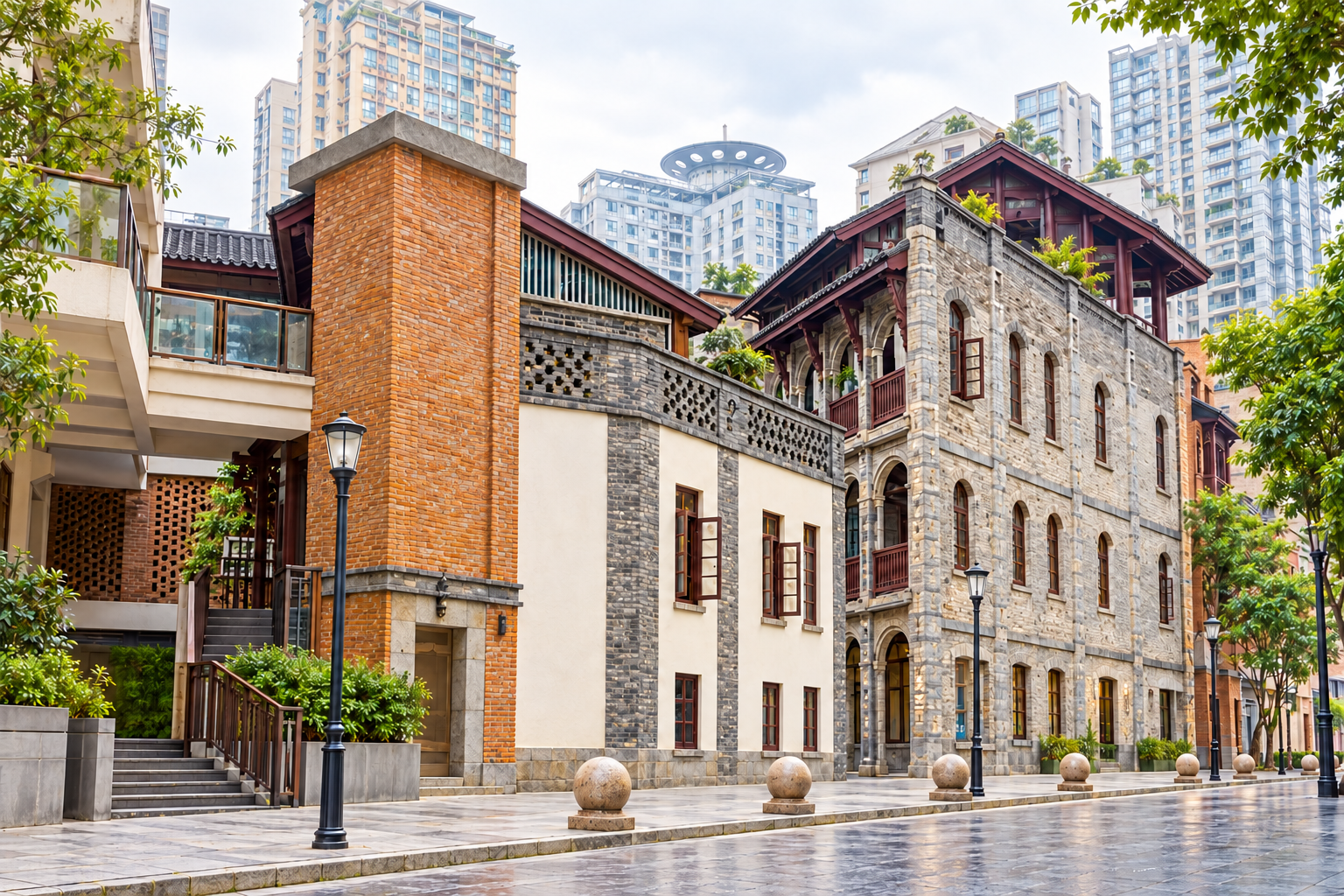
AI illustration. Grey-brick Luzumiao-style streetscape below modern towers. Approximate illustration based on a historical reference photograph, not a current photo. Viewpoint, entrances and access are not guaranteed. Original AI illustration for this guide. Historical photo reference only, not republished: Chongqing municipal government, Yuzhong news report
Sources checked: 24 October 2026. This is a researched planning guide, not a report of a new on-site visit.
A Central Afternoon with Three Different Stops
For a smaller-scale alternative to the usual Jiefangbei-to-Chaotianmen circuit, allow about two and a half to four hours for 鲁祖庙, Luzumiao, 临江门魁星楼广场, Kuixinglou Square at Linjiangmen, and 戴家巷, Daijiaxiang. Include one café or meal break. The allowance and order are editorial suggestions, not a timed route.
Start among Luzumiao’s restored streets and newer businesses, continue to Kuixinglou for Chongqing’s changes of level, then finish in Daijiaxiang’s upper lanes. Decide separately whether to descend onto the cliffside path. Keeping that last choice optional makes the afternoon easier to adapt to rain, tired legs or a dislike of heights.
This route works best without heavy luggage. Travelers who need continuous step-free access should verify each connection before committing; a short distance on a flat map does not settle the question.
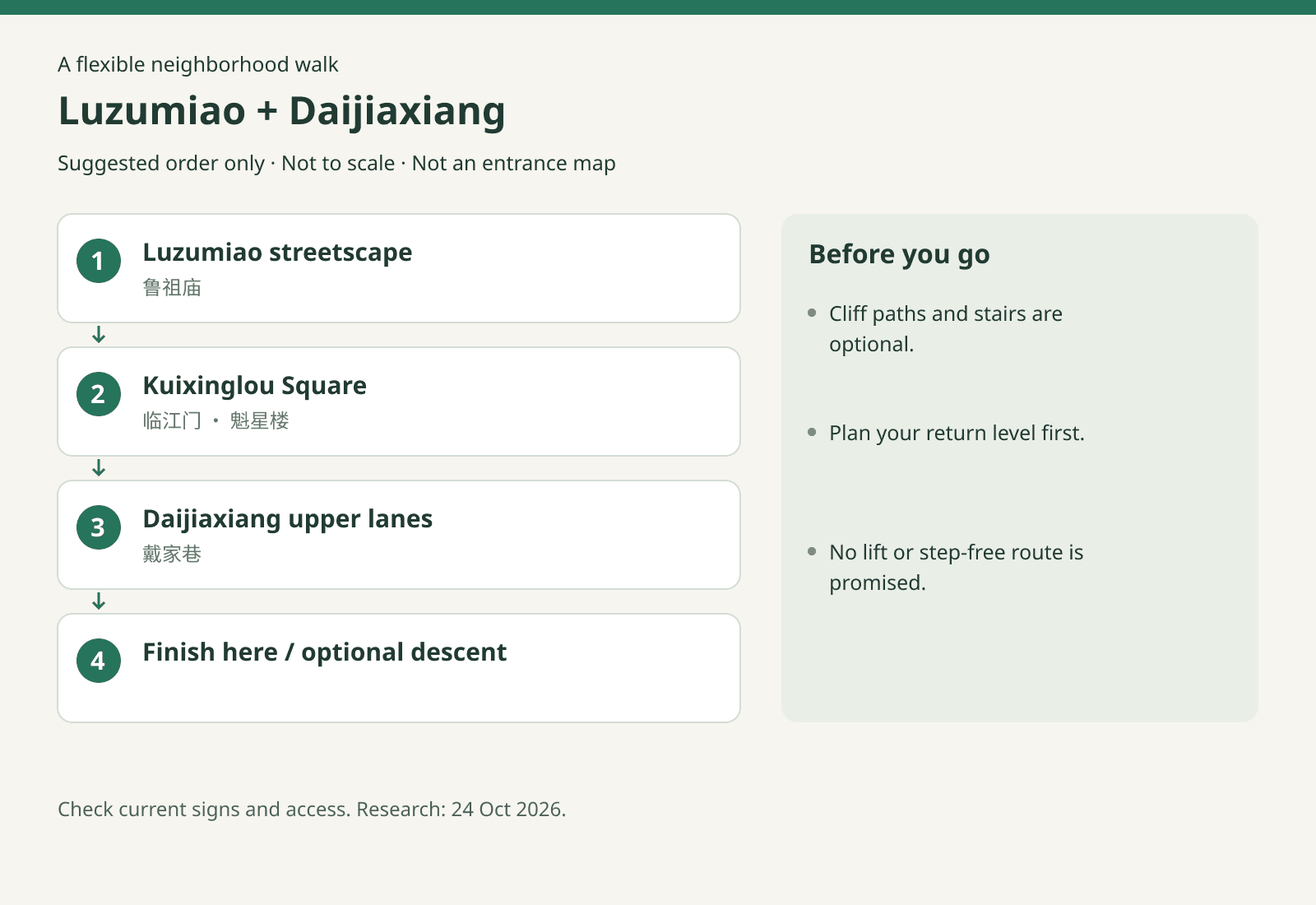
Suggested order only · Not to scale · Not an entrance map. Cliff paths and stairs are optional. Plan your return level first. No lift or step-free route is promised. Original editorial sequence diagram created for this guide.
Begin at Luzumiao, with Time for One Discovery
Search 鲁祖庙传统风貌区, Luzumiao Traditional Streetscape Area. Its official reopening report records the opening on 17 January 2025 after renewal work, combining older street fabric with creative businesses, dining and other newer uses.
Take a first pass through the public lanes before choosing your stop. Look at how the lower buildings sit among the surrounding commercial blocks, then pick one current shop, café or meal that genuinely interests you. A manageable visit is more satisfying than searching for every tenant mentioned at the reopening.
Luzumiao’s history includes craft, book and flower trading, but a present-day visit should not depend on finding a particular historic market stall. Nor is the January 2025 opening market a recurring event. Check any exhibition, performance or workshop directly before arranging your day around it.
If you want to photograph a shop interior, ask first. Keep a clear passage through the lanes and avoid using a residential entrance as a place to arrange a long photo session.
Continue to Linjiangmen and Kuixinglou
Use 临江门魁星楼广场 as the next search name. Specifying Linjiangmen helps avoid similarly named places elsewhere. Line 2’s 临江门站, Linjiangmen Station, is a useful arrival or exit anchor for this central section. Follow current maps and public signs rather than an old screenshot with a historical exit letter.
Kuixinglou is interesting because streets, squares and building levels meet in unexpected ways. CQNews’s architectural overview distinguishes the present recreation from the earlier historic structure. Do not expect an intact Qing-era tower.
A June 2026 Chongqing Morning Post account describes the square, elevated connection and visitors enjoying the scene. Treat that as evidence of the place’s character, not permission to follow the writer through an office building or use any particular lift.
Stay with the signed public space. You can appreciate the change of level from a comfortable position without leaning over a railing. If heights bother you, skip the exposed connection and continue with the street-level portion of your outing. A photograph is not worth blocking a bridge or making yourself uncomfortable.
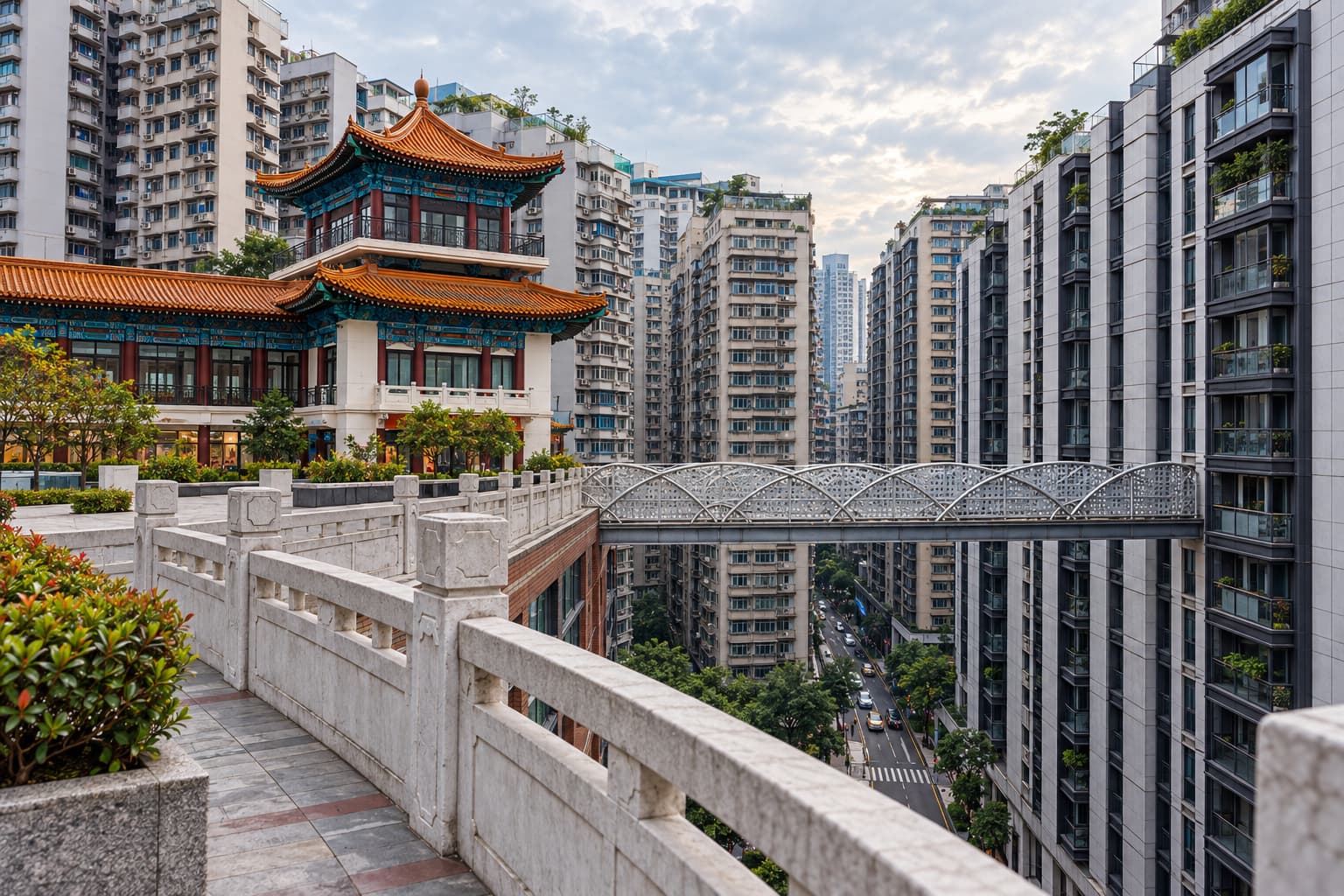
AI illustration. A recreated pavilion, footbridge and high-rises inspired by modern Kuixinglou. Approximate illustration based on a historical reference photograph, not a current photo. Viewpoint, entrances and access are not guaranteed. Original AI illustration for this guide. Historical photo reference only, not republished: CGTN Official, historic published photograph
Finish in Daijiaxiang’s Upper Lanes
Daijiaxiang lies between Kuixinglou and Hongya Cave, as described in the city’s traditional-neighborhood account. Its appeal comes from the combination of a lived-in neighborhood, older buildings, newer small businesses and the steep river-facing setting.
Start with the upper lanes. Choose a permitted viewpoint or a café whose actual view you can see before ordering. Do not assume every business has the same river outlook or that a rooftop appearing in a social-media photograph is publicly accessible.
People’s Daily’s report on the renewal describes the addition of cliffside walking space and viewpoints. Published measurements can refer to different parts of the project, so this guide does not turn them into an exact length for your walk. A July 2026 Chongqing Daily feature also records visitors in Daijiaxiang; its individual walking-time anecdote is not a promise for this route.
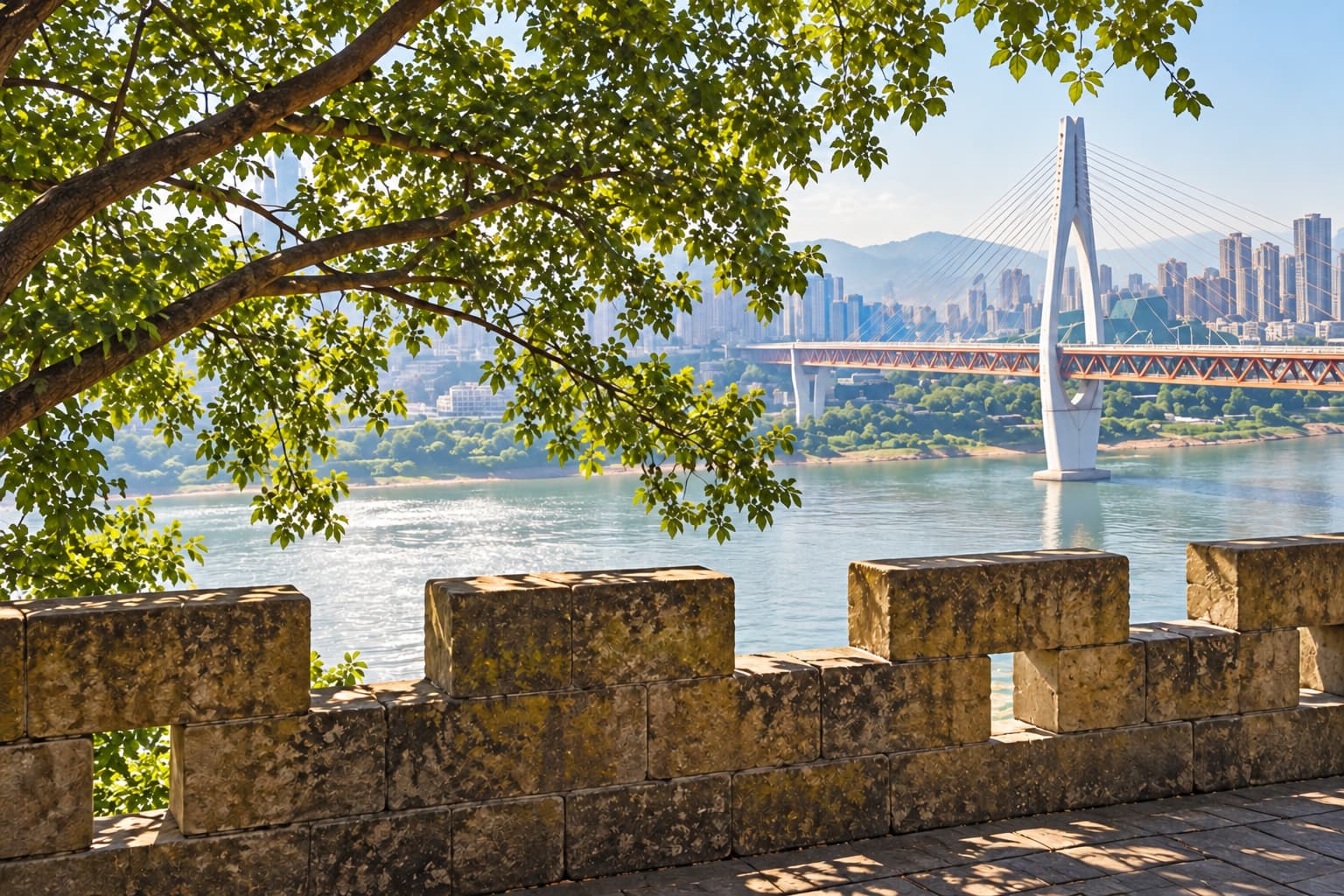
AI illustration. A stone parapet and tree canopy above the Jialing River, inspired by Daijiaxiang. Approximate illustration based on a historical reference photograph, not a current photo. Viewpoint, entrances and access are not guaranteed. Original AI illustration for this guide. Historical photo reference only, not republished: Xie Zhiqiang / Visual Chongqing; Chongqing Daily municipal mirror
Decide Before Taking the Cliffside Descent
Before heading down, check that the path is open, look at the steps and work out where you intend to finish. Follow on-site signs and any barriers. There is no verified universal lift shortcut in this guide, and descending does not guarantee an easy step-free way back up.
In rain, or if the stairs look uncomfortable, stay with the upper-level visit. Allow other pedestrians to pass at narrow sections and keep both hands available where the footing needs attention. Do not climb barriers or descend onto an unofficial riverside access point for a lower photo angle.
You may choose to continue toward Hongya Cave afterward, but it is a separate extension rather than a required final stop. Our Hongya Cave guide covers its own entrance levels and viewing choices.
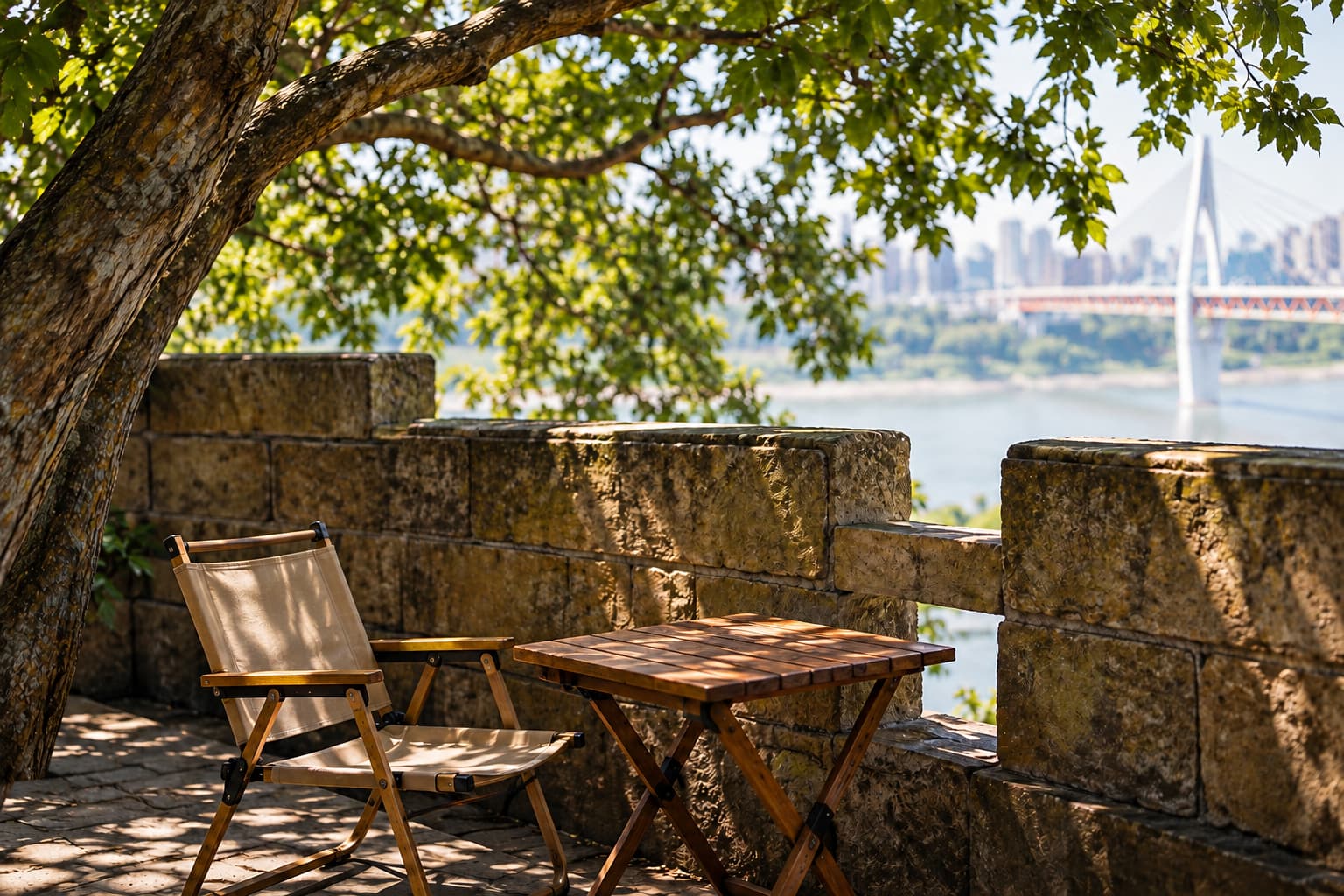
AI illustration. An empty chair and table beside a shaded stone parapet, inspired by Daijiaxiang. Approximate illustration based on a historical reference photograph, not a current photo. Viewpoint, entrances and access are not guaranteed. Original AI illustration for this guide. Historical photo reference only, not republished: Xie Zhiqiang / Visual Chongqing; Chongqing Daily municipal mirror
End on the Level You Intended
Before booking a car, confirm the actual road-accessible pickup point and tell the driver which street level you are on. For rail, check the walking approach to the station rather than heading toward its map label through an uncertain shortcut.
These neighborhoods do not share one opening timetable or admission rule. Public space, shops, cultural activities and building interiors operate separately. Keep the afternoon anchored by the open public route, then spend time or money only on the stops that suit you. That leaves room for the city’s layers without turning a relaxed walk into a staircase challenge.
Give Each of the Three Stops a Different Job
Our suggested sequence works because the stops offer different things. Use Luzumiao for browsing and a possible first drink, Kuixinglou for understanding the contrast between street level and the surrounding buildings, and Daijiaxiang for the cliffside neighborhood setting. You do not need three shopping stops or three long café breaks to make the walk worthwhile.
If your main interest is photography, leave enough attention for the spaces between those subjects rather than racing toward one famous angle. If you are more interested in small businesses, spend longer at Luzumiao and shorten the final section. The Yuzhong reopening report provides context for Luzumiao's renewed commercial uses, but its January 2025 launch activities are not a current events calendar.
Keep the route separate from a full Jiefangbei-to-Chaotianmen outing. Combining both can turn a compact neighborhood plan into a much longer day. Our Jiefangbei to Raffles City guide is an alternative plan, not an automatic continuation of this one.
Check Two Things Before Following a Map Pin
Check the destination name and the street level you are trying to reach. A map pin can identify Kuixinglou or Daijiaxiang without proving that the nearest-looking door, staircase or lift is a public connection. We would pause at a signed public junction rather than continue into an office lobby simply because the location dot seems close.
For Kuixinglou, save 临江门魁星楼 as well as 魁星楼. For the next section, save 戴家巷 and specify that you want the upper neighborhood if that is your plan. “请问去戴家巷上面的街区怎么走?” asks how to reach Daijiaxiang's upper streets. An answer on the spot should still be checked against current public signs and any barriers.
This is why the sequence is a planning outline rather than a list of exact entrances. The architectural account of Kuixinglou helps explain its setting and rebuilding history; it does not establish permission to use any particular building lift today.
Make One Clear Decision Before Descending
At Daijiaxiang, decide whether the upper lanes are enough before committing to a lower section. Ask yourself whether the path is open, whether everyone is comfortable with the steps, and where you intend to finish. If you cannot answer the return question, remain on the public upper-level route rather than treating every downward staircase as progress.
We suggest agreeing on this decision as a group. One person wanting a river-level photograph should not leave another person facing an unexpected climb. If you split up, choose a named public meeting point and confirm that both parties understand its level. A screenshot of a shopfront can help identify a meeting place, but it does not replace checking that the shop is currently open.
If Hongya Cave becomes your main goal instead, use our Hongya Cave visitor guide to plan it separately. Do not assume that an apparent connection from Daijiaxiang establishes an open entrance or an effortless return.
Keep Two Ways to End the Walk
The first ending is simply to stop after the upper Daijiaxiang lanes and choose an open place for a break. The second is to continue farther only when the public route, weather and your energy make that sensible. Neither ending requires a fixed sunset appointment or an unverified lift shortcut.
In rain, we would reduce the number of changes of level and avoid rushing for photographs. A wet-weather plan should involve a genuinely suitable indoor destination, not an assumption that the next lane will be covered. See our rainy-day planning guide if the outdoor section no longer suits the group.
Frequently Asked Questions
Q: What order should I use for the three places? A: Luzumiao, Kuixinglou, then Daijiaxiang is our suggested order. It is an editorial sequence, not a surveyed turn-by-turn route. Your hotel location, an indoor booking or a closure may justify reversing or shortening it.
Q: Is Kuixinglou an intact ancient tower? A: No. The architectural source describes rebuilding in the 1990s. Enjoy the present setting without presenting the structure as untouched historic fabric or relying on viral claims about an exact number of floors.
Q: Can I use an office lift as a free shortcut? A: This guide does not confirm public access to any office lift. Use signed public connections and respect staff instructions. A lift shown in somebody else's visit is not permission to enter today.
Q: Must I walk down the Daijiaxiang cliff path? A: No. The upper neighborhood is a valid finish. Make any descent conditional on current access, weather, everyone's ability and a clear plan for what happens at the bottom.
Q: Are these three places covered by one ticket or opening time? A: We have not established a combined ticket or universal schedule. Public streets, indoor businesses and any managed path have separate conditions. Check the specific venue or route segment you intend to use.
About This Guide
We reviewed the cited material on 24 October 2026. The two-and-a-half-to-four-hour allowance is an editorial planning range, not a measured walk. This guide combines published place history with cautious route decisions; it does not claim a fresh on-site inspection of every entrance, lift, barrier or stairway.
Traveler comments
Share a recent experience or ask a practical question about this guide.