
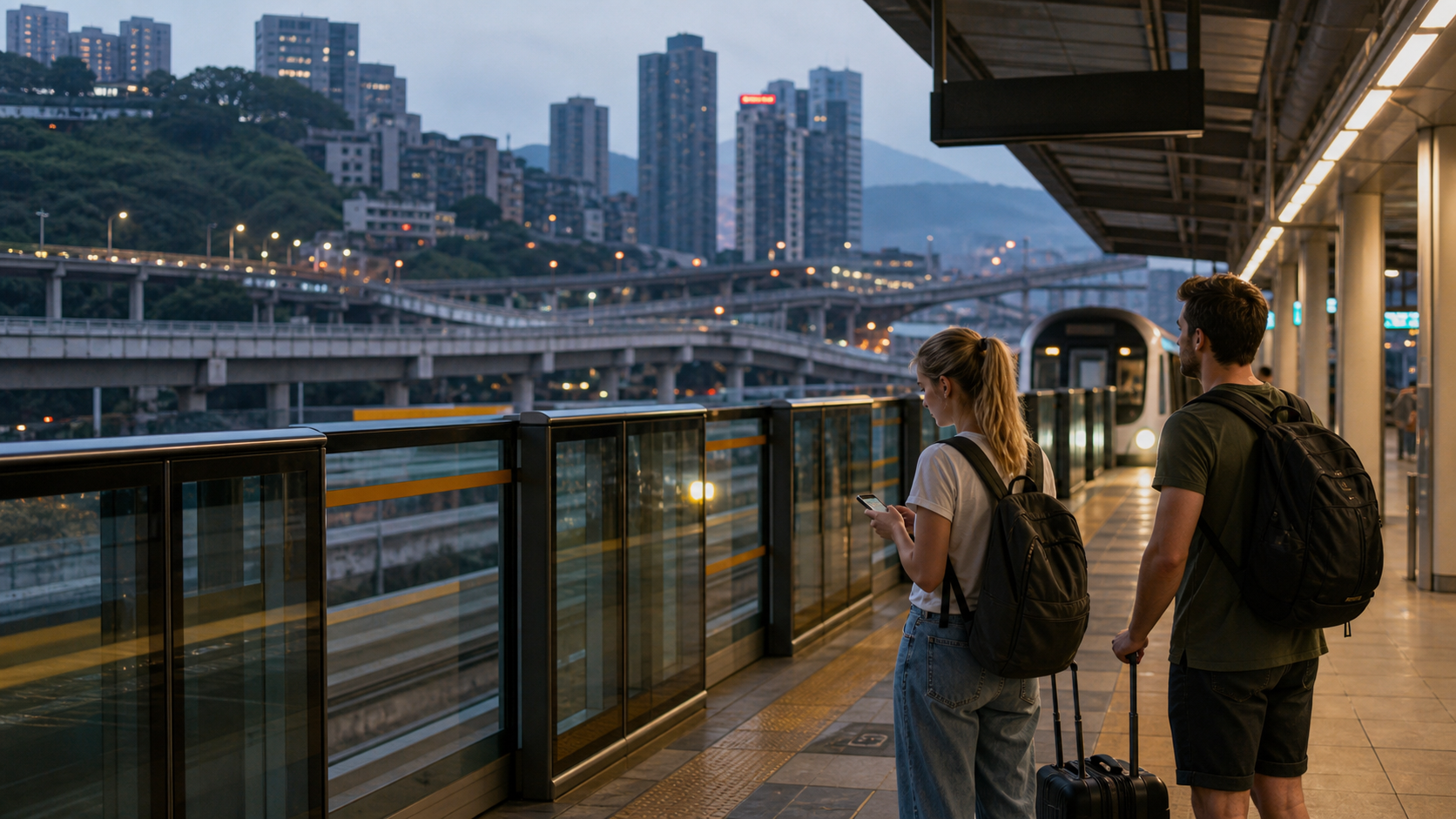
Single-journey Chongqing rail fares in 2026 are distance-based: CNY 2 for 0–4 km, then rising by distance; after 55 km, each additional 20 km adds CNY 1. The official 2025 assessment put the current longest 88 km charged trip at CNY 11. By the end of 2025, the operating network had reached about 582 km.
Chongqing Rail Transit is not hard to ride, but it punishes vague planning. The map can make two places look close while the street route adds stairs, overpasses, and different building levels. This guide explains how to use the system as a visitor, not as a local commuter who already knows the exits.

The Short Answer: When Metro Works
Metro is a good first choice for daytime travel, light luggage, and routes that stay near Line 1, Line 2, Line 3, Line 6, or Line 10. It is especially useful for Jiangbei Airport, Chongqing North Railway Station, Liziba, Jiefangbei, Xiaoshizi, Linjiangmen, and many central sightseeing areas. The official Chongqing Rail Transit site keeps a 首末班时间 (first/last train) section, so open that or read the station display before a late ride.
Which line for which arrival point
| Where you are going | Line to check first | What to confirm before you go |
|---|---|---|
| Jiangbei Airport T2 | Line 10 or Line 3 | Which terminal your flight actually uses |
| Jiangbei Airport T3A | Line 10 | T3B is a domestic satellite concourse: check in, drop bags and clear security at T3A, then take the airport APM after security for J/K/L/M gates |
| Chongqing North Railway Station | Line 10, with Line 3 and Line 4 also listed | North Square or South Square — they are different stops |
| Chongqing West Railway Station | Line 5 or the Circle Line | Allow extra time; it is not a central station |
| Liziba and the elevated Line 2 views | Line 2 (monorail) | Ride a few stops rather than only photographing the platform |
| Jiefangbei, Xiaoshizi, Linjiangmen | Line 1 and Line 6 | The exit number, not just the station name |
- Where you are going
- Jiangbei Airport T2
- Line to check first
- Line 10 or Line 3
- What to confirm before you go
- Which terminal your flight actually uses
- Where you are going
- Jiangbei Airport T3A
- Line to check first
- Line 10
- What to confirm before you go
- T3B is a domestic satellite concourse: check in, drop bags and clear security at T3A, then take the airport APM after security for J/K/L/M gates
- Where you are going
- Chongqing North Railway Station
- Line to check first
- Line 10, with Line 3 and Line 4 also listed
- What to confirm before you go
- North Square or South Square — they are different stops
- Where you are going
- Chongqing West Railway Station
- Line to check first
- Line 5 or the Circle Line
- What to confirm before you go
- Allow extra time; it is not a central station
- Where you are going
- Liziba and the elevated Line 2 views
- Line to check first
- Line 2 (monorail)
- What to confirm before you go
- Ride a few stops rather than only photographing the platform
- Where you are going
- Jiefangbei, Xiaoshizi, Linjiangmen
- Line to check first
- Line 1 and Line 6
- What to confirm before you go
- The exit number, not just the station name
Line assignments come from TravelChinaGuide's Chongqing subway guide and its Line 10 page, re-read on 2026-08-08.
Avoid metro as the default when the group has 2+ large suitcases, a late-night arrival, children who are already tired, or a hotel entrance that sits above or below the station level. In those cases, a taxi or ride-hailing car can save the first night. My local rule is simple: use metro for the clean middle of the route, and do not be afraid to pay for the last kilometer.
Works for: light bags, daytime airport arrivals, Line 2 sightseeing, and central area hopping.
Avoid if: your phone battery is low, you cannot read the Chinese hotel address, or the route requires 2 transfers with luggage.
Common mistake: choosing the nearest station on the map without checking which exit reaches the street level you need.

What Chongqing Rail Transit Is
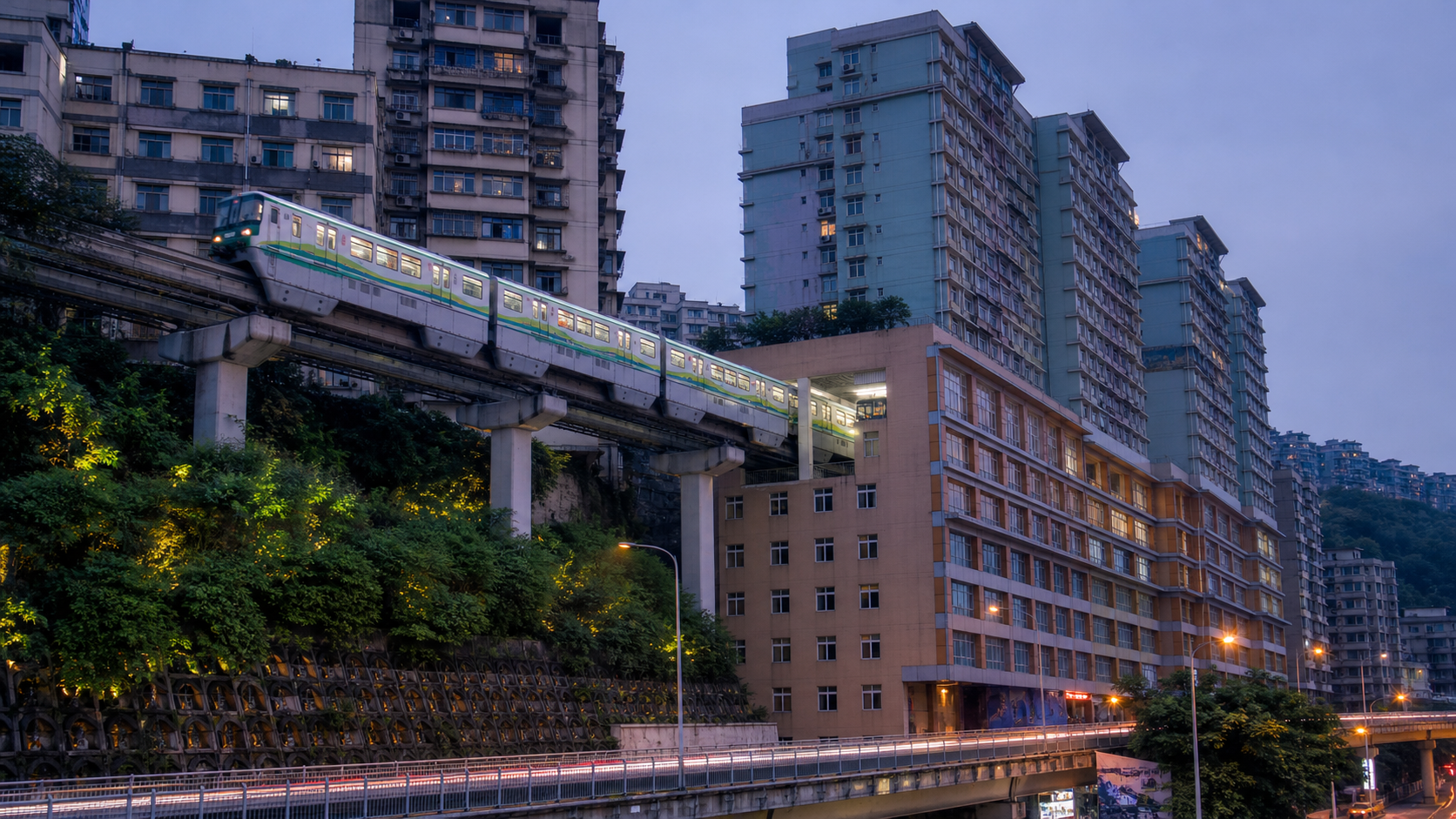
Chongqing Rail Transit combines underground metro lines, elevated monorail sections, and mountain-city stations that may sit on different vertical levels. Wikipedia's Chongqing Rail Transit entry is useful for network background, while TravelChinaGuide's Chongqing subway guide is easier for visitors because it groups lines, stations, and airport/railway connections in plain travel language.
The scale, in numbers a visitor can use
By the end of 2025, Chongqing's operating rail-transit network had reached about 582 km, according to the Chongqing municipal government. Line and station counts vary with statistical scope, so this guide uses route names and station displays instead of treating an old network count as a live fact.
The lines that matter for a first visit are the monorails, Lines 2 and 3. They are the elevated ones. If you booked a "subway" ride expecting a tunnel and got a hillside view, that is why.
One honest caveat on that line count: the sources disagree. Wikipedia counts 14 including monorails and suburban lines, TravelChinaGuide lists 10 metro lines, and Trip.com's July 2026 guide says 11 main lines plus suburban extensions. They are counting different things, not contradicting each other. For trip planning the count does not matter — the 6 lines in the table above cover nearly every visitor route.
The system is reliable enough to build a 2-4 day trip around, but it is not the whole trip. A station exit can put you on a high road while your restaurant sits on a lower riverside road. A 600 m walk can feel short in Shanghai and complicated in Chongqing. When I plan routes for foreign guests, I check the rail line first, then the exit, then the walking level.
Useful visitor anchors:
- Line 10: airport and Chongqing North Railway Station logic.
- Line 2: elevated monorail experience and Liziba-style city views.
- Line 1 and Line 6: central Yuzhong transfers around Xiaoshizi, Linjiangmen, and related sightseeing patterns.
- Line 3: older north-south airport-side context, depending on where you start.
Airport, Railway Stations, and Luggage
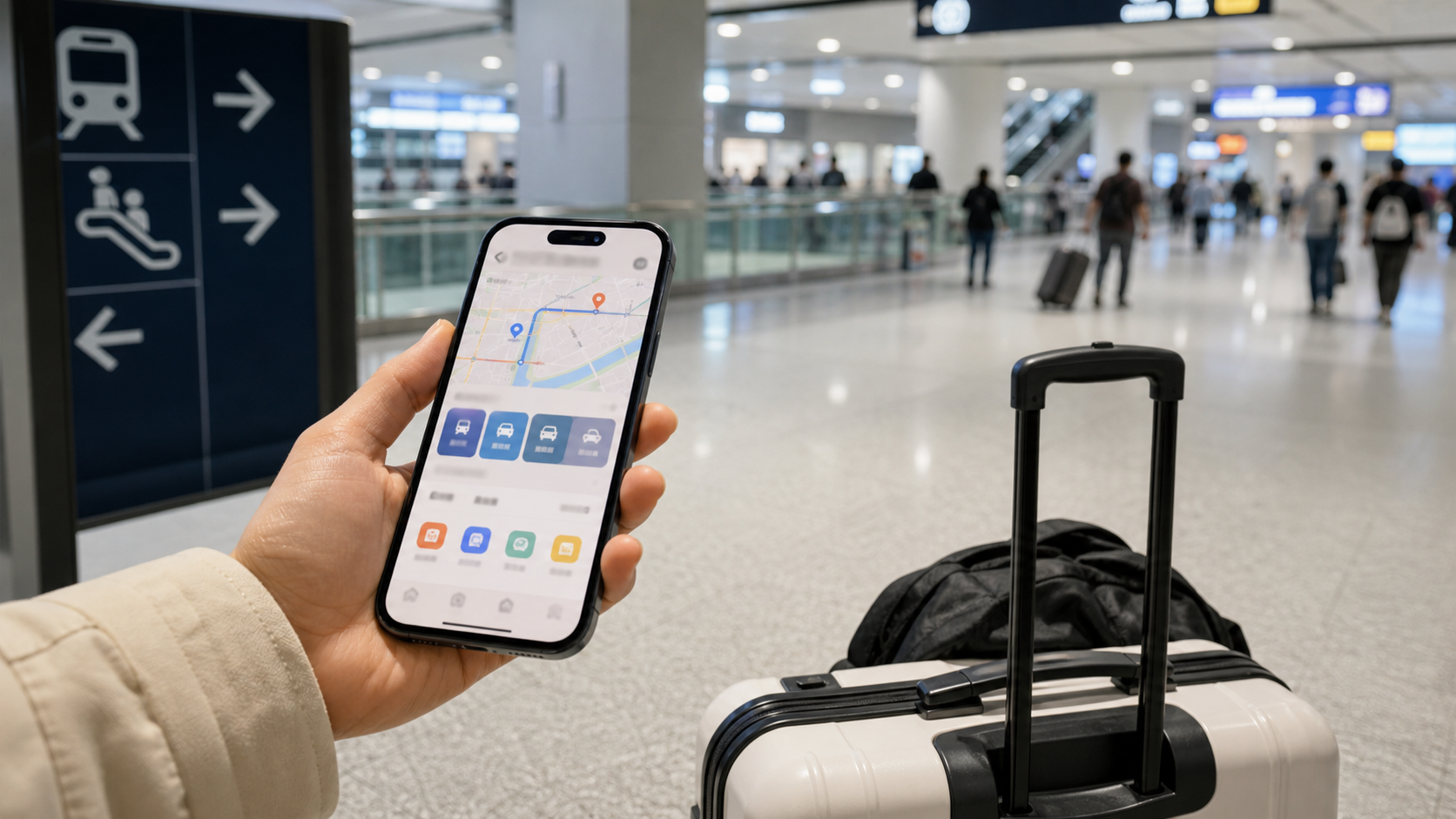
Line 10 is the line many airport arrivals notice because it connects airport areas and major rail-transfer points. It can work well if you land during normal operating hours, have one carry-on, and stay near a station with a simple exit. For late arrivals or 2 large bags, compare a taxi before committing to a transfer route. Our dedicated airport to downtown transfer guide covers that decision in more detail.

For Chongqing North Railway Station, metro can be useful because station traffic and taxi pickup zones can be confusing. The key is to know whether you are going to a rail station, a metro station, or a hotel nearby — and which square. TravelChinaGuide lists North Square and South Square as separate rail stops, with the Line 3 transfer at South Square. Do not show a driver or staff member just "Chongqing North" in English; save the Chinese name, the square, and your final destination. Our railway stations guide covers the same split for the West and East stations.
Time needed: airport-to-central rail routes often take longer than the train ride alone because you need terminal walking, ticket or gate setup, transfer walking, and a final exit decision. If your hotel check-in is after a long international flight, build in a 30-45 minute buffer beyond the route-app estimate.
Line 2 and Liziba: Ride It Like Transit, Not Just a Photo Stop
Line 2 is the rail-transit line most visitors recognize because of elevated sections, hillside buildings, and the famous Liziba viewpoint. The Liziba monorail viewpoint guide explains the photo stop, but the better way to understand Chongqing is to ride Line 2 for a few stops and watch how the train moves through the city levels.

Works for: first-time visitors, families, railway fans, and people who want a low-effort city texture experience.
Avoid if: you are chasing a tight sunset plan, carrying large luggage, or expecting every station to be a scenic viewpoint.
Local tip: keep the ride practical. Combine Liziba with Eling, Jiefangbei, or another central route, and leave before the viewpoint becomes a long photo queue. The point is not one platform photo; it is seeing how rail, cliffs, roads, and apartment blocks stack together.
Line 1 is the other line worth a deliberate ride, because it ends the day somewhere rather than at another downtown block: it runs out to Ciqikou Station for the old town. The Ciqikou Ancient Town guide explains why that stop works better as a controlled 2-4 hour block than as a spontaneous add-on.
Tickets, Phone Payment, and Gates
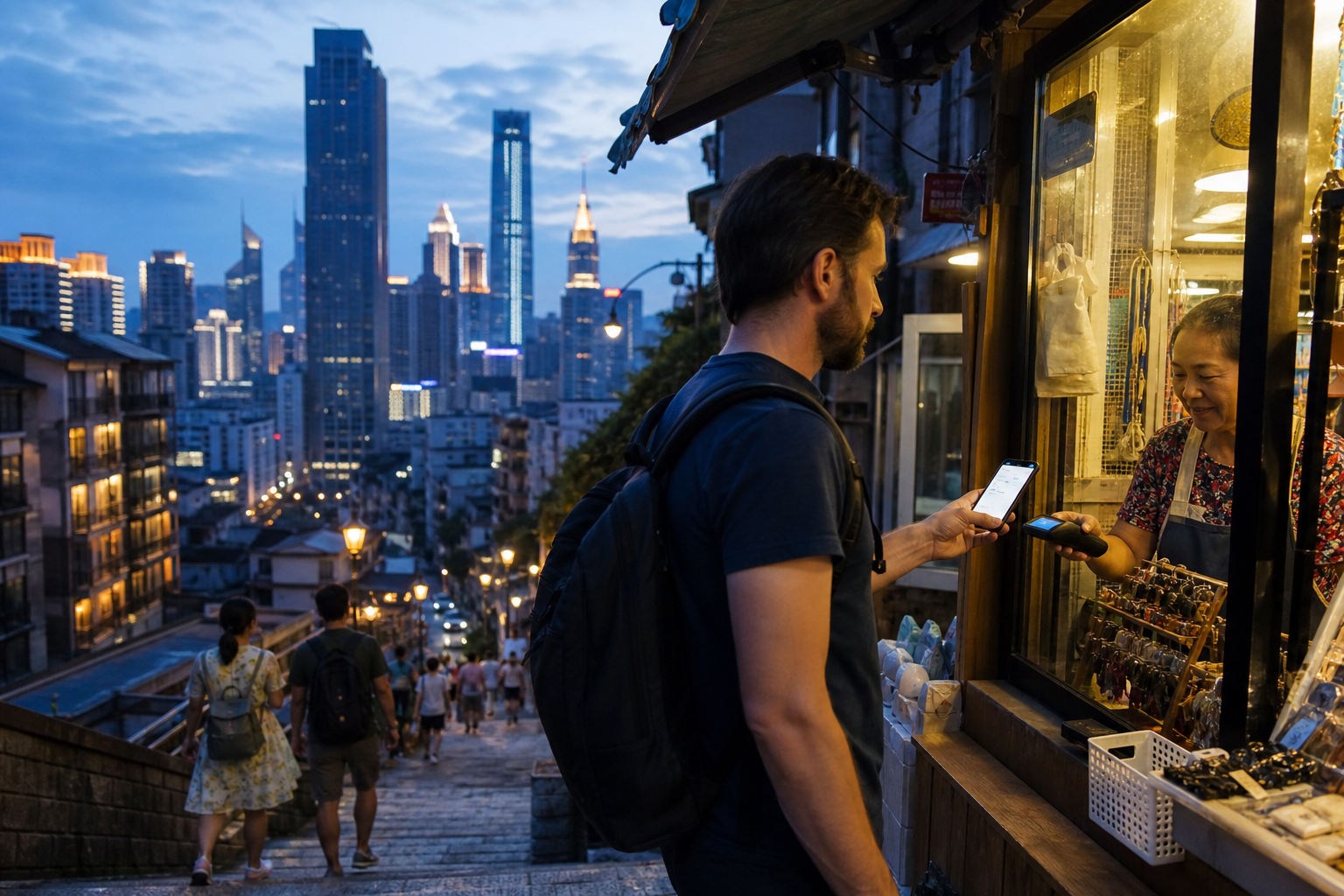
Foreign visitors usually have 3 practical ways to pass the system: buy a single-ride ticket at the station, use a supported phone payment / transit QR flow if your app is set up, or ask staff when the gate does not read your phone. The official Chongqing Rail Transit site is the authority for current rules, so treat any online guide as a starting point and the station machine or staff desk as the same-day answer.
What a ride actually costs
| Ticket type | Price | Worth knowing |
|---|---|---|
| Single journey, distance-based | Starts at CNY 2; current longest charged trip is CNY 11 | 0–4 km costs CNY 2; after 55 km, each additional 20 km adds CNY 1. Check the machine for the exact trip |
| One-day travel pass | CNY 18 | Breaks even at roughly 4–6 rides, so it suits a dense sightseeing day, not a 2-ride day |
| Chongqing Public Transportation Card | 10% off the metro fare | Useful for a longer stay; less useful for a 3-day trip |
- Ticket type
- Single journey, distance-based
- Price
- Starts at CNY 2; current longest charged trip is CNY 11
- Worth knowing
- 0–4 km costs CNY 2; after 55 km, each additional 20 km adds CNY 1. Check the machine for the exact trip
- Ticket type
- One-day travel pass
- Price
- CNY 18
- Worth knowing
- Breaks even at roughly 4–6 rides, so it suits a dense sightseeing day, not a 2-ride day
- Ticket type
- Chongqing Public Transportation Card
- Price
- 10% off the metro fare
- Worth knowing
- Useful for a longer stay; less useful for a 3-day trip
Fares and ticket types come from TravelChinaGuide's subway guide, re-read on 2026-08-08. The 180-minute rule is the one that catches sightseers: a long lunch inside the paid area is not free.

Set up payment before the first gate, not at it
If you are new to China, set up payment before your first ride. Read the Chongqing payment guide before you arrive, then test your app with a small purchase. A merchant QR code that works in a shop does not guarantee that the transit code is configured for Chongqing — they are separate flows inside the same app. At the gate, do not block the flow while troubleshooting. Step aside, reset brightness, confirm the correct code type, or ask staff.
Useful Chinese phrases:
可以买单程票吗?— Can I buy a single-ride ticket?我可以用支付宝进站吗?— Can I enter with Alipay?我可以用微信支付进站吗?— Can I enter with WeChat Pay?这个二维码进不了站,可以帮我看一下吗?— This QR code will not open the gate. Could you help check it?请问人工服务在哪里?— Where is the staff service desk?
Transfers, Exits, and the Final 800 Meters
Transfers are where Chongqing becomes different from a flat-city metro. A transfer can mean a long corridor, an escalator stack, a direction change, and another gate-level decision. Build 8-15 minutes for a normal transfer when you are new to the station, and more if the group has luggage.

Exit choice matters more than many visitors expect. If a hotel, restaurant, or attraction says "near the station", ask which exit and which road level. In Yuzhong, a wrong exit can still leave you close by distance but far by effort. This is why I save Chinese place names, screenshots of addresses, and one backup taxi phrase before leaving the station.
Chinese phrases for exits and direction:
请问去解放碑从哪个出口走?— Which exit should I use for Jiefangbei?请问去洪崖洞从哪个出口比较方便?— Which exit is more convenient for Hongya Cave?这里可以打车吗?— Can I get a taxi here?请带我到方便打车的出口。— Please take me to an exit where it is easy to get a taxi.
Night Rides and When to Switch to Taxi
The metro is useful at night, but late planning needs discipline. Check the official first/last-train page, the station display, and your destination side before assuming the last ride solves the evening. If you finish around Hongya Cave, Qiansimen Bridge, Nanbin Road, or a hotpot restaurant after a long day, walking to a wider pickup road can be better than forcing a final metro transfer.

Good switch-to-taxi moments:
- You have more than 1 transfer after 21:30.
- Someone in the group is tired, wet, or carrying shopping bags.
- The destination is a hillside hotel, river-road restaurant, or attraction entrance that needs a specific drop-off.
- Your phone battery is under 20 percent.
Taxi phrase: 请送我到这个地址,尽量停在方便下车的入口。
Meaning: Please take me to this address and stop at an entrance where it is easy to get out.
About This Guide
This guide was rechecked on 2026-08-08 against the official Chongqing Rail Transit site, TravelChinaGuide's route overview, its Line 10 page, Wikipedia's Chongqing Rail Transit entity page, and a July 2026 Trip.com metro guide. Every fare and line assignment in the tables above traces to those pages.
The operator's first/last-train sub-page cited in the July 2026 version now returns 404; the section is reachable from the operator site root instead. Exact first and last trains, payment acceptance, and service disruptions remain station-display or same-day official checks.

The public images are original AI-generated scenes created for this article after reviewing real Chongqing rail-transit references. They are not copied from official pages, social platforms, or user posts.
Continue planning with the airport transfer guide, Liziba monorail viewpoint guide, and payment setup guide.
Frequently Asked Questions
Q: Is Chongqing metro easy for foreign visitors in 2026?
A: Yes for daytime routes, light luggage, and major stations such as Jiangbei Airport, Chongqing North Railway Station, Liziba, Xiaoshizi, Linjiangmen, and Jiefangbei. Fares run CNY 2+ by distance. It becomes harder when the final 500-800 m involves hills, stairs, or an unclear exit.
Q: Which metro line should I use from Chongqing airport?
A: Line 10 is the main airport rail-transit anchor most foreign arrivals should check first. Confirm your terminal, transfer station, and last-train timing on the official CRT page or station display before a late ride.
Q: Can I use Alipay or WeChat Pay on Chongqing metro?
A: Many visitors use phone payment or transit QR flows, but setup details can change. Test your Alipay or WeChat Pay before the first ride, keep a backup single-ride ticket option, and ask staff if the gate does not scan.
Q: Is Line 2 worth riding if I already visit Liziba?
A: Yes if you have 30-60 minutes. Riding a few Line 2 stops helps you understand Chongqing's cliffs, elevated tracks, and hillside buildings better than taking one photo outside Liziba.
Q: When should I choose taxi instead of metro?
A: Choose taxi after a late flight, with 2 large suitcases, after 21:30 if the route needs more than 1 transfer, or when the destination is a hillside or river-road entrance that needs a precise drop-off.
Traveler comments
Share a recent experience or ask a practical question about this guide.