
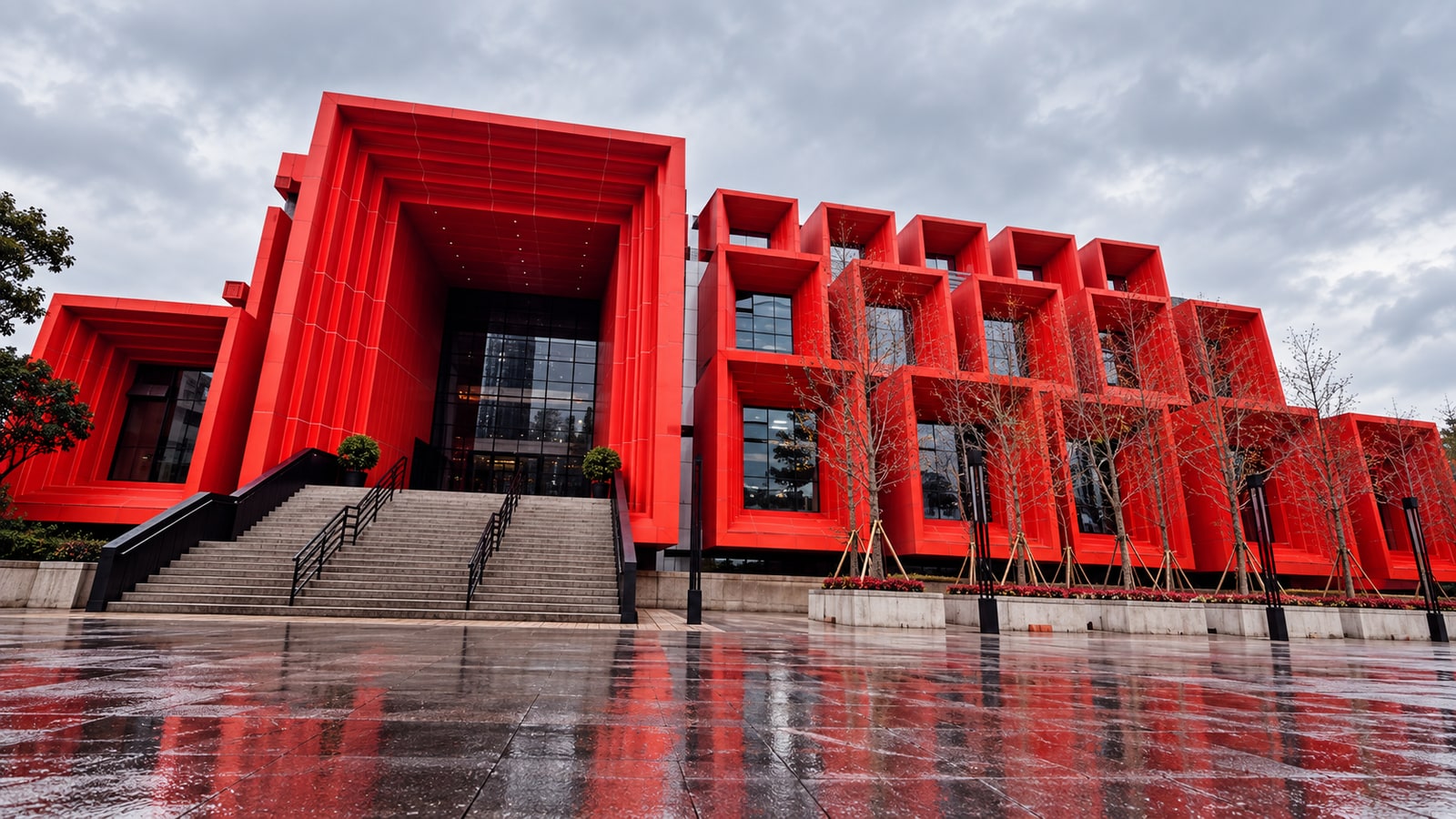
For Chongqing Art Museum in 2026, plan around the museum’s own schedule: its website currently lists 10:00–18:00, with last entry at 17:30 and Monday closure exceptions. I would combine a focused gallery visit with the red Guotai Arts Center exterior, checking the current exhibition and admission arrangements before leaving for No. 1 Linjiang Road.
The red building often appears in travel photographs without much explanation of what is inside. That can lead to two avoidable mistakes: arriving for galleries after admission has ended, or expecting a particular artwork from an old post. This guide separates the exterior, the museum and the current exhibition so you can choose the visit you actually want.
Identify the museum inside Guotai Arts Center
The museum operator’s website gives the address as floors 5–7 of Guotai Arts Center, No. 1 Linjiang Road, Jiefangbei Street, Yuzhong District. Save 重庆美术馆 and 国泰艺术中心 together. I would use both names when checking a map result, rather than following an English name that could refer to another gallery elsewhere in Chongqing.
Guotai is the building context; the museum is the institution you are visiting. Do not assume that every entrance, performance space or event in the arts center belongs to the museum. At arrival, follow the current museum directions and ask which floors or halls are available. An impressive exterior does not tell you whether the exhibition route begins at the doorway directly in front of you.
For a taxi destination, keep the Chinese names and street address visible on your phone. If you are meeting friends, agree on a specific permitted meeting point rather than saying “inside the red building.” A clear arrival plan is especially useful when someone wants exterior photographs while someone else heads toward the galleries.

Use the operator’s hours and check the date
As checked on 14 September 2026, the official museum homepage lists opening at 10:00, last entry at 17:30 and closing at 18:00. It says Mondays are closed except for public holidays and special circumstances. I would check the notice section again on the morning of a visit, particularly around a holiday or exhibition change.
Older tourism descriptions show different hours. The operator's current notice is the more relevant starting point, but it is still a published schedule rather than proof that every gallery will open on a particular day. Do not arrive close to last admission and expect enough time to see an exhibition properly. Build a margin for finding the entrance, asking questions and moving through the building.
Keep 3 clocks separate: when the museum opens, when admission ends, and when the building closes. A fourth consideration is your own return journey, especially if you are combining the visit with evening photographs or dinner. The public street outside and the galleries do not share one universal timetable.
A useful question is 请问,今天几点停止入馆? — “What time does admission end today?” If the visit is on a Monday, ask whether a special opening has actually been announced rather than assuming a holiday exception applies. It is easier to rearrange the day before you set out than to negotiate at a closed door.
Confirm entry and the exhibition you want
iChongqing’s museum profile records free public opening in October 2013. That supports the museum's free-access background. I would still verify the arrangement for the exhibition I plan to see, including any registration, capacity control or temporary change. Free admission does not mean every programme operates without conditions.
Check the current exhibition's title, start and end dates, and venue floor. Distinguish “current exhibitions” from archives and previews when using browser translation. A photograph in a social post may document a show that has finished, and a homepage headline may remain visible after an event. Do not plan around a famous artist's work unless the current announcement explicitly lists it.
I would save 2 items before leaving: the exhibition announcement and the address. If an online booking flow does not accept your document or phone format, ask the museum how an international visitor should enter. Do not invent a local identity number or assume a particular identity-document rule from another museum.
Useful phrases are 今天需要预约吗? — “Is a reservation required today?” and 请问,外国游客怎么入馆? — “How do international visitors enter?” Have your travel document available if you need to ask about verification, but follow the actual procedure rather than treating this guide as a claim that passport scanning is mandatory.

Look beyond the red facade
The museum’s background profile describes Chinese painting, oil painting, prints and small sculpture among its exhibition interests. Its 2013 opening gives context to the venue, but its present value depends on what is showing when you arrive. I would choose a gallery for its subject, not try to cover an assumed permanent collection.
Start with the introductory panel. Identify the exhibition's theme, then choose a few works that help you understand it. If the labels are difficult, translate a short section at a time and compare it with the actual artwork. Titles, dates and technical terms can be mistranslated; treat a phone translation as assistance, not an authoritative explanation of the artist's intention.
Give yourself permission to spend longer with fewer works. A painting can reward looking at composition, surface, repeated shapes and how the eye moves around the image. You do not need specialist vocabulary to notice those features. For a child, ask what detail they saw first, then invite them to find a second detail without touching the work.
Keep your expectations tied to the current display. This guide does not promise a particular artist, international touring exhibition, English tour or hands-on activity. If a talk or family workshop matters to your visit, check its date, language and registration separately. That prevents an enjoyable gallery stop from depending on a programme you have not booked.
Photograph the building and ask inside
The architectural overview describes interwoven red and black beams. I would try 2 exterior compositions: one wide view to show the whole relationship of entrance and facade, and one tighter view of the repeated geometry. Work from a permitted pedestrian position and avoid backing into a road while watching the screen.
Do not assume that every part of the building appears red from every angle, or that a tightly framed travel photograph shows the whole complex. The cover here is a reference-based AI illustration of the exterior, not a documentary image of today's weather or public access. Use it for atmosphere and recognition of the architectural theme, not as a route instruction.
Inside, ask 这里可以拍照吗? — “May I take photographs here?” Follow signs for the particular exhibition. Permission may depend on the work or area, and personal photography does not establish permission to commercially reuse an artwork image. Keep flash off unless staff explicitly permit it, and do not let a camera bag or tripod obstruct the display route.
A traveller report distinguishes an exterior photo stop from entering the galleries. That is a useful planning distinction. If you return later for the building, treat it as a separate outdoor visit and check conditions rather than assuming the museum remains open or the lighting follows a guaranteed schedule.

Make a rain plan that includes the journey
I would allow roughly 1–2 hours for a focused museum visit as an editorial planning choice, with additional time for the journey and a break. The operator's floors 5–7 address is a reminder to check the complete access route if you need a lift. We have not verified the current street-to-gallery step-free route, accessible toilet provision or luggage storage.
A museum can be a useful indoor destination, but the approach is still part of the day. Choose footwear suitable for wet surfaces and carry an umbrella bag if you use one. Ask where wet umbrellas and larger bags should go instead of leaving them beside an artwork. Keep essential medication, documents and valuables with you according to the venue's rules.
For a family or mixed-interest group, agree on a meeting point and a manageable visit length. Do not promise children a play area or interactive exhibit unless it appears in a current announcement. Plan food and rest separately: a gallery address does not prove there is a café, a prayer room, a particular menu, or a suitable place to sit for a long break.
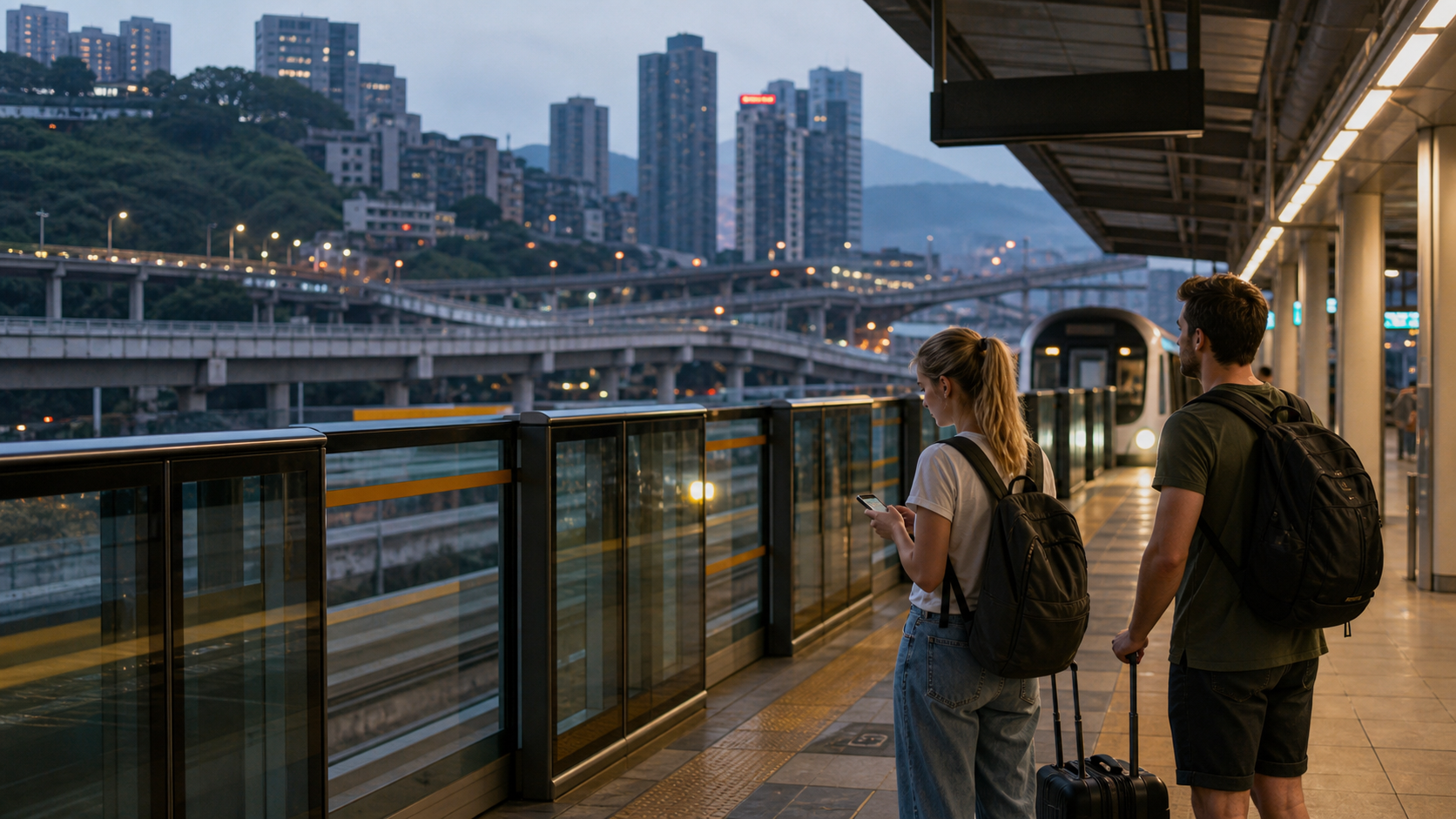
For the wider day, consult our heat and stairs guide and metro guide. The architectural reference names Linjiangmen on Line 2 as a transit point; verify the current exit and final approach in your map app. If mobility requirements are essential, ask about them before starting the trip.
Pair it with one central-city stop
I would choose 1 follow-on activity rather than making the museum a brief pause between many appointments. Its No. 1 Linjiang Road location puts it within a central-city outing, but the next route still needs checking. A shopping walk, a meal or an exterior photo stop can each be enough after concentrating on art.
Use the Jiefangbei and Raffles City walking guide for a longer urban plan, or the Hongya Cave guide if that is already part of your day. Do not confuse a suggested pairing with a promise of a level, covered or crowd-free connection.
Before choosing food, confirm the menu and payment method at the business itself. Travellers who need halal food or strict ingredient control should arrange that meal deliberately rather than selecting the first convenient café. Keep a backup plan if the museum has a temporary closure: an exterior look and another confirmed activity can still make a useful afternoon without forcing entry into an unavailable exhibition.

About This Guide
We checked 4 source domains on 14 September 2026, giving priority to the museum operator for hours and address. This is desk research, with no on-site visit claimed. The cover is a reference-based AI illustration and the 4 planning cards are original. For travel-date opening, exhibitions and entry procedures, consult the museum's current notices.
Frequently Asked Questions
Q: What hours does Chongqing Art Museum currently publish? A: On 14 September 2026 its website listed 10:00–18:00, last entry 17:30, with Monday closure except holidays or special arrangements. Recheck current notices before travelling.
Q: Is Chongqing Art Museum free? A: Local tourism information describes free public admission. Confirm the current exhibition's entry and registration conditions with the museum rather than assuming every programme is unrestricted.
Q: Is this the red Guotai Arts Center building? A: The museum's listed address is floors 5–7 of Guotai Arts Center, No. 1 Linjiang Road. Save both 重庆美术馆 and 国泰艺术中心 to identify the correct destination.
Q: Can I visit the galleries at night? A: The published museum schedule ends at 18:00, with admission ending earlier. Exterior photography and gallery admission are separate activities.
Q: Is the museum a workable rainy-day option? A: It can be if it is open and the current exhibition interests you. Check the journey, entrance and any lift requirements; no continuous step-free route has been verified here.
Traveler comments
Share a recent experience or ask a practical question about this guide.