
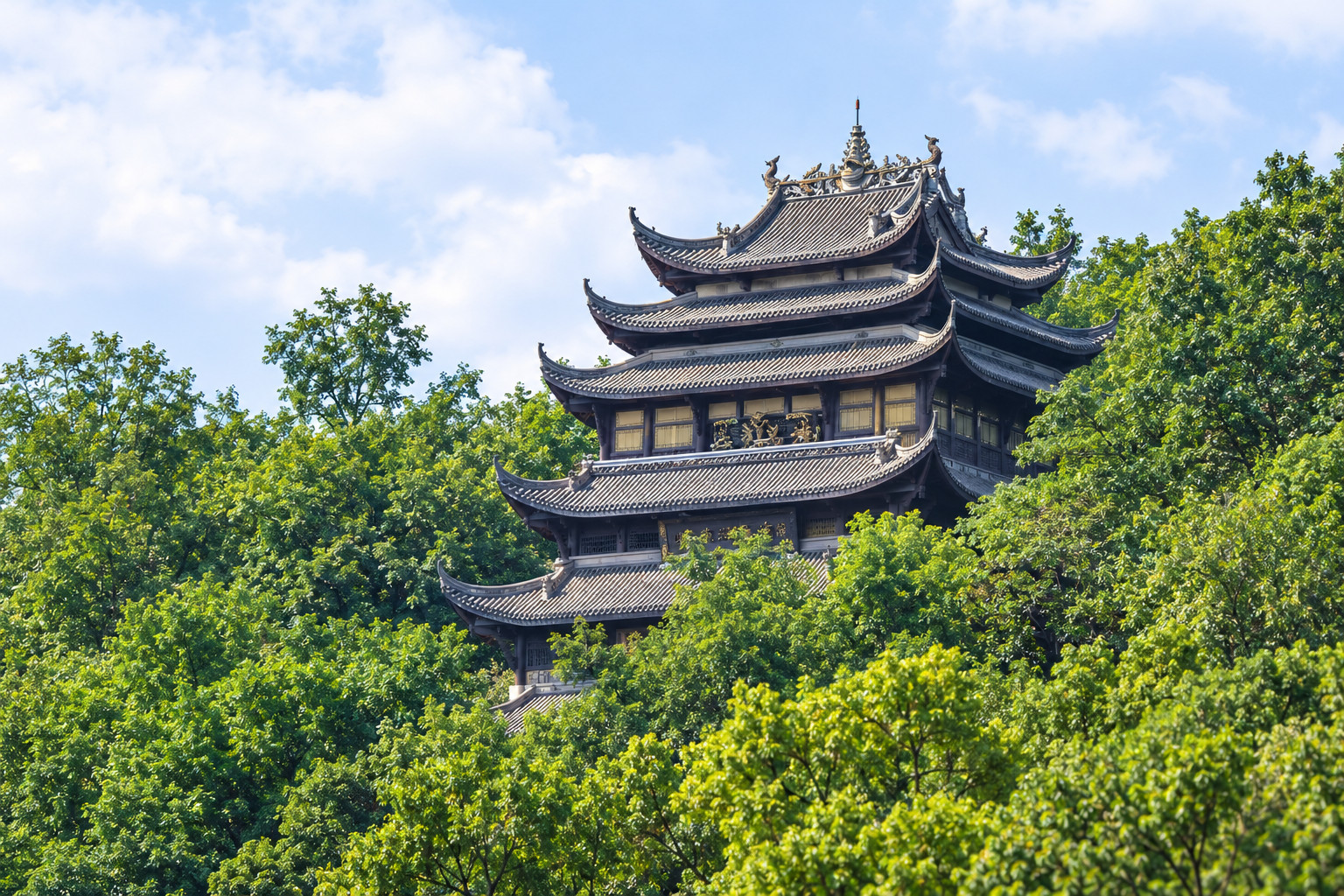
Cover illustration: AI illustration based on historical photo references. Upper tiers of the Tongnan Dafo Temple pavilion among foliage; the forecourt and stairs are outside the frame. Tiny plaque marks are illustrative and must not be read as historical text. The scene and details are approximate, not a current photograph or proof of public access, a public path or an authorized viewpoint. Reference photographs were published in 2019; capture dates are unverified.
Historical photo reference only; original not republished; the reference grants no reuse permission: Tongnan District Government / Photographer not confirmed
Visitor-information update based on the source check of 2 October 2026; this is not confirmation of conditions on your travel date.
Tongnan Dafo Temple in 2026 is a focused visit to a monumental cliff Buddha, its protective pavilion and the Fujiang river landscape. Chongqing's heritage authority records an 18.43-metre seated sculpture. Plan around the permitted temple route, then consider a separate riverside walk if current access and your return arrangements allow.
Use 潼南大佛寺 when searching or asking for transport. “Dafo Temple” means Great Buddha Temple and is not a unique place name. This destination is in Tongnan; it is not the Dafo Bridge area beside central Chongqing's Yangtze River, and it is not the Dazu Rock Carvings.
This guide builds on research conducted on 1 October 2026 and does not claim a personal visit. A source check on 2 October 2026 found that the official directory dated 5 March 2026 lists free admission, 08:30–17:30, and No. 528 Fujiang Road, Dafo Subdistrict, Tongnan (重庆市潼南区大佛街道办事处涪江路528号). Confirm holiday arrangements and access to your intended halls or upper floors at +86 23 4422 2300. A government response dated 8 May 2026 describes online real-name reservations and timed visitor-flow controls in busy periods; it does not establish a universal reservation requirement. Check the arrangements for your date. No foreign-passport reservation or manual-entry process, current boat service, or complete step-free route has been verified.
Make the place identity precise
The municipal heritage description published on 7 May 2024 places the carvings inside Dafo Temple in western Tongnan. An iChongqing account from 2020 relates the temple to Dingming Mountain and the Fujiang, also written Fu River in English.
A public travel post reviewed for this guide mixes Tongnan with central Chongqing's Danzishi and Dafo Bridge geography. That is a useful warning about matching names rather than proof of a connecting route. Save the temple's Chinese name with 潼南 and check the district before accepting a map result, hotel suggestion or transport quote.
For a driver, a confirmed visitor entrance is more useful than a photograph of the Buddha. Ask which gate is being used on your day and where vehicles can stop legally. A map pin for a large scenic area can otherwise leave you on the wrong side of a controlled approach.
Read the Buddha and pavilion together
The 2024 heritage record describes carving carried out across the Tang and Song periods, with the body completed in 1151. The useful point is the long development of a cliff sculpture, rather than a claim that every surface or building visible today has remained untouched since that date.
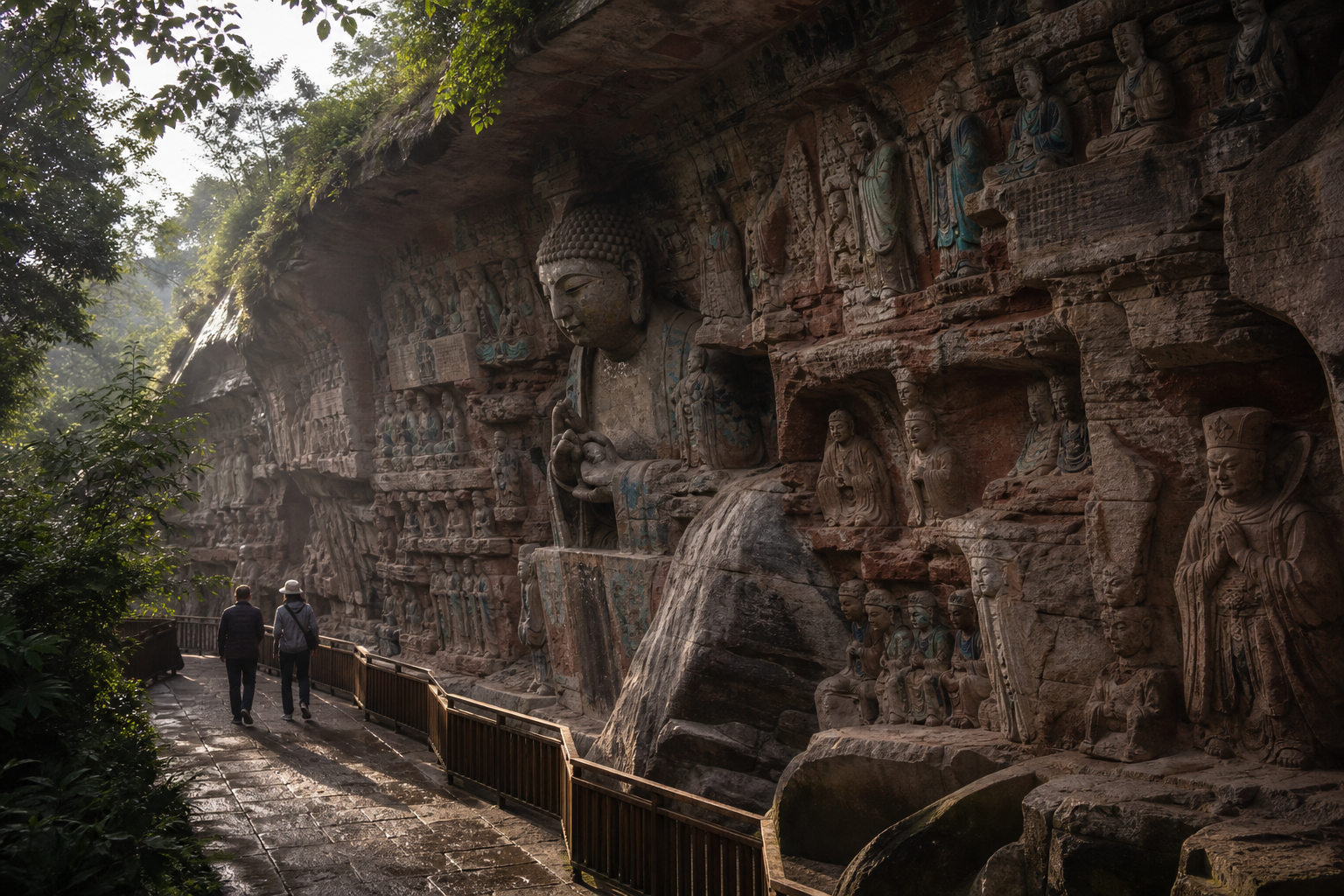
Begin with the relationship between rock, statue and shelter. From an authorized position, notice how the pavilion frames the figure and limits the view. Then look at the seated posture, robe folds and scale. Comparing the sculpture with its architectural enclosure often explains more than trying to capture everything in one close-up photograph.
The official text itself uses inconsistent names for the Buddha's identity. This guide therefore calls it the seated cliff Buddha rather than choosing a deity label unsupported by a resolved specialist source. If iconography is your main interest, seek a current site interpretation or qualified guide and record which explanation they use. A confident tourism caption is not enough to settle a scholarly question.
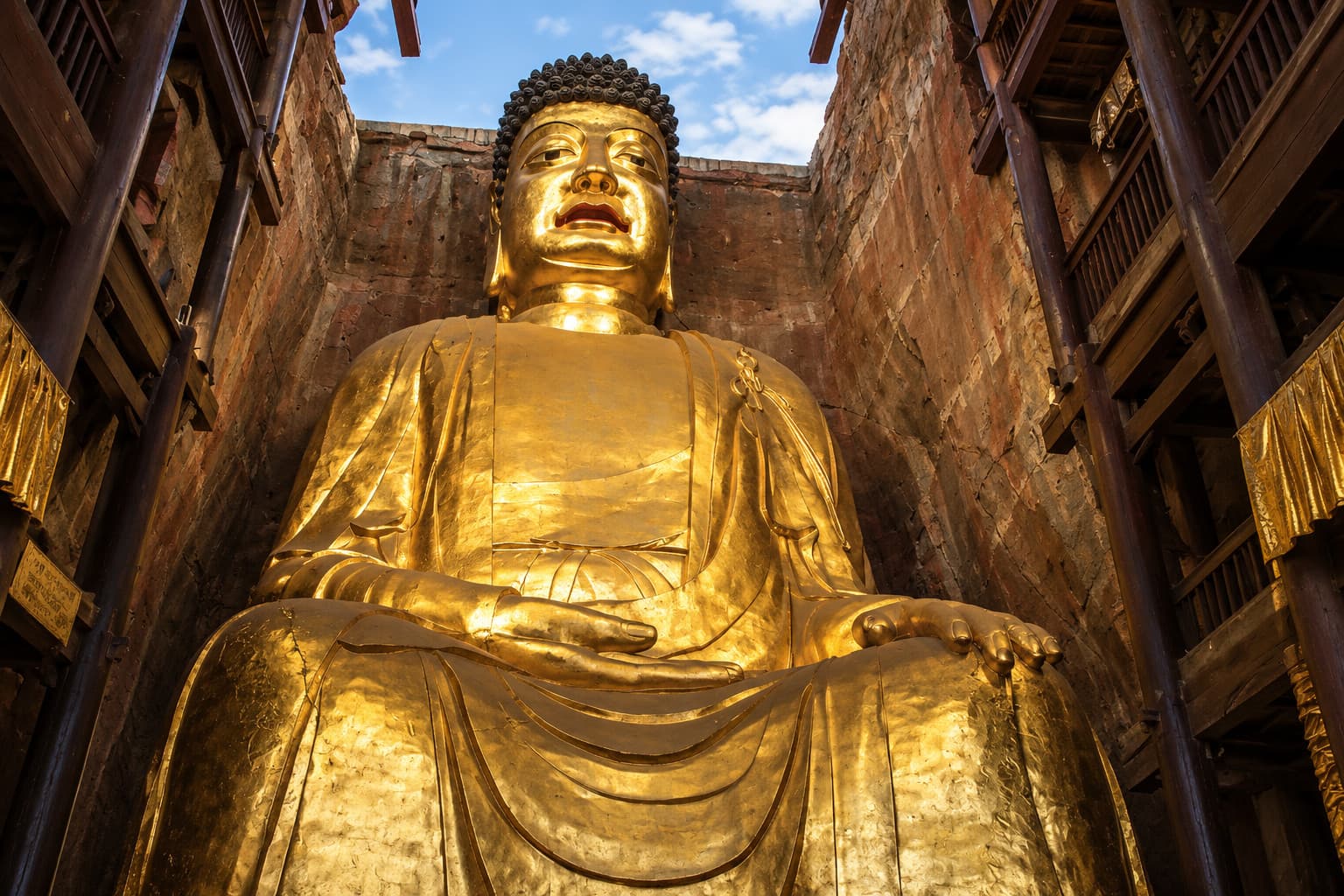
AI illustration based on historical photo references. The seated cliff Buddha within its architectural shelter; no disputed deity identity is assigned. The scene and details are approximate, not a current photograph or proof of public access, a public path or an authorized viewpoint. Reference photographs were published in 2019; capture dates are unverified.
Historical photo reference only; original not republished; the reference grants no reuse permission: Tongnan District Government / Photographer not confirmed
Look beyond one large statue
The heritage authority's account names four surviving structures: the Great Buddha Pavilion, Guanyin Hall, Jade Emperor Hall and Jian Pavilion. It also describes cliff inscriptions and Buddhist, Daoist and Confucian subjects. A protected site's designation can cover more material than the visitor route exposes.
Choose two themes to follow through whatever areas are open. One could be the changing relationship between sculpture and writing; another could be how halls and passages organize the approach to a cliff. Read labels before assigning dates, religious identities or meanings to individual figures. Weathered surfaces are not blank canvases for an imaginative story.
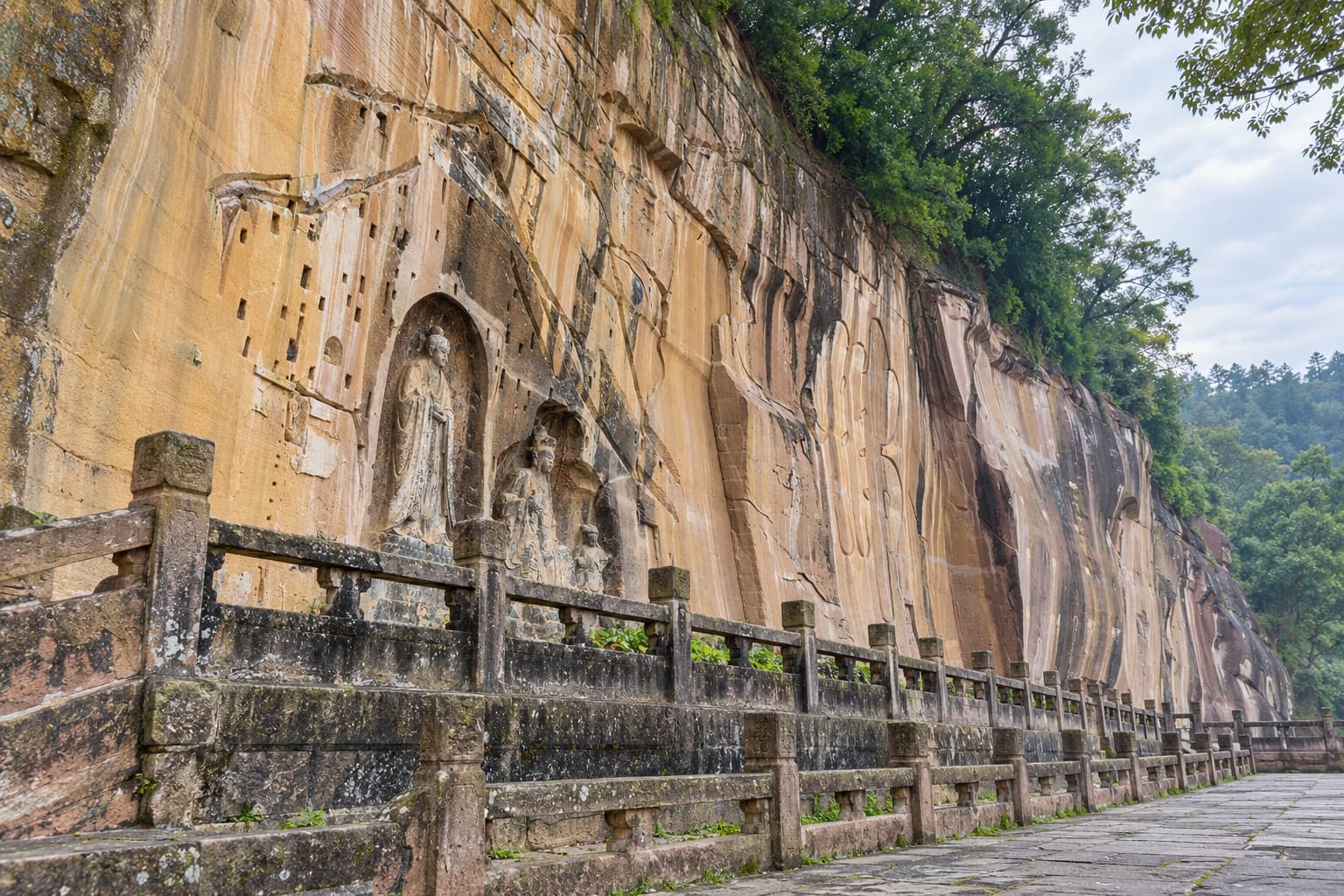
AI illustration based on historical photo references. A sandstone cliff, carved figures and a railed walkway; individual figures and current access are not identified. The scene and details are approximate, not a current photograph or proof of public access, a public path or an authorized viewpoint. Reference photographs were published in 2019; capture dates are unverified.
Historical photo reference only; original not republished; the reference grants no reuse permission: Tongnan District Government / Photographer not confirmed
The national heritage record also incorporates a separate Qianfo Temple site in Chongkan. That administrative relationship does not establish a shared entrance, a combined ticket or an easy walk between them. Do not add it to this route simply because it appears in the same official article. A focused Dafo visit can stand on its own.
Build a route from the day's permitted access
A Tongnan joint-agency notice dated 9 February 2024 imposed special holiday gate arrangements, restricted some halls and controlled stair movement. Those rules belonged to that dated holiday window. They are evidence that access can change, not instructions for your 2026 visit.
On arrival, ask about three things together: the entrance in use, any closed interiors and the exit that suits your return pickup. Then choose a simple sequence: approach and exterior context, permitted main-sculpture viewing, selected inscriptions or halls, and the approved exit. This is a suggested order of attention, not a surveyed turn-by-turn path.
Do not assume an upper level is open because a photograph was taken there. Equally, a closed hall need not invalidate the whole visit if the sculpture and exterior route remain accessible. Decide what matters most to you before committing to the visit, and ask whether that part is available. If your central interest is closed, postponing is more sensible than hoping a barrier will disappear.
Treat stairs and worship as part of the visit
The 2024 holiday notice specifically addressed stairs and upper-floor access. A current mobility assessment must concern the actual route from your drop-off point to the areas you want to see, not a general statement that the attraction welcomes visitors.
Ask whether a step-free alternative exists for each essential section. If travelling with someone who cannot manage stairs, request a clear explanation of what can be seen without them before booking transport or add-on activities. Carry a manageable bag and leave hands free on steps. Wet stone and crowded transitions warrant slowing down rather than squeezing past someone.

AI illustration based on historical photo references. An unlettered sandstone texture study; no historical inscription, translation or river view is depicted. The scene and details are approximate, not a current photograph or proof of public access, a public path or an authorized viewpoint. Reference photographs were published in 2019; capture dates are unverified.
Historical photo reference only; original not republished; the reference grants no reuse permission: Tongnan District Government / Photographer not confirmed
Respect worshippers' space. Follow current photography and incense rules, avoid blocking a doorway and ask before photographing people at prayer. Do not touch gilded surfaces, rub inscriptions or copy online suggestions to throw coins at carvings. These are heritage features, not props for a participation challenge. A quiet pause outside an occupied hall can be more appropriate than pushing ahead with a fixed checklist.
Give the river its own decision
The 2020 iChongqing feature places a wetland landscape near the temple and describes Fujiang sightseeing. It does not verify that a particular boat, boarding point or riverfront segment operates today. A temple ticket should not be assumed to include any of those experiences.
If conditions permit, add a short public riverside section after the heritage visit. Its purpose is to understand the temple's setting: the relationship between the cliff, water and surrounding city. Keep this optional so that a closure, heavy rain or an unexpectedly long temple visit does not jeopardize your departure.
Stay on maintained public paths and respect flood or maintenance barriers. Do not walk down exposed river steps simply to reproduce an old photograph. If offered a boat product, confirm its operator, embarkation point, duration, return location, fare and cancellation terms separately. This guide has not verified a current river-cruise service, and a historic promotional photograph is insufficient reason to buy one.
Choose a regional day that is not overfilled
Consider reserving a half-day block in Tongnan for the temple, a meal and flexible local travel. That is an itinerary allowance, not a claim about exact sightseeing duration. Add the journey from your accommodation and your required return separately. The 2024 heritage description establishes the destination's substance; it does not supply transport timing.
If using rail, compare the actual services for your date and verify the departure and arrival stations printed on the ticket. Our railway-stations guide covers that distinction. Do not interpret a route search result as a through service to the temple gate.
Set the pickup point before leaving the driver or public-transport stop. Save the return plan in Chinese and offline. Our taxi and ride-hailing guide can help with location communication, but no particular vehicle availability is promised here. If you add another Tongnan attraction, confirm its access independently rather than treating a district-wide tourism article as a ready-made same-day itinerary.

Original planning card; the full wording is also selectable below. Planning questions, not a surveyed route or current access guarantee.
Original editorial planning diagram based on this article; not a photograph or geographic map.
Plan Tongnan Dafo Temple
Start with permitted access:
- Identify: Confirm Tongnan, the entrance and return pickup.
- Prioritise: Ask whether your essential sculpture and halls are open.
Check personal needs and return:
- Check steps: Does each essential section meet your mobility needs?
- River: optional: Check riverside access separately; leave time to return.
Planning questions, not a surveyed route or current access guarantee.
Compare the experience with Dazu thoughtfully
For a traveller choosing one heritage excursion, compare the questions you want answered. Tongnan Dafo focuses attention on a large sheltered cliff sculpture and its river setting. The separate Dazu Rock Carvings guide covers a different destination and visit structure. Neither site's name should be used as shorthand for the other.
The municipal record records national protection for Tongnan's carvings in 2006; that designation does not make every Chongqing rock-carving site administratively or geographically connected. Choose on the basis of your interests, available time and confirmed access rather than a ranking of “more authentic” monuments.
For photography, an exterior frame, a permitted overall sculpture view and one labelled detail can tell a coherent story. Ask before using flash or support equipment indoors. Do not exaggerate scale through a caption, and distinguish a photograph of a replica, an interpretation panel or a historic image from the monument itself.
About This Guide
This is AI-generated text based on the cited sources. It does not report an author visit or independent human editorial review.
Sources were read on 1 October 2026 across municipal heritage material, Tongnan's joint-agency notice, iChongqing and a public Ctrip travel post. The Ctrip post is dated 2022 and contains older event content and geographic errors; it informed questions and visual checks, not present-day operating claims. The article does not claim a visit or human review.
Before departure, confirm the ticket scope, hours, accessible entrance and any holiday controls. The 2024 notice's prices and gate instructions are deliberately not repeated as current advice. Sculpture identity and conflicting totals also remain unresolved; the practical route does not depend on choosing an unsupported answer.
Frequently Asked Questions
Q: Is Tongnan Dafo Temple near central Chongqing's Dafo Bridge? A: They are different places. Search 潼南大佛寺 in Tongnan and verify the district; some online travel copy incorrectly mixes in Danzishi and central Chongqing geography.
Q: How large is the cliff Buddha? A: Chongqing's heritage authority records a height of 18.43 metres. This guide avoids disputed identity labels and promotional size rankings.
Q: What is the current ticket price and opening time? A: The official directory dated 5 March 2026 lists free admission and 08:30–17:30, as found in the 2 October 2026 source check. Confirm holiday arrangements and access for your date at +86 23 4422 2300; do not reuse the expired 2024 Spring Festival controls.
Q: Can I visit every hall or upper floor? A: No complete-access promise is supported. Tongnan has previously restricted halls, stairs and upper levels during holiday management; ask which areas are open when you arrive.
Q: Does a temple visit include a Fujiang boat ride? A: Do not assume so. Fujiang river products need separate checks for current operation, fare, route and return point; this guide confirms no operating cruise for your date.

Traveler comments
Share a recent experience or ask a practical question about this guide.