

Cover illustration: AI illustration based on a historical photograph. Anju eaves: gray tiles, painted brackets and latticework; decorative details are approximate and their symbolism is not interpreted. Scene, terrain and architectural details are approximate; not a current photograph, access confirmation or navigation guide.
Historical reference only; original photograph not republished or licensed for reuse: iChongqing / Photographer not credited
This guide contains four explicitly labeled AI scene illustrations from historical photo references and one original localized planning diagram. Photograph capture dates and current access are not established by the page update dates. No independent review is claimed.
Anju Ancient Town in 2026 is a Tongliang outing for riverside history, traditional streets and the institutions that linked a trading community. Chongqing's heritage authority places it beside the Fu and Qiong rivers. Choose one compact cultural route, check the day's building access, and arrange the local connection beyond Tongliang before leaving central Chongqing.
The destination to save is 铜梁安居古城, also described as 安居古镇. Keep 铜梁, Tongliang, attached to the name when using maps, translation or transport booking. A search result containing only “Anju” is not enough to identify the correct destination or the right entrance.
This guide proposes a way to read the town, not a record of an editorial visit. It separates the durable setting from the performances, shuttle arrangements and water activities that need current confirmation.
Identify the core old town before adding the wider area
The iChongqing attraction profile distinguishes Anju's core old town from a wider tourism area that includes Pipa Island and Polun Temple. A listing can therefore use the same attraction name for more than a walk through the historic streets.
Make two choices before arranging transport: the part of Anju you actually want to visit and the entrance serving it. For a first heritage visit, the old streets and one or two identified buildings are a sensible focus. Ask whether a quoted car drop-off or tour stop reaches that core or leaves you at a larger visitor facility with a further transfer.
Do not join pins into a route simply because an attraction page lists them together. The relationship between them may require extra transport, a separate entrance or more time than your group wants. The old town can be a complete outing without becoming a checklist of every site in the administrative town.

AI illustration based on a historical photograph. Anju buildings beside one river and an unnamed concrete arch bridge; neither a two-river confluence nor current waterfront access is established. Scene, terrain and architectural details are approximate; not a current photograph, access confirmation or navigation guide.
Historical reference only; original photograph not republished or licensed for reuse: iChongqing / Photographer not credited
Use the rivers to understand the settlement
The municipal heritage-office description dated 12 March 2013 identifies Anju as an important historic port and relates the settlement to the Fu and Qiong rivers and surrounding hills. That geography offers a stronger introduction than starting with a list of souvenir shops.
From a safe, open viewpoint, consider three connections: river to landing, landing to street, and street to buildings above it. A river port is a place of transfer. People, goods and information need routes inland as well as a waterway alongside them. Look for changes in direction and level that make those relationships visible.
Do not assume every riverside path descends to an open wharf, or that an appealing flight of steps forms a public route. Follow current signs and barriers. Historic waterborne commerce is also different from today's tourism boats; evidence of the first cannot confirm the second.
If a guide discusses a building's connection to trade, ask what identifies that link. An inscription, donor record or documented former use is more informative than a generic claim that all waterfront buildings belonged to wealthy traders.
Read institutions as well as architecture
A Tongliang district reply displayed as 13 August 2025 describes architectural interpretation involving Huguang Guild Hall and the Confucian temple, with migration history as an important theme. These are useful anchors for asking how different groups used the town.
Choose two contrasting institutions if they are open. At a guild hall, ask who its community was and what business, social or religious activities it supported. At a Confucian temple, ask about the site's educational and ritual role. Do not treat every ceremonial building as interchangeable simply because each has a courtyard or decorated entrance.
Compare how the spaces organize visitors: an approach, a threshold, an open court and an inner hall. You can notice where a line of sight ends, where a roof offers shelter and where ornament is concentrated without claiming expertise in construction history. Use the site's own interpretation for named architectural features.
The district reply also discusses a proposed architecture-themed route. Its planned status matters. This guide does not assume that a particular booklet, scanning system or guided product was subsequently launched, or that English interpretation is available at every building.

AI illustration based on a historical photograph. Anju entrance arch; not a verified guild hall. The main plaque reads 安居 right to left; ancillary inscriptions and ornaments are not interpreted. Scene, terrain and architectural details are approximate; not a current photograph, access confirmation or navigation guide.
Historical reference only; original photograph not republished or licensed for reuse: iChongqing / Photographer not credited
Treat the famous temple count as historical language
The 2013 heritage description uses the traditional formulation “nine palaces and eighteen temples” and identifies several surviving religious buildings. It should not be read as a promise of 27 separately visitable attractions on a current ticket.
A better approach is to choose a small number of documented sites and ask about each one's survival, restoration and use. A historic name may refer to a complete building, a preserved fragment, a site with later additions or a place whose current function has changed. Record that distinction rather than filling in the missing history from appearance.
If an interior is closed, look for a public information panel and respect the boundary. Do not regard a resident's open door as an alternative visitor entrance. There is value in understanding why a structure matters even when you cannot enter every room.
This keeps the visit manageable for companions who enjoy streets and food more than a long sequence of temples. Agree on one shared priority, then allow an optional additional building rather than turning the whole day into a compulsory heritage marathon.
Check performances before arranging the rest of the day
The August 2025 district reply describes folk performances at Huguang Guild Hall and the Confucian-temple area, alongside festival events. It documents the offer at that time. It does not establish today's performance times, tickets or whether a particular dragon-dance programme is running.
If a show is important, obtain the current programme before fixing your arrival. Confirm the venue, date, start time and whether you need separate admission. A photograph of a festival procession is evidence of that event, not an everyday street scene that a visitor can reliably encounter.
Leave time to reach the venue without pushing through a gathering crowd. Follow staff instructions on viewing areas and photography. If the performance does not operate, use the building and street visit as your fallback rather than waiting indefinitely for an event that was only described in an old article.
For families, it can help to choose between a performance-centered outing and a quieter architecture walk at the planning stage. Combining the two is possible only if the confirmed schedule and everyone's stamina fit.
Do not build an evening around an assumed cruise
An important detail in the reply dated 13 August 2025 is that night cruises had not then received approval. That statement is historical: it does not prove a permanent ban, and it does not prove later approval either.
The practical consequence is to ask for a currently offered, identifiable service before planning a night on the water. You need the operator, boarding point, sailing date, return location and cancellation conditions. An illuminated boat in promotional material is not a booking product.
Even a confirmed evening event changes the transport calculation. Check whether your return to Tongliang or central Chongqing remains available after it ends. If the only verified return is earlier, keep a daytime plan or arrange suitable transport in advance. Do not solve that gap by assuming a late bus or a readily available car will appear.

Original planning card; all labels also appear as selectable text below. Planning questions only. Confirm current access and return transport; this is not a route map.
Original editorial planning diagram based on this article; not a photograph or geographic map.
Keep Anju compact
Visit plan:
- Choose the core old town and its actual entrance.
- River setting, two open heritage spaces, then a seated break.
Check before leaving:
- Confirm performances for your date and venue.
- Verify an identifiable cruise service before planning around it.
- Check the Tongliang connection, return trip and whole-route access.
Planning questions only. Confirm current access and return transport; this is not a route map.
Build a lunch stop around what is actually offered
The iChongqing profile names Hanlinsu and Taishou dough twists among Anju's food associations. Use the names as two possible things to ask about, rather than assuming a particular stall is open or every product has identical ingredients.
For lunch, prioritize a clear menu, an agreed portion size and somewhere the group can sit comfortably. Ask about ingredients and preparation if dietary needs matter. A snack's name or shape alone will not tell you whether it contains nuts, dairy, egg or an animal-based filling.
Do not use the profile's undated totals of restaurants and inns to predict choice on your day. Nor does the existence of a local food tradition guarantee that a ceremonial or group meal can be ordered casually. A simple meal that fits your schedule can be more useful than chasing a dish across the town.
Separate the regional journey from the final connection
The district's 2025 reply describes a visitor-center parking area and a shuttle to the core. Those are two different arrival stages, and both need checking if you are planning a reduced-walking visit. Its historical fare is not presented here as a current price.
For public transport, establish the actual Tongliang arrival point, the onward service to Anju and the return departure. A journey planner result to Tongliang alone does not complete the outing. Save the Chinese destination name and ask which stop is nearest the open old-town entrance, rather than leaving yourself at an administrative office or distant road junction.
For a private transfer, agree on where the vehicle can legally wait and whether the pickup point changes if a street closes for an event. Share a precise pin rather than a photograph of a riverside building. The navigation guide offers a broader method for checking such locations.
Travelers with limited mobility should ask about the entire chain from drop-off through the chosen buildings to the return vehicle, including toilets. A shuttle can shorten one leg without making thresholds, slopes or internal stairs accessible.
Make a compact route feel complete
Use a three-part plan: understand the river setting, visit a contrasting pair of heritage spaces if available, and finish with a seated break. Add a confirmed performance only when it fits. This is an editorial pacing suggestion, not a measured itinerary or a claim that all buildings share one entrance.
The Huguang Guild Hall guide offers a separate urban comparison for migration and community institutions. The family-trip guide can help with broader preparation. Neither should blur the identity of Tongliang's Anju with another old town or venue.
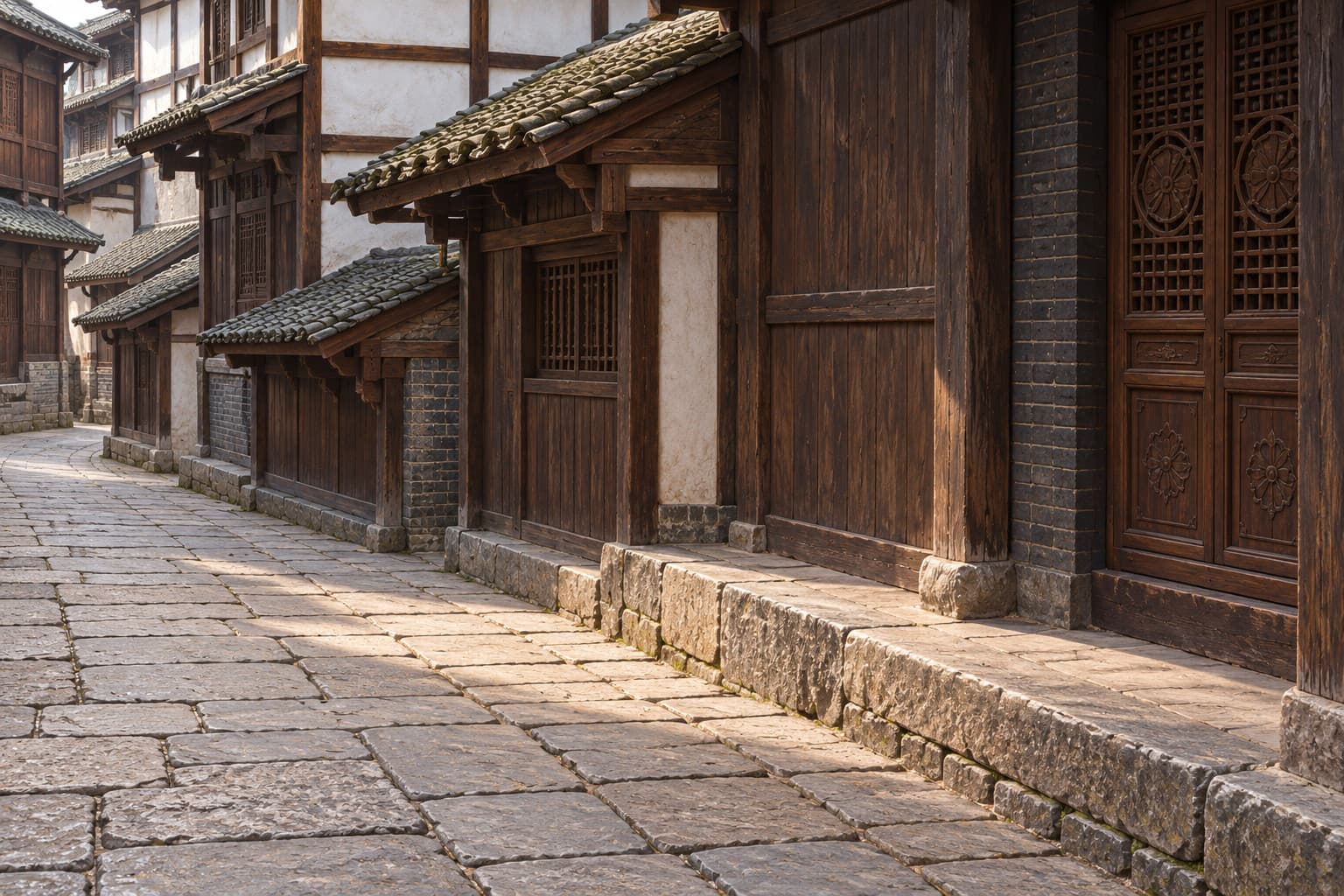
AI illustration based on a historical photograph. Anju stone paving and raised thresholds beside timber and plaster buildings; the street name and current public passage are unverified. Scene, terrain and architectural details are approximate; not a current photograph, access confirmation or navigation guide.
Historical reference only; original photograph not republished or licensed for reuse: iChongqing / Photographer not credited
About This Guide
Public sources were read on 1 October 2026. They include municipal heritage information, a dated Tongliang district reply and a public English tourism profile. The route and questions are editorial synthesis, with no personal visit or human field review claimed. Transport, interiors, performances and boat operations require fresh confirmation before travel.
Frequently Asked Questions
Q: Which Anju Ancient Town does this guide cover? A: It covers 铜梁安居古城 in Tongliang District, Chongqing. Keep Tongliang in the map search and transport booking.
Q: Is the whole Anju scenic area one short walk? A: The wider listing includes places beyond the core old streets. Choose your specific Anju stops and verify their connections separately.
Q: Can I count on a dragon dance every day? A: No current daily programme was verified. Ask Anju's visitor service for your date, venue and ticket details.
Q: Are night cruises operating now? A: The district said they were unapproved in August 2025. That historical notice cannot establish present operation; confirm a current operator before planning around a cruise.
Q: Does a parking shuttle mean Anju is step-free? A: No. Confirm thresholds, slopes, toilets and access inside your selected Anju buildings as well as the shuttle itself.

Traveler comments
Share a recent experience or ask a practical question about this guide.