
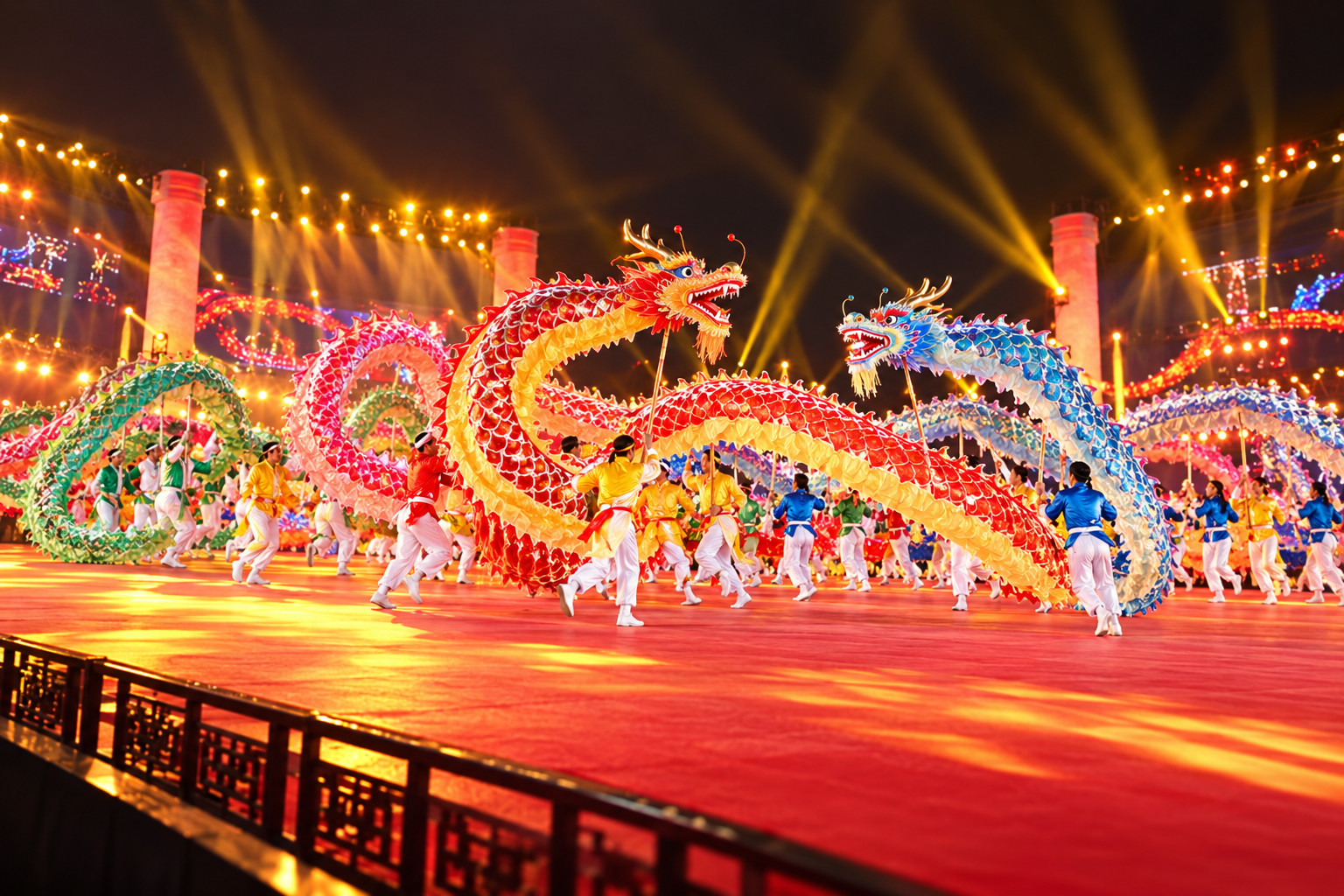
AI illustration approximating a historical Tongliang stage scene. Reference published 2020-10-14; photo capture date unreported. No current performance is confirmed. AI-generated illustration; historical reference: Reference photo credit 唐彬; Reference published 2020-10-14; Reference photo taken Not reported. Reference source
Tongliang dragon culture in 2026 offers three different visit formats: museum interpretation, an arranged craft activity or a dated performance. The district's June 2026 directory gives public museum hours, but it does not promise a daily dragon show. Choose the experience you actually want before building the journey around a dramatic festival photograph.
Save 铜梁区博物馆 for the museum, 铜梁龙舞 for dragon dance and 铜梁龙灯彩扎 for dragon-lantern making. These terms refer to related cultural practices and venues, not a single all-inclusive attraction. The itinerary below helps you decide between them without suggesting that every workshop welcomes drop-in visitors.
Sources were read on 1 October 2026. A current show calendar, bookable private workshop, admission price and confirmed evening return service were not established. Dated museum information is supplied as a useful starting point, with the checks needed before travel.
Decide whether you want to look, make or watch
The national intangible-heritage record for Tongliang dragon-lantern making distinguishes performance objects, landscape lanterns and decorative craft pieces. Its 2021 designation concerns making. A Xinhua report separately identifies the dragon dance's national listing in 2006. Do not merge the two into one undated accolade.
A museum visit suits someone who wants to understand materials, forms and local history at a self-directed pace. A workshop suits someone who values an explanation and a small hands-on task, provided a host confirms what is offered. A performance suits someone chiefly interested in movement, teamwork, music and the live setting.
You may combine formats, but each requires its own confirmation. Buying a scenic-area ticket does not necessarily reserve a workshop or admit you to a night show. Start with one priority and a fallback, rather than a list of three promises that no operator has actually made.

AI illustration approximating a historical Tongliang Museum dragon-lantern gallery. Reference published 2020-10-14; photo capture date unreported. The current display may differ. AI-generated illustration; historical reference: Reference photo credit 唐彬; Reference published 2020-10-14; Reference photo taken Not reported. Reference source
Use the museum's visitor hours, not its office hours
The Tongliang official venue directory, displayed as 4 June 2026, lists the museum at 169 Longmen Street, Bachuan subdistrict, with telephone 023-45692846. Its public schedule is Tuesday–Sunday, 09:00–12:00 and 14:00–17:30, with Monday closure except holidays. The entry separately lists administrative office hours, which are not the visitor schedule.
Treat that as a dated planning baseline. Confirm holiday arrangements, last admission, any reservation requirement and which exhibition areas are open. If you arrive close to noon, do not assume the whole building stays open because another government directory shows staff working until 12:30.
For a non-Chinese-speaking visitor, ask in writing whether the relevant displays have English labels or whether an interpreter is available. Also clarify the exact arrival entrance and any document requirement. The public directory does not establish an English guided service, free entry or acceptance of a particular booking document, so none is promised here.
Give a display object time to explain itself
An August 2026 report from Tongliang's local media centre describes the museum's completed summer educational programme, including dragon-lantern activities. It supports the museum's role in presenting this tradition. It does not mean the same class remains bookable after the reported programme ended.
In an open gallery, look for three layers: how the object is built, how it is carried or animated, and the occasion for which it was made. A dragon head is not simply an ornamental sculpture. Its size, support points and relationship to the body may tell you something about performance, although an interpretation label or guide is needed to explain the particular object accurately.
Compare a full view with a permitted close-up of a joint or painted detail. Read whether an object is historic, recently made, a replica or a teaching model. Avoid treating colour or apparent wear as proof of age. Do not move handles or touch fragile parts unless a specifically marked interactive exhibit invites it.
Arrange a workshop as a hosted activity
The national craft record describes materials including bamboo, fabric and paper, and stages from design and shaping through covering and decoration. Its account of workshops and craftspeople documents a living tradition. It is not a public booking directory, and a production workshop may have no casual visitor programme.
Before paying, ask what one participant will actually do. Will you observe a demonstration, assemble prepared components, paint a small object or make something from the beginning? Ask how long the session lasts, whether materials are included, what language is used and whether the finished piece can be taken away that day.
For children, clarify age suitability, adult supervision and which tools the host handles. For a group with mixed interests, an observation-focused session may be preferable to a lengthy making class. Do not arrive at an artisan's workplace expecting free instruction because their name appears in a heritage article. Time, preparation and consent are part of a respectful cultural visit.

AI illustration approximating the Longcheng Dragon Lantern Craft Factory. Reference photo taken 2025-01-25, published 2025-01-31. Visitor workshops are not confirmed. AI-generated illustration; historical reference: Reference photo credit Not reported; Reference published 2025-01-31; Reference photo taken 2025-01-25. Reference source
Confirm a live show with a date and venue
Xinhua's 3 February 2023 report describes a Spring Festival performance and the training behind it. That is historical reporting, not a standing promise that a similar show occurs every evening somewhere in Tongliang. Search results often keep old holiday articles visible long after their schedules expire.
A usable confirmation should answer six questions: which date, which venue, which programme, what starting time, what ticket scope and what cancellation policy. Ask whether “dragon performance” means a daytime dance, a lantern display, a staged evening production or a fire-dragon sequence. Those experiences can look very different.
Keep a screenshot of the confirmed programme and venue name. Recheck close to departure, particularly for an outdoor performance. If the show is the reason for travelling, establish the return journey before booking. A late performance without a workable return is a transport problem that should be solved in advance, not at the venue exit.
Understand the fire-dragon spectacle without copying it
The 2023 Xinhua account identifies molten-iron effects and trained performers as elements of the fire-dragon show it reported. It distinguishes that spectacle from an ordinary dragon dance. A video of sparks is therefore not an invitation to approach the performance boundary for a closer photograph.
Follow the event's designated viewing areas and staff instructions. Keep children beside you and explain beforehand that barriers are part of the experience. If smoke, noise or dense crowds are uncomfortable for a member of your group, choose a viewing position with an easy exit or select a different cultural format.
Ask the operator about the actual programme's suitability rather than extrapolating from an edited online clip. This guide does not provide a safe viewing distance, exposure standard or universal age limit because those depend on the specific production and its rules. Do not imitate the effects, request a private demonstration outside the organized programme or assume a workshop includes performance training.

AI illustration approximating training at Tongliang Vocational Education Center. Reference photo taken 2025-01-02, published 2025-01-31. This does not establish public access. AI-generated illustration; historical reference: Reference photo credit Not reported; Reference published 2025-01-31; Reference photo taken 2025-01-02. Reference source
Plan two different versions of the day
A daytime version can centre on a confirmed museum visit, lunch and an optional prearranged craft session. Reserve a suggested 60–90-minute museum block as a personal planning allowance, not a venue-mandated duration. Check the split opening hours in the district directory before placing lunch between activities.
An evening version should start with the show confirmation and work backward. Determine the admission deadline, transfer from the daytime stop, meal opportunity and return arrangement. Avoid filling every gap with another attraction. An overnight stay may fit better if your confirmed transport ends before the performance, but accommodation suitability and check-in requirements need their own checks.
Do not assume Anju Ancient Town is part of the same compact walking route as Tongliang's museum. Anju has a separate heritage focus and transport needs. This article concentrates on choosing cultural formats; it does not repeat an old-town itinerary or establish a district-wide shuttle connecting all the named places.
Make the transport and purchase details explicit
Use the maps and navigation guide to save the exact venue and pickup point, and the taxi and ride-hailing guide for communicating the return. A confirmed Tongliang arrival point is just one part of the journey; the museum, an artisan's workshop and an event site may require different final transfers.
A district reply issued on 27 August and published on 1 September 2026 described a tourism circuit bus as a possible future pilot when conditions allow. It is not evidence of a bus you can board now. The same reply discussed upgrading the Chasing Dreams Tongliang Dragon production, without supplying a visitor timetable.
Check the actual services on your travel date. This guide does not supply a current bus route, rail connection or late-night vehicle guarantee. Allow time to find the entrance and resolve a ticket issue without rushing, and ask whether a performance-related road closure changes the pickup position.
If buying a craft object, ask who made it, what materials it uses and whether it is a decorative object or a working performance item. Agree on the final price, packing and collection arrangements. The craft-souvenirs guide offers broader purchase questions; a heritage designation does not authenticate every object sold nearby.

Original editorial planning card; not a map or confirmed booking Planning checks; confirm current availability with each venue
Plan your dragon-culture visit
- Choose one format
- Museum, arranged craft session or dated show
- Confirm the details
- Check hours, venue, ticket scope and booking
- Arrange the return
- Confirm your last ride and exact pickup point
About This Guide
Research was read on 1 October 2026 from Tongliang's official visitor directory, the national intangible-heritage database, Xinhua and a recent local-media report. No personal museum visit, artisan interview or attended performance is claimed. The distinction between museum, workshop and show is an editorial decision aid built from those sources.
The museum's June 2026 public hours are a dated baseline. The summer programme reported in August had ended, and the 2023 fire-dragon performance is historical. Fresh venue confirmation is still required for a class, show, ticket, accessible route or holiday visit. A good fallback is meaningful cultural interpretation, rather than waiting for an unconfirmed spectacle.
Frequently Asked Questions
Q: Can I see a dragon dance every day in Tongliang? A: No daily schedule was verified on 1 October 2026. Confirm a specific venue, date and programme rather than relying on a past festival report.
Q: What hours does Tongliang District Museum list? A: The June 2026 directory lists Tuesday–Sunday 09:00–12:00 and 14:00–17:30, with Monday closure except holidays. Recheck before travelling; office hours in the same directory are different.
Q: Is dragon-lantern making the same heritage listing as dragon dance? A: They are related but distinct. The craft entry records a 2021 listing, while Xinhua records the dance's national listing in 2006.
Q: Can I walk into a dragon workshop and make something? A: A walk-in session is not established here. Contact a specific Tongliang host and confirm the activity, materials, duration, language and price before arrival.
Q: Does a museum visit include a fire-dragon show? A: Do not assume a combined product. Tongliang District Museum admission, a craft session and a performance each need separate scope and schedule checks.

Traveler comments
Share a recent experience or ask a practical question about this guide.