
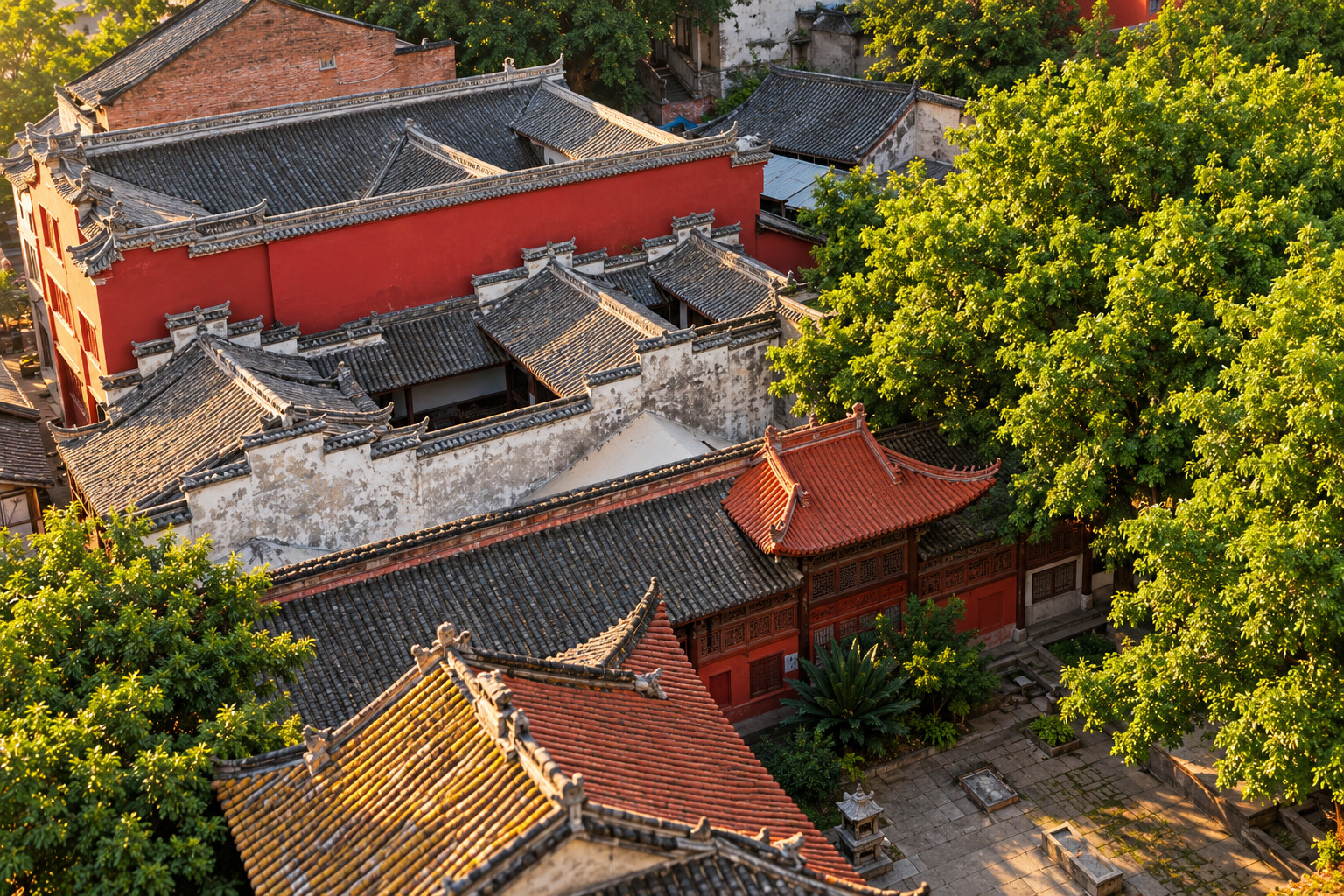
Cover illustration: AI illustration based on a historical photograph. Longxing roofscape and red wall; an elevated architectural study, not a verified visitor viewpoint. Reference published 2025-05-13; capture date unknown. Scene geometry, terrain and architectural details are approximate; not proof of current conditions, access or navigation.
Private historical reference (not a reuse license): Sohu / 重庆晚报 / 重庆两江新区 / Photographer not credited
This guide includes four explicitly labeled AI scenes and one original localized planning card, not a map. Original photographs remain private references only; no republication rights or reuse license are established. No independent review is claimed. The gate and museum illustrations show partial architectural studies. The palace illustration shows architectural detail; no craft demonstration is depicted. All four reference photographs were published on 2025-05-13; capture dates and photographers are unknown.
Longxing Ancient Town in 2026 offers old streets, community history and craft traditions after a documented renewal. Liangjiang's government reported partial renovation and trial reopening on 31 December 2024. Make the historic settlement your main destination, with the nearby film attraction or football stadium planned as a separate addition.
Use 龙兴古镇 when confirming the destination. A booking or map result for Liangjiang International Film City, 两江国际影视城, does not automatically describe the same place. That distinction affects the entrance, transport, admission and the kind of history you will encounter.
This guide was researched on 1 October 2026. It draws on a government reopening announcement and reporting before and after renovation. It does not claim a personal visit or a tested route, and it leaves current tickets, individual venue hours and transport departures for date-specific confirmation.
Understand what changed before choosing a visit
The Liangjiang New Area government's announcement of 2 January 2025 says Longxing reopened for trial operations on 31 December 2024 after partial renovation. It also describes the conversion of an old temple into the Residents' Memory Museum, using objects and audiovisual interpretation to tell the town's story.
That history matters when you compare pictures. A CGTN report published in October 2021 described the old streets and traditional shops before that reopening. Its images and language belong to an earlier moment; they are not evidence that each shopfront or interior remains unchanged.
The reasonable expectation is a historic settlement with conservation, adaptation and contemporary tourism activity. Look for interpretation that explains which parts were retained and what was altered. A newly finished surface is a prompt to ask about restoration, rather than proof that the whole town is either ancient in every detail or entirely newly built.

AI illustration based on a historical photograph. A partial study of Nanlongmen’s stone arch and lower red gatehouse. The full upper roof and plaques are outside the frame; this is not a complete gate portrait. Reference published 2025-05-13; capture date unknown. Scene geometry, terrain and architectural details are approximate; not proof of current conditions, access or navigation.
Private historical reference (not a reuse license): Sohu / 重庆晚报 / 重庆两江新区 / Photographer not credited
Make community memory the centre of the outing
If it is open during your visit, the Residents' Memory Museum is a useful first indoor stop. Ask for the current Chinese venue name, entrance and hours locally; the translated name in a reopening article may not be what every navigation service uses.
A community-history display can help you see more in the streets afterwards. Look for how residents describe work, family life, migration or changes to buildings. Compare a historic photograph with the present street only when the caption identifies the same location. Similar rooflines are not enough to match two scenes confidently.
Consider three questions while reading: who used this building, how did its use change, and whose memories are being presented? They are an accessible way to approach local history without needing to memorise a dynasty-by-dynasty chronology. Children can join in by choosing one everyday object and asking what it was used for.
If the museum is closed, adjust the plan rather than assuming another temple or hall contains the same exhibition. A street walk and a craft stop can still form a coherent visit. When community memory is the main reason for travelling, however, confirm this specific venue before committing to the journey.
Read the streets at the scale of everyday life
A Bridging News report dated 12 September 2026 describes a media visit to Longxing the previous day and places its commercial past in a network connecting waterways and inland areas. It also reports plans to develop cultural experiences. The visit supports recent reporting about the place; the plans do not establish a timetable of bookable activities.
On a public street, notice how a shop meets its threshold, where a covered area protects an entrance and how communal buildings differ from neighbouring houses. Work at a comfortable scale: one short street observed carefully can be more rewarding than a fast circuit through every lane.
Keep a distinction between what you can see and what an interpretation panel establishes. A decorative carving is visible; its age and meaning may require a reliable label. Ask before photographing inside a shop or workshop, and do not treat a resident's open doorway as an invitation.
The Huguang Guild Hall and Dongshuimen guide offers another way to explore communal architecture in central Chongqing. Use it as a separate comparison for a wider trip, not as evidence about the identity or admission rules of Longxing's buildings.

AI illustration based on a historical photograph. Timber-roof detail inspired by the Longxing Memory Museum reference. Exhibits and portraits are excluded; this does not document the current display. Reference published 2025-05-13; capture date unknown. Scene geometry, terrain and architectural details are approximate; not proof of current conditions, access or navigation.
Private historical reference (not a reuse license): Sohu / 重庆晚报 / 重庆两江新区 / Photographer not credited
Approach crafts as skilled work, not a guaranteed show
An August 2025 iChongqing profile documented sugar-painting artist Li Mei working in Longxing. It offers a specific example of a living craft associated with the town. It does not promise that she will be present whenever a visitor arrives or that an unannounced group can join a class.
If a demonstration is available, ask whether watching, photographing and making something yourself are separate activities. Confirm the cost and the time required before a child chooses a design or a group occupies the work area. A craftsperson may need to finish an order rather than repeat a process for cameras.
Watch the sequence of actions rather than only the finished souvenir: preparation, controlled movement, cooling or assembly, and the maker's response when something changes. These observations make a small purchase or demonstration more meaningful without assuming expertise you do not have.
For any workshop, distinguish an advertised session from an informal shop encounter. Ask about tools, suitable ages and supervision before participating. A report showing skilled use of hot sugar is not instruction for visitors to handle it themselves. If the named craft is unavailable, avoid inventing a replacement story around unrelated souvenirs.
Check the date on every performance announcement
Longxing's 2 January 2025 reopening announcement included activities around New Year and that year's Spring Festival. Such programmes help explain how the town has been promoted, but a past holiday schedule should not become a promise of daily opera, parades or interactive performances.
If a show is essential, seek a current notice with the date, start time, venue and admission conditions. Check whether it is included in general entry or needs a separate booking. Ask what happens in poor weather and whether the programme changes between weekdays and holidays.
If you are mainly interested in architecture, choose your timing around the kind of visit you prefer. A special event can provide performance and atmosphere, while also changing pedestrian flow and the ability to inspect a building quietly. Neither version is inherently more authentic. It is simply useful to know which one you are planning for.
Do not leave return transport vague because an event might run late. Work backwards from the confirmed finish or choose a departure time you are willing to keep even if you miss the final activity.

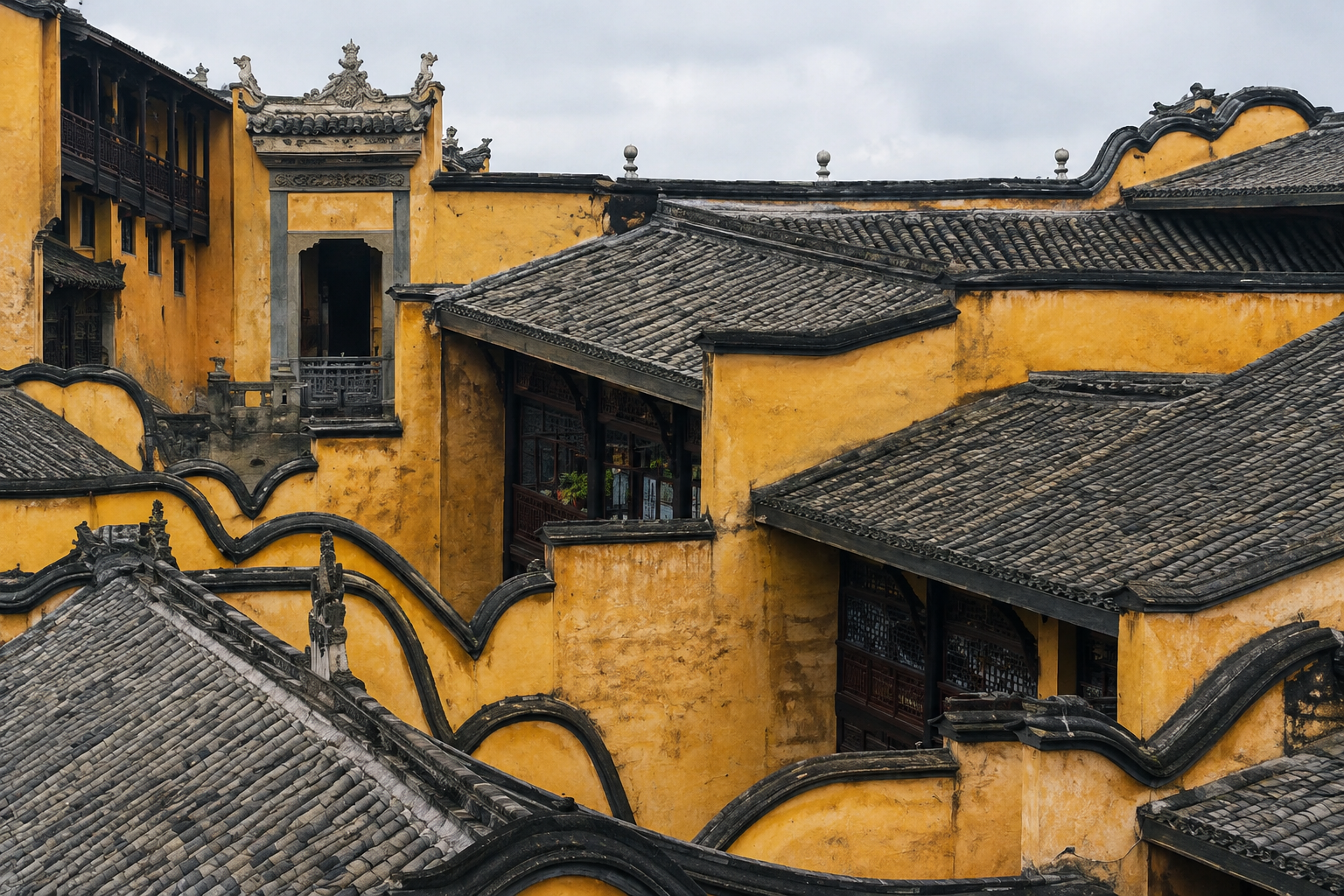
AI illustration based on a historical photograph. Longcang Palace yellow facade and carved timber detail; the plaque is excluded. This is architecture, not a craft demonstration. Reference published 2025-05-13; capture date unknown. Scene geometry, terrain and architectural details are approximate; not proof of current conditions, access or navigation.
Private historical reference (not a reuse license): Sohu / 重庆晚报 / 重庆两江新区 / Photographer not credited
Choose between Longxing's separate destinations
The September 2026 local cultural-tourism report names Longxing Football Stadium and Liangjiang International Film City as surrounding resources to connect with the old town. The distinction is useful: a heritage walk, a sports event and a film-themed attraction each need their own plan.
If adding the film attraction, confirm the exact product and transfer before you buy anything. A reconstructed scene can be enjoyable on its own terms, but it should not be described as a surviving Longxing street merely because both locations appear in the same day-trip advertisement.
If combining the town with a match, allow the sporting event's entry arrangements to set the schedule. Check where transport will collect you after the event and whether a road closure changes that point. Do not assume the entrance used for the old town will be the convenient stadium entrance.
For most first visits, choosing one main attraction and one modest addition is easier to manage than stitching together all three. The old town deserves enough time to understand it, while an added ticketed activity deserves enough time to enjoy what you have bought.
Choose a street-first or interpretation-first visit
A street-first outing begins with a short orientation loop, then adds a meal and whichever confirmed venue or craft activity most interests the group. It suits people who want flexibility and are happy to change direction when a particular doorway is closed.
An interpretation-first outing starts with a prechecked museum or guided activity, then returns to the streets with that context. It suits a traveller whose main interest is the town's history or renovation. In either case, keep one clear meeting point outside the pedestrian lanes so the party can regroup without retracing every turn.
The family-trip planning guide can help with broader pacing decisions. For Longxing specifically, alternate looking, listening and resting rather than asking everyone to maintain museum-level attention throughout a street walk. Agree on one or two priorities before adding shopping or another venue.
A wet day may make indoor interpretation more appealing, but only if the venue is actually open. A hot day may favour a shorter route. The existence of traditional roofs and covered thresholds does not certify continuous shelter or a step-free circuit.

Original planning card; every label is also repeated below as selectable text. Planning prompts only. Confirm current access and return transport; this is not a route map.
Original editorial planning card based on this article; not a photograph or geographic map.
Focus your Longxing visit
Observe on site:
- Streets: notice thresholds, roofs and changed surfaces.
- Memory: ask whose stories an open display presents.
- Craft: watch only if a maker agrees.
Check before leaving:
- Confirm Longxing Ancient Town, entrance and museum hours.
- Check any craft or event date, cost and permission.
- Arrange the final transfer, pickup and return.
Planning prompts only. Confirm current access and return transport; this is not a route map.
Check the entire transport chain
Compare the route from your accommodation to the old-town entrance, including the final walk or road connection. A rail journey to the wider Longxing area is not the same thing as a station at the precise entrance you need. This research did not verify a current station exit, bus timetable or last-train connection for the visit.
Use a current route planner with 龙兴古镇 as the destination, then inspect the final segment. Decide whether its walking distance and road crossings suit the group. If hiring a car, specify the old town rather than simply “Longxing,” and confirm the pickup separately if you are adding another attraction.
Save the entrance's Chinese name and a street-level landmark. The existing Chongqing navigation guide explains how to prepare precise pins and avoid confusing pedestrian and vehicle approaches. Before leaving the main street, check that you can still identify the place where the return journey begins.
About This Guide
Sources read on 1 October 2026 included Liangjiang's reopening notice, CGTN's 2021 report text and local journalism from 2025–2026. No embedded video was treated as watched footage. The suggested visit styles are editorial synthesis, with no author site visit, tested transport chain or human field review claimed.
Frequently Asked Questions
Q: Is Longxing Ancient Town the same as Liangjiang International Film City? A: Longxing Ancient Town and Liangjiang International Film City are separately named places in current local reporting. Check which entrance and product your transport or ticket serves.
Q: Has the ancient town been renovated? A: Longxing has undergone partial renovation. Liangjiang's government reported its trial reopening on 31 December 2024, so earlier photographs may show a different stage of the town.
Q: What is a useful indoor focus for the visit? A: Longxing's Residents' Memory Museum is described in the 2025 reopening report as occupying an adapted former temple. Confirm its current name, entrance and opening arrangements before relying on it.
Q: Will sugar painting or a performance definitely be available? A: No daily craft or performance schedule for Longxing was verified. The August 2025 sugar-painting profile and past holiday programmes are leads to check, not current booking confirmations.
Q: Can I combine the old town with football or the film attraction? A: Consider adding Longxing Football Stadium or Liangjiang International Film City only after checking separate admission, transfer and finish times. Preserve enough time for the ancient town if heritage is your main interest.
Traveler comments
Share a recent experience or ask a practical question about this guide.