
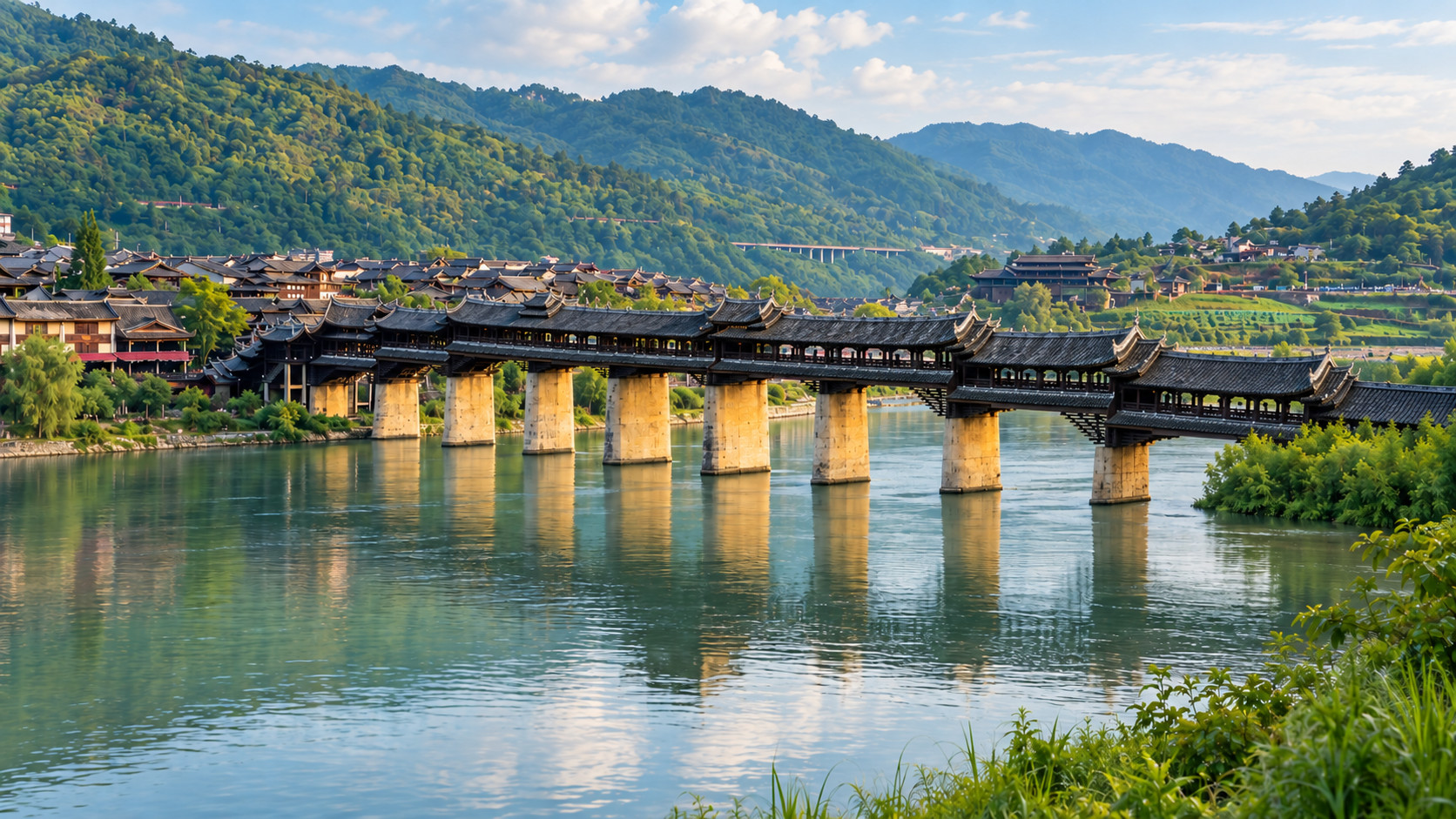
Cover illustration: AI-generated illustration informed by historical photographs of Zhuoshui’s covered bridge. Architectural details and viewpoint are approximate; this is not a current photograph or a route guide.
AI illustration created with OpenAI image generation. Visual references: iChongqing’s Qianjiang overview and covered-bridge report, published August 2020; capture dates unknown. Reference photos are not republished.
The scene images in this guide are AI-generated illustrations based on historical real photographs of Zhuoshui. Architecture and viewpoints are approximate. They do not document current conditions, prove public access or provide navigation. The decision diagram summarizes this guide’s planning questions.
Zhuoshui Ancient Town in Qianjiang makes a distinct regional Chongqing trip in 2026 for travelers interested in a covered bridge, river streets and cultural interpretation. The municipal tourism page describes three parts within the wider scenic area. Start with the town-and-bridge visit, then decide separately whether the Puhua underground-river excursion fits your plans.
Save the Chinese names 濯水古镇 and 黔江 before arranging transport. Zhuoshui is not another lane inside central Chongqing's downtown walking circuit. A photo labelled simply “Chongqing covered bridge” leaves out the regional journey that determines whether the outing works.
This guide is based on published sources and current page checks. The suggested sequence is a planning narrative, not a claim that the editorial team walked it. It does not establish today's lighting times, boat operation, fares or step-free access.
Get the destination and product names straight
The municipal tourism description, published in June 2026, places Zhuoshui in Qianjiang District and distinguishes three components: the ancient town, the Puhua agricultural experience area and the underground river. A broad scenic-area name does not make those components one identical visit.
Before buying anything, write down the specific part you want. An old-street walk, a river or cave excursion, and a staged performance can have different meeting points, operating conditions and ticket rules. Ask the seller which place the product actually enters, what transport it includes and where the experience ends.
This is particularly important when a listing's translation looks unfamiliar. A public Trip.com page read for this guide displayed an inconsistent English town and district address. Use 濯水古镇, 黔江区 and the operator's confirmed meeting point to resolve ambiguity rather than copying that translation into a driver message.
Keep the original Chinese booking name alongside any English description. It gives staff a clearer reference if two products have similar promotional photographs.

AI-generated architectural illustration based on historical Zhuoshui bridge photographs. Roof details, pier spacing and viewpoint are approximate; no exact structural survey or current access is implied.
AI illustration created with OpenAI image generation. References: iChongqing’s August 2020 river-and-bridge view and aerial context; original capture dates unknown. Reference-only photographs are not republished.
Read the bridge as architecture and a crossing
The 2026 municipal page gives 658 metres for the Wind and Rain Bridge complex. The older 303-metre figure refers to its earlier form, not a competing measurement of the same unchanged structure. A December 2021 People’s Daily Japanese report describes the former bridge, the November 2013 fire that damaged its wooden superstructure, and subsequent restoration and extension. CQNEWS’s original report of 12 September 2017 dates completion of the extension to the end of July 2017, giving the enlarged structure as 658 metres. That architectural length is not a verified walking distance or a promise that every section is open.
A useful way to look at the bridge is to separate its roofed structure from its role in the town. Notice how a covered crossing frames views differently from the open riverbank. From permitted positions, compare the view along the structure with the view back toward it. Those are observation prompts, not instructions to leave the public route.
Do not treat the entire crossing as a private photography set. Leave space for people passing, avoid blocking narrow points and follow any current crowd-management signs. If you are using a tripod, check the venue's rules rather than assuming photography permission includes every accessory.
The name “ancient town” does not make the present bridge unchanged medieval fabric. Its restoration and extension are part of the place’s history. A photograph’s date matters when comparing the earlier crossing with the larger complex; neither an old view nor the overall length establishes which sections you can enter today.
Make the old streets the second part of the visit
The municipal description emphasizes the town's surviving street pattern. That suggests a useful two-part approach: spend time understanding the river crossing, then look at how the streets relate to it. You do not need to turn every shopfront into a separate attraction.
Walk with a question in mind. Where does a lane lead toward the river? How does a building meet the street? Which spaces are clearly commercial or public, and which appear to be in residential use? Observe from permitted public areas without entering a doorway simply because it is visually interesting.
A cultural outing can include ordinary activity without treating residents as performers. Ask before making a close portrait, stepping into a workshop or photographing a private interior. If someone declines, move on. Do not interpret a traditional-looking building as permission to inspect every room.
For a small group, choose an identifiable meeting point and keep a shared place-name note. A row of similar roofs can make a photo an ambiguous navigation aid. A named entrance or confirmed public landmark is more useful when someone wants to pause or take a shorter route.

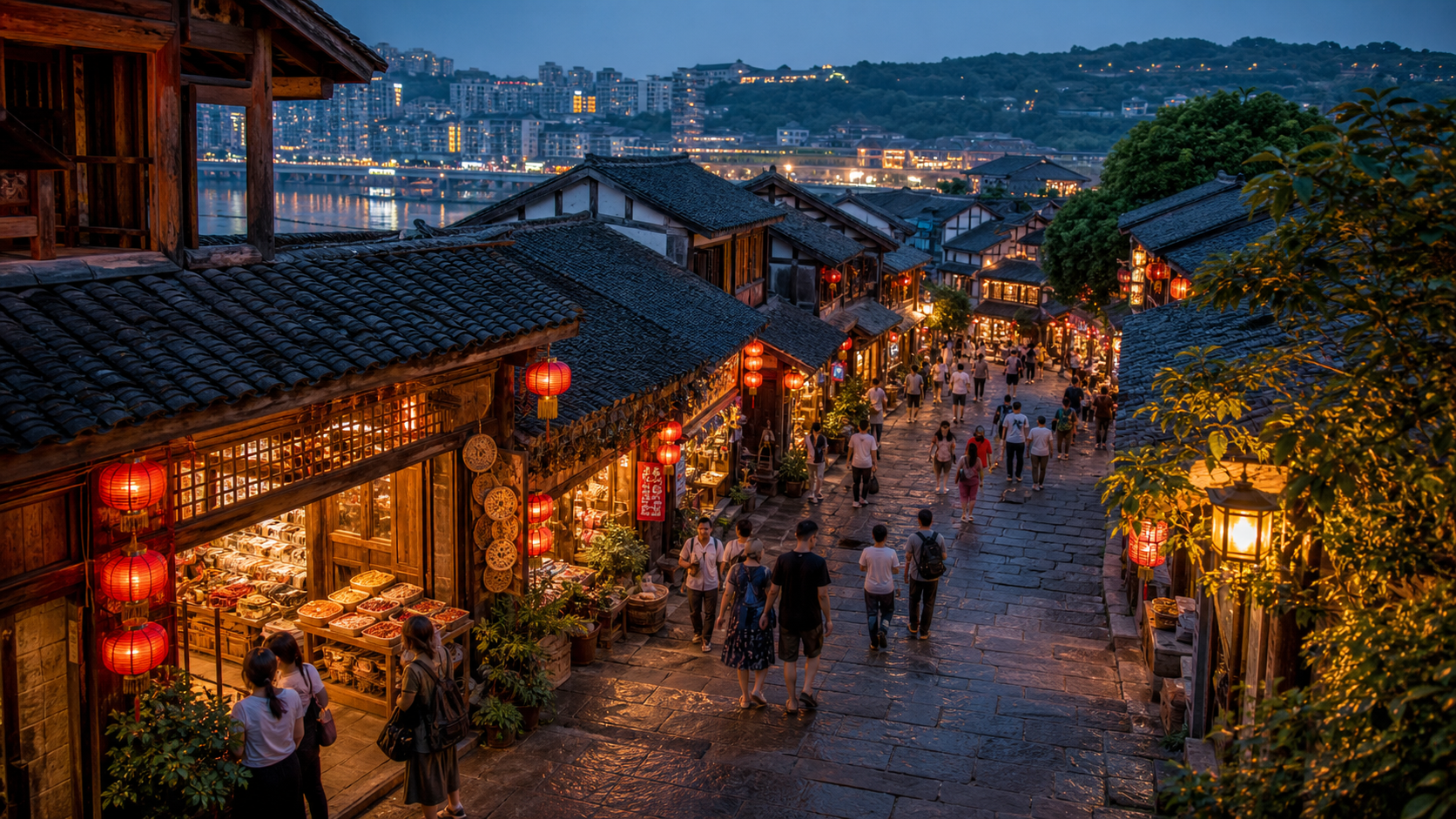
AI-generated Zhuoshui town-setting illustration informed by a historical canal photograph. This is canal-side architectural context, not a verified lane-level view; details and viewpoint are approximate and public access is not established.
AI illustration created with OpenAI image generation. Reference: iChongqing’s Zhuoshui Ancient Town image, published 12 August 2020; capture date and photographer unknown. The protected original is not republished.
Choose a manageable walking sequence
Use three stages as an editorial planning suggestion: orient yourself on arrival, visit the bridge from an open public approach, and explore a selected part of the old town before returning to your agreed pickup point. The sequence is deliberately flexible because this research did not verify a complete current walking circuit.
A March 2025 Tripadvisor review describes one visitor's difficulty finding a toilet while crossing the bridge. That is an individual experience, not proof that a facility is absent today. It does suggest a useful practical question: locate the facilities your party needs before setting off across a long structure.
Ask at arrival about toilets, places to rest and any restricted or one-way sections. If a member of the group wants a shorter visit, agree on a real public waiting point rather than assuming they can sit anywhere inside a business.
Do not convert a booking platform's recommended duration into a minimum everyone must complete. Decide how much time to devote to the town from your interests, walking needs and return transport. Leave enough flexibility to pause without sacrificing the last part of the journey.
Keep the Puhua underground-river decision separate
The municipal source describes karst features in the wider Puhua underground-river area. Its scenery is a different focus from the town's streets and roofed bridge. Seeing the old town does not prove that you have visited the underground river, or that a river excursion is included in an old-town product.
Before adding it, check four things: the actual operating status, the meeting point and transfer, the ticket inclusions and the return arrangement. Ask what the experience requires in terms of boats, steps, enclosed spaces or other physical conditions. Current operator information matters more than a video showing an earlier trip.
Do not promise that a particular cave section or water activity operates during unsuitable weather or changing water conditions. Likewise, a scenic photograph does not establish the suitability of the experience for a wheelchair user, a young child or someone uncomfortable with enclosed spaces.
For a short first visit, the town-and-bridge focus can stand on its own. Add a second product when the confirmed arrangements leave enough time and the whole group wants that experience, rather than because the scenic-area marketing combines the names.

AI-generated pavilion-and-pond illustration based on a photograph identified by its creator as Zhuoshui’s covered-bridge complex. The exact pavilion name is unverified; details and viewpoint are approximate. This is not a Puhua cave image or a current photograph.
AI illustration created with OpenAI image generation. Reference: Chen Lobo’s Zhuoshui photograph, provider-dated 30 September 2025, time zone unverified. All-rights-reserved original used internally as reference only and not republished.
Plan the complete Qianjiang connection
The official address identifies Zhuoshui Town in Qianjiang District. That is the geographical starting point. It does not establish that an arrival at a station or airport puts you directly at the covered bridge.
Build the journey in three parts: travel to the region, a verified local connection to the attraction, and the corresponding return. Search date-specific departures and keep the actual station names. Do not borrow an old train journey from a travelogue or assume a recently discussed shuttle runs at the time you arrive.
This research found a dated local-transport news lead but did not successfully read its full official page. Its indexed journey-time claim is therefore not reproduced as an operating fact. Ask the relevant operator for the current service, departure point, fare and final return departure if you plan to rely on public transport.
For a car transfer, agree on whether the service is one-way, a timed return or a waiting arrangement. Save the exact pickup location and a contact method. An attractive one-way estimate is not enough to decide whether you can make a fixed train or flight afterward.
Our railway-stations and navigation guides can help with the name and meeting-point checks. They do not replace current Qianjiang transport information.
Decide whether to stay overnight for the experience you want
An overnight stay can be an editorial option if you want to avoid compressing the regional journey and visit into one day. It is not necessary for every traveler, and this guide does not establish a lighting schedule or promise a particular evening atmosphere.
The Trip.com attraction page presents the destination as suitable for night views, but a category label is not an operator timetable. Before booking accommodation specifically for an illuminated bridge photograph, check what is planned on your date and where public access will be available.
Choose a place to stay from verified arrival and departure logistics, not solely from a room photograph. Confirm the actual address, check-in requirements, access to the property and the onward transfer. If you need an elevator, a quiet room or specific bedding, ask about that particular property and room category.
Keep the next morning's plan modest. If weather or access changes, having time to leave comfortably is more useful than turning an overnight stay into two tightly timed excursions. The purpose of the extra night should be less pressure and a more deliberate visit.
Approach food and cultural presentation with clear questions
The Japanese consulate's 2021 overview mentions Qianjiang's local food traditions, while the municipal page describes Tujia-related cultural presentation. These provide context rather than current restaurant recommendations or a schedule of live performances.
For a meal, begin with two questions: what is in the dish and how much are you ordering? Do not assume a translated name tells you whether it includes offal, animal stock or a particular sauce. If an ingredient matters to you, ask the venue directly and show the answer to everyone sharing the dish.
A costume display, souvenir stall or staged dance should not be treated as representing every member of a community. When you describe what you saw, name the specific performance or craft where possible. Ask before photographing a person or participating in an activity, and clarify any charge.
This guide does not recommend a named restaurant because current menus, service and dietary claims were not independently verified. Food can be part of a thoughtful visit without manufacturing a list of allegedly universal local favorites.

Editorial decision diagram: choose the town-and-bridge visit first, assess the Puhua excursion separately, and confirm the complete return journey. This is not a map, timetable, ticket offer or accessibility audit.
Original diagram by Chongqing Travel Editorial, based only on the planning questions in this guide. English portrait edition with selectable text.
Diagram text (selectable)
ZHUOSHUI / QIANJIANG
Choose the visit before the ticket
Town and bridge, then a separate decision about the underground river
TOWN + COVERED BRIDGE
- Confirm the entrance and public approach
- Ask about open sections and facilities
- Agree on a meeting and return point
- Do not infer access from a photograph
OPTIONAL PUHUA EXCURSION
- Check whether the product is operating
- Confirm the meeting point and transfer
- Check inclusions and physical demands
- Allow time for the confirmed return
ONE COMPLETE JOURNEY
Regional arrival → verified local connection → chosen visit → return pickup
Keep the Chinese destination name and the operator-confirmed meeting point.
Editorial decision diagram from this guide. Not a map, timetable, ticket offer or accessibility audit.
About This Guide
Research on 1 October 2026 included a live read of the municipal tourism page, the Japanese consulate's dated cultural page, Trip.com and a public Tripadvisor review. A subsequent revision on the same date read original 2017 extension reporting and a 2021 reconstruction account to distinguish the earlier 303-metre bridge from the 658-metre enlarged complex. The mistranslated travel-platform address is not adopted. No personal visit, resident interview or completed accessibility survey is claimed. The municipal page provides context; operational questions require the current operator's confirmation.
Frequently Asked Questions
Q: Is Zhuoshui Ancient Town a downtown Chongqing stop? A: It is in Zhuoshui Town, Qianjiang District. Plan the regional journey and local transfer separately from a central Chongqing walking day.
Q: How long is the covered bridge? A: The municipal tourism description gives 658 metres for the restored and extended complex. The 303-metre figure describes its earlier form; reporting documents a 2013 fire and an extension completed in July 2017. Neither length guarantees that every section is open or step-free.
Q: Does an old-town visit include the Puhua underground river? A: The municipal source identifies them as different parts of the wider scenic area. Confirm the exact product and its inclusions rather than assuming one ticket or route covers both.
Q: Is entry free? A: Travel-platform and older cultural pages describe free old-town entry, but a current operator ticket policy was not verified. Confirm access charges and any separately paid experience for your visit date.
Q: Is the bridge walk suitable for a wheelchair or stroller? A: A complete step-free chain was not verified. Ask about the approach, bridge entry, old-town surfaces, toilets and return pickup before relying on that route.
Traveler comments
Share a recent experience or ask a practical question about this guide.