
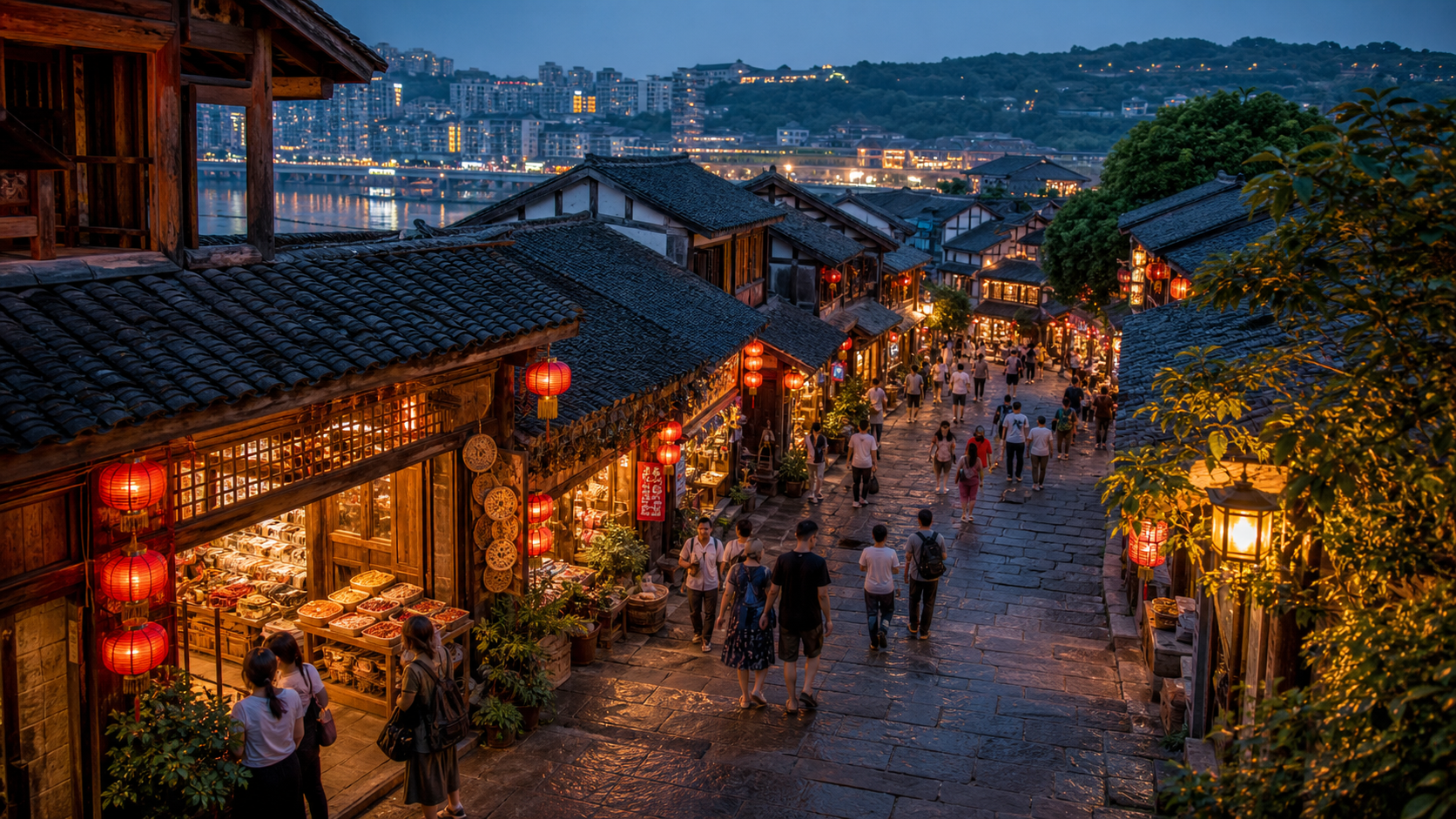
For a 2026 Ciqikou Ancient Town visit, budget 2-4 hours, take Chongqing Rail Transit Line 1 to Ciqikou Station, and treat the main street as one layer of the stop. The Chongqing municipal page we rechecked on 2026-08-08 lists Ciqikou as a national 4A scenic area; Wikipedia puts the old town at 1.18 km².
Current access notice (verified 2026-09-02): Ciqikou Station Exit 1 remains usable. Its original staircase is closed for Line 27 construction; passengers use the new staircase at Exit 1. Follow on-site signs because construction routing can change.
Ciqikou is worth visiting if you want old Chongqing texture without leaving the urban area. It is not worth treating as a full-day "ancient town escape." The good visit is selective: enter cleanly, snack carefully, leave the crowded commercial lane, and give yourself time to sit down before moving to Liziba, Shapingba, or central Yuzhong.

The Short Answer: Who Should Go, and Who Should Skip
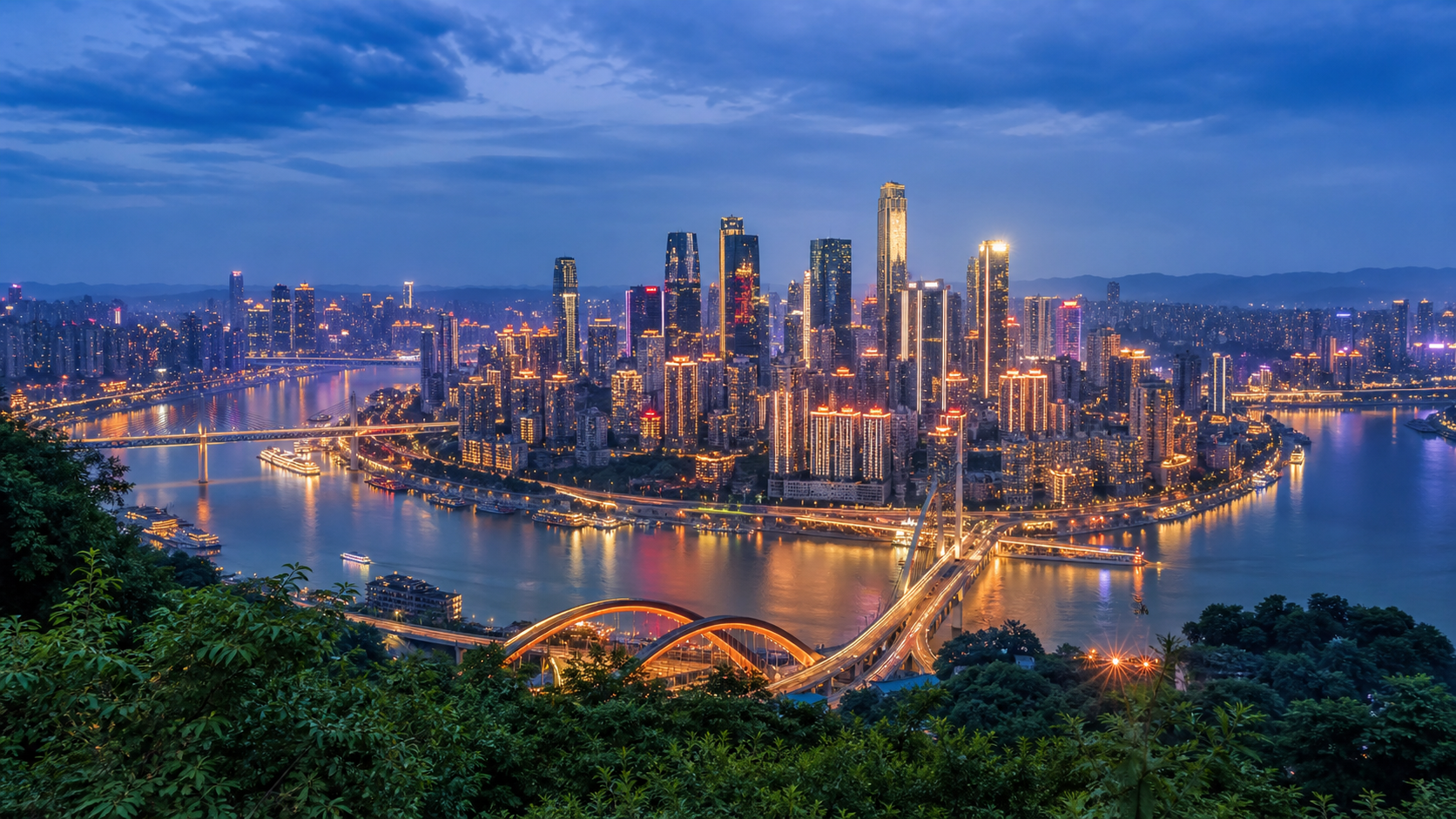
Good for: first-time visitors who want a 2-4 hour old-street walk, snack tasting, tea, stone alleys, and a visible contrast between old Shapingba and modern Chongqing. The Chongqing municipal page describes Ciqikou as a Shapingba riverside town with Bayu dwellings, folk customs, national 4A scenic-area status, and "one river, two streams, three mountains" geography — the Jialing River, the Phoenix and Qingshui streams, and the Gold Jade, Saddle and Phoenix hills.
Avoid if: you dislike crowds, only want quiet heritage, or have already planned a tight Hongya Cave night route the same evening. I would not stack Ciqikou, Liziba, Yangtze Cableway, and Hongya Cave into one day unless you are comfortable with stairs and slow crowd flow. If a night route is already on the plan, read the Chongqing night-view route guide first and decide which one gets the good hours.
Local tip: Ciqikou works better as a controlled half-day block than as a spontaneous add-on. Put it before a rest break or before a simple metro ride, not before a time-sensitive dinner reservation.
Quick facts, and where each one comes from
| Fact | Detail | Source |
|---|---|---|
| District | Shapingba, west bank of the Jialing River | Wikipedia |
| Area | 1.18 km² | Wikipedia |
| Founded | Song dynasty, reign of Emperor Zhenzong (998-1004) | Wikipedia |
| Former name | Longyin Town, also called Little Chongqing | Wikipedia |
| Name meaning | "Porcelain port", from Ming and Qing porcelain production | Wikipedia |
| Scenic rating | National 4A; State Council first-batch Chinese historical and cultural street | Chongqing municipal government |
| Metro | Line 1 to Ciqikou Station, Exit 1 | Chongqing municipal government, Trip.com, Travel Of China |
| Distance from the centre | About 14 km; roughly 30-40 min from central areas by Line 1 | China Odyssey Tours, Travel Of China |
| Entry | Free | Trip.com, Travel Of China, China Odyssey Tours |
| Suggested duration | 2-3 hours at the short end, 2-4 hours in the wider guides | Trip.com, Travel Of China, China Odyssey Tours |
| Shop hours | Town open all day; shops roughly 09:00-22:00 | Travel Of China |
| Baolun Temple | More than 1,500 years old, on the hill in the middle of town; listed 07:30-18:00, entry CNY 5 | iChongqing, China Odyssey Tours, Travel Of China |
| Hanlin Academy | Listed 09:00-21:00 | China Odyssey Tours |
| Back street | Listed as open 24 hours | Chongqing municipal government |
- Fact
- District
- Detail
- Shapingba, west bank of the Jialing River
- Source
- Wikipedia
- Fact
- Area
- Detail
- 1.18 km²
- Source
- Wikipedia
- Fact
- Founded
- Detail
- Song dynasty, reign of Emperor Zhenzong (998-1004)
- Source
- Wikipedia
- Fact
- Former name
- Detail
- Longyin Town, also called Little Chongqing
- Source
- Wikipedia
- Fact
- Name meaning
- Detail
- "Porcelain port", from Ming and Qing porcelain production
- Source
- Wikipedia
- Fact
- Scenic rating
- Detail
- National 4A; State Council first-batch Chinese historical and cultural street
- Source
- Chongqing municipal government
- Fact
- Metro
- Detail
- Line 1 to Ciqikou Station, Exit 1
- Source
- Chongqing municipal government, Trip.com, Travel Of China
- Fact
- Distance from the centre
- Detail
- About 14 km; roughly 30-40 min from central areas by Line 1
- Source
- China Odyssey Tours, Travel Of China
- Fact
- Entry
- Detail
- Free
- Source
- Trip.com, Travel Of China, China Odyssey Tours
- Fact
- Suggested duration
- Detail
- 2-3 hours at the short end, 2-4 hours in the wider guides
- Source
- Trip.com, Travel Of China, China Odyssey Tours
- Fact
- Shop hours
- Detail
- Town open all day; shops roughly 09:00-22:00
- Source
- Travel Of China
- Fact
- Baolun Temple
- Detail
- More than 1,500 years old, on the hill in the middle of town; listed 07:30-18:00, entry CNY 5
- Source
- iChongqing, China Odyssey Tours, Travel Of China
- Fact
- Hanlin Academy
- Detail
- Listed 09:00-21:00
- Source
- China Odyssey Tours
- Fact
- Back street
- Detail
- Listed as open 24 hours
- Source
- Chongqing municipal government
Wikipedia's Ciqikou entry is the cleanest source for the town's history and scale: 1.18 km², established under Emperor Zhenzong of Song, originally Longyin Town, renamed for the porcelain trade that ran through the port. That 1.18 km² number is the one to hold on to. It is small. The reason Ciqikou feels crowded is not that the town is big and busy; it is that a large number of people are moving through a very compact grid.
How to Get There by Metro Without Overthinking It
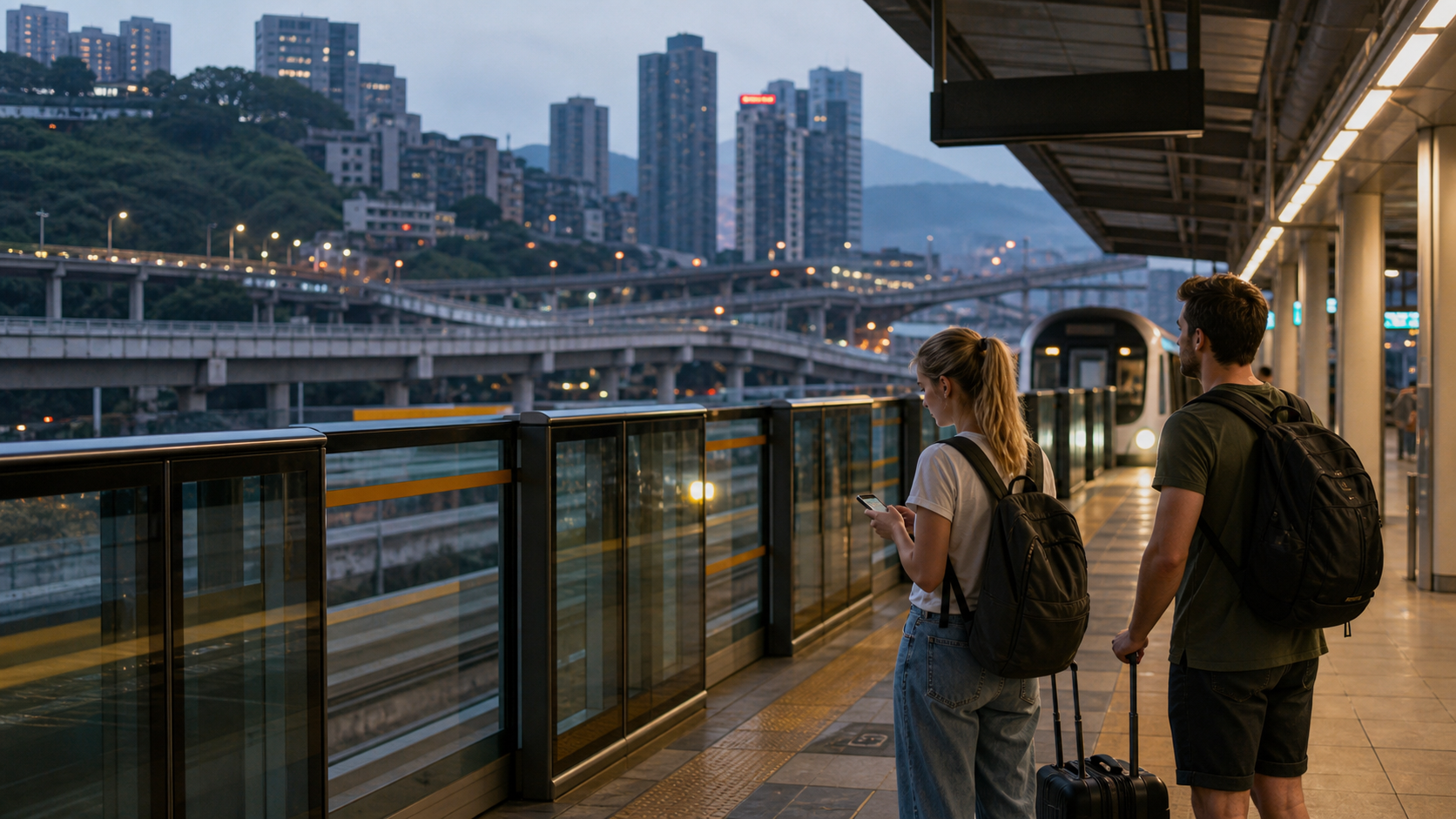
For most foreign visitors, the simplest route is Chongqing Rail Transit Line 1 to Ciqikou Station, then a short walk toward the old town. The municipal page states it plainly — 乘坐轨道交通1号线至磁器口站下车 — and Trip.com's attraction page lists the same Line 1 / Ciqikou Station anchor, with entry free and 2-3 hours suggested.
If you are coming from Jiefangbei or Xiaoshizi, expect a transfer depending on your starting station. If you are pairing Ciqikou with Liziba, check the Chongqing metro guide first because Chongqing routes often look short on the map but feel longer when you add station exits and vertical walking.
Going back late matters more here than at a central stop, because Ciqikou sits west of the centre on a single line. Check the 首末班时间 (first/last train) section on the official Chongqing Rail Transit site or the platform display before you settle into a teahouse at 21:00.

Chinese phrase for taxi or help: 请带我到磁器口古镇正门附近。
Meaning: Please take me near the main entrance of Ciqikou Ancient Town.
The Route I Would Use: Main Street, Then Side Streets
Do the main street first for orientation, but do not stay trapped there. A practical route is: metro arrival, main pedestrian street, one snack stop, side alley stairs, Baolun Temple or courtyard area if open and convenient, teahouse pause, then back-street or river-edge exit. This keeps the visit to about 2-4 hours instead of turning it into a slow crowd loop.
The route, leg by leg
| Leg | Time to budget | What it gives you | Watch out for |
|---|---|---|---|
| Line 1 to Ciqikou Station, then walk in | 10-15 min after a 30-40 min ride from the centre | A clean entry rather than a taxi drop on a busy road | Use Exit 1 and follow signs to the town, not the nearest exit |
| Main pedestrian street | 30-45 min | Orientation, shopfronts, snack stalls | The densest crowd flow of the whole visit |
| Side alleys and stone stairs | 20-30 min | The texture people actually remember | Steep steps; wet stone after rain |
| Baolun Temple / courtyard area | 20-30 min | A 1,500-year-old temple on the hill in the middle of town | Listed 07:30-18:00 with CNY 5 entry, so it closes well before the lantern hour |
| Teahouse pause | 30 min | The reset that makes the second half enjoyable | Some teahouses run opera performances on a schedule |
| Back street or river-edge exit | 20-30 min | Jialing River edge and a calmer way out | The back street is listed as open 24 hours; the shops are not |
- Leg
- Line 1 to Ciqikou Station, then walk in
- Time to budget
- 10-15 min after a 30-40 min ride from the centre
- What it gives you
- A clean entry rather than a taxi drop on a busy road
- Watch out for
- Use Exit 1 and follow signs to the town, not the nearest exit
- Leg
- Main pedestrian street
- Time to budget
- 30-45 min
- What it gives you
- Orientation, shopfronts, snack stalls
- Watch out for
- The densest crowd flow of the whole visit
- Leg
- Side alleys and stone stairs
- Time to budget
- 20-30 min
- What it gives you
- The texture people actually remember
- Watch out for
- Steep steps; wet stone after rain
- Leg
- Baolun Temple / courtyard area
- Time to budget
- 20-30 min
- What it gives you
- A 1,500-year-old temple on the hill in the middle of town
- Watch out for
- Listed 07:30-18:00 with CNY 5 entry, so it closes well before the lantern hour
- Leg
- Teahouse pause
- Time to budget
- 30 min
- What it gives you
- The reset that makes the second half enjoyable
- Watch out for
- Some teahouses run opera performances on a schedule
- Leg
- Back street or river-edge exit
- Time to budget
- 20-30 min
- What it gives you
- Jialing River edge and a calmer way out
- Watch out for
- The back street is listed as open 24 hours; the shops are not
Total: about 2.5 to 3.5 hours at an unhurried pace, which lands inside the 2-4 hour band the guides suggest.
Trip.com and iChongqing both describe the older layers: stone roads, Bayu-style architecture, Baolun Temple, Hanlin Academy, tea houses, and the long porcelain-port history. iChongqing dates the town's origins to 998 AD and notes that the Ciqikou name came after migrants from Fujian brought ceramics production roughly 300 years ago. The point is not to "complete" every site. The point is to see how the commercial lane, religious and courtyard spaces, and river-town geography fit together.

Common mistake: walking straight down the busiest snack lane, buying 4 small things in 20 minutes, then leaving because the crowd feels repetitive. Better move: buy 1 snack, walk 100-200 m into a quieter lane, then decide whether the atmosphere is still worth your time.
What to Eat: Try Snacks, but Keep It Light
Ciqikou is snack-heavy. Trip.com's attraction page names Chen-style fried dough twists (mahua), maoxuewang, qianzhangpi, and salt-and-pepper peanuts as the local specialities; steamed cakes and spicy street snacks fill in around them. I would treat this as a tasting stop, not a full meal, especially if hotpot is planned later the same day — our hotpot survival guide explains why arriving already full is a bad way to meet a Chongqing pot.

Good for: one shared bag of mahua, one spicy snack if your stomach handles chili, and tea or water afterward.
Avoid if: you are sensitive to oil, chili, or street-food uncertainty before a long metro ride. In that case, keep snacks packaged and eat a proper meal later.
Useful phrase: 这个辣吗?可以少辣吗?
Meaning: Is this spicy? Can it be less spicy?
Where to Slow Down: Tea, Courtyards, and Back Streets
The most useful Ciqikou reset is a 30-minute sit-down. Teahouses and courtyard-style spaces matter because the main street can become visually noisy, and some teahouses run opera performances if you want the pause to be an event rather than a rest. iChongqing's February 2026 report followed a group of 42 international visitors from Malaysia and Vietnam through red lanterns, mythology-themed light installations, cured meats, steamed rice cakes and fried dough twists during Spring Festival. That energy is real, but it is easier to enjoy after you step away from the densest lane.

For photos, look for texture rather than signs: roof tiles, stone steps, wooden railings, steam, tea cups, and uphill lanes. Do not block narrow alleys for posed shots. Chongqing old streets are working pedestrian routes, not a private photo studio.
Timing: Morning, Late Afternoon, or Evening?
If you mainly want comfort, go in the morning or on a weekday. If you want lanterns and atmosphere, late afternoon into early evening looks better, but the crowd cost rises. Travel Of China's guide frames a normal visit at 2-4 hours, or 4-5 if you want temples, back alleys and a proper meal without rushing; China Odyssey Tours says 2-3 hours. That spread matches the pacing I would use for first-timers.
The two closing times that decide your arrival
There is a real scheduling conflict inside Ciqikou. The town itself is open all day and the back street is listed as 24 hours, but the interior sites close early: Baolun Temple 07:30-18:00, Hanlin Academy 09:00-21:00, and most shops around 09:00-22:00. So the lantern-lit evening and the temple-and-courtyard visit are effectively two different trips. Arrive by 15:30 if you want both; arrive at 18:00 if you only want the atmosphere.
China Odyssey Tours also suggests spring (March to May) and autumn (September to October) for comfortable temperature and thinner crowds, which is worth knowing if your dates are still flexible.

Summer note: Chongqing heat plus stone lanes can drain energy quickly. Carry water and do not plan the hardest stair-heavy old-town section after a large lunch.
Rain note: wet stone looks beautiful but can be slippery. Wear shoes with grip. If rain is heavy, make Ciqikou a shorter snack-and-tea stop.
How to Pair Ciqikou with the Rest of Chongqing
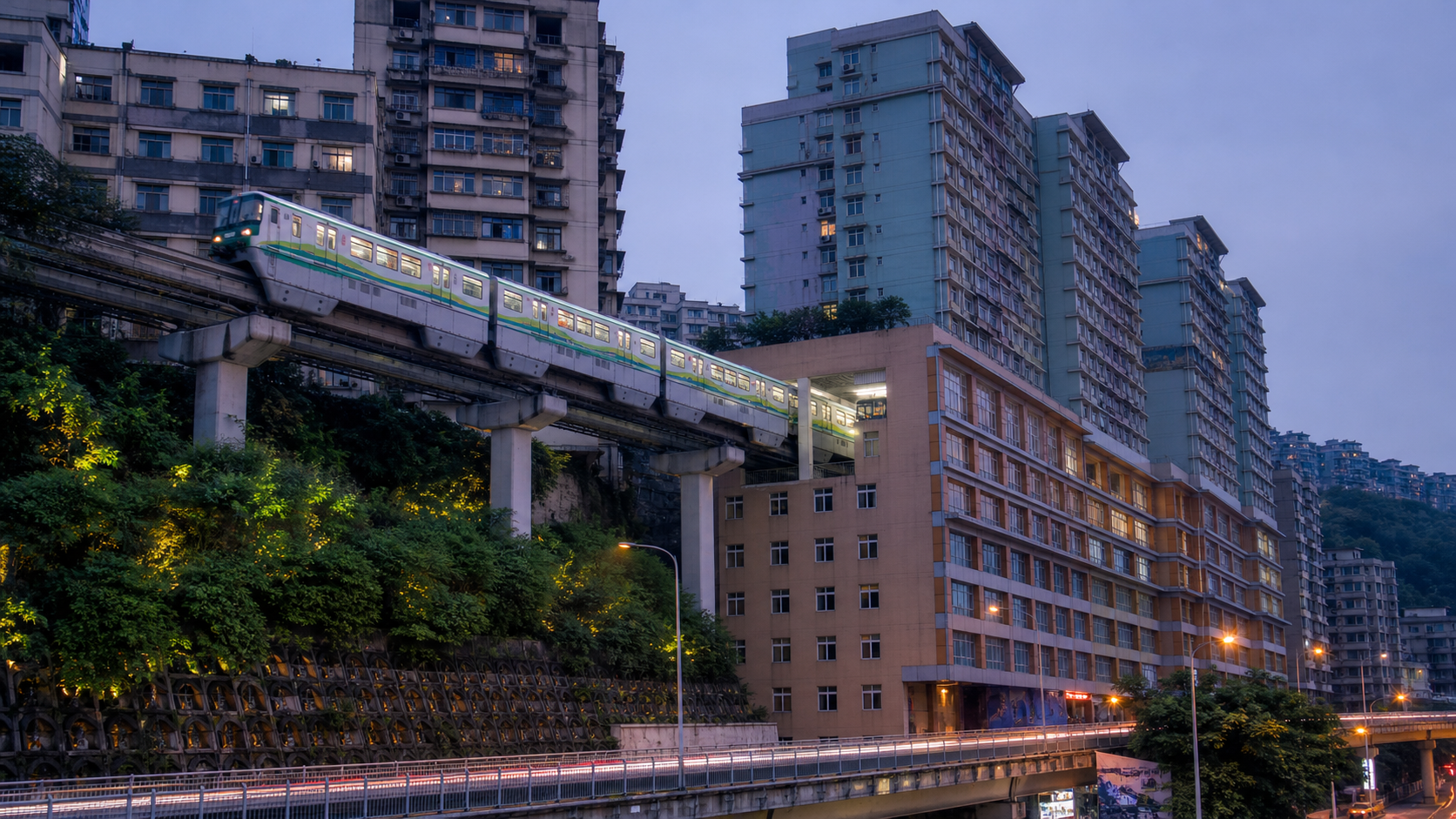
Ciqikou pairs well with Liziba because both show the "not flat" side of Chongqing: one is old-street slope and river-town texture, the other is monorail geometry. Read the Liziba monorail viewpoint guide if you want a compact west-side day.
It also fits Day 2 or Day 3 of a first trip, after you have already seen Jiefangbei and Hongya Cave. The 3-day Chongqing guide uses this logic: put visual and walk-heavy stops together, then protect your evening energy.

I would not pair Ciqikou with a far outer-district attraction on the same day. The real cost is not only distance; it is decision fatigue, stairs, transfers, and snack-heavy pacing.
About This Guide
This guide was written on 2026-05-27 and substantively updated on 2026-08-08, when every source was reopened and re-verified: the Chongqing municipal scenic-area page, Wikipedia's Ciqikou entry, Trip.com's attraction page, iChongqing's town guide, Travel Of China, China Odyssey Tours, and the official Chongqing Rail Transit site. Every figure in the tables above traces to one of those pages.
In the earlier version these references sat at the end of paragraphs as bare URLs. They are now inline citations, and the Wikipedia entity page and the rail operator were added, so a reader or an AI engine can see which source each number came from. It uses official sources for location and transport context, travel platforms for visitor pacing and prices, and recent foreign-visitor reporting for atmosphere. Hours and prices for individual sites change; confirm Baolun Temple and Hanlin Academy on the day if they are the reason you are going.
The public images are original AI-generated recreations. Web photos and travel pages were reference-only; no Trip.com, iChongqing, government, social-platform, or third-party photo is republished.
Frequently Asked Questions
Q: Is Ciqikou Ancient Town worth visiting in Chongqing in 2026?
A: Yes if you want a 2-4 hour old-street, snack, tea, and stone-alley stop inside urban Chongqing. Entry is free and the town is only 1.18 km², so the cost is your time, not your budget. It is less useful if you want a quiet heritage site with no commercial street.
Q: How do I get to Ciqikou Ancient Town by metro?
A: Take Chongqing Rail Transit Line 1 to Ciqikou Station and use Exit 1, then walk toward the old town entrance. It runs roughly 30-40 minutes from central areas. Save the Chinese name 磁器口古镇 in your map app before leaving your hotel.
Q: How long should foreign visitors spend at Ciqikou?
A: Plan 2-4 hours for a normal visit. Use the shorter end if you only want snacks and photos; use the longer end if you want tea, side alleys, Baolun Temple, or a slower river-edge exit.
Q: What should I eat at Ciqikou?
A: Try one shared bag of Chen-style mahua fried twists, listed at CNY 15-18, plus one light spicy snack if you tolerate chili, and tea or water afterward. Avoid turning Ciqikou into a full meal if hotpot is planned later.
Q: Should I visit Ciqikou in the morning or evening?
A: Morning is easier for crowd control and photos of alleys, and it is what lets you include Baolun Temple, which is listed as closing at 18:00. Late afternoon or early evening gives more lantern atmosphere, but it usually means slower walking on the main street. Arrive by 15:30 if you want both.
Traveler comments
Share a recent experience or ask a practical question about this guide.