
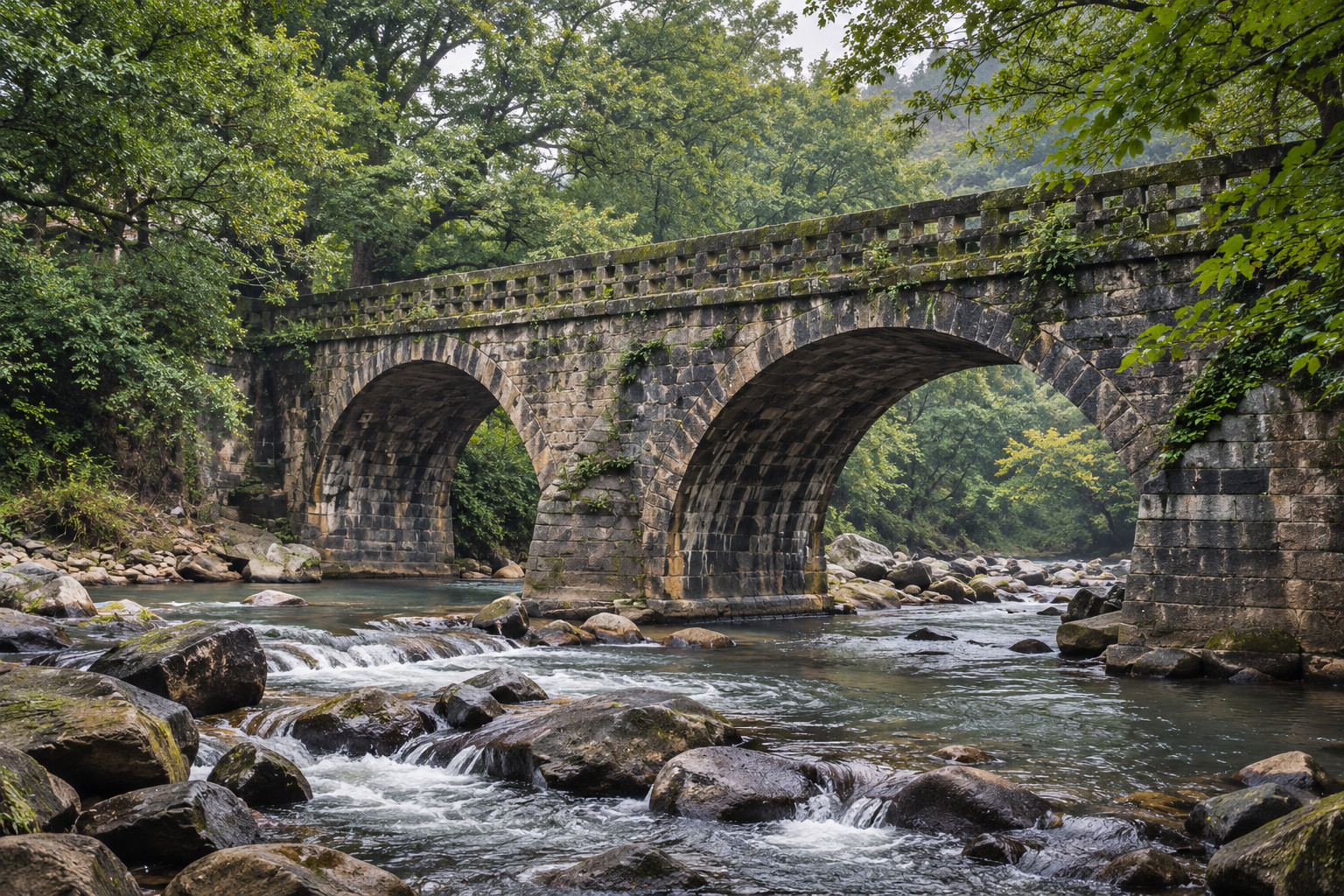
Cover illustration: AI illustration based on a historical photograph. An architectural detail of Dongxi’s Taiping Bridge stone arch, not a complete survey of its approaches. Reference published 2022-09-14; capture date unknown. Reference photographer: 陈星宇 / Visual Chongqing. Scene geometry, terrain and architectural details are approximate; not proof of current conditions, access or navigation.
Private historical reference (not a reuse license): Visual Chongqing / Sohu / 陈星宇 / Visual Chongqing
This guide includes four explicitly labeled AI scenes and one original localized planning card, not a map. Original photographs remain private references only; no republication rights or reuse license are established. No independent review is claimed. The bridge and Nanhua Palace are partial architectural views, not complete access records. The lane/material study and waterside scene do not establish walking-surface conditions; no craft demonstration or performance is shown. References were published on 2022-09-14; capture dates are unknown. Illustrated stream flow does not establish current river conditions.
Dongxi Ancient Town in Qijiang suits a bridge-and-heritage outing in 2026. The district government's January tourism overview links it to salt transport towards Guizhou and identifies Taiping Bridge's Ming-era origins. Build the visit around that river setting and a confirmed cultural interior, with return transport arranged before the walk.
The full destination name is 綦江东溪古镇. Keep Qijiang in the search, and do not confuse Dongxi with similarly romanised towns elsewhere. This guide focuses on the settlement and its heritage; it does not treat every nearby canyon, mountain or proposed tourism project as part of one accessible attraction.
Research was completed on 1 October 2026. No editor visited the site or timed the suggested sequence. Sources establish useful historical themes and document cultural activity, but current bus departures, venue access and performance schedules still need local confirmation.
Start with the bridge and the trade route
The Qijiang government's tourism overview dated 20 January 2026 describes Dongxi as a shipping node in the salt trade towards Guizhou. It attributes Taiping Bridge, 太平桥, to the Ming Hongwu period. The point of starting here is to connect a physical crossing with a town that developed around movement and exchange.
From a safe, permitted viewpoint, look at the relationship between the bridge, water and routes into the settlement. Ask where people could approach from higher ground, where goods might have needed handling, and how a crossing changes the importance of a market. Treat these as questions for interpretation, not as proof that any unlabelled stair or platform served a particular historic function.
A bridge's founding date is also different from the age of every stone visible today. Read the heritage plaque for repairs and reconstruction if that detail matters to you. Avoid repeating a precise current age calculated from an older article that may have been republished without rewriting its numbers.

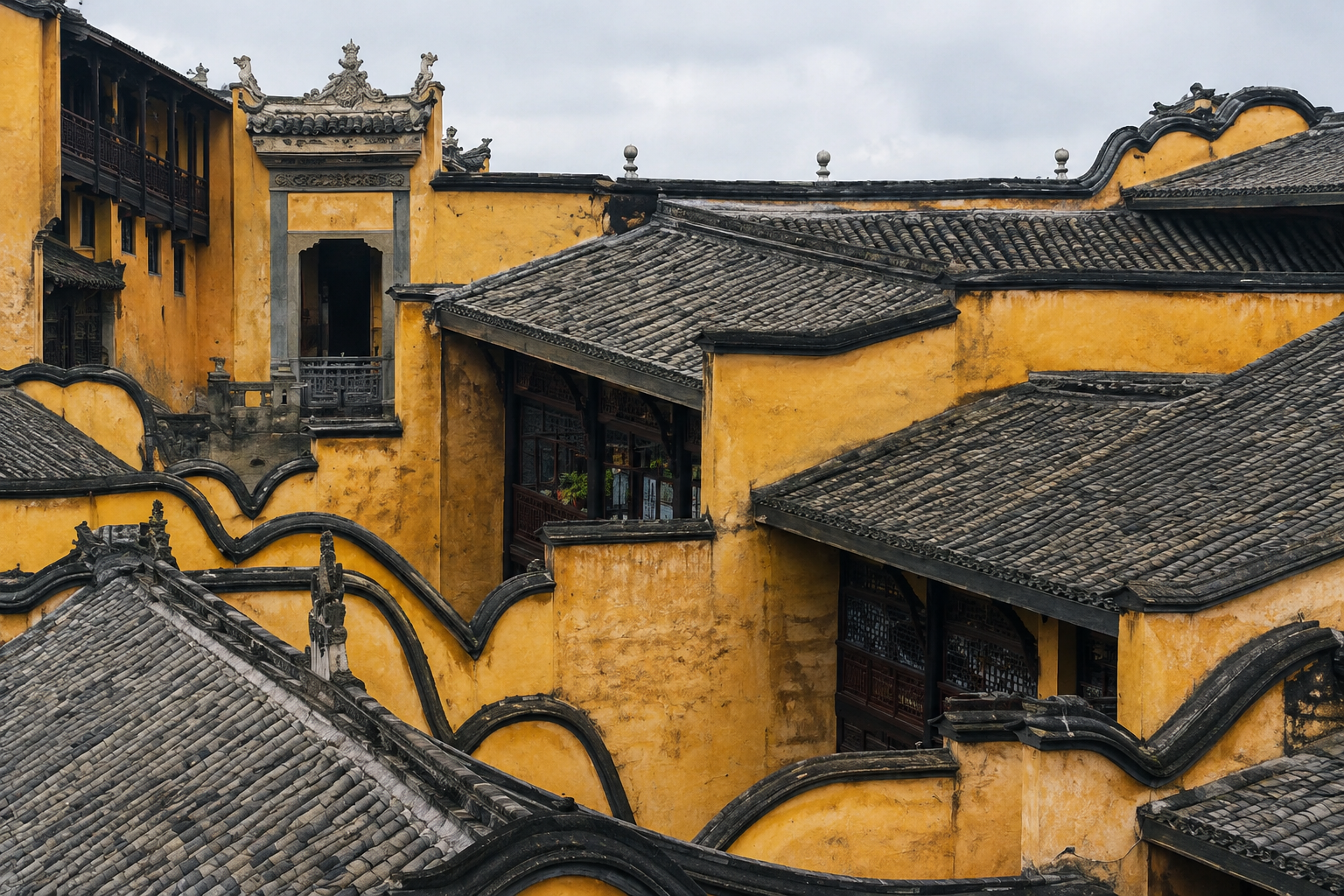
AI illustration based on a historical photograph. A Dongxi lane and material study: paving, timber and masonry. It does not verify a named route or today’s walking surface. Reference published 2022-09-14; capture date unknown. Reference photographer: 胡光银 / Visual Chongqing. Scene geometry, terrain and architectural details are approximate; not proof of current conditions, access or navigation.
Private historical reference (not a reuse license): Visual Chongqing / Sohu / 胡光银 / Visual Chongqing
Walk the lanes as links between places
A district profile displayed with a June 2026 date describes an old Sichuan–Guizhou road, traditional dwellings and mature huangjue trees in Dongxi. Parts of that page retain obviously older transport language. This guide uses its landscape description cautiously and does not turn its old road claims into today's driving instructions.
On arrival, identify the main pedestrian route and make small excursions from it. Look at where a lane widens enough for people to gather and where a building uses the slope to create different floor levels. The relationship between a lane, a tree and a doorway can reveal more about everyday space than another distant panoramic photograph.
Do not assume a downhill continuation is the easiest exit. In a hillside settlement, a short descent can lead to a longer climb back. If travelling with someone who wants limited walking, keep the route reversible and pause before committing to a lower section.
Treat tree roots, thresholds and stone paving as part of the terrain you must negotiate, not decorative details to ignore while looking through a camera. Stay on permitted paths and give residents carrying goods or using the lane priority. The streets remain spaces of work and daily life.
Give Nanhua Palace its own time
Nanhua Palace, 南华宫, is one of the cultural buildings identified in the district heritage overview. A Visual Chongqing item published in February 2022 captions a scene of neighbours and visitors watching opera and taking tea there. That records one use of the space at that time; it does not supply a standing performance schedule.
If the venue is open, first ask how it is being used that day. A cultural building can function as a place of interpretation, performance or community gathering at different times. Check whether sitting for tea, entering an exhibition and attending a performance have separate arrangements.
Look at how the audience space relates to the stage or courtyard, where movement is possible without interrupting others, and how the building's setting differs from a shop-lined lane. If a performance is underway, follow staff guidance about seating and photography. Do not move furniture or step into a working area to improve a picture.
If there is no event, the building may still be worth understanding through its exterior and any available interpretation. Arriving without a show is not a failure of the visit unless a particular performance was what you intended to book.

AI illustration based on a historical photograph. Nanhua Palace timber column, stone steps and gallery detail. No lanterns, people or performance are depicted. Reference published 2022-09-14; capture date unknown. Reference photographer: 陈星宇 / Visual Chongqing. Scene geometry, terrain and architectural details are approximate; not proof of current conditions, access or navigation.
Private historical reference (not a reuse license): Visual Chongqing / Sohu / 陈星宇 / Visual Chongqing
Add Wantian Palace only after checking access
Wantian Palace, 万天宫, is separately named in official material. The culture and tourism commission's reply signed 26 June 2025 discusses its recognition as a public cultural space. This gives a reason to investigate it beyond a quick exterior photograph.
Ask what visitors can currently enter and what interpretation is available. Do not assume a cultural-space award means every part of the building functions as a museum, or that all activities are designed for casual visitors. If the venue is hosting a local gathering, respect its purpose and any restricted areas.
For a short visit, comparing the public fronts of Nanhua and Wantian may be enough. For a deeper one, select whichever has a confirmed exhibition or guide suited to your interests. It is better to understand one building's use and history than to hurry through several halls without knowing what distinguishes them.
The existing Huguang Guild Hall and Dongshuimen guide offers a central-Chongqing comparison for communal architecture. It is a separate destination and does not establish Dongxi's building functions or ticket rules.
Use event reports as evidence of possibility
The June 2025 official reply records twelve weekend opera events during 2024 and discusses future cultural programming. Twelve past events do not mean a show every weekend, still less every afternoon. The same document contains proposals and investment work that should not be promoted as finished visitor products.
Before travelling for opera or a workshop, ask for a current dated announcement. Confirm the venue, language, duration and whether booking is required. If your plan depends on a particular craftsperson, ask about that person or session rather than simply asking whether the town has intangible cultural heritage.
For a general walk, keep events as a bonus. That makes it easier to enjoy architecture, food and the river setting even if the programme has changed. For an event-led trip, let the confirmed session determine arrival and departure, and avoid buying non-refundable transport around a rumoured performance.
Choose food and crafts without turning them into a checklist
A China Daily report from November 2024 describes Dongxi black duck, fermented tofu and Huangjing bean curd among local food traditions. It also reports woodcarving activity and visitor classes associated with the Huang family. These are specific leads, but the article is not a current restaurant inspection or booking directory.
Pick one meal or snack stop that fits the day rather than trying every named food. Check the actual menu, ingredients, spice and serving size. A translated name may not explain whether a dish contains meat stock or how it is prepared. If buying preserved products to take away, ask about storage and handling for the remainder of the journey.
For a craft purchase, ask who made it, what material it uses and whether the piece is intended for daily use or display. A workshop can be enjoyable, but confirm its price, duration and supervision before beginning. Do not assume the business described in a 2024 article is always open or that a maker can interrupt work to teach an unbooked group.

AI illustration based on a historical photograph. Dongxi stream cascade with the edge of a waterside building. The flow is illustrative; the building is not identified as a named palace. Reference published 2022-09-14; capture date unknown. Reference photographer: 胡光银 / Visual Chongqing. Scene geometry, terrain and architectural details are approximate; not proof of current conditions, access or navigation.
Private historical reference (not a reuse license): Visual Chongqing / Sohu / 胡光银 / Visual Chongqing
Plan the Dongxi walk and return
The district's 20 January 2026 tourism overview lists Dongxi alongside Gujian Mountain, Hengshan and Laoying Mountain. It describes a region, not one walkable attraction. Choose Dongxi's bridge and cultural halls as the focus before considering a separate road journey to another destination.
Build the outing around its heritage anchors
A bridge, a lane walk and one open cultural building form a coherent first visit. Add a meal and leave enough time to return without rushing. This is a suggested structure, not a measured route or a promise that the anchors connect by a particular step-free path.
An architecture-focused visitor can spend longer comparing the public spaces around the bridge and halls. Someone interested in performance should reverse the priorities and organise the walk around a confirmed event. A group with mixed stamina can agree on a shorter shared section before deciding whether anyone wants an additional loop.
Carry enough battery for translation and navigation, and save the names of your selected places offline. Photograph the agreed pickup landmark at the beginning so that returning through similar-looking streets does not become a guessing game.
Make Qijiang transport a complete return plan
First establish how you will reach the Dongxi entrance from your actual starting point. A journey to Qijiang's urban area or a railway station still leaves a local road leg. The railway-stations guide can help with checking the exact arrival station, but this guide does not verify a direct connection to the town.
For a car arrangement, agree on the full destination 綦江东溪古镇, a reachable pickup point, waiting time and the final return address. Ask about any additional cost before adding another stop. A driver dropping you near one part of the town is not a guarantee of availability later in the day.
For public transport, obtain the return departure details before leaving the main terminal or town centre. Plan a margin for reaching the departure point from the historic streets. If the onward connection cannot be established reliably, choose a simpler transfer rather than depending on finding a vehicle at the last minute.
The maps and navigation guide explains general pin and road-level checks. In Dongxi, the useful practical test is whether a vehicle can actually reach the spot where you expect to meet it.

Original planning card; every label is also repeated below as selectable text. Planning prompts only. Confirm current access and return transport; this is not a route map.
Original editorial planning card based on this article; not a photograph or geographic map.
Dongxi: leave room to turn back
Observe on site:
- Bridge: compare the arch, water and higher approaches.
- Lane: notice roots, thresholds and paving.
- Hall: choose one cultural building with confirmed access.
Check before leaving:
- Confirm hall access and any dated performance.
- Check rain closures, steps and usable toilets.
- Save a reachable pickup point and your last usable return connection.
Planning prompts only. Confirm current access and return transport; this is not a route map.
Keep the water and weather in perspective
The river setting is part of Dongxi's appeal, but a scenic crossing or exposed bank is not a water-play invitation. Stay behind barriers and follow any local closures. After rain, reconsider lower approaches and smooth stone surfaces rather than trying to reproduce a photograph taken under different conditions.
For visitors who require an accessible route, ask about the specific bridge approach, venue entrance, toilets and return path. “Ancient town” does not answer those questions, and a short section without steps does not certify the whole outing. Shortening the route is often a better option than discovering too late that the only convenient exit involves a climb.
About This Guide
The research combines Qijiang government descriptions, a June 2025 tourism-authority reply, China Daily reporting and a dated Visual Chongqing caption. Planning suggestions are editorial synthesis. Displayed source dates were checked against the text, and historical programmes were not presented as current bookings. No firsthand visit or independent human review is claimed.
Frequently Asked Questions
Q: Which Dongxi is covered here? A: This guide covers Dongxi Ancient Town in Qijiang, Chongqing, written 綦江东溪古镇. Use the district name when arranging transport.
Q: What should a first visit focus on? A: Dongxi's Taiping Bridge, an old-street section and one confirmed cultural building provide an introduction to the town's river and trade heritage.
Q: Is there opera every weekend at Nanhua Palace? A: A current weekly opera schedule at Dongxi's Nanhua Palace was not verified. Official reporting records twelve weekend events in 2024; obtain a dated programme for your visit.
Q: Are the canyon and other proposed projects already open attractions? A: Dongxi's Taiping Canyon and wharf projects appear in development and investment discussion. Those sources do not establish current public access, so check each separately rather than adding it automatically.
Q: Can I rely on a bus back after wandering the town? A: For the return from Dongxi, verify the actual service and boarding point before beginning the walk. No current bus timetable was confirmed in this research.
Traveler comments
Share a recent experience or ask a practical question about this guide.