
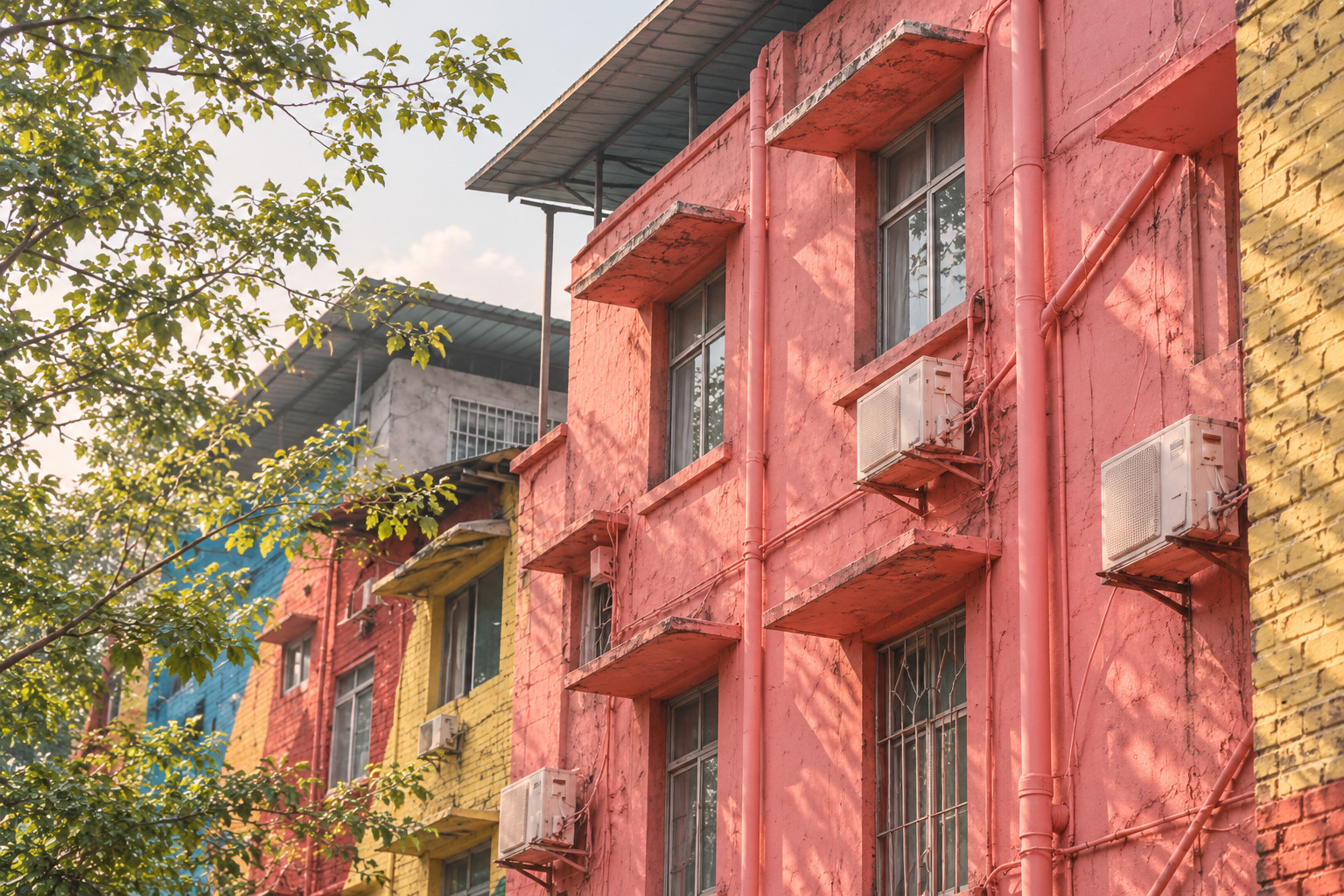
Cover illustration: AI illustration based on historical photo references. Shijingpo: colored residential facades; no exact renewal project or public route is identified. The scene and details are approximate, not a current photograph or proof of public access, a public path or an authorized viewpoint.
Historical photo reference only; original not republished; the reference grants no reuse permission: mars探索新鲜城事, user-contributed 澎湃号·湃客 (not an independent The Paper newsroom report) / Photographer not credited
This guide contains four explicitly labeled AI scene illustrations from historical photo references and one original localized planning diagram. Photograph capture dates and current access are not established by the page update dates. No independent review is claimed.
For Shijingpo in 2026, plan a respectful neighborhood walk around painted residential lanes, rather than expecting a managed attraction. Shapingba’s authority records a Tuanjieba renewal completed in April 2025, while the subdistrict reports community life continuing in January 2026. Those records explain the setting; they do not grant access to homes or courtyards.
Save 石井坡彩色房子 and 石井坡涂鸦街 as search terms, then check the actual street-level destination. “Shijingpo” also names a wider administrative area. A pin for the subdistrict office, a residential development or a photograph’s upload location may take you somewhere quite different from the buildings in that photograph.
This walk suits visitors interested in how ordinary housing changes over time. It is less suitable if your main requirement is a particular mural, guaranteed access to a photographed staircase or a fully signed heritage circuit. Treat the colorful streets as a place where people live, with a visit that can become shorter when access is unclear.
Find the painted lanes, then check the boundary
The November 2021 Hualong feature identifies Shijingpo’s colored buildings as renovated older housing. Its photographs and description distinguish whole painted façades from the contrasting treatment of windows and door surrounds. That is a useful visual clue when comparing map listings; it is not a current entrance guide.
Before leaving, match the Chinese place name, district and street photograph. Save a wider view that includes the approach, rather than a close crop of a wall. At the destination, look for public street signs and any community notices before following a narrow lane. If the route ends at a gate, intercom or residential stairwell, stop there and ask rather than assuming an attractive building must have visitor access.
An older photograph can help identify a place without telling you its present condition. Paint fades, planting grows, parked vehicles move and residents change the way a shared space is used. Keep the purpose of the visit broad enough to enjoy what is actually visible. Reproducing another photographer’s precise position should never require entering a home or moving somebody’s belongings.

AI illustration based on historical photo references. Shijingpo: orange and turquoise wall layers and utilities. The scene and details are approximate, not a current photograph or proof of public access, a public path or an authorized viewpoint.
Historical photo reference only; original not republished; the reference grants no reuse permission: mars探索新鲜城事, user-contributed 澎湃号·湃客 (not an independent The Paper newsroom report) / Photographer not credited
Read the industrial story behind the colors
A Chongqing Release feature republished by Sina in April 2025 traces Shijingpo’s special-steel factory to 1934. The same account describes painted discarded objects and lanes called Shiguangli, Huanongli and Tonghuali. These details connect the neighborhood’s visual identity with industrial memory rather than a newly invented fantasy village.
Keep that relationship in mind while looking at the streets. A building’s current paint is one layer; its proportions, window arrangement and relationship to communal space are another. A painted bicycle or reused container can be a contemporary decorative intervention without being an original factory artifact. Unless a label establishes its provenance, describe what you see rather than assigning it an industrial date.
The distinction also changes what you should ask for. “Where is the public lane with the colored houses?” is a reasonable visitor question. “Can you show me inside the old factory?” is a different request with different permissions. This guide has not established an operating factory museum, public industrial tour or lawful route through former production buildings. Keep industrial history as context for the residential walk.
Notice what renewal changed beyond the façade
The city-management bureau’s December 2021 account describes the refurbishment of Tuanjieba’s so-called Soviet-style buildings in 2019. It reports work on drainage, paving, cables and lighting alongside strengthening and painting, informed by historical material and residents’ photographs. The nickname concerns architectural appearance; it does not establish who designed every building.
Those less photogenic improvements are important to understanding the place. Look at the relationship between a doorway, shared path and planting rather than treating color as the entire story. A refreshed exterior can be part of practical maintenance, and a small planted corner can serve residents who have nowhere else nearby to sit. You do not need to inspect private infrastructure to appreciate that ordinary needs shaped the redesign.
There was also later work. A Shapingba state-assets authority statement, dated June 27, 2025, records a Tuanjieba community renewal project completed on April 15. It does not provide a visitor map or say that every colored lane belongs to that project. Avoid merging different renewal phases into a single opening date for a supposed attraction.

AI illustration based on historical photo references. Shijingpo: a turquoise canopy and yellow window surround, excluding household laundry. The scene and details are approximate, not a current photograph or proof of public access, a public path or an authorized viewpoint.
Historical photo reference only; original not republished; the reference grants no reuse permission: mars探索新鲜城事, user-contributed 澎湃号·湃客 (not an independent The Paper newsroom report) / Photographer not credited
Build a short walk around what is open
Shijingpo’s named lanes in the 2025 Chongqing Release account provide places to investigate, not proof of a continuous signed circuit. Choose an arrival point and a return point you can recognize, then explore accessible streets between them. This is an editorial method for a flexible visit, not a route we have walked or timed.
Start with a broad view of the painted housing from the street. Continue toward a clearly public lane if the entrance is open and local signs allow it. Pause where there is space to look at architectural details without blocking residents. If the next connection becomes ambiguous, return the way you came. A modest out-and-back can be more satisfying than spending the visit hunting for a back passage from a video.
For a group, agree where to meet before anyone goes looking for a different angle. Use a named street corner or recognizable public entrance, rather than “the pink building,” which may be difficult to distinguish. Keep the saved return destination on more than one phone. If somebody needs a rest, do not assume a residential doorstep or courtyard chair is available for visitors.
Allow the neighborhood to determine the pace. A delivery, maintenance job or community gathering may temporarily occupy the space you hoped to photograph. Wait without obstructing movement or move on. There is no obligation to complete a checklist of lanes, and this research has not established a fixed visitor circuit with a staffed finish point.
Treat residential space as residential space
The Shijingpo subdistrict’s January 6, 2026 report describes a neighborhood meal at Tuanjieba’s Soviet-style buildings. Its significance for a traveler is straightforward: these spaces continue to support community life. The report is not an invitation to attend future meals, a restaurant listing or a schedule of tourist activities.
Public passage and permission to linger are different matters. Stay clear of doors, washing, parked bicycles and work areas. Do not ring a doorbell to request a rooftop view, climb an external stair because its gate happens to be open, or ask a resident to pose as part of an “old Chongqing” scene. A polite refusal ends the request.
If a resident starts a conversation, let them decide what to share. Ask before recording audio or a portrait, and explain whether the image will remain personal or be published. Avoid photographing house numbers together with identifiable residents. You can tell a meaningful architectural story through façades, paving and planting without turning somebody’s routine into travel content.

AI illustration based on historical photo references. Shijingpo: pink utility housing against blue brick; the animal mural is outside the frame. The scene and details are approximate, not a current photograph or proof of public access, a public path or an authorized viewpoint.
Historical photo reference only; original not republished; the reference grants no reuse permission: mars探索新鲜城事, user-contributed 澎湃号·湃客 (not an independent The Paper newsroom report) / Photographer not credited
Photograph layers rather than chasing a replica
The 2021 Hualong article on Shijingpo emphasizes the contrast between colorful façades and window surrounds. Use that as a compositional question: how do the colors interact with the actual building? You can make an original photograph by including the surrounding street, the slope or the planting instead of repeating a tightly cropped portrait setup.
Take your wider establishing picture first. It records the setting and helps you remember where a detail belongs. Then look for a permitted close view of paint, brickwork or a reused object. Keep a clear walking line around you and put away large equipment when the lane is narrow. A companion watching for residents is useful, but does not turn a public passage into your reserved shooting area.
Be honest when describing the result. Do not call a fresh finish original, imply that an empty frame proves the neighborhood is usually quiet, or publish a portrait without the subject’s agreement. Color adjustment should not erase the visible age of the housing. The point of this neighborhood is the relationship between refurbishment and continuing life, which disappears if the street is edited into an imaginary theme park.
Plan the return before adding another stop
The 2025 Tuanjieba project notice confirms completed community work but supplies no transport or accessibility assessment. This guide therefore does not assign a metro exit, walking time or step-free route to the colorful lanes. Use current navigation for the specific entrance, and check the route on foot before committing to an unfamiliar descent.
For practical preparation, the Chongqing maps and road-level guide explains why a nearby pin may be on a different level. The metro guide covers using the network without inventing a last-mile shortcut. Carry water and leave bulky luggage elsewhere if you cannot comfortably turn back along the same streets.
If you are considering another old-neighborhood visit, read the Ciqikou guide separately and compare its more visitor-oriented purpose with Shijingpo’s residential setting. Do not assume the two form a simple continuous walking route. A shorter Shijingpo visit followed by a separately planned journey leaves room for uncertainty without turning it into a problem.

Original planning card; all labels also appear as selectable text below. Planning checklist only, not a route map or access audit. Follow current local signs and instructions.
Original editorial planning diagram based on this article; not a photograph or geographic map.
Visit planning: Shijingpo
Choose a small focus:
- Compare paint and building texture.
- Keep doors and walking space clear.
- Return by a known public approach.
Check before continuing:
- Is this the correct neighborhood?
- Which passages are public today?
- Can everyone manage the return?
Planning checklist only, not a route map or access audit. Follow current local signs and instructions.
Frequently Asked Questions
Q: Is Shijingpo a ticketed colorful-house attraction? A: The sources describe Shijingpo’s painted residential neighborhoods and Tuanjieba renewal projects, not a single managed attraction. This guide has not verified a ticketed entrance or current visitor-access policy for every lane.
Q: Can I enter Tuanjieba’s Soviet-style buildings for photographs? A: The Soviet-style buildings in Tuanjieba remain part of a living community. Stay on permitted public routes and obtain explicit permission before entering a shared courtyard, stairwell or private building.
Q: How old is Shijingpo’s industrial connection? A: The April 2025 Chongqing Release account dates Shijingpo’s special-steel factory’s origins to 1934. That historical connection does not establish the age of an individual painted house or provide factory-tour access.
Q: Are all the colorful lanes part of the 2025 renovation? A: No such conclusion is supported. The June 2025 notice concerns a Tuanjieba project completed on April 15; earlier reporting describes other Shijingpo renewal work, including the Soviet-style buildings in 2019.
Q: Should I follow a film-location route around Shijingpo? A: Use Shijingpo’s public streets and verified place names as your starting point. Film references in the 2021 promotional feature were not independently corroborated here and should not be used to identify a private home or justify entering it.
About This Guide
Prepared from five topic-specific sources read on October 1, 2026, including Shapingba project records and a Shijingpo community report. The walking method and photography advice are editorial suggestions, not firsthand observations. Current entrances, public permissions and mobility conditions remain to be checked. No independent review is claimed.
Traveler comments
Share a recent experience or ask a practical question about this guide.