
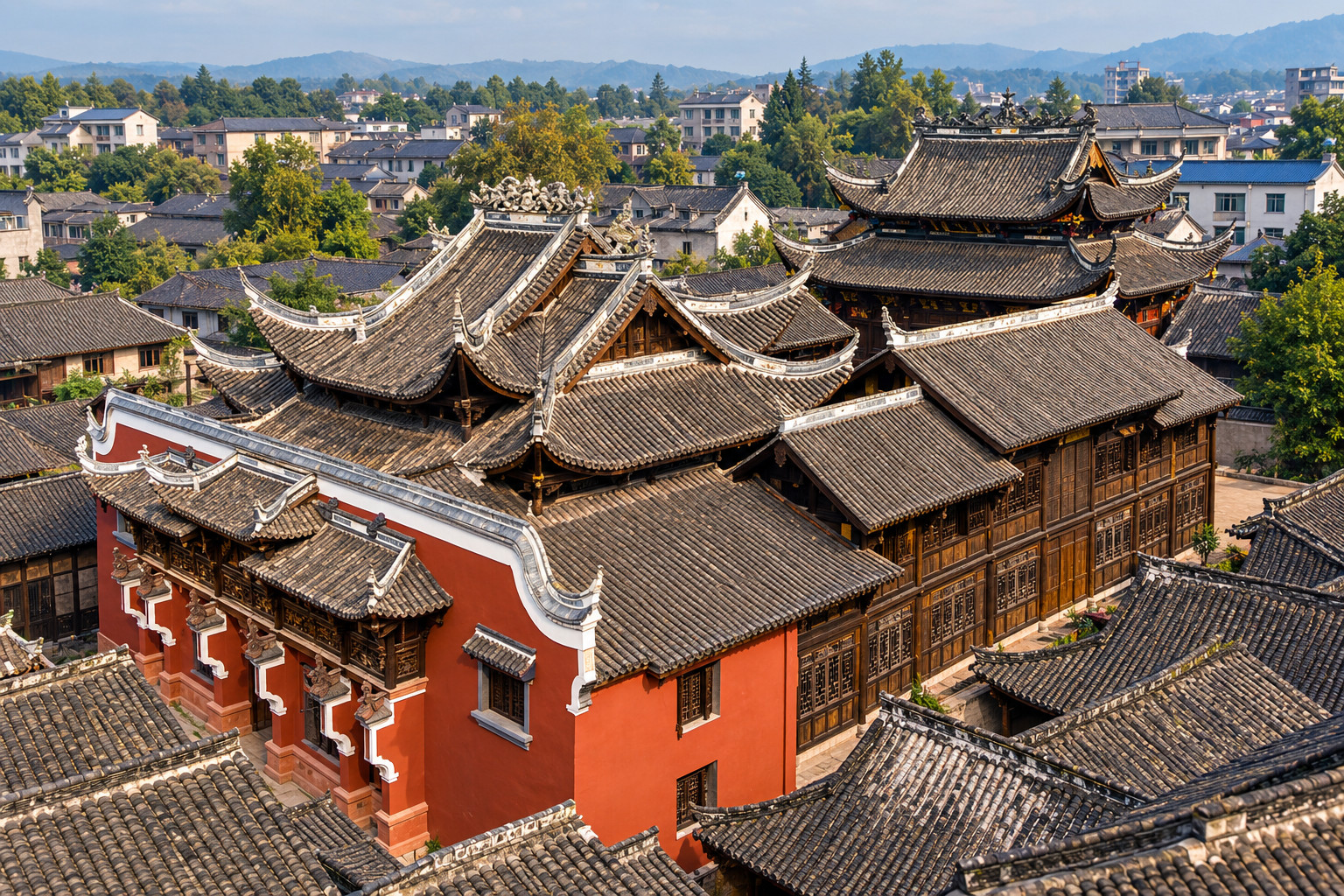
Cover illustration: AI illustration based on a historical photograph. Songji: red walls, timber and layered roofs; the compound name and age are unverified. Scene, terrain and architectural details are approximate; not a current photograph, access confirmation or navigation guide.
Historical reference only; original photograph not republished or licensed for reuse: Yongchuan District Government / Photographer not credited
This guide contains four explicitly labeled AI scene illustrations from historical photo references and one original localized planning diagram. Photograph capture dates and current access are not established by the page update dates. No independent review is claimed.
Songji Ancient Town in 2026 suits travelers interested in how a Yangtze port became a neighborhood of lanes, courtyards and ancestral halls. Yongchuan's tourism authority places it in the district's south. Plan one focused heritage walk, with the river as your starting question and the return journey arranged before you leave Chongqing.
Use the Chinese name 松溉古镇 when checking a map or booking transport. The district explicitly gives the second character's local reading as “Ji,” which explains the English spelling Songji. This is an outing to Yongchuan, not a central-Chongqing waterfront neighborhood. Similar-looking river scenes elsewhere are poor substitutes for the correct destination pin.
The suggested sequence below is desk-researched. It is intended to help you notice the relationship between commerce, buildings and terrain, rather than promise that a particular doorway, exhibition or historic landing will be open on your date.
Start with the Yangtze, then look inland
The Chongqing Local Chronicles Office's June 2026 account places Songji on the Yangtze's north bank and describes its former role as a meeting point for river and land transport. Its historical account distinguishes upper, middle and lower wharves. That is a useful framework for understanding the town, not evidence of three operating passenger piers today.
At a permitted river-viewing position, look back toward the buildings and ask how goods could have moved between waterfront and streets. Where does an approach narrow? Where might a load need to change direction? Which buildings face the river, and which turn toward a lane? These observation prompts give the walk a purpose without assigning an unsupported function to every surviving structure.
Do not go down an unsigned flight of steps simply because it appears to reach an old landing. Water levels, barriers and surfaces can change independently of the town's historical importance. A safe view from an open public area is enough to understand the wider setting. A heritage port visit need not include a boat ride.

AI illustration based on a historical photograph. Songji roofscape beside the Yangtze; no current boat service is implied. Scene, terrain and architectural details are approximate; not a current photograph, access confirmation or navigation guide.
Historical reference only; original photograph not republished or licensed for reuse: Yongchuan District Government / Photographer not credited
Let a short street sequence explain the trading town
The same historical-office account names Zhengjie, Jiefangjie, Banbianjie and Linjiangjie among the old streets. Choose two or three signed lanes that are open when you arrive. Ask for a local visitor map before assuming the names form a continuous, level circuit.
A useful suggested progression is waterfront orientation, a main commercial street, a side lane, then a courtyard or ancestral-hall stop. It moves from the town's external connections toward its domestic and community spaces. Reverse the order if your actual drop-off point or access conditions make that easier; this is an interpretation sequence rather than a surveyed walking route.
Notice changes in scale. A street-facing opening may be broad enough for business, while the spaces behind it become more enclosed. A covered edge can mediate between shop and pavement. Look for these relationships where they are visible, but avoid deciding that every wide doorway was a warehouse or every large house belonged to a merchant without a sign or documented explanation.
The recent official descriptions count streets differently. There is no need to turn the visit into a search for a supposedly definitive total. A small section read carefully can reveal more than a hurried attempt to tick off every lane.
Read the houses as structures, not just backdrops
Songji's 2026 heritage description discusses timber framing, bamboo-and-plaster walls, tiled roofs and internal courtyards. Use three questions while looking from public space: what supports the roof, how does light enter, and how does the house meet the uneven street?
A courtyard can help you think about light, ventilation and the relationship between rooms. It does not automatically mean the building is open for visitors. If a door is unlocked or someone is sitting inside, ask before entering. A shopkeeper's invitation into the front room is not permission to explore the household's rear rooms or upper floor.
Be equally careful about dates. A district promoted as historic may contain older fabric, rebuilt portions and recent repairs within the same view. The weathered appearance of a beam is not a reliable dating method. Read a building's own panel if available, and distinguish a site's foundation history from the age of its present walls or roof.
For a sketch or photograph, choose one feature you can explain accurately, such as a threshold, roof junction or courtyard opening. A precise caption about a visible detail is more useful than a claim that the whole street has remained unchanged for centuries.

AI illustration based on a historical photograph. Roof, timber and plaster relationships in Songji; not a verified named lane or evidence of original ancient fabric. Scene, terrain and architectural details are approximate; not a current photograph, access confirmation or navigation guide.
Historical reference only; original photograph not republished or licensed for reuse: Yongchuan District Government / Photographer not credited
Choose an ancestral hall with a clear question
The Yongchuan tourism page dated 20 January 2026 identifies Luo ancestral hall, the Chen family courtyard and the Fan ancestral hall among Songji's heritage places. Pick one as a priority and confirm its current entrance, rather than assuming every named building is a staffed attraction.
An ancestral hall and a commercial guild hall are different institutions. When reading a panel, ask whether the building served a lineage, a professional association, a group from a shared place of origin, or another community. That distinction keeps the port's history from becoming a vague story about “rich merchants” attached to every impressive entrance.
You can make a compact comparison between the hall's public-facing entrance and a nearby residential frontage. What is emphasized by the entry, roof or arrangement of space? Is there an inscription identifying a donor or family? Use a translation tool cautiously, keeping the original Chinese text for names. Do not assign a clan identity from a surname on a modern shop sign.
If the interior is unavailable, the visit need not fail. Read the exterior from the public lane, move on without obstructing residents, and leave the undocumented interior out of your account. Access is a practical question separate from a building's historical significance.
Leave room for residents and everyday commerce
A March 2019 iChongqing photo essay records residential courtyards and the preparation of preserved vegetables in Songji. It is a dated account, but it usefully reminds visitors that an old-town street can be someone's workplace and front door as well as a travel subject.
Apply two simple photography rules: request permission for an identifiable close portrait, and never block a doorway or work area to compose a picture. A resident does not owe a visitor a performance of traditional life. Avoid following people into a courtyard because their clothing or activity seems photogenic.
If you stop for tea or buy something, establish the price and what it includes before sitting or ordering. A genuine transaction can be a better way to spend time in a neighborhood than hovering with a camera. Do not assume a purchase authorizes photography of staff, family members or private rooms.
Old photographs also need honest captions. A 2019 image can illustrate a documented historical moment, but cannot demonstrate present crowd levels, the survival of a particular business or what will be drying outside a house when you visit.

AI illustration based on a historical photograph. Songji archway and steps; exact gate name, age and access are unverified. Some roof tips lie outside the illustration frame. Scene, terrain and architectural details are approximate; not a current photograph, access confirmation or navigation guide.
Historical reference only; original photograph not republished or licensed for reuse: Yongchuan District Government / Photographer not credited
Make food a pause in the walk
The June 2026 historical feature names Songji's salt-preserved cabbage and puffed-rice sweets, alongside the local nine-bowl banquet tradition. Treat these as food leads to investigate, not a promise that every shop serves the same recipe or that a banquet is available without advance arrangement.
For a small group, a simple lunch and one shared snack may fit the outing better than searching for a complete ceremonial meal. Ask what is available that day, how a portion is priced and whether a preserved product needs refrigeration after opening. If dietary restrictions matter, check ingredients with the seller instead of inferring them from an English translation.
Allow the stop to break the walk naturally. A seated pause before another lane or courtyard can help companions with different interests enjoy the same outing. There is no need to order a large meal just because an article associates it with the town.
Solve the Yongchuan transfer before departure
The district's January 2026 page locates the attraction near Songji's passenger-station exit and mentions buses from a passenger transport center. It does not supply enough detail to establish a current end-to-end itinerary from your Chongqing hotel.
Confirm three separate legs: reaching your chosen Yongchuan arrival point, transferring to Songji Ancient Town, and returning from Songji. If using rail, the station arrival is only an intermediate step. Check the exact onward terminal, departure location and last useful return rather than combining unrelated schedules from old travel posts.
For a hired car, agree on a practical pickup point outside narrow lanes. Save the driver's contact details and a Chinese map pin for that point. A riverfront photo location is not necessarily a place where a vehicle can wait. Build your departure around the confirmed return, not around an assumed availability of taxis after dark.
The railway-stations guide and navigation guide explain broader checks. Neither substitutes for the local connection you need to verify.
Give the walk a realistic boundary
For this one-town outing, choose the river setting, a signed lane and a named heritage building as your minimum plan. Add other stops only after you know the surface conditions, your group's energy and the time required to return. Treat a slow visit as a choice about attention rather than a contest to cover the largest area.
Ask specifically about steps between drop-off, the desired building and a usable toilet if anyone needs a reduced-step route. This research did not establish a continuous accessible circuit. Rain can also make stone paving less forgiving, so change the sequence or shorten it rather than forcing a planned descent.
Readers interested in the difference between family and migrant institutions can use the Huguang Guild Hall guide as a separate Chongqing-city comparison. Keep Songji's own names and evidence central to what you see here.

Original planning card; all labels also appear as selectable text below. Planning questions only. Confirm current access and return transport; this is not a route map.
Original editorial planning diagram based on this article; not a photograph or geographic map.
Set a boundary for Songji
Minimum walk:
- River: observe from an open, permitted public position.
- Lane: choose a signed lane that is open.
- Heritage exterior: choose a named building; ask before entering.
Check before leaving:
- Confirm every transfer and the last useful return.
- Check steps, surfaces and a usable toilet for your group.
- Keep pickup outside narrow lanes; allow a shorter visit.
Planning questions only. Confirm current access and return transport; this is not a route map.
About This Guide
Sources were read on 1 October 2026, including Yongchuan tourism information, the municipal historical office and a dated public photo feature. Route order and visitor questions are editorial suggestions. No field visit or human review is claimed. Current transport, interiors, charges and access arrangements remain to be checked for your date.
Frequently Asked Questions
Q: Is Songji the same place as Songgai? A: English spellings can vary, but the Yongchuan authority explicitly gives 松溉 the reading “Ji.” Use 松溉古镇 and Yongchuan when confirming the destination.
Q: Can I arrive directly by a sightseeing boat? A: Songji's historic wharves do not establish a current passenger service. Confirm an actual operator and departure before planning a boat arrival.
Q: Are the ancestral halls open every day? A: Daily access to Songji's individual halls was not verified. Confirm the named hall separately from access to public town streets.
Q: Is a Yongchuan railway ticket enough for the trip? A: No. You still need the local connection to Songji and a confirmed return arrangement from the town.
Q: Can I see Songji without entering private houses? A: Yes. A suggested visit can focus on its Yangtze setting, public lanes and visible heritage exteriors, with interiors added only when clearly open or permission is given.
Traveler comments
Share a recent experience or ask a practical question about this guide.