

Cover: AI illustration: Chongqing Sichuan Opera Art Center exterior. Original AI illustration using historical photo references; capture dates are unknown. Approximate scene, not the current display, cast, programme or proof of public backstage access.
Visual reference: iChongqing / Chongqing Municipal Commission of Culture and Tourism Development
Original AI illustration using historical photo references; capture dates are unknown. Approximate scene, not the current display, cast, programme or proof of public backstage access.
For Sichuan opera in Chongqing in 2026, choose the performance format before choosing a ticket: a complete play, an excerpt programme or a visitor-oriented variety show. Chongqing’s official New Year programme described its resident introduction as about 1 hour. Language support, auditorium and the actual bill matter more than a face-changing photograph.
A ticket labelled “Sichuan opera” can lead to very different evenings. You might follow characters through a sustained dramatic story, see selected scenes with contrasting performance styles, or attend a presentation designed to introduce visitors to particular skills. None of these descriptions tells you whether English interpretation is supplied. Decide what you want to watch, then ask the organiser to confirm what the purchase includes.
This guide focuses on the choice of performance, rather than a ranking of theatres. It also separates examples of previous programmes from performances announced for a particular date. An attractive poster from an earlier holiday is useful for identifying a production, but it is a poor basis for deciding when to leave your hotel.
Understand what the different ticket descriptions promise
Chongqing’s official account of the New Year 2026 programme explicitly separated complete plays, excerpt performances and the resident tourism production Zuiren de Chuanju, 醉人的川剧. The last was described as approximately 1 hour, with 3 themed units. That description is a historical guide to its format, not a confirmed running time for every later version.
Look for 大幕戏 when the listing presents a complete dramatic work. For a visitor who enjoys theatre, this offers the possibility of following a story and noticing how the performers sustain a role. The useful preparation is a synopsis: who the central people are, what they want and what changes between scenes. You do not have to understand every sung word to watch carefully, but a full play requires more tolerance for gaps in comprehension.
折子戏 means selected scenes or excerpts. An excerpt bill can let you compare different characters and theatrical situations without following a whole plot. The trade-off is that the context can change between pieces. Ask for the names of the excerpts, rather than assuming a single storyline links the entire performance. A translated summary of each scene will be more useful than a general description of the art form.
A tourism-oriented resident show may combine scenes, skills and audience interaction. That can suit a visitor who wants an introduction and enjoys visible changes of pace. It should still be evaluated by its actual programme. Face-changing may be part of the presentation, but the label does not tell you how much singing, spoken dialogue, movement or other material surrounds it.
A restaurant’s brief entertainment act is a different purchase again. Before treating dinner entertainment as your theatre visit, establish whether the performance is a scheduled attraction, an occasional appearance or a separately charged activity. Ask whether it has a named company and programme. A dining room photograph cannot establish any of those details.

AI illustration: Opera museum display corridor. Original AI illustration using historical photo references; capture dates are unknown. Approximate scene, not the current display, cast, programme or proof of public backstage access.
Visual reference: iChongqing / Event organizer, via iChongqing
Match the bill to your interest in a story
A holiday programme published on 30 September 2026 gives a concrete example of these distinctions. It announced Bibo Honglian on 1–2 October, White Snake on 3–4 October and an exchange programme of excerpts on 5 October, all at 14:00 in the large theatre of Chongqing Sichuan Opera Art Centre. These are dated announcements, not a repeating weekly timetable; seat availability was not checked for this guide.
For a complete play, search by the Chinese title as well as the venue. A translated title may vary between booking platforms, while the Chinese production name gives staff a precise reference. Save the date, performance title and auditorium together. The question to ask is whether this is the full production or an excerpt from it. Familiarity with a story does not establish which version you are booking.
Choose a full play if you want to spend time watching dramatic development and are comfortable preparing beforehand. Read the organiser’s synopsis, note the central relationship and leave room to discover the staging. Avoid loading your phone with a long explanation that will require constant reading in a dark auditorium. A short printed or offline note can do the practical work before the curtain rises.
Choose an excerpt programme if your curiosity is about contrast: the shape of a comic scene, a change in singing style, the handling of a prop or a physical sequence. You can ask which pieces are being performed and whether the organiser offers introductions between them. Do not assume those introductions will be in English. A clear programme can make an excerpt evening easier to follow even when the spoken introduction is unfamiliar.
For a mixed group, discuss the experience before buying. Someone interested in storytelling may be disappointed by a rapid collection of skills; someone expecting a short visual introduction may struggle with a longer drama. Treat those as preferences, rather than as measures of cultural seriousness. A smaller commitment that everyone genuinely wants is more useful than a performance chosen because a travel checklist says to attend.
Keep the rest of the day compatible with the show. If you have booked an afternoon performance, arrange lunch and travel around its actual start time. If your group is already tired from walking, remove another stop rather than planning to arrive late. Late admission, re-entry and leaving during a scene are venue-specific questions to settle beforehand.

AI illustration: Embroidered costume and back flags. Original AI illustration using historical photo references; capture dates are unknown. Approximate scene, not the current display, cast, programme or proof of public backstage access.
Visual reference: iChongqing / Event organizer, via iChongqing
Check language support, sightlines and participation
The April 2026 report on Zuiren de Chuanju’s revision described a comic compere linking pieces and interaction beginning half an hour before the May holiday performances. It also located the show in the art centre’s small theatre. That is useful evidence of an introductory format, but it does not establish English surtitles, current pre-show access or participation at a later performance.
Ask about language in separate parts. Are there written English summaries? Are surtitles projected, and in which language? Does the host explain scenes? Is any audio interpretation available? These are different services. “Suitable for foreign visitors” can mean that a show has strong visual elements; it should not be read as confirmation that every line will be translated.
If surtitles matter to you, ask where the screen is relative to the seats you are considering. A close view of the stage is not automatically a comfortable view of a high or side-mounted screen. Request a seating plan and clarification about obstructions. If you have specific access needs, describe the route and seat features you require rather than relying on a general accessible-venue label.
Think about your tolerance for sound, darkness and unexpected effects. Ask the organiser whether the booked production uses fire effects, loud percussion or audience approaches, and explain any concern before purchase. Do not infer that a technique mentioned in a general introduction appears in every performance. Likewise, do not assume a front-row seat will involve participation unless the organiser confirms it.
Interaction should feel voluntary. If you would rather watch, ask whether you can choose a seat away from the activity area. If you would like to join, follow the performer’s invitation and instructions. Do not touch costumes, masks, instruments or stage objects to investigate how an effect works. Enjoying a theatrical technique does not require turning another person’s working equipment into an exhibit.
Children’s admission and seating rules also need a production-specific answer. Ask whether a child needs a ticket, whether there is an age restriction and whether a seat is required. A general description such as “family friendly” does not settle ticket conditions or whether a particular child will enjoy the sound and pacing.

AI illustration: Parasol, fan and robe on an illustrative stage. Original AI illustration using historical photo references; capture dates are unknown. Approximate scene, not the current display, cast, programme or proof of public backstage access.
Visual reference: Source publisher / Image uncredited; CQNews article
Buy for the exact venue and protect the evening
The municipal institution directory, updated 16 March 2026, places Chongqing’s Sichuan opera company at No. 2 Jinshan Avenue in Liangjiang New Area. Its listed office hours are administrative hours. They are not show times, box-office opening promises or evidence that every company performance takes place at that address.
Start with the event listing and the company’s named official ticket channel. The September holiday announcement identifies the 重庆市川剧院票务 mini-program. Compare the title, date, start time, auditorium and seat category before paying. If another platform sells the same event, check that its product is the same performance rather than a different tourist show using a similar English description.
Ask what is included in the quoted price. The June 2026 municipal performance calendar listed a cup of tea with a particular Sunday excerpt programme. That does not mean all opera tickets include tea or that a later offer has identical terms. Treat drinks, introductions, photography experiences and costume activities as separate inclusions unless the current product explicitly combines them.
Review cancellation and exchange conditions, the method of receiving your ticket and any document required at entry. If the interface is difficult to use, ask the venue to explain its supported purchase method. Do not send identity information to an unofficial helper merely because they offer an easier booking. Keep the confirmation accessible offline, including the Chinese venue name and a reliable contact channel.
Plan the journey using the venue attached to the booking. Chongqing Sichuan Opera Art Centre and Chongqing Grand Theatre are different names and should never be substituted by an automatic map search. Use the metro guide for general preparation and the road-level navigation guide when interpreting the final approach. Neither replaces an up-to-date route to your auditorium entrance.
At the venue, follow the photography and recording instructions for that performance. Permission to take a curtain-call photograph does not necessarily cover filming scenes. Keep screens dim, avoid blocking other audience members and wait for a suitable pause if you need to leave. Afterwards, a simple meal near your return route may fit better than racing to another attraction. The night-view route guide can help you choose a separate evening for sightseeing.
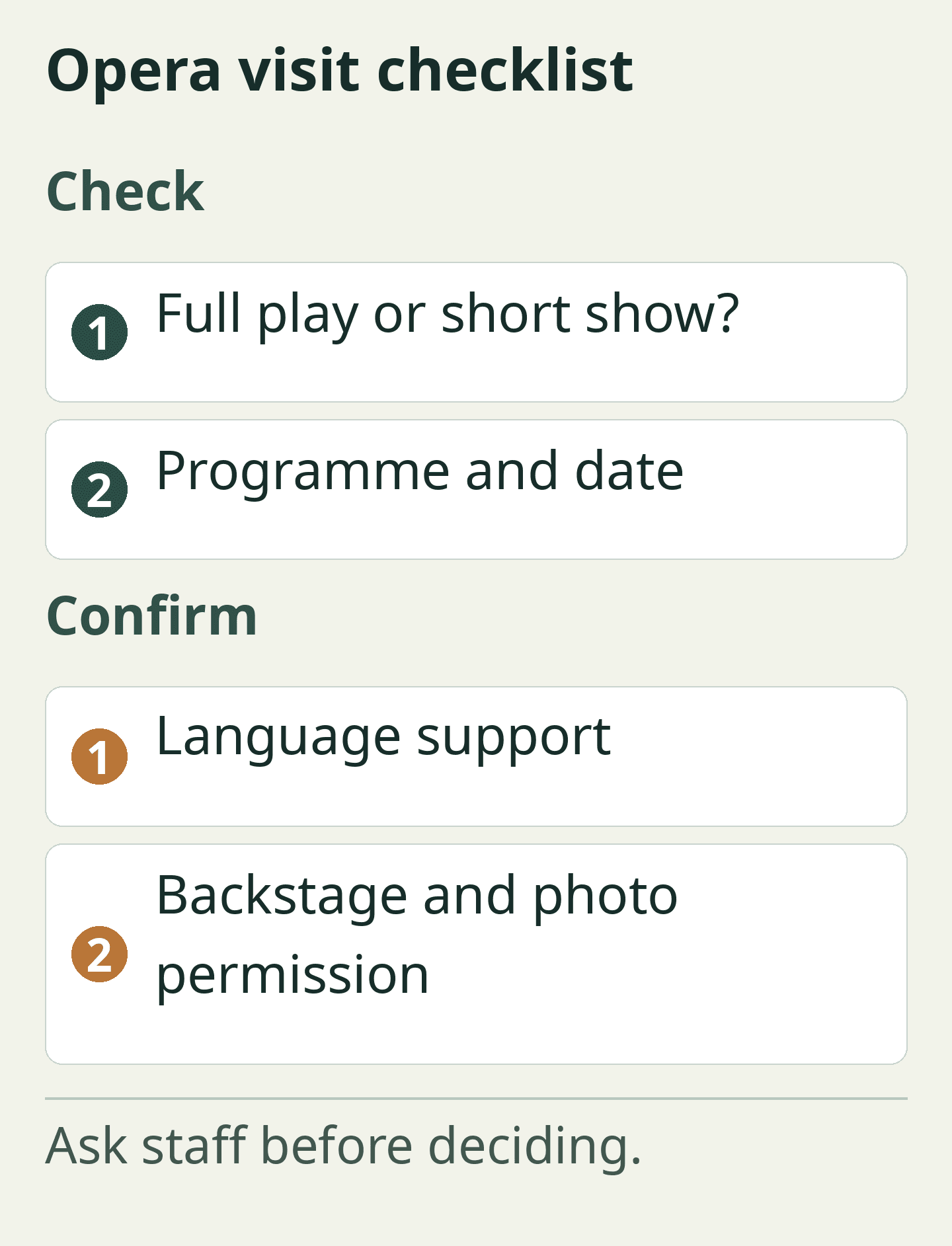
Opera visit checklist. Ask staff before deciding.
Original editorial checklist
Opera visit checklist
Check:
- Full play or short show?
- Programme and date
Confirm:
- Language support
- Backstage and photo permission
Ask staff before deciding.
About This Guide
Prepared from public sources read on 1 October 2026, including municipal programme information and reporting based on the opera company. This is a research-based planning guide, not a report of an attended performance. Historical examples are labelled by their dates. Current availability, running time, language support and ticket conditions require confirmation with the specific organiser. No independent review is claimed.
Frequently Asked Questions
Q: Is Sichuan opera in Chongqing the same as a face-changing show? A: Chongqing listings can describe a complete play, an excerpt bill or a visitor-oriented show that includes face-changing. Read the actual programme before deciding which experience you want.
Q: Can I enjoy a Chongqing performance without understanding Chinese? A: You can focus on movement, costumes and staging, but comprehension depends on the production and your preparation. Ask the Chongqing organiser about English summaries or surtitles; neither is assumed here.
Q: How long does a Sichuan opera show last? A: Chongqing’s New Year 2026 notice described Zuiren de Chuanju as about 1 hour. Full plays and later versions may differ, so confirm the running time attached to your ticket.
Q: Does an opera ticket include tea or audience participation? A: A June 2026 Chongqing calendar included tea with a particular excerpt programme. Other performances may have different inclusions, and participation should be checked with the organiser.
Q: Which Chongqing theatre should I put into my map? A: Use the precise Chinese venue and auditorium shown on the booking. Chongqing Sichuan Opera Art Centre is distinct from Chongqing Grand Theatre, and the company may perform at other locations.

Traveler comments
Share a recent experience or ask a practical question about this guide.