
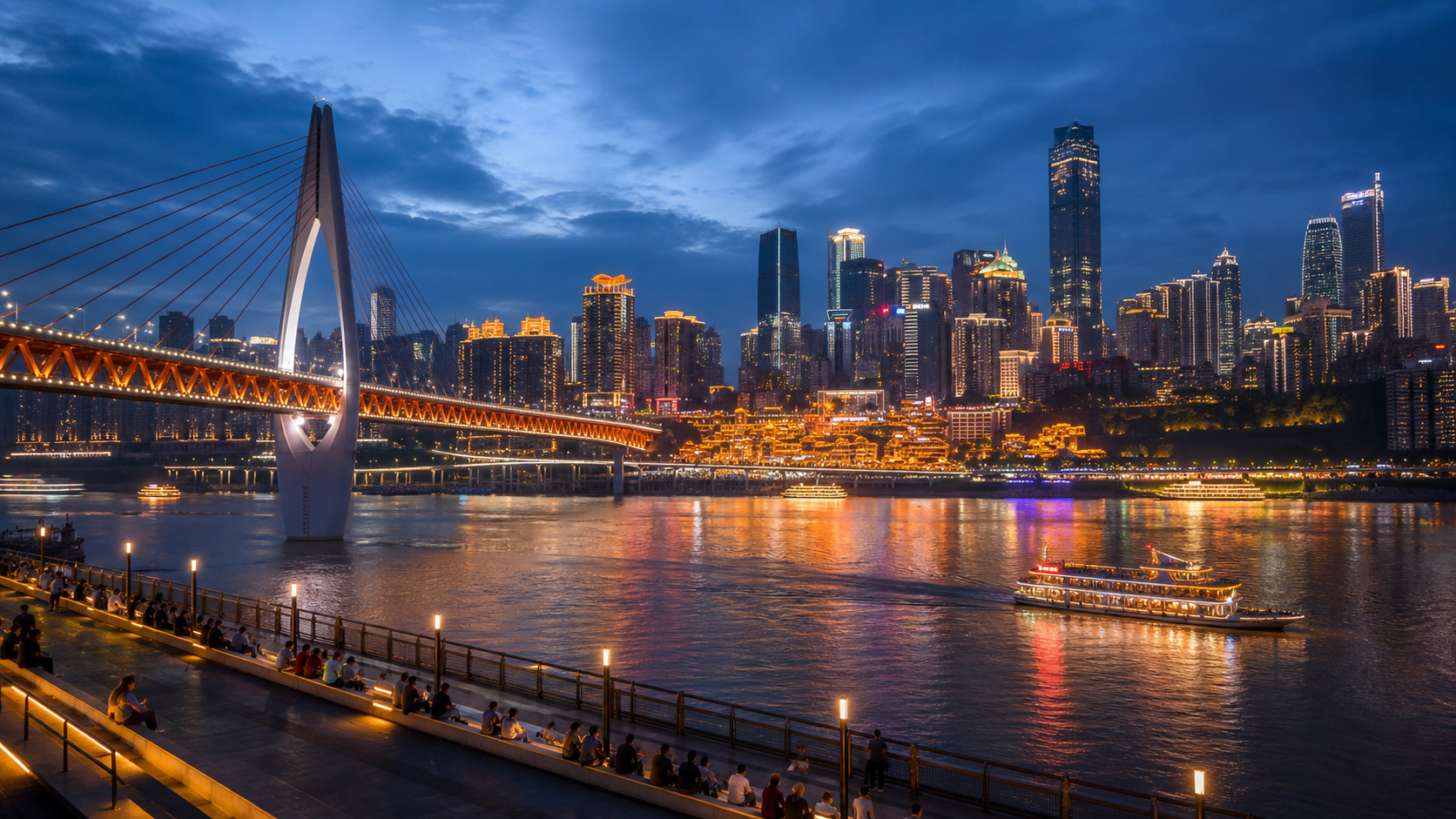
For a 2026 Chongqing night-view route, plan Hongya Cave 11F/1F, Qiansimen Bridge, and the Grand Theatre riverbank in 90-150 minutes, or 3-4 hours with Chaotianmen and Nanbin Road added. I rechecked this sequence on 2026-09-19; lighting and crowd controls can change, so confirm same-day conditions before leaving.
Chongqing looks close on a map and slow on foot. A 600 m line can involve stairs, overpasses, riverside roads, and two different city levels. This guide treats the night view as a route decision: where to start, when the lights matter, which angle is worth your energy, and where to leave without fighting the densest taxi crowd.

The Short Answer: Choose One of 2 Routes
If this is your first night in Chongqing, use the compact Yuzhong loop. Start near Jiefangbei or Linjiangmen, walk to Hongya Cave from the 11F / Cangbai Road side, check the 1F Jiabin Road angle if the flow is moving, then cross or view Qiansimen Bridge and finish at the Grand Theatre riverbank. The Chongqing Publish repost of the Hongya Cave notice describes the same basic 11F, 2F, 1F, bridge, and riverbank logic.
Use the wider route if you already know you want skyline distance. Start at Chaotianmen / Raffles City, walk toward Qiansimen Bridge and Hongya Cave, then take a taxi or metro connection toward Nanbin Road for a broad Yuzhong Peninsula view. A Trip.com route note frames a Huguang Guild Hall to Chaotianmen, Qiansimen Bridge, and Hongya Cave walk as about 3-4 km and 3-4 hours at a relaxed pace; I would treat that as a full evening, not a quick stop.
Time budget per stop
| Stop | Time to budget | What it gives you | Skip it if |
|---|---|---|---|
| Hongya Cave 11F (Cangbai Road) | 20-30 min | The easier arrival level and your first read on the vertical layout | You arrived from the river road and the climb is the problem |
| Hongya Cave 1F (Jiabin Road) | 10-20 min | The low-angle photo everyone recognises | The road and elevator crowd has stopped moving |
| Qiansimen Bridge | 20-30 min | Scale: a 720 m bridge with a 312 m main span, Hongya Cave below | Wind, rain, or anyone in the group is nervous about heights |
| Grand Theatre riverbank | 20-30 min | Distance, railings, and space for a clean group photo | You already have the frame you wanted from the bridge |
| Chaotianmen / Raffles City | 30-45 min | The two-river confluence and a wider skyline | The group has stopped talking about the view |
| Nanbin Road (optional) | 45-90 min | Yuzhong as a full opposite-bank skyline | Your ride back is unsolved or your battery is low |
- Stop
- Hongya Cave 11F (Cangbai Road)
- Time to budget
- 20-30 min
- What it gives you
- The easier arrival level and your first read on the vertical layout
- Skip it if
- You arrived from the river road and the climb is the problem
- Stop
- Hongya Cave 1F (Jiabin Road)
- Time to budget
- 10-20 min
- What it gives you
- The low-angle photo everyone recognises
- Skip it if
- The road and elevator crowd has stopped moving
- Stop
- Qiansimen Bridge
- Time to budget
- 20-30 min
- What it gives you
- Scale: a 720 m bridge with a 312 m main span, Hongya Cave below
- Skip it if
- Wind, rain, or anyone in the group is nervous about heights
- Stop
- Grand Theatre riverbank
- Time to budget
- 20-30 min
- What it gives you
- Distance, railings, and space for a clean group photo
- Skip it if
- You already have the frame you wanted from the bridge
- Stop
- Chaotianmen / Raffles City
- Time to budget
- 30-45 min
- What it gives you
- The two-river confluence and a wider skyline
- Skip it if
- The group has stopped talking about the view
- Stop
- Nanbin Road (optional)
- Time to budget
- 45-90 min
- What it gives you
- Yuzhong as a full opposite-bank skyline
- Skip it if
- Your ride back is unsolved or your battery is low
Add the stops in that order rather than by distance. Each one is a step further back, so the evening keeps making visual sense even if you stop halfway.
Works for: first-time visitors, photographers, couples, and people who want the classic river-and-bridge frame. Avoid if: you have heavy luggage, sore knees, or a tight dinner reservation within 60 minutes. Common mistake: following the nearest crowd into an elevator instead of choosing the next viewpoint outside.
If you want the daytime version of Hongya Cave first, the Hongya Cave foreign visitor guide covers entrances, levels, and the queue pattern.
Timing: Use Sunset, Not a Fixed Lighting Time
Plan to reach the upper Hongya Cave area about 30 minutes before local sunset. The current sources checked on 2026-09-19 disagree on exact seasonal light-on and light-off times, and event nights can bring temporary controls. Blue hour gives you enough daylight to read the levels; if the facade is not fully lit yet, use that time to find the bridge or far-bank angle.
My local pacing rule is simple: do not put dinner, Hongya Cave, Qiansimen Bridge, and Nanbin Road into the same 90-minute window. You will spend some time repositioning, waiting at traffic lights, and deciding whether a staircase is worth it.
A clock plan for a less stressful first night
| Clock | Where to be | Why then |
|---|---|---|
| Sunset - 30 min | Arriving at Linjiangmen or the Cangbai Road / 11F side | You get oriented while there is still sky light |
| Sunset to +30 min | At a Hongya Cave viewpoint | You can adjust if seasonal lighting starts later than expected |
| +45 to +90 min | Qiansimen Bridge or the Grand Theatre riverbank | The route gains distance and a cleaner full-facade angle |
| Before your final metro buffer | Walking toward a wide road or sitting down to dinner | You verify the last train before committing to rail |
- Clock
- Sunset - 30 min
- Where to be
- Arriving at Linjiangmen or the Cangbai Road / 11F side
- Why then
- You get oriented while there is still sky light
- Clock
- Sunset to +30 min
- Where to be
- At a Hongya Cave viewpoint
- Why then
- You can adjust if seasonal lighting starts later than expected
- Clock
- +45 to +90 min
- Where to be
- Qiansimen Bridge or the Grand Theatre riverbank
- Why then
- The route gains distance and a cleaner full-facade angle
- Clock
- Before your final metro buffer
- Where to be
- Walking toward a wide road or sitting down to dinner
- Why then
- You verify the last train before committing to rail
A September 2026 Hongya Cave guide likewise warns that lighting is seasonal, while recent Trip.com visitor material gives conflicting clock times. That conflict is the reason this plan uses sunset-relative steps instead of promising one daily schedule.
If the bridge is crowd-controlled
Do not fight a one-way barrier or temporary closure. Stay on the Yuzhong side for the upper/lower Hongya Cave views, or take Line 6 to Grand Theatre and use the Jiangbeizui riverfront as the wide-angle finish. A recent Chongqing local discussion also points visitors to the Grand Theatre, Beibin Road, and Nanbin Road as night-view alternatives. Keep Nanbin Road as a separate taxi/metro extension rather than improvising a long cross-city walk.
If it rains, shorten the route
If weather is rainy or the riverbank is slippery, shorten the route. Night photos still work in light rain, but foreign visitors often underestimate the polished stone, steps, and road-level changes. The river view is not worth walking below barriers or down to wet stones.

Stop 1: Hongya Cave 11F and 1F
Hongya Cave is useful because it teaches Chongqing's vertical layout in 20 minutes. The same place can feel like a street entrance at 11F and a cliff-side building at 1F. Start from 11F / Cangbai Road if you want the easier arrival; use 1F / Jiabin Road for the dramatic low-angle photo, then leave before the road and elevator crowd eats the evening.
A short-video viewpoint guide on Douyin Jingxuan lists 1F, Qiansimen Bridge, Grand Theatre, and riverbank viewpoints, and warns that 1F gets crowded. I agree with that route logic. At 1F, spend 10-20 minutes, take the low shot, then move. You do not need to "complete" every interior level. The outside route explains the mountain-city structure better than another commercial corridor.
Local tip: if you are staying near Jiefangbei, save your hotel address in Chinese before leaving. If you are based at Walling Hotel (Jiefangbei Hongyadong), No. 68 Linjiang Road, treat Linjiangmen / Cangbai Road as the natural upper-side starting pattern rather than forcing a lower river-road taxi drop-off.
Stop 2: Qiansimen Bridge for Scale
Qiansimen Bridge is not mainly for close-up detail; it is for scale. From the pedestrian side, you can see the Jialing River, Hongya Cave below, and the Yuzhong skyline behind it. Wikipedia's Twin River Bridges entry lists Qiansimen at 720 m total length with a 312 m main span; the upper deck carries four vehicle lanes plus pedestrian walkways, and the lower deck carries CRT Line 6. It opened to rail in April 2014 and to road traffic in April 2015.
Its sibling downstream, Dongshuimen Bridge, is longer at 858 m with a 445 m main span. Both were built with deliberately short towers so they would not visually dominate the buildings around them, which is exactly why the skyline behind Hongya Cave reads as buildings rather than as bridge hardware.
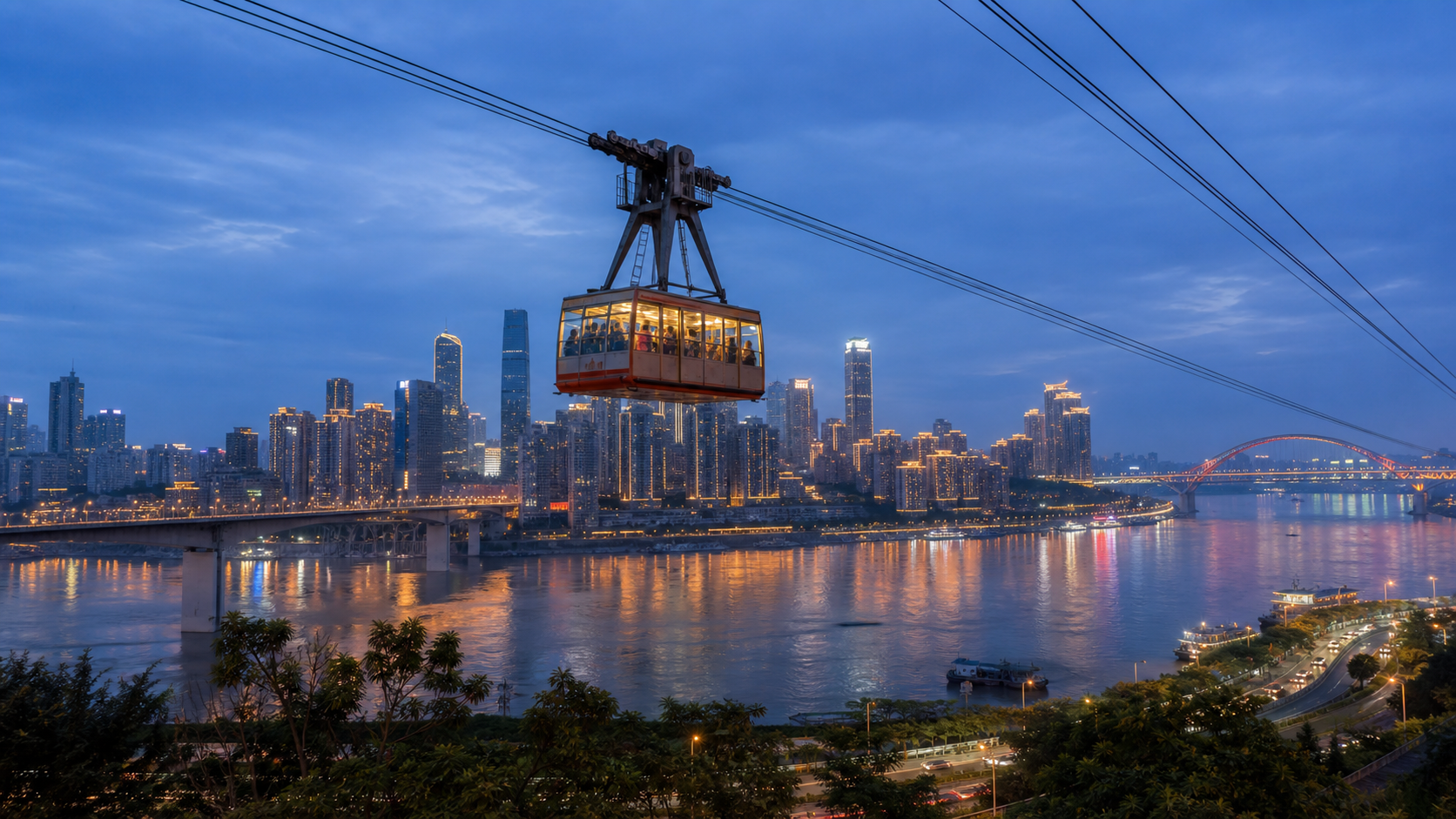
Use the bridge after you have already seen Hongya Cave from 11F or 1F. That order helps your brain understand the height difference. Keep moving to the side when taking photos; a bridge walkway is still a walkway. I usually prefer one wide skyline frame and one short video of the river and lights, then continue to the Grand Theatre side if the group is not tired. If you would rather cross the river with a view instead of on foot, the Yangtze River Cableway guide covers the queue and ticket pattern.

Stop 3: Grand Theatre Riverbank for the Clean Group Photo
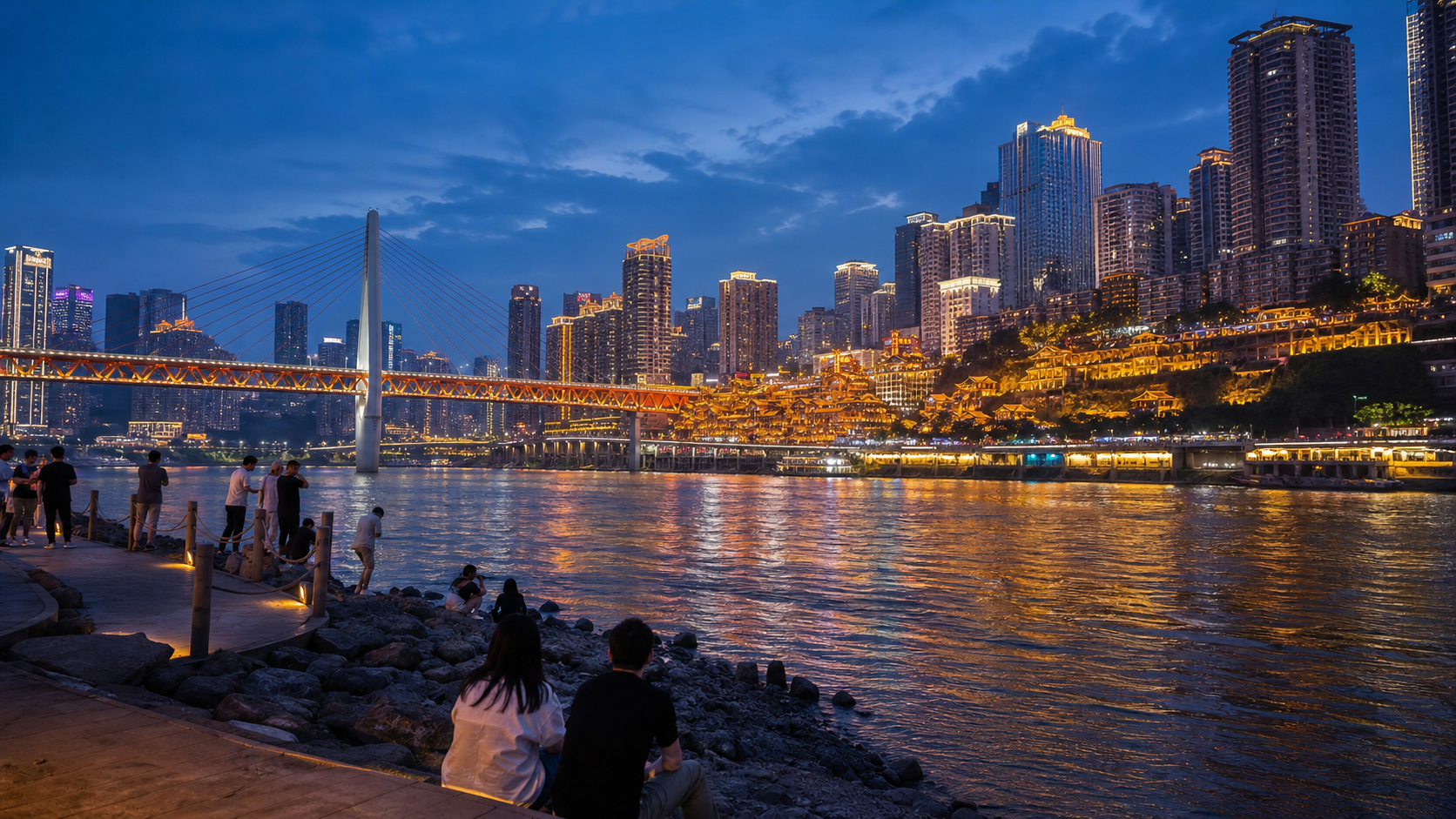
The Grand Theatre riverbank is often easier for a group photo than standing directly in front of Hongya Cave. You get distance, railings, open space, bridge lines, and the building lights across the river. The government repost and the Douyin viewpoint guide both support this cross-river logic. I would use this stop when you are traveling with family, children, or anyone who gets tired in dense crowds.
Safety matters here. Stay behind the riverbank boundary, especially after rain or when water levels change. The view is already wide enough; stepping down toward wet stones does not improve the photo enough to justify the risk. If you use a tripod, place it where people can still pass.

Stop 4: Chaotianmen and Raffles City for the Confluence Frame
Chaotianmen is where the route becomes more skyline-focused. Raffles City, the river confluence, cruise boats, and bridge lights give you a different kind of night view from Hongya Cave. The Nihao Chongqing night-view guide treats Chaotianmen and the rivers as major night-view material, and that matches how visitors actually use the area: wider frames, water reflections, and a more open sense of the two rivers.
Use this stop if you still have energy after Qiansimen Bridge, or if your hotel is near Chaotianmen / Raffles City. Do not add it mechanically if your group already looks tired. A good Chongqing night route is not measured by the number of pins; it is measured by whether you still enjoy the last 30 minutes.

Optional Cross-River Finish: Nanbin Road
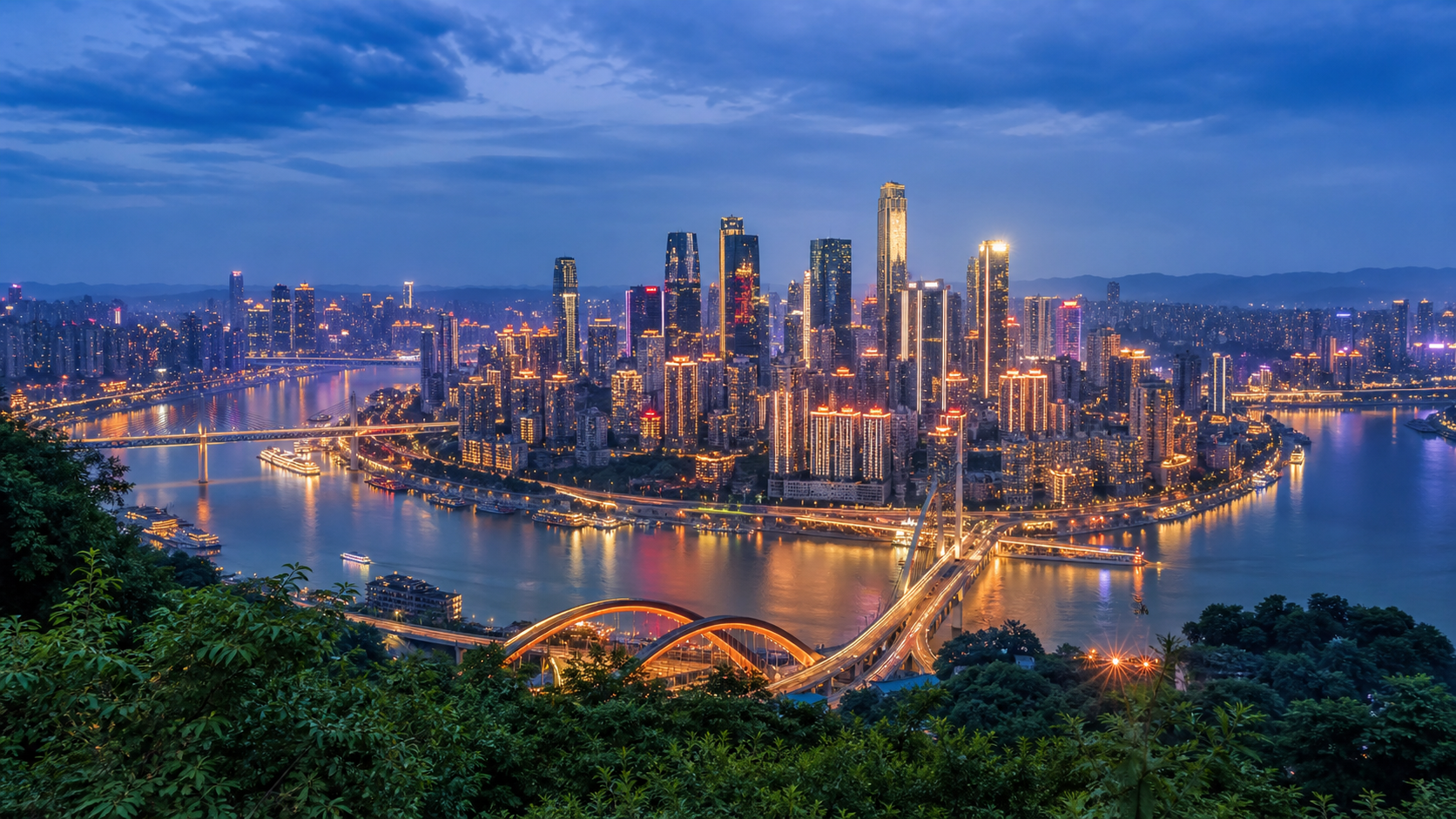
Nanbin Road is the better choice when you want to step back and see Yuzhong as a skyline. The Chinese Wikipedia entry describes Nanbin Road as a Nan'an District riverfront corridor opposite Yuzhong, with a tourism/viewing corridor listed at 25 km and about 160,000 square meters. For a traveler, the practical point is simpler: this is not one small photo pin. It is a long opposite-bank viewing zone, so choose your exact drop-off before you go — 25 km of riverfront means a vague pin can leave you a 3 km walk from the frame you wanted.
Works for: skyline photos, couples, slower evening walks, and visitors who want a calmer finish after Hongya Cave. Avoid if: you have not solved your ride back, your phone battery is low, or you still need to cross the river for a late dinner. Estimated time: 45-90 minutes if you treat it as a separate ending rather than a quick add-on.

Taxi and Exit Strategy
Do not request a ride from the tightest photo point. Walk 200-500 m toward a wider road, a hotel entrance, a mall frontage, or a clearer pickup area first. This is especially important after the facade is fully lit, when people, taxis, ride-hailing cars, and sightseeing traffic compete for the same roads.
Useful Chinese phrases:
请带我到洪崖洞11楼沧白路入口。— Please take me to the 11F Cangbai Road entrance of Hongya Cave.请带我到重庆大剧院江滩附近,方便拍洪崖洞。— Please take me near the Grand Theatre riverbank for Hongya Cave photos.请带我到南滨路可以看渝中夜景的地方。— Please take me to a Nanbin Road spot where I can see the Yuzhong night view.这里不好打车,我们走到大路上再叫车。— It is hard to get a taxi here; let's walk to a main road first.
Common mistake: copying an English attraction name into a ride-hailing app and assuming the driver knows the level you mean. Chongqing needs entrance-level language, not just landmark names.
Or leave by metro, if you leave early enough
Last trains vary by line, direction, and service adjustment. Before you leave the riverfront, check the 首末班时间 section in the Yu Chang Xing app or the station display, then keep at least a 20-minute buffer for stairs, security, and finding the correct entrance. Our Chongqing metro guide covers exits, transfers, and when to stop fighting the map and pay for a car.

About This Guide
This guide was rechecked on 2026-09-19 against a recent Chongqing local discussion, current Qiansimen Bridge visitor material, and an independent Hongya Cave guide updated in September 2026. The three sources agree on the core Hongya Cave–bridge–Grand Theatre sequence but conflict on exact lighting times, so this update deliberately uses sunset-relative planning.
Event and drone-show schedules remain same-day checks, and no source we opened publishes ticket prices for these viewpoints, so this guide does not either. The public images are original AI-generated recreations; third-party references remain internal.
For deeper planning, continue with the Hongya Cave foreign visitor guide, Yangtze River Cableway guide, and first-time 3-day Chongqing itinerary.
Frequently Asked Questions
Q: What is a realistic Chongqing night-view route for a first visit?
A: Use Hongya Cave 11F/1F, Qiansimen Bridge, and the Grand Theatre riverbank as the short 90-150 minute route. Add Chaotianmen or Nanbin Road if you have 3-4 hours and enough energy.
Q: What time should I arrive for Hongya Cave lights in 2026?
A: Arrive about 30 minutes before local sunset and check the same-day lighting notice because seasonal and event schedules can change. The 2026 sources reviewed on September 19 did not agree on one reliable daily clock time.
Q: Is Nanbin Road worth adding on the same night?
A: Add Nanbin Road if you want the opposite-bank skyline and still have 45-90 minutes. Skip it if your phone battery is low, your group is tired, or you still need a late dinner in Yuzhong.
Q: Is Qiansimen Bridge safe for photos?
A: Yes if you stay on the pedestrian side, keep moving when others need to pass, and do not climb or lean over railings. The 720 m upper deck carries four vehicle lanes alongside the walkways, so treat it as a walkway first and a viewpoint second.
Q: Where should I call a taxi after Hongya Cave at night?
A: Walk 200-500 m away from the densest photo point toward a wider road, hotel frontage, or mall entrance. In Chongqing, the pickup level matters as much as the landmark name.
Traveler comments
Share a recent experience or ask a practical question about this guide.