
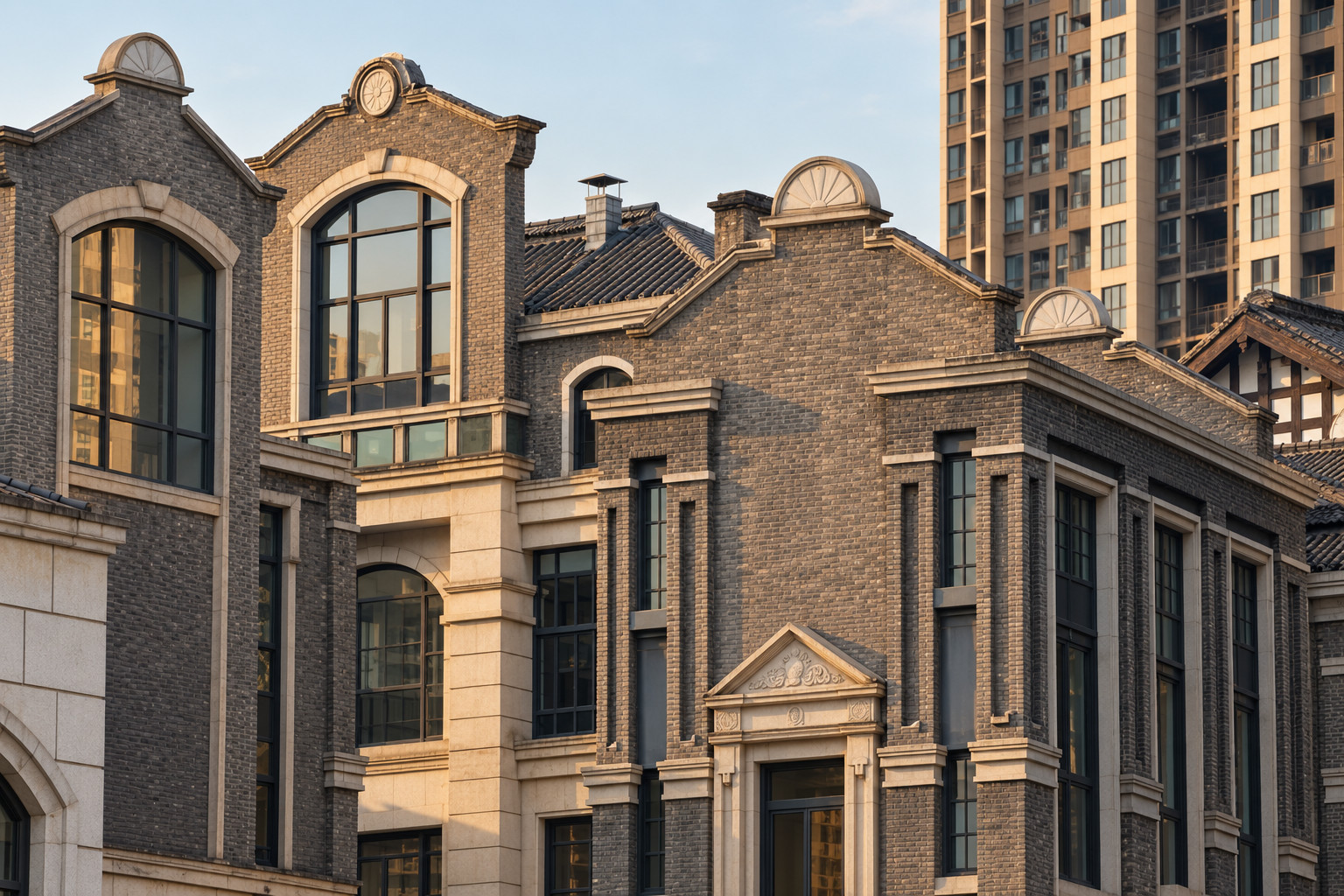
For Danzishi Old Street in 2026, plan a terraced architecture walk with time to understand what has been restored or rebuilt. Chongqing’s Local Chronicles Office describes nine hillside levels and an 80-metre elevation difference. The reward is the relationship between port-city memory, modern leisure space and river views, rather than an untouched historic street.
Save 弹子石老街 for Danzishi Old Street and 长嘉汇 for the associated Changjiahui development. These names can overlap in search results without identifying the same entrance. Before travelling, decide whether your priority is the upper historic-style streets, the lower river-facing public space or a particular cultural venue.
Danzishi is especially useful for visitors who like to read buildings critically. You can enjoy a reconstructed courtyard while recognising that its present form is a modern interpretation. That distinction makes the visit more interesting: the street is both a place with history and a contemporary choice about how to present it.
Understand the place before judging its age
The Japanese consulate’s visitor account dated August 2019 describes a reconstructed old-style precinct that opened in June 2018. It places the area across the Yangtze from Chaotianmen, between Taichang Road and Nanbin Road. This is a useful spatial and historical starting point, not a current directory of businesses.
Look for interpretation that distinguishes an original object, a restored feature and a reconstructed building. They can all contribute to the story, but they are not interchangeable. A weathered surface or traditional roof does not establish age by itself. If a label is unclear, record the wording where photography is allowed rather than inventing a date from appearance.
Danzishi’s port-city theme makes the river part of the explanation. Consider how people, goods and information would move between a waterfront and the slope above it. You do not need a detailed economic history to notice that a staircase is more than a photographic background: it expresses a practical relationship between different levels of the city.
Avoid letting a single attractive corner stand in for the whole neighbourhood. Include contemporary structures and public circulation in your mental picture. The contrast between historical reference and present-day development is a visible part of Danzishi, not something that needs to be cropped away to make the visit meaningful.

Editorial planning card. The selectable text below contains the same labels and advice. Verify arrangements for your visit.
Choose your Danzishi walk
- Route levels: Mark your arrival level and exit before descending. Confirm an upper entrance and return transport for a downhill walk.
- Heat & steps: Choose a short section, pause in permitted shade and allow for the climb back. Downhill steps can still strain knees.
- Read the history: Look for reconstructed courtyard and arch labels. Check barracks access separately before making it your main stop.
Nine levels and 80 m describe the whole site, not your required ascent. A continuous step-free route is unverified.
Choose the direction that suits your knees and your return
The Local Chronicles Office account, whose article body is dated April 2021, describes nine sloping levels and an 80-metre height difference. These are site-description figures. They are not a measured ascent for the route you will take, nor proof that every level connects by a step-free path.
Before starting, identify your arrival level and intended finishing point. If you want a predominantly downhill walk, first confirm that your chosen upper entrance is accessible and that the lower exit connects with your return transport. A downhill route can reduce climbing while still being uncomfortable for someone who finds steps difficult.
If you prefer to return the way you came, choose a smaller part of the street and make the turnaround deliberate. Do not keep descending because the next terrace looks close without considering the climb back. Allow companions to stop at a comfortable public place instead of treating every level as compulsory.
Ask specifically about lifts or ramps if you need them. This guide did not verify a continuous accessible route on 1 October 2026. A shopping building may have an elevator, but that does not prove it links every street terrace or remains available throughout your visit. Our heat and stairs guide helps frame the physical planning without promising facilities here.
Use courtyards and gateways as interpretation stops
The municipal historical account names Wang Family Courtyard, Sun Family Garden, Xia Family Courtyard and Qingyang Mansion as the four courtyards in the landscape scheme. Crucially, it describes the present Wang Family Courtyard as reconstructed. It also explains that Baisui Archway recreates an earlier arch associated with an 1888 commemoration.
Choose the features whose public interpretation you can actually read. At a courtyard, look at the relationship between entrance, central space and surrounding rooms. At a gateway, notice what it marks: a transition, an approach or a commemorative story. These observations do not require you to enter a closed building or a business that is not receiving visitors.
Read names carefully before sharing a photograph. 百岁坊 is Baisui Archway, while 王家大院 is Wang Family Courtyard. Keeping the Chinese name beside the English one helps avoid confusing these with similarly named places elsewhere in Chongqing. If you cannot establish the feature’s identity, a general caption about the street is preferable to a confident wrong label.
Commercial use and cultural interpretation may sit beside each other. Check whether a doorway leads to an exhibition, a restaurant or a private event. Ask before stepping inside simply to photograph an interior. You can appreciate the outer form and public panels even when access to the courtyard itself is unavailable.

AI illustration: Reconstructed Baisui Archway. Original AI illustration based on the linked reference photographs. Buildings, spatial relationships and exhibits are approximate. This is not a documentary photograph or evidence of current opening, access or accessibility. A reconstructed Baisui Archway, not an untouched historic structure.
Private visual reference: Yuan Bingqing / Jiemian Chongqing (article photo credit; image-specific credit not separately stated) (Publication: 2019-06-21T21:04:00+08:00; Capture: unknown).
Give the French Navy Barracks its own context
The local destination profile of the French Navy Barracks dates the building to 1902 and places it near Danzishi Old Street. The Local Chronicles Office identifies its address as 142 Qiantai Lane and links it with Chongqing’s port-opening history. Save 法国水师兵营 when checking the location.
Treat the barracks as a distinct historical stop rather than assuming it is another reconstructed shopfront. Before visiting, check the current access arrangement. Older descriptions of restaurants, bars or exhibition use do not establish what is operating inside today. A building’s heritage significance and its present visitor opening are separate facts.
From a lawful public viewpoint, look at how the structure relates to the river-facing terrain. If interpretation is available, use it to understand its original purpose and later changes. Avoid reducing the building to a vaguely European photograph; the specific name and date give it a more accurate place in the story of Danzishi.
If the interior is closed, do not follow staff through a service entrance or assume an open door is permission. Decide whether the public exterior satisfies your interest and continue with the street. Someone particularly interested in heritage should confirm the building’s access before making it the reason for travelling across the city.
Keep photographs respectful of present-day users. An old building may contain a business, work space or event whose occupants are not part of a public display. Ask before making them the subject, and do not move furniture or objects to produce a cleaner architectural composition.

AI illustration: French Navy Barracks entrance exterior. Original AI illustration based on the linked reference photographs. Buildings, spatial relationships and exhibits are approximate. This is not a documentary photograph or evidence of current opening, access or accessibility. Exterior gateway detail only; no interior or current-access claim.
Private visual reference: Mikkel Larsen (Publication: unknown; Capture: unknown).
Make the river view part of the story
The 2019 consular account describes viewing space toward Chaotianmen and the meeting of the Yangtze and Jialing rivers. Use that as geographic orientation, then choose an open public viewpoint on your day. The source does not establish a particular viewing platform’s current access or a dependable night-light schedule.
Start by identifying the peninsula and the river directions before taking a close photograph. A wide frame can show why this bank matters to the city’s spatial story. If haze limits distant detail, focus on the relationship between the terraces and the waterfront rather than waiting for a view that weather may not provide.
For changing light, choose your exit and transport meeting point before you settle in. Keep stairs, railings and public passages clear. A tripod or elaborate portrait setup should never force other walkers into a bottleneck. Let people pass naturally instead of asking a crowd to disappear from a shared viewing area.
Do not infer a ferry service from a pier’s presence or an old photograph of boats. A river crossing needs its own current operating check. If you want to compare a land-based evening with a boat trip, read the two-rivers cruise or riverfront guide and verify the actual departure arrangements separately.
Recognise change instead of chasing an old photograph
A 2018 local photographic feature pairs Danzishi images labelled 1980 and 2016. Its importance is the visible passage of time. An archive photograph can help you ask how the street changed, but it is not evidence of the scene or access you will find during a visit in 2026.
If you bring a reference photograph, compare broad relationships such as the slope, street direction and building scale. Do not enter a residential passage, climb a wall or lean over a barrier to reproduce the camera position. A view can have been taken from a place that is now private, altered or inaccessible.
The same caution applies to social photographs of lanterns, performances or decorated courtyards. Check whether they record a dated event rather than a permanent installation. Build the visit around the street and its interpretation, with any current event treated as a separately confirmed addition.
Danzishi and Xiahaoli are both associated with the south-bank city, but they are distinct neighbourhood experiences. Use the Xiahaoli guide if you are deciding between them. Avoid promising yourself a continuous walk through multiple named old streets before checking the real connection, road levels and energy required.
End at the entrance or public pickup point you selected. If you finish at a different level, stop and correct the location before requesting transport. Keeping the return simple leaves more attention for the architecture and history that brought you here.

AI illustration: Chaotianmen skyline from the Danzishi side. Original AI illustration based on the linked reference photographs. Buildings, spatial relationships and exhibits are approximate. This is not a documentary photograph or evidence of current opening, access or accessibility. Approximate skyline based on a reference from 21 April 2026; not current conditions.
Private visual reference: WWF (blog author; photograph-specific credit not separately stated) (Publication: 2026-04-25T19:43:00-11:00; Capture: 2026-04-21).
About This Guide
Research was completed on 1 October 2026 from the Local Chronicles Office, a consular visitor account and local destination and photographic reporting. No personal visit, current interior inspection or tested accessible route is claimed. Source dates distinguish historical interpretation from operating information; venue access, transport and temporary displays require a current check.
Frequently Asked Questions
Q: Is Danzishi Old Street entirely original? A: No. The consular account dates the present Danzishi Old Street precinct’s opening to June 2018, and Chongqing’s historical authority explicitly describes reconstructed features including Wang Family Courtyard and Baisui Archway. Read individual labels rather than assuming every traditional-looking building has the same history.
Q: How much climbing does Danzishi involve? A: The municipal description gives nine hillside levels and an 80-metre elevation difference for Danzishi Old Street. Your route can cover a smaller section, but this guide has not verified a continuous step-free connection.
Q: Can I go inside the French Navy Barracks? A: Check the current arrangement for 法国水师兵营 before travelling. Its 1902 history is supported by the sources, while present interior access and operating uses were not confirmed on 1 October 2026.
Q: What can I see across the river? A: The Danzishi-side viewing context includes Chaotianmen and the confluence area, as described in the consular account. Visibility and access vary, so choose a permitted public viewpoint rather than relying on a particular photograph.
Q: Should I combine Danzishi with Xiahaoli? A: Combine them if you want two distinct south-bank visits and have checked the transfer between them. Danzishi’s terraced port-city interpretation can also fill the outing without adding another old street.
Traveler comments
Share a recent experience or ask a practical question about this guide.