
AI disclosure: This guide was generated with AI from the cited sources. It is not a record of a personal visit or independent human verification. The historical photographs are source-attributed photographs, not AI-synthesized scenes.

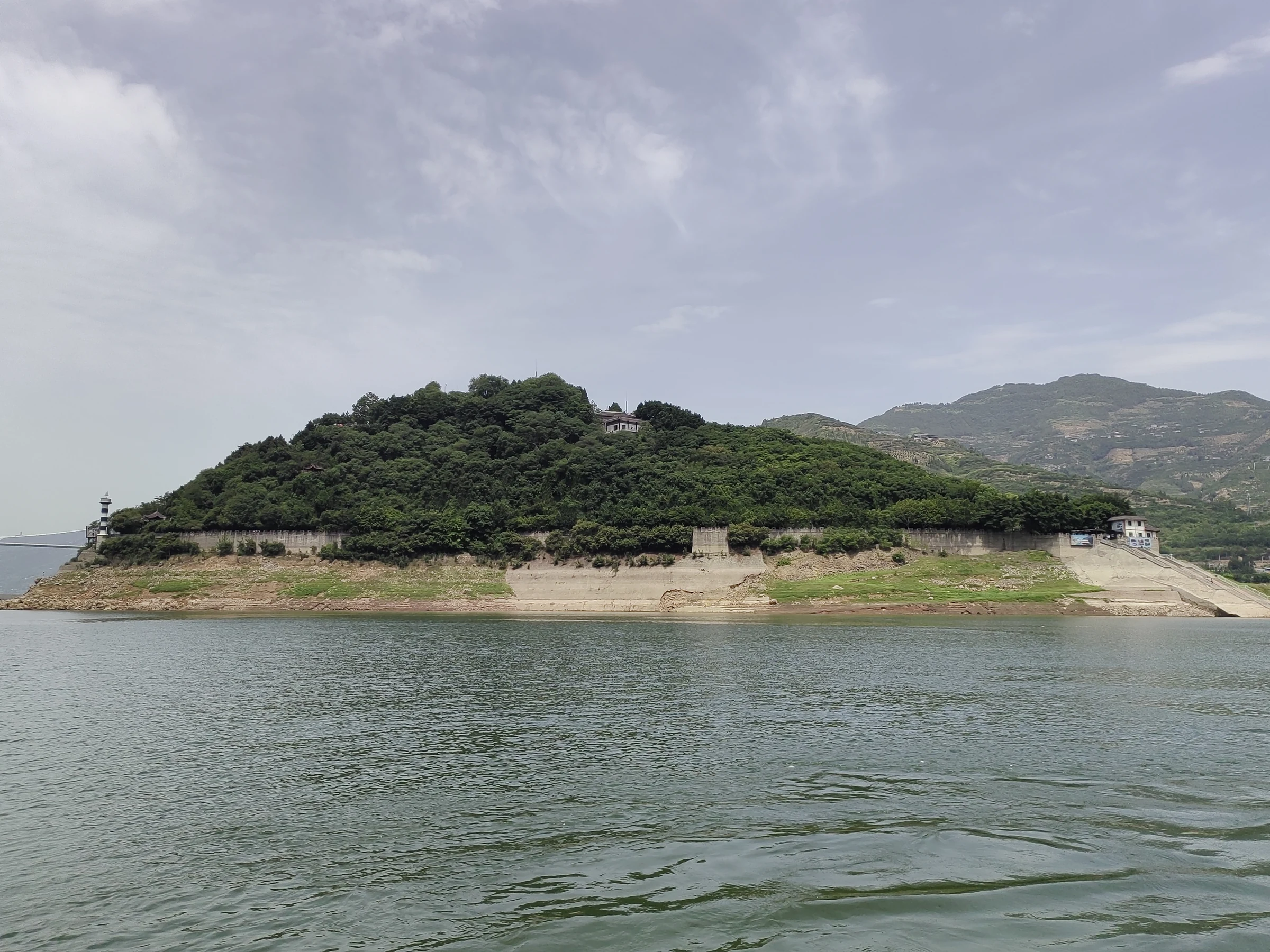
Baidi Mountain in its reservoir setting, photographed on 23 May 2025. The photograph records that day’s shoreline rather than the present water level. Creator: Yumeto; Source: File:20250523 Baidi Shan.jpg; License: CC BY-SA 4.0; Recorded capture date: 2025-05-23 11:04:52; Changes: EXIF-based auto-orientation; proportional full-frame downsize without enlargement; WebP re-encoding; embedded metadata stripped. No crop, generative fill, scene retouch, recolouring, added caption, or removal of original date imprint. If adapted, retain the applicable ShareAlike license.
Baidi City and Qutang Gorge make a 2026 Fengjie visit for travellers interested in poetry, temple history and river geography. Chongqing's official directory identifies an 8-kilometre gorge beside the historic hill complex. Plan around the cultural site and Kuimen view first; a Three Gorges Summit ascent is a separate commitment.
Save the full Chinese name 白帝城·瞿塘峡景区. Baidicheng, Baidi City and White Emperor City refer to the same named cultural destination in this context. 瞿塘峡 is Qutang Gorge, while 夔门 is Kuimen, the gorge's western gateway. Knowing those distinctions helps you read a ticket without assuming every nearby landmark belongs to one route.
This is a researched interpretation and planning guide, not a report from an editorial visit. It separates the age of a place's associations from the age of its buildings, and historical booking notices from current arrangements.
Read the river gateway before the buildings
The municipal profile dated 4 June 2026 locates Baidi on the Yangtze's north bank at the western entrance to Qutang Gorge. Across the river stands Baiyan Mountain. Kuimen names the dramatic gateway where the opposing slopes frame the water, rather than a separate town you need to find.
At a permitted viewpoint, spend a moment identifying 3 things: the river's passage into the gorge, the mountain on the opposite bank, and the hill complex's position relative to both. That small exercise makes the literary and strategic stories easier to follow. A narrow opening in a photograph becomes a geographic relationship rather than a backdrop.
The source's 8-kilometre gorge length is not a walking distance through the visitor site. Nor does the broad scenic-area name mean that every named cliff, relic or viewpoint is reachable on your ticket. Ask which parts of the landscape are viewed from a distance and which are actual stops on the current visitor route.

A view from Baidicheng toward Qutang Gorge, photographed on 2 December 2009. The named viewpoint and historical date are part of the image’s context. Creator: Tan Wei Liang Byorn; Source: File:Qutang Gorge on Changjiang.jpg; License: CC BY 3.0; Recorded capture date: 2009-12-02; Changes: EXIF-based auto-orientation; proportional full-frame downsize without enlargement; WebP re-encoding; embedded metadata stripped. No crop, generative fill, scene retouch, recolouring, added caption, or removal of original date imprint.
Understand the name without giving every wall the same age
The scenic-area operator's introduction connects the White Emperor name with Gongsun Shu and dates a change in temple dedication to Liu Bei and Zhuge Liang to 1533. These are layers in the site's story. They do not mean that every building visible today survives from the original foundation.
iChongqing's architectural profile places the surviving complex largely in the Ming and Qing periods and names Mingliang Hall and the Zhuge Liang memorial among its features. Use that distinction when reading labels: the person commemorated, the institution's origin and the construction date of a particular hall may be centuries apart.
A useful visit question is “What is this object?” before “How old is this place?” An old inscription, a later architectural enclosure and a modern interpretive display can occupy one room. Read each label individually. That approach preserves the value of the site without turning a long historical association into a misleading claim of untouched antiquity.
Let poetry give you a way to look
Baidi's official poetry section makes clear that literature is part of the destination's interpretation. Li Bai's poem about departing Baidi in the morning is a natural starting point. You do not need to memorise an English translation to notice how a poem can compress distance, sound and movement into a brief journey.
Try 2 reading passes. Before the visit, read a credited translation and identify its moving viewpoint: the narrator is travelling, not standing in a fixed modern viewing platform. At the site, compare that imagined movement with the river corridor you can actually see. The exercise is a literary comparison, not a reconstruction of an exact ancient sailing time.
Avoid using the poem's speed or distance as a practical transport estimate. Modern water levels, boats and travel products belong to a different context. Likewise, a photographed quotation does not prove that its author stood at the precise spot where the sign now stands.
If translation interests you, compare the choices of 2 named translators after the visit. Keep their credits; do not copy an anonymous online translation into your own publication and label it an original rendering.
Follow the Three Kingdoms story with care
The operator's introduction places Liu Bei and Zhuge Liang within the site's commemorative history. That gives visitors a useful narrative thread, but a memorial hall, a dramatic tableau and a documented event are different kinds of evidence.
Choose 1 display to read slowly. Identify who is represented, what episode the interpretation describes, and whether the scene is presented as historical account, later literature or modern artistic reconstruction. If the distinction is not clear in translation, ask a guide rather than filling in the gaps with a film version you remember.
You can appreciate the emotional subject of loyalty or political responsibility without treating every familiar story as an archaeological finding. It is also sensible to avoid sweeping claims about the exact room where an ancient event happened unless the local interpretation supplies strong evidence.
Travellers with little Three Kingdoms background may find a short explanation of the main figures more useful than trying to recognise every statue. Agree on guide language and the scope of an explanation before paying for a separate guiding service.

The entrance of Baidi Temple, photographed on 23 May 2025. The image does not assign a single construction date to every visible element. Creator: Yumeto; Source: File:20250523 Baidi Miao.jpg; License: CC BY-SA 4.0; Recorded capture date: 2025-05-23 09:51:49; Changes: EXIF-based auto-orientation; proportional full-frame downsize without enlargement; WebP re-encoding; embedded metadata stripped. No crop, generative fill, scene retouch, recolouring, added caption, or removal of original date imprint. If adapted, retain the applicable ShareAlike license.
Treat inscriptions as objects, not just decoration
The iChongqing profile describes tablet collections alongside the halls. Their value is not confined to whether a visitor can immediately read the characters. Arrangement, lettering, material and the relationship between inscription and setting can all give a visit focus.
For 1 selected inscription, look for the date assigned to the physical object and the date of the text it carries. They may differ. A later carving can preserve an earlier poem or piece of calligraphy; that does not make the stone itself as old as the author. If the label mentions a copy, restoration or transfer, retain that word in your notes.
Use a phone translation as a prompt for questions, especially with personal names and literary titles. Do not rub, trace or touch a surface to make the lettering easier to read, and respect any photography restrictions. A careful photograph from an allowed position, with the explanatory label noted separately, is more informative than a collection of disconnected close-ups.

The display identified by its photographer as the Phoenix Stele at Baidicheng, photographed on 4 May 2006. No object age or calligraphic authorship is inferred from the photograph. The precise camera position is unknown; rejected source GPS coordinates must not be used as a visitor pin. Creator: chp13579753; Source: File:白帝城凤凰碑 - panoramio.jpg; License: CC BY-SA 3.0; Recorded capture date: Taken on 4 May 2006; Changes: EXIF-based auto-orientation; proportional full-frame downsize without enlargement; WebP re-encoding; embedded metadata stripped. No crop, generative fill, scene retouch, recolouring, added caption, or removal of original date imprint. If adapted, retain the applicable ShareAlike license.
See a reservoir landscape with a longer memory
The June 2026 municipal profile describes the hill becoming an island setting after reservoir impoundment. Its reference to 175 metres is reservoir context, not a measurement of the water on the day you arrive.
This makes before-and-after images potentially valuable, provided they are dated. Compare the relationship between water, slopes and the cultural complex rather than searching for proof that one photograph is the permanently correct view. An older low-water photograph can be historically accurate and still be unsuitable as an illustration of present access.
The Kuimen composition associated with the 10-yuan banknote provides another comparison exercise. First find the gorge shape without holding up a note; then consider what the designed image selects and leaves out. A banknote is an artistic representation, not a route map or a promise of a particular lens angle.
For broader context, the existing Three Gorges Museum guide offers a separate central-Chongqing cultural stop. It should not be confused with a museum or entrance inside this Fengjie attraction.
Read reservation notices in chronological order
Two official notices show why a timeless booking instruction would be unreliable. The Fengjie county notice of 24 April 2025 gave a 3-hour same-day reservation lead. The operator's 30 April 2025 notice changed that to 1 hour. Neither should be presented here as a verified October 2026 rule.
For your visit, use the current booking screen for the exact date, attraction and ticket category. Confirm admission, any internal boat or transfer, and cancellation conditions. The older notices refer to identification documents and booking codes but do not fully explain the foreign-passport process. Ask the operator which entry channel handles your document before relying on an automated identity-card field.
The operator notice lists Baidi/Qutang separately from Three Gorges Summit. Do not assume a reservation for one gives access to the other. Keep the product's Chinese name visible in the confirmation, especially if a reseller uses a shortened English title covering several possible outings.

The covered bridge at Baidicheng–Qutang, photographed on 9 February 2024. Signs and entry arrangements visible in the image are historical. Creator: Liuxingy; Source: File:白帝城 瞿塘峡-风雨廊桥.jpg; License: CC BY-SA 4.0; Recorded capture date: 2024-02-09 10:49:31; Changes: EXIF-based auto-orientation; proportional full-frame downsize without enlargement; WebP re-encoding; embedded metadata stripped. No crop, generative fill, scene retouch, recolouring, added caption, or removal of original date imprint. If adapted, retain the applicable ShareAlike license.
Build a visit around two priorities
For a culture-led visit, choose 2 priorities such as the temple interpretation and a Kuimen viewpoint. Ask staff for the currently open route linking them. This is a more dependable starting point than attaching a long list of attractions to an unverified number of hours.
For a cruise excursion, compare those priorities with the ship's actual programme. Confirm whether Baidi is included, optional or absent, and use the ship's meeting and return instructions. An independent visitor can instead plan the journey through Fengjie, but must arrange both the last-mile transfer and the onward connection.
The railway-stations guide can help you avoid confusing Chongqing departure stations. The map and navigation guide explains why a named pickup point is preferable to an ambiguous attraction pin. Neither supplies a current Fengjie shuttle timetable.
If someone in your party needs limited steps, ask specifically about the entrance, halls, viewing area and exit. Do not assume that the existence of a bridge or an internal boat makes the complete hill visit step-free. A shorter cultural route may be the appropriate plan.
Keep a summit ascent as a separate decision
The Summit operator page identifies a high viewpoint on Chijia Mountain at 1,388 metres. Looking toward the gorge from Baidi and ascending to that viewpoint answer different travel interests. Seeing both names on one regional map does not make them interchangeable visits.
If you want to combine them, obtain a current combined itinerary that accounts for the hiking entrance, permitted direction, internal transport and finish point. Decide before starting whether the main goal is cultural interpretation or an extended ascent. Avoid allowing an unexpected queue or an attractive sign to turn a manageable cultural outing into a mountain route for which the group has not prepared.
A successful Baidi visit can finish with a clear understanding of the river gateway and a few well-read objects. Completing every nearby attraction is not a measure of how much you learned.
About This Guide
Research was completed on 1 October 2026 using municipal and county sources, the scenic-area operator and public cultural-tourism coverage. The text is original editorial synthesis; no first-hand visit or human review is claimed. Prices, live hours and passport-entry procedures remain date-specific checks. Historical source dates are retained where they materially change the advice.
Frequently Asked Questions
Q: Is Baidi City the same as White Emperor City? A: Yes, in this Fengjie context both refer to 白帝城. Qutang Gorge and Kuimen name the adjacent gorge and its western gateway.
Q: Is the 8-kilometre gorge length my walking distance? A: No. It describes Qutang Gorge, not the length of the cultural-site visitor route or the distance between your transport stops.
Q: Does Baidi admission include Three Gorges Summit? A: Do not assume so. Official notices list Baidi/Qutang and Three Gorges Summit separately; confirm any combined product's inclusions.
Q: How far ahead must I reserve? A: The April 2025 official notices changed from 3 hours to 1 hour for same-day booking. Check the current date-specific rule rather than relying on either old notice.
Q: Are all the temple buildings as old as Baidi's founding story? A: No. The place has multiple historical layers, and the surviving complex includes Ming and Qing fabric. Read the date of each building or object separately.
Traveler comments
Share a recent experience or ask a practical question about this guide.