
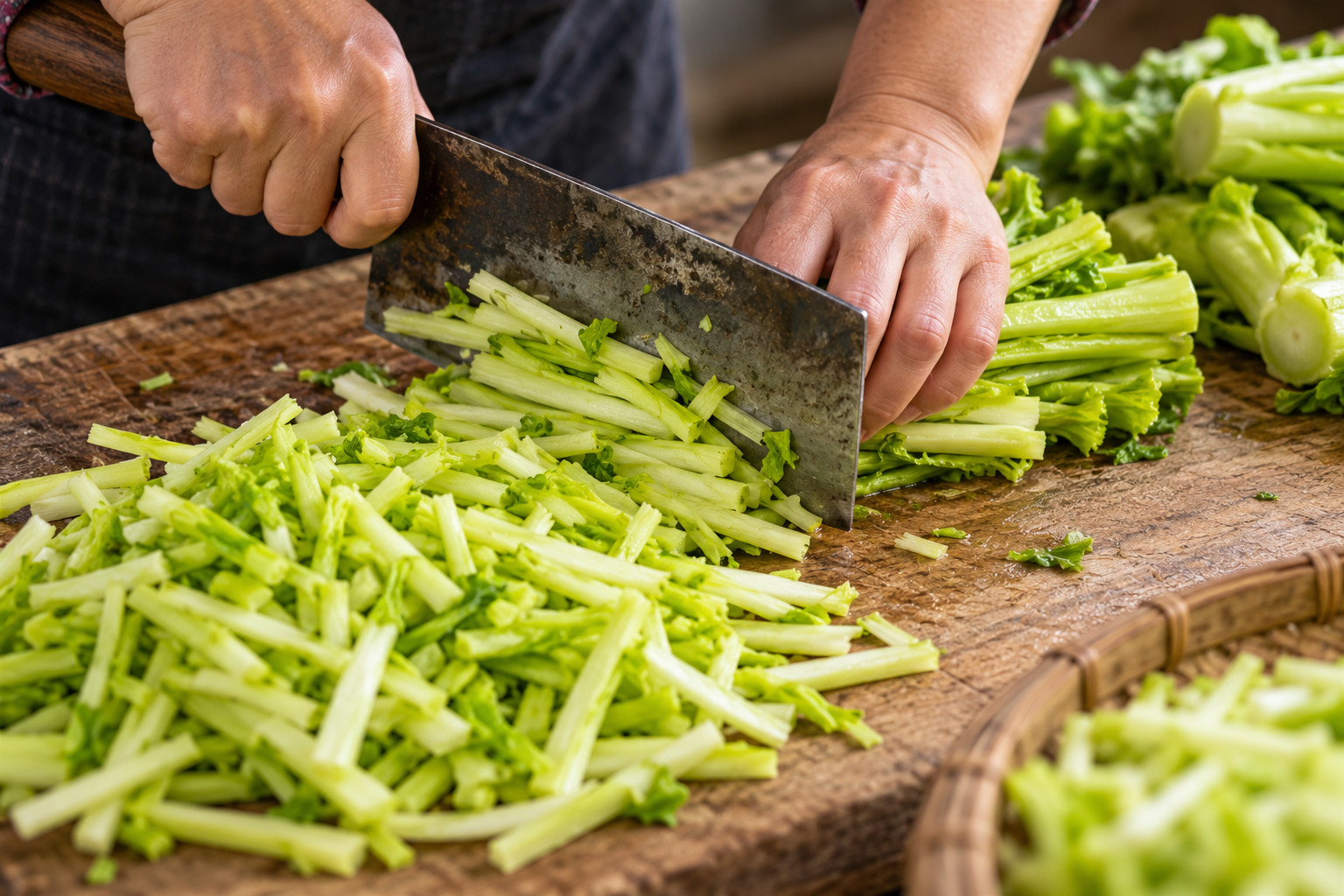
Cover: AI illustration: Cutting fresh mustard stems. Based on 2017 mustard-stem preparation references; not a current museum, factory or visitor activity photograph.
Visual reference: Xinhua / Liu Chan (刘潺), Xinhua
AI illustration: Based on 2017 mustard-stem preparation references; not a current museum, factory or visitor activity photograph.
For a Fuling zhacai visit in 2026, start with the Fuling Zhacai Historical Memory Museum and confirm any hands-on session separately. Fuling’s local newsroom documented a mustard-stem activity on 25 September, while official agricultural reporting explains the longer production process. A museum visit can illuminate the food without granting access to a working factory.
Zhacai is often encountered as a small packaged accompaniment, which makes it easy to overlook the agriculture and skilled work behind it. In Fuling, the useful question is how a swollen mustard stem becomes the preserved food on the table. A thoughtful visit follows that transformation rather than treating a shop shelf as the whole story.
Use the Chinese names 涪陵榨菜 for the food and 涪陵榨菜历史记忆馆 for the museum when checking a location or asking for help. The food, the heritage venue and a branded manufacturing company are different destinations. This guide does not identify a currently bookable factory tour, and no factory admission should be inferred from a company's visitor photographs.
Follow the process rather than a packet brand
The Chongqing agricultural authority’s April 2025 account traces a Fuling workshop to 1898 and describes drying, salting, pressing and fermentation. It refers to 17 traditional production steps. Those details make the preserved stem a useful lens on work, storage and trade, rather than simply another flavor to collect.
At an exhibit, look for the relationship between the original vegetable and the finished product. Ask which part is used, why moisture is removed and what pressing changes. A display of jars makes more sense when you understand what was placed inside them and what had already happened to it. Tools should be read as parts of a sequence, not isolated rustic decorations.
Keep traditional interpretation separate from modern production. A reconstructed workshop may explain hand techniques that a contemporary plant organizes differently. Equally, a film of automated packaging does not explain every earlier stage. Ask whether the material being shown is a historical reconstruction, a live demonstration or a description of present-day industrial practice.
A tasting helps connect these ideas, but it need not be the start of the visit. Learning the process first gives you better questions about the product you are offered. If the venue provides no tasting, the historical displays can still support a food-culture visit; buying food is a separate choice.

AI illustration: Arranging strips for drying. Based on 2017 mustard-stem preparation references; not a current museum, factory or visitor activity photograph.
Visual reference: Xinhua / Liu Chan (刘潺), Xinhua
Confirm the museum destination and the usable entrance
A participant account published on 11 June 2026 locates the museum in group 5 of Hongguang Community, Chongyi Subdistrict. It describes the Qiu family workshop, domestic rooms, a history hall and agricultural interpretation. This is useful destination evidence, but a group visit does not establish general admission arrangements for your date.
Before travelling, ask for the visitor entrance pin rather than accepting the address of an administrative office or a broad neighbourhood. Confirm the museum's Chinese name with the person providing directions. A driver recognizing “zhacai” might otherwise understand a factory, market or brand shop. Keep a screenshot of the intended entrance alongside the name.
The same account mentions wooden stairs and stone steps. Treat that as a reason to ask about the route through the displays, not as a complete accessibility survey. If stairs are difficult, request specific information about which rooms can be reached without them, whether another entrance is permitted and whether a companion can remain with you throughout.
A short visit can become frustrating when the route back is an afterthought. Save the pickup point and return destination before entering. Our Chongqing taxi and ride-hailing guide explains the communication checks to make. It does not provide a tested route or a fixed fare to this museum.
Ask what the current hands-on activity actually includes
The Fuling newsroom report dated 25 September 2026 shows an activity using already cured mustard stems. Participants sliced, worked and seasoned the material before packing it. That distinction matters: joining a finishing activity is different from producing fermented zhacai from a freshly harvested stem during a short visit.
Ask the venue to describe your session in plain terms. Will you watch, handle prepared material, help season a portion or take something away? Ask who supervises, which tasks visitors perform and whether any sharp tools are involved. A photograph of people around a table is not a description of the session currently offered to independent visitors.
Confirm the date, start time, teaching language, group size and total charge before arranging your day around it. If the reply mentions a festival, ask whether the activity continues after that festival. The September report establishes a recent event and a hands-on area, but it does not supply a standing timetable or booking terms for October.
For a family, discuss the task rather than relying on a general “suitable for children” label. Explain who will participate and ask whether the staff can adapt the activity. If the response is unclear, plan to observe. A respectful visit does not require every person to handle food or equipment to be worthwhile.

AI illustration: Washing dried strips in a wooden tub. Based on 2017 mustard-stem preparation references; not a current museum, factory or visitor activity photograph.
Visual reference: Xinhua / Liu Chan (刘潺), Xinhua
Leave room for seasonality and production restrictions
The April 2025 agricultural account describes a traditional preparation taking five to six months. It also distinguishes mustard-stem growing and processing from packaged products. The practical lesson is to ask which stage can actually be seen during your visit, instead of expecting harvest, drying and finished-food production together.
A planted area can be educational without being ready to harvest. A display of drying equipment can be meaningful even when nothing is hanging from it. If a particular seasonal scene is your reason for travelling, obtain current confirmation and a recent image from the venue. Historical publicity photographs are poor evidence of today's field conditions.
Factory access requires its own permission. Ask the company whether there is a designated public visitor route, whether independent foreign visitors are accepted and whether the production area is included. An office appointment, shop visit or presentation room may be offered instead. Do not cross a work boundary because another group appears to have been admitted.
Photography needs similar care. Ask before photographing staff, demonstrations or production machinery, and follow any restrictions on the specific area. A museum admission ticket does not grant permission to reproduce an exhibit commercially. Keep personal interest separate from a plan to publish images, especially where people, company processes or copyrighted display material are prominent.
Taste deliberately and read the specific label
The September 2026 activity report records visitors tasting zhacai after a supervised activity. It does not establish the ingredients or handling of every product sold in Fuling. Treat a sample and a sealed retail packet as separate items whose preparation you need to understand.
Ask to see the ingredient information for the exact flavor and format you intend to eat. If you avoid an ingredient, describe that ingredient rather than asking whether the food is generally “healthy” or “suitable.” When a dietary restriction is important, ask about seasonings and shared preparation as well as the vegetable itself. This guide makes no allergy, vegan or halal guarantee.
For an unlabelled sample, a staff explanation may be useful, but do not let politeness push you into eating something whose contents remain unclear. You can learn from the demonstration and decline the tasting. Likewise, a milder-looking color does not establish how much chili or other seasoning was used.
If you buy a product, retain its label and follow its stated storage instructions. Ask whether a demonstration portion has the same packaging and shelf-life instructions as a commercial packet. Do not assume that a bag filled during an activity is intended for a long unrefrigerated journey. Check your destination's food-import requirements independently before carrying food across a border.

AI illustration: Traditional wooden press and stone weight. Based on 2017 mustard-stem preparation references; not a current museum, factory or visitor activity photograph.
Visual reference: Xinhua / Liu Chan (刘潺), Xinhua
Build a modest food-culture day with a fallback
The June 2026 visit account describes 4 interpretive stops, but its sequence belonged to that organized visit. Use the variety as a prompt for questions, rather than a promise that every space will be open or that you can follow the same route independently.
Choose your priority before setting out: understanding the preserved food, seeing the historical workshop or joining a confirmed activity. If participation is essential, secure the session first and arrange transport around it. If general interpretation is enough, a normal museum visit may meet your purpose without the extra coordination of an industrial tour.
Ask what remains possible if the activity is cancelled. An exhibit visit, a label-reading tasting or a nearby meal may provide a useful alternative, but confirm any suggested venue rather than inventing a replacement on the spot. Leave space in the day for explanation and communication. A food heritage visit loses much of its value if you spend it rushing between uncertain addresses.
Use our railway-station guide when planning the wider journey and our payment guide before a shop or activity purchase. Neither establishes a particular departure, museum payment method or admission charge. Recheck those details with the actual provider.
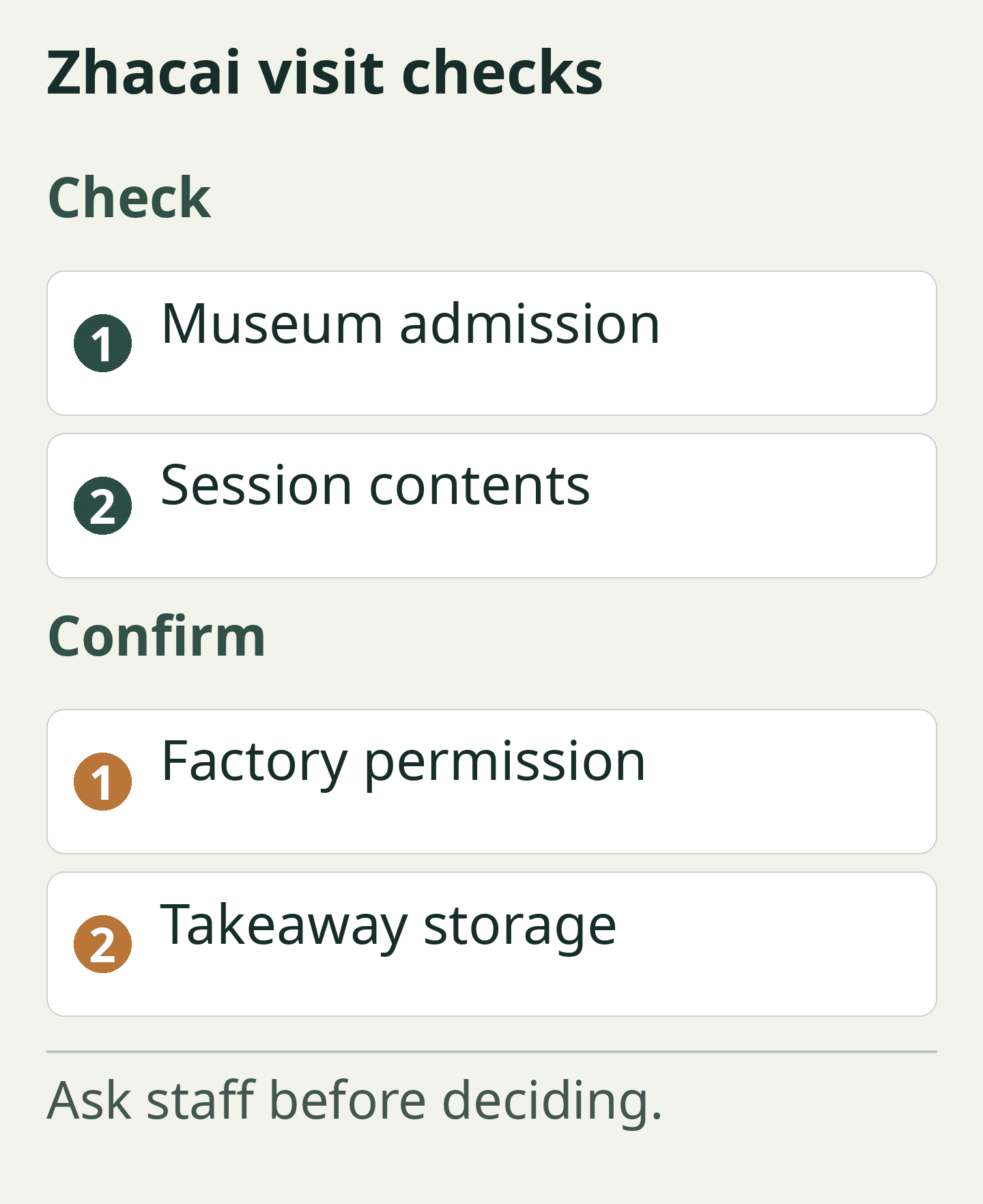
Zhacai visit checks. Ask staff before deciding.
Original editorial checklist
Zhacai visit checks
Check:
- Museum admission
- Session contents
Confirm:
- Factory permission
- Takeaway storage
Ask staff before deciding.
About This Guide
Researched on 1 October 2026 using official agricultural reporting and dated Fuling and Jiangjin local reports. No on-site visit, tasting, booking or factory inspection was performed for this guide. Current opening hours, admission prices, workshop availability, teaching language and accessible routes were not verified. The article explains the evidence and the questions needed to turn it into a workable visit. No independent review is claimed.
Frequently Asked Questions
Q: Where should I start a Fuling zhacai food-culture visit? A: Start by checking the Fuling Zhacai Historical Memory Museum, 涪陵榨菜历史记忆馆, in Hongguang Community, Chongyi Subdistrict. Confirm its public entrance and current admission arrangements before travelling.
Q: Can I make Fuling zhacai during a museum visit? A: Fuling reporting documented a supervised activity on 25 September 2026 using already cured mustard stems. Ask the Fuling museum whether a comparable session runs on your date and what visitors actually do.
Q: Does the Fuling museum provide access to a working factory? A: No factory access is established by the museum reports used here. Any Fuling factory visit needs a separate confirmation from the company responsible for that site.
Q: Is Fuling zhacai suitable for every dietary restriction? A: This guide does not certify Fuling zhacai for any diet. Check the exact product's ingredients, seasonings and preparation with the seller, and decline an uncertain sample if necessary.
Q: Is the Fuling Zhacai Historical Memory Museum step-free? A: A June 2026 account describes stairs and steps at the Fuling museum. Ask which specific rooms and entrances are accessible; no complete step-free route was verified.



Traveler comments
Share a recent experience or ask a practical question about this guide.