
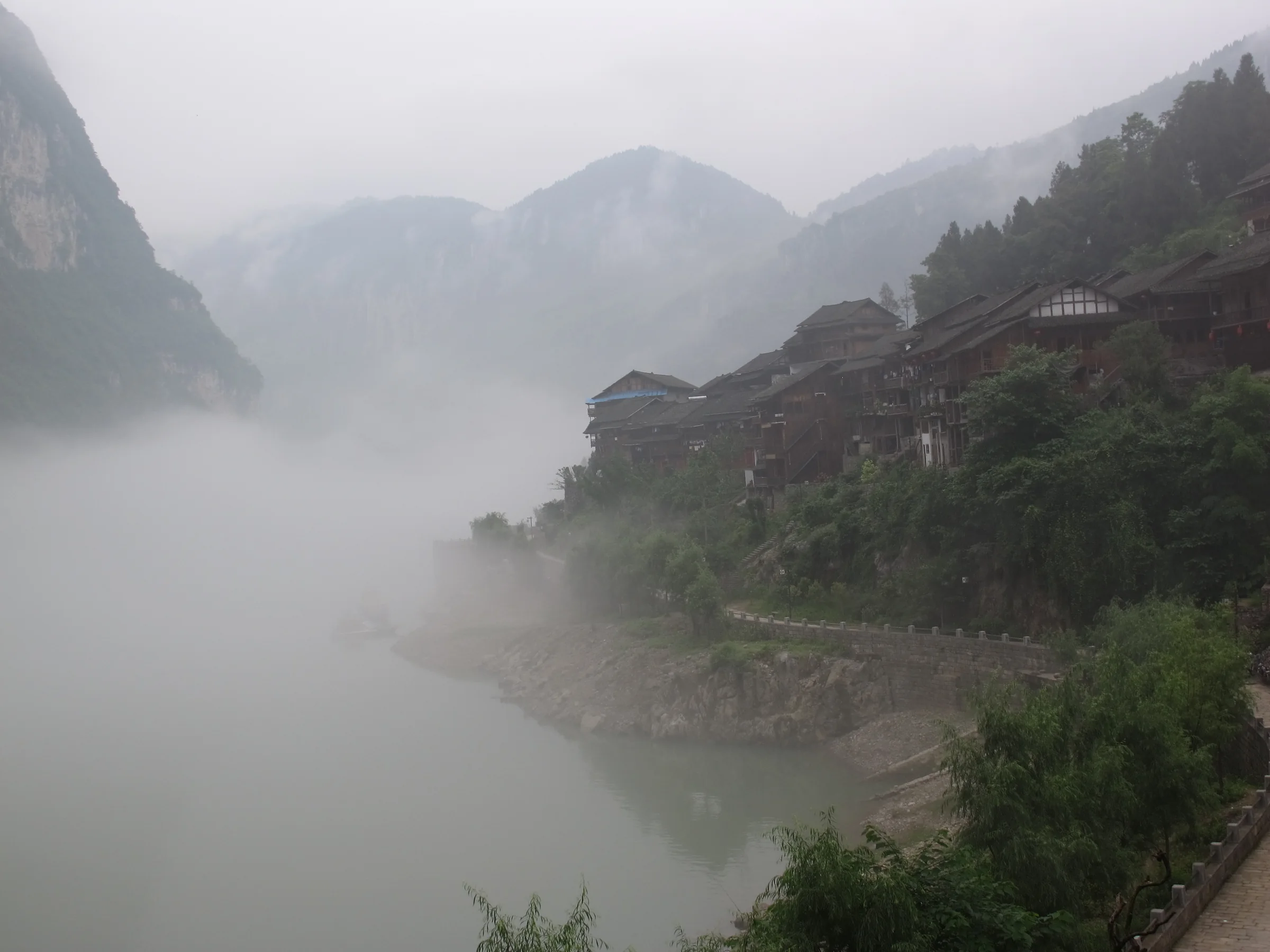

Cover image: Gongtan beside the Wujiang in morning mist, photographed on 13 June 2012. Mist, water level and visible access are historical conditions. Creator: Nyx Ning; Source: 重庆市 酉阳-晨雾中的龚滩古镇 - panoramio.jpg; License: CC BY-SA 3.0; Changes: EXIF auto-orientation, proportional resizing and WebP conversion; full composition retained and EXIF removed. No crop, retouch, scene synthesis or watermark removal. Adapted photographic material is offered under the same CC BY-SA version linked above.
Gongtan Ancient Town in 2026 is a place to explore river-facing architecture and the history of a relocated settlement. A 2023 county-government response confirms that hydropower development prompted the move. We suggest choosing a town walk first, then adding a Wujiang boat trip only after its landing points and return arrangements are clear.
The Chinese name is 龚滩古镇. Save that name with Youyang, Chongqing, rather than relying on a broad search for “Wujiang Gallery.” The scenic river label can refer to different products and stretches of water; it does not identify one departure pier or standard boat journey.
This guide offers a way to read the town, not a claim of an on-site inspection. Road journeys, interior access and boat operations need date-specific confirmation. The point is to arrive knowing what you want to see and how you will leave.
Begin with the relocation, not an untouched-town story
A Youyang housing and urban-rural development commission response published in July 2023 records Gongtan's relocation from its original site because of the Pengshui hydropower project. It describes principles of preserving materials, form, craftsmanship and community during rebuilding. Read the present town in that context rather than assuming everything stands exactly where it stood centuries ago.
The distinction does not make a visit pointless. It changes the questions. Instead of asking whether a street looks “old enough,” ask how the river settlement was reconstructed, what material was reused, which buildings have a documented history and how residents continued their lives through the move.
Two different dates can also refer to a building: its earlier origin and its reconstruction at the present site. A guide or display should clarify which is being described. Do not infer a roof's age from the age of the community or treat every weathered surface as evidence of original placement.
Historical photographs need the same care. A view of the earlier town, a photograph from the rebuilding period and a recent image are not interchangeable. Keep their dates visible when comparing them, and avoid searching for an old viewpoint through barriers or unofficial river approaches.

A stone-paved Gongtan street photographed on 13 June 2012, after the town’s relocation. The age of individual materials and buildings requires separate evidence. Creator: Nyx Ning; Source: 重庆市 酉阳-龚滩古镇街景 - panoramio.jpg; License: CC BY-SA 3.0; Changes: EXIF auto-orientation, proportional resizing and WebP conversion; full composition retained and EXIF removed. No crop, retouch, scene synthesis or watermark removal. Adapted photographic material is offered under the same CC BY-SA version linked above.
Read the riverfront in layers
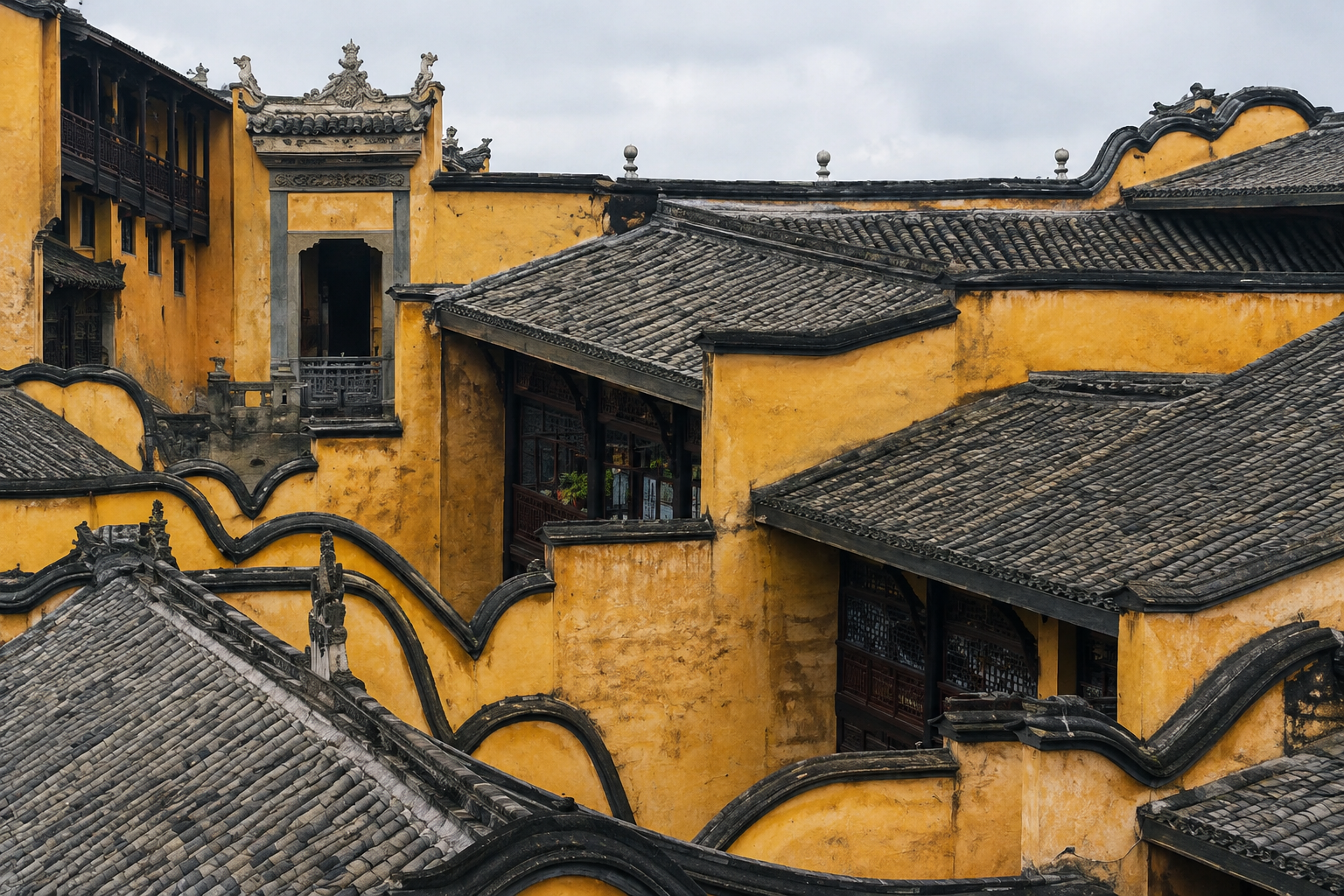
The tourism group's April 2025 description identifies stone streets, firewalls, courtyards and stilted buildings as features of Gongtan. Those details suggest a focused architectural walk without requiring a catalogue of every named attraction.
Use three observation scales. First, look at the town against the river and slope. Second, look at the frontage of a short street: where doors, balconies and roofs overlap. Third, pause at a permitted detail such as a threshold, joint or courtyard entrance. Moving between the whole setting and a small element can make a short walk more rewarding.

The entrance of Ran Family Courtyard (冉家院子) in Gongtan, photographed on 13 June 2012. This is a courtyard detail, not Xiqin Guild Hall or confirmation of present interior access. Creator: Nyx Ning; Source: 重庆市 酉阳-龚滩古镇-冉家院子 - panoramio.jpg; License: CC BY-SA 3.0; Changes: EXIF auto-orientation, proportional resizing and WebP conversion; full composition retained and EXIF removed. No crop, retouch, scene synthesis or watermark removal. Adapted photographic material is offered under the same CC BY-SA version linked above.
Keep the observation distinct from its explanation. You can see a raised building edge, but identifying why it was made that way or when it was rebuilt may require a display or guide. Avoid repeating an attractive structural story merely because it seems plausible from a photograph.
Gongtan is also a place where people work, trade and stay. A photogenic doorway is not permission to enter. Leave passage space, ask before photographing someone closely and check whether a courtyard is public, ticketed or part of a business before walking inside.
Set a turnaround point before descending further
We would start with one manageable section and leave an extension optional. At the visitor information point, establish the actual drop-off, the area you want to walk and the point where you will meet your transport afterward. Confirm the permitted path between them.
A river view can tempt a group to keep moving down toward the water without considering the climb or exit later. Agree in advance which conditions would make you turn back: tiredness, wet steps, a closed passage or the time needed to make your pickup. That is an itinerary decision, not a failure to finish the attraction.
Ask about stairs and resting places for the specific section. Neither an overall scenic-area rating nor a flat stretch in a photograph establishes wheelchair or stroller suitability. If the group needs a step-free visit, check the whole journey from vehicle access to the chosen viewing area and back.

Layered roofs and balconies on Gongtan’s slope, 13 June 2012. The steps visible in the foreground illustrate why a single level-looking street view cannot describe an entire walk. Creator: Nyx Ning; Source: 重庆市 酉阳-龚滩古镇一角 - panoramio.jpg; License: CC BY-SA 3.0; Changes: EXIF auto-orientation, proportional resizing and WebP conversion; full composition retained and EXIF removed. No crop, retouch, scene synthesis or watermark removal. Adapted photographic material is offered under the same CC BY-SA version linked above.
Our maps and road-levels guide explains a useful habit: pair a map pin with a named entrance and a photograph of the meeting point. In Gongtan, that is more practical than telling a driver to wait “by the river.” Do not assume a vehicle can reach the end of a pedestrian walk.
Choose a cultural stop for its content
The Gongtan operator's English page identifies Xiqin Guild Hall and art-related spaces, including a Wu Guanzhong memorial hall. Its description gives useful leads, but current interior access, exhibitions and any separate charges still need checking. Do not build the visit around a room that appears in an old itinerary without confirming it is open.
Pick one cultural stop according to your interest. For a guild-hall visit, ask about the building's earlier function and the trade networks it represented. For an art space, look for the relationship between a depicted townscape, the date of the work and the landscape visible now.
The town's relocation makes that comparison particularly valuable. A painting can preserve a remembered place without serving as a literal map of the present streets. It can also show what an artist emphasized, omitted or rearranged. Treat it as a work of interpretation, not an unquestionable documentary record.
If this becomes a wider interest, our Huguang Guild Hall guide offers a separate urban context for thinking about migration and community institutions. The two destinations should not be collapsed into the same history simply because both contain guild-hall architecture.
Separate entry to the town from paid experiences
The county attraction directory dated 9 January 2026 lists Gongtan admission as free and gives 023-75677000 as its contact number. That dated entry does not say that every interior, performance or river journey is free.
There is a source conflict here. The operator's English page contains both a free-admission statement and a separate town-maintenance-fee statement. Rather than combine them into an invented current tariff, this guide leaves the price of your actual visit to confirmation with the attraction or seller.
Before buying a package, have its contents itemized. A town walk, an exhibition, a performance and a cruise can be different purchases even when sold under the same destination name. Ask whether entry is tied to a time window and whether leaving for a boat trip affects re-entry.
Keep a record of what the seller promised. If a charge appears at a later stage, compare it with the product description before paying. A broad phrase such as “Gongtan experience” is less useful than a list naming the included areas, activity and transport.
Decide exactly what a Wujiang boat trip adds
A town visit looks at the river from the settlement; a boat journey changes the viewpoint and adds boarding, sailing and landing logistics. Neither automatically replaces the other. The operator page lists river products, but the product you buy must identify its own route.

Boats at Gongtan’s riverbank on 13 June 2012. This dated photograph illustrates the change from street to water viewpoint; it identifies no current departure pier, vessel or sailing product. Creator: Nyx Ning; Source: 重庆市 酉阳-龚滩古镇-码头 - panoramio.jpg; License: CC BY-SA 3.0; Changes: EXIF auto-orientation, proportional resizing and WebP conversion; full composition retained and EXIF removed. No crop, retouch, scene synthesis or watermark removal. Adapted photographic material is offered under the same CC BY-SA version linked above.
Ask four questions before comparing prices: where does it board, where does it end, is it one-way or returning to the same place, and what land transfer is included? A cheaper one-way ticket may create a separate transport problem. A shorter round trip may fit a town-focused day more comfortably, but duration and route must come from the actual offer.
“Wujiang Gallery” is a landscape description, not sufficient ticket detail. Do not assume that a cruise sold elsewhere reaches Gongtan, that a Gongtan departure visits a particular stretch or that a photograph shows the route currently being sold.
Check the expected return window against your onward journey and ask what changes in unsuitable weather or water conditions. Find out whether a cancellation is handled by the attraction, a boat operator or the booking platform. A daytime river view does not establish that a sunset or night product exists.
If the whole group is primarily interested in architecture, leave the boat trip optional until the walking plan is workable. Adding an activity should improve the visit rather than consume the time reserved for the part that brought you here.
Make the return plan before choosing an overnight stay
Build the journey in two layers: the regional connection and the local transfer to Gongtan. This research did not verify a current bus timetable, a guaranteed ride-hailing supply or a fixed door-to-door drive time. Our railway-stations guide can help with naming checks, but it is not a timetable for this town.
For a driver, agree whether the arrangement includes waiting, a timed pickup or transport from a different landing place. Save a contact method that works locally. For public transport, confirm the precise departure point, actual operating date and final service you intend to use.
An overnight stay is worth considering if it reduces pressure around those connections or leaves time for a deliberate architectural visit. It should not rest on an unverified promise of empty streets, river mist or evening entertainment. Those are different expectations from having a workable place to sleep.
Ask accommodation providers about vehicle access, luggage steps, the booked room's outlook and the next morning's departure. “Riverside” does not establish a river view from every room. Nor does a charming building photograph tell you whether the walk between the room and pickup suits your group.
About This Guide
Sources read on 1 October 2026 include the 2023 county relocation response, the January 2026 attraction directory, the Gongtan operator and the tourism group's architectural introduction. Recommendations about the walk are editorial choices. No firsthand survey, resident interview, current sailing confirmation or verified step-free route is claimed.
Frequently Asked Questions
Q: Is Gongtan still in its original location? A: The county's 2023 response records whole-town relocation for Pengshui hydropower development. Read the present settlement as a relocated and rebuilt town, with individual building histories requiring their own evidence.
Q: Is Gongtan free to enter? A: The county directory of 9 January 2026 lists free admission, while the operator's English wording is inconsistent. Confirm the current arrangement and any separately charged interiors, performances or boat products.
Q: Does a Wujiang Gallery cruise always visit Gongtan? A: No route should be inferred from that scenic label. Check the boarding pier, endpoint, direction and land transfers on the specific product before purchase.
Q: Can I do a town walk without taking a boat? A: A town-focused visit is the editorial starting point in this guide. Confirm current public access, then treat any river trip as a separate decision with its own time and ticket requirements.
Q: Should I stay overnight in Gongtan? A: Consider one night if it makes your connections or walking plan less pressured. Check the property's actual access and departure arrangements rather than relying on a promise of mist, quiet streets or river views.
Traveler comments
Share a recent experience or ask a practical question about this guide.