
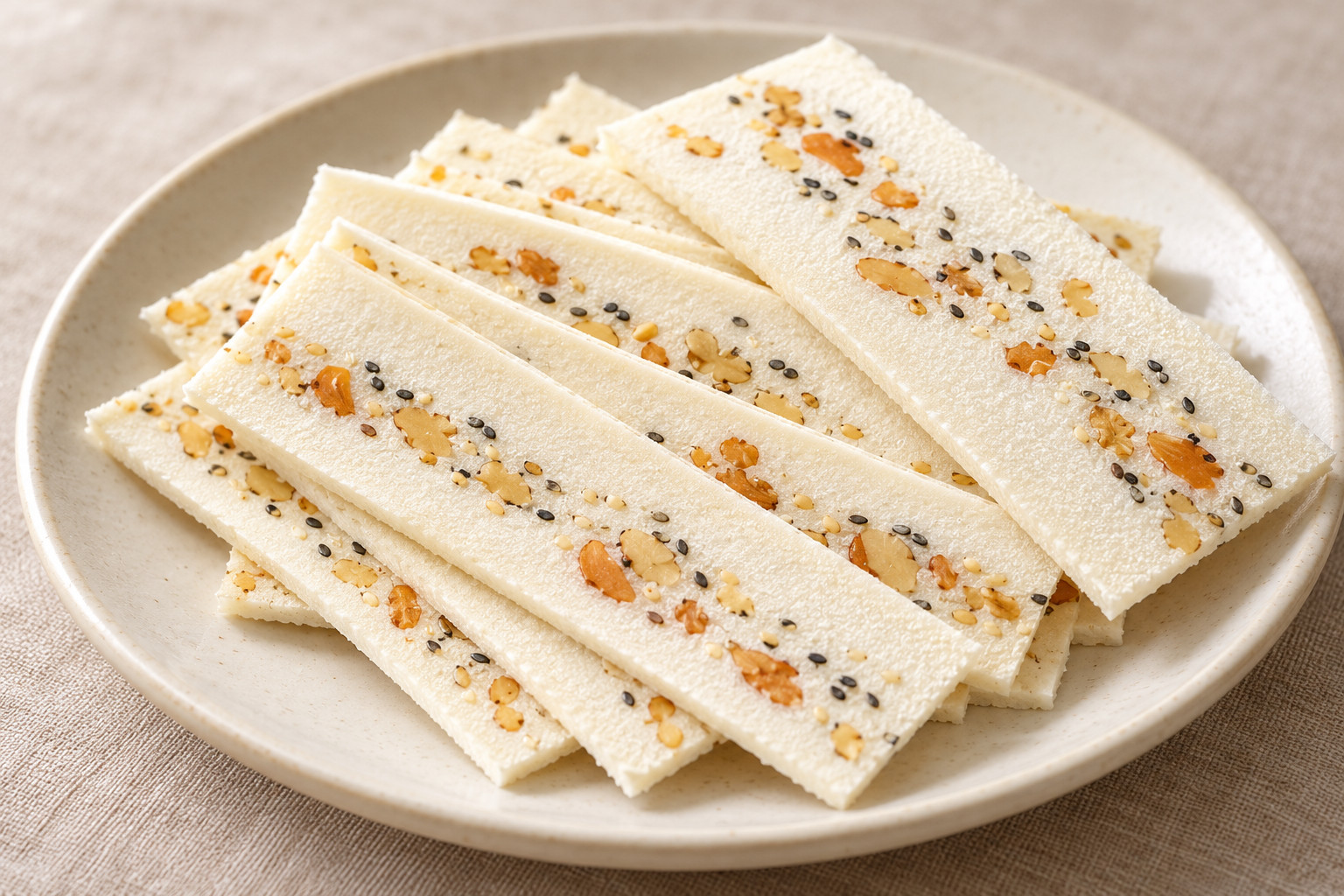
Cover: AI illustration: Soft white taopian slices. Food and slicing cues only; not proof of current products, ingredients, dietary safety or a visitor-made result.
Visual reference: iChongqing / Photographs uncredited, iChongqing/CISU collaborative article
AI illustration: Food and slicing cues only; not proof of current products, ingredients, dietary safety or a visitor-made result.
For a Hechuan taopian tasting in 2026, compare a clearly labelled soft version with a crisp version and ask how each was made. Chongqing’s intellectual-property bureau describes 18 traditional processing steps and identifies rice, walnuts, sugar and honeyed rose as core ingredients. The regional description helps explain the craft; the actual packet determines your purchase.
Taopian, 桃片, is a thin sliced confection associated with Hechuan. Its name can lead an English-speaking shopper toward “peach slices,” but the official ingredient description points to walnuts rather than peach fruit as a core ingredient. Keep the Chinese name 合川桃片 on your phone so that a shop assistant can distinguish it from other local sweets.
The aim of a food-craft visit is to connect the slice in your hand with the decisions that produced it: ingredients, preparation, forming and cutting. You do not need to buy a large gift box to do that. A small, properly labelled selection and a careful conversation can be more informative than a bag filled with unfamiliar packages.
Begin with the soft-and-crisp distinction
The intellectual-property bureau’s entry dated 6 July 2026 separates Hechuan taopian into 2 broad categories, soft and crisp. It also describes sweet and pepper-salt variations. Category and flavor are different decisions: ask about both before assuming that a familiar-looking package will have the texture you expect.
Ask the seller to point out 软桃片, soft taopian, and 脆桃片, crisp taopian, if both are stocked. If samples are available and suitable for your diet, compare small pieces of the actual products you might buy. Notice how the slice separates, how it breaks or bends and how prominently the nut and sweet elements appear. These are tasting questions, not a quality score that every maker must satisfy.
Do not use a bending demonstration as a universal test. A crisp version is not supposed to behave like a soft slice, and packing or storage can affect the sample. Ask which texture is intended for that product. If the answer is vague, the label and a clearly identified sealed packet offer firmer ground than a dramatic sales demonstration.
Taste before ordering a large quantity when possible. A gift recipient who prefers a less sweet or crisper snack may choose differently from you. The seller can describe the options, but an attractive box or a heritage story should not substitute for understanding what is inside it.

AI illustration: Slicing a taopian block. Food and slicing cues only; not proof of current products, ingredients, dietary safety or a visitor-made result.
Visual reference: iChongqing / Photographs uncredited, iChongqing/CISU collaborative article
Use the making process to read the finished slice
The July 2026 official product entry includes roasting rice, milling, steaming the formed cake and slicing within its 18-step account. This is a useful outline for interpretation, not a recipe. A shop demonstration may show a late stage after substantial preparation has already happened elsewhere.
If you see slicing, ask what the block was made from and what happened before it reached the counter. Watch how the maker supports it and separates the slices. The skill is easier to appreciate when you understand the material being cut, rather than concentrating entirely on speed. Do not ask to handle knives or enter a preparation space without an invitation.
At a display, distinguish finished food, demonstration material and historical equipment. A wooden tool behind glass may explain an earlier method without proving that every current producer uses it. Conversely, modern packaging does not erase the significance of skilled preparation. Ask which steps are manual at that particular business and which are mechanized.
A useful question is “这一步是做什么的?” or “What does this step do?” It gives a demonstrator room to explain a decision rather than perform for a camera. Ask permission before recording, keep other customers out of the frame where possible and do not block a work surface. The conversation is valuable even if you leave without footage.
Separate the shared history from an individual brand story
A Hechuan government historical account published in April 2025 discusses production in 1895 and notes an alternative earlier origin account. It also records the craft’s municipal heritage recognition in 2007. Those are different kinds of dates: a food’s development, a particular business’s history and an official listing need not begin in the same year.
Avoid choosing a product solely because a sign claims the longest history. Ask who made the packet, where it was produced and which business is selling it. A shop can stock products from several manufacturers, while an old brand name can appear in contexts that are not its own factory or flagship store. Read the manufacturer details rather than relying on a decorative street sign.
The Ministry of Commerce’s Tongdefu digital-museum profile provides a brand-specific account of the craft. Use it to recognize 同德福, Tongdefu, as a documented producer, not to rank it above every alternative. Its digital exhibition is also not evidence of a physical museum that accepts walk-in visitors.
A compelling brand story can improve a tasting by explaining a maker's priorities. It should remain separate from present purchasing questions: the flavor, quantity, ingredient label and storage instructions. You can respect the history while deciding that another product fits your taste or luggage better.

AI illustration: Crisp pale taopian slices. Food and slicing cues only; not proof of current products, ingredients, dietary safety or a visitor-made result.
Visual reference: iChongqing / Photographs uncredited, iChongqing/CISU collaborative article
Choose an honest shop visit or a confirmed demonstration
The March 2025 profile of producer Li Nian describes 5 flavors and a crisp adaptation. It shows that the craft continues to develop, but it does not advertise a public class or factory visitor program. A producer being featured in cultural reporting is not an invitation to arrive at a production site.
For a simple tasting, choose a shop that can identify its stock and explain the differences between products. Ask whether any sample is from the same sealed batch or product you intend to buy. If you care about seeing preparation, ask in advance whether there will actually be a demonstration, who conducts it and whether independent visitors are welcome.
If a workshop is offered, confirm what you will do yourself. Watching a professional cut slices, arranging prepared ingredients and participating in production are different activities. Ask about the duration, language, price and any take-home food. No current visitor course was verified for this guide, so do not build a time-sensitive journey around an assumed lesson.
You can still make the visit meaningful without a class. Read the packet with the seller, compare textures and ask why the maker offers those flavors. Keep the learning goal narrow enough to fit an ordinary retail interaction. A busy shop assistant may be able to answer a specific product question even when a long account of local history would be impractical.
Read ingredients beyond the familiar main components
Hechuan’s district newsroom in January 2026 describes the confection through rice, walnuts and sugar and repeats its 2007 heritage recognition. That broad description does not establish the complete recipe of a modern flavor. The packet's full ingredient information is essential when an ingredient matters to you.
Walnuts are a core part of the official regional description, so do not assume that a pale rice-based slice is nut-free. Ask about any other nuts, oils, flavorings or shared preparation that concern you. A shop's general description of “rice cake” is less useful than the precise product label and an informed answer from the maker.
Dietary assumptions also need care. The April 2025 district history discusses lard in a historical recipe. That does not mean every present product contains it, but it is a clear reason not to infer vegetarian or halal suitability from the name or the main ingredients. Check the actual fats and any relevant certification for the specific product.
If the label cannot be read or the seller cannot clarify an important restriction, leave the tasting for another time. Do not use a tiny sample as an ingredient test. This guide offers no allergy-safety, gluten-free, vegan or halal certification, and it does not repeat health-benefit claims attached to the food in some secondary descriptions.

Taopian label checks. Ask staff before deciding.
Original editorial checklist
Taopian label checks
Check:
- Ingredients and allergens
- Production date
Confirm:
- Storage instructions
- Import rules at destination
Ask staff before deciding.
Make the tasting fit the rest of your Hechuan day
The district’s April 2025 account mentions a reconstructed Tongdefu shop scene in the Three Gorges Museum in central Chongqing. That is a possible interpretation lead for someone staying in the city, not evidence of a current live Hechuan demonstration. Confirm the relevant display if it is the reason for your museum visit.
In Hechuan itself, save the precise shop or confirmed activity address before planning transport. Do not use the district name as though it were an entrance. If you are adding the tasting to other sightseeing, choose the food stop around your existing route rather than assuming every historic attraction has a taopian workshop nearby.
Buy with the journey in mind. Check the production date, seal, storage instructions and the amount of food you actually want. Ask the seller whether the packaging protects soft slices from compression or crisp pieces from breaking. A gift box may be attractive but take more space than the food requires. No standard shelf life applies to all varieties in this guide.
For wider planning, see our railway-station guide, payment guide and Three Gorges Museum guide. These help with the surrounding trip; verify the current shop, train and exhibition separately. If food will cross a border, check the destination's import rules before purchasing it as a gift.

Taopian visit checks. Ask staff before deciding.
Original editorial checklist
Taopian visit checks
Check:
- Viewing or participation
- Slicing demonstration
Confirm:
- Date and teaching language
- Exact meeting point
Ask staff before deciding.
About This Guide
Sources were read on 1 October 2026, including Chongqing’s intellectual-property bureau, Hechuan government and newsroom material, a producer profile and the Ministry of Commerce’s brand museum. No tasting, shop visit or manufacturing inspection was carried out. Conflicting origin dates are attributed rather than resolved into a false single anniversary. Current stock, prices, demonstrations and dietary handling remain venue-specific. No independent review is claimed.
Frequently Asked Questions
Q: Is Hechuan taopian made from peach fruit? A: Chongqing’s July 2026 official description of Hechuan taopian lists glutinous rice, walnuts, white sugar and honeyed rose as core ingredients. Read the exact product label for additional ingredients or flavor variations.
Q: What is the difference between soft and crisp Hechuan taopian? A: Hechuan taopian is officially described in soft and crisp categories, with different flavors available within the broader tradition. Ask the shop which texture the specific product is intended to have before comparing samples.
Q: Can I join a Hechuan taopian-making class? A: No current public Hechuan taopian class was verified for this guide. Confirm an actual session, its activities, teaching language and price before arranging travel around participation.
Q: Is Hechuan taopian vegetarian or halal? A: Neither follows from the food's name. Hechuan historical reporting includes lard in an older recipe, while modern products vary, so check the precise ingredients and any relevant certification.
Q: Can I learn about Hechuan taopian without visiting a factory? A: Yes, a well-explained Hechuan shop tasting can connect texture, ingredients and cutting technique. A 2025 district account also identifies a reconstructed shop display at Chongqing’s Three Gorges Museum, whose current display should be confirmed.



Traveler comments
Share a recent experience or ask a practical question about this guide.