
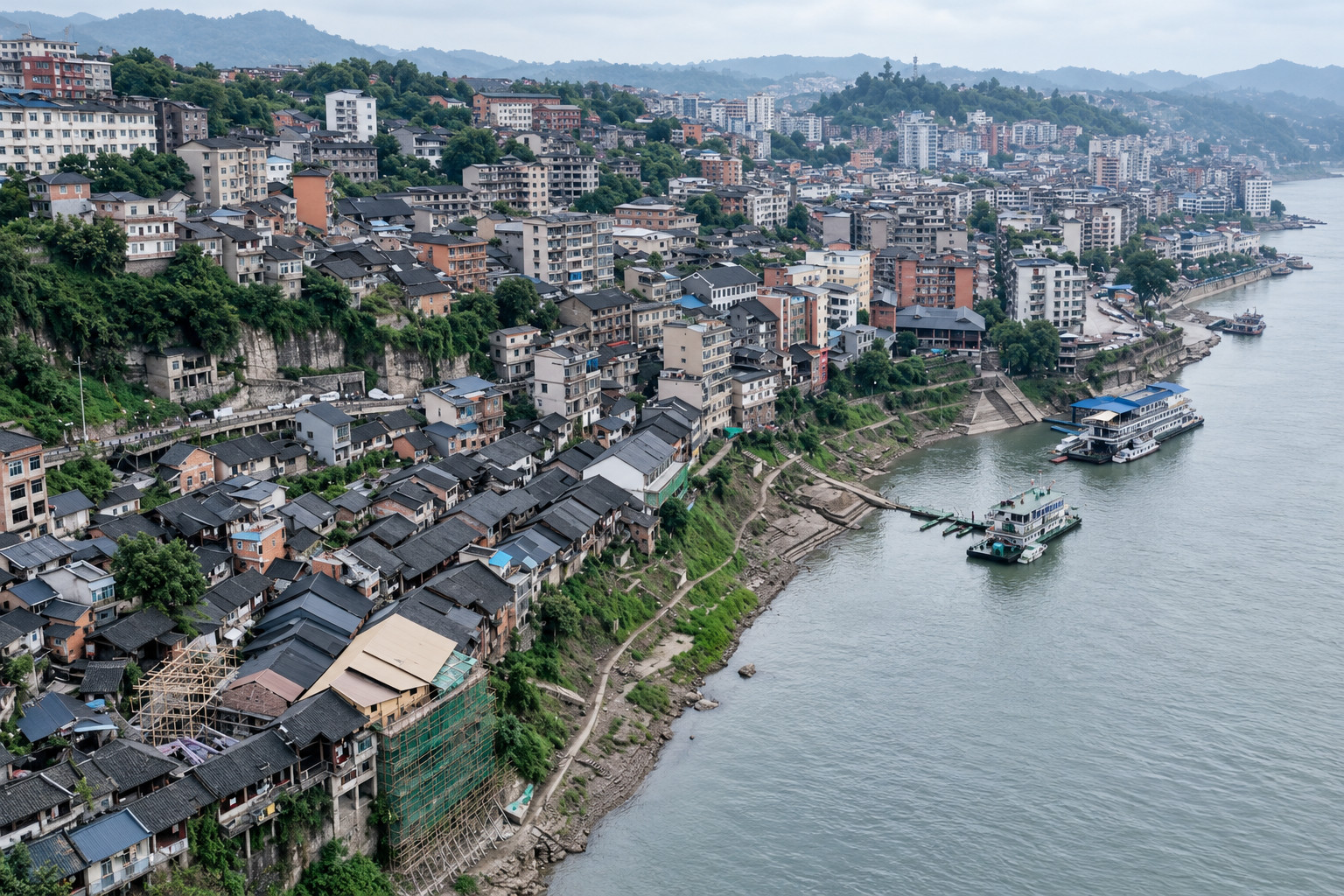
Cover illustration: AI illustration based on a historical photograph. Jiangjin Baisha’s dense riverfront roofs, hillside town and Yangtze overview. Reference published by Sohu / Jiangjin Daily on 2019-11-20, not a capture date; photographer and capture date unknown. Architecture and viewpoint are approximate. Not evidence of current conditions, public access or a navigation route.
Historical reference only; original photographs kept for internal reference, not republished; no reuse license established: Sohu / Jiangjin Daily / Photographer not credited; capture date unknown
This guide includes four labeled AI scene illustrations based on historical photographs and one original localized observation and planning card. The actual photographs remain internal reference-only; no reuse license has been established and the original photos are not republished. Sohu / Jiangjin Daily published the references on 2019-11-20; this is not their capture date. The photographer and capture dates are unknown. Architecture and viewpoints are approximate, with no evidence of current conditions, public access or navigation. No independent review is claimed.
Baisha in Jiangjin is a port-heritage outing in 2026, with old streets and wartime sites distinguished from film facilities in the district government's September tourism route. Start with the riverside settlement, then add a named exhibition or filming area only when its visitor access is confirmed for your date.
The destination to save is 江津白沙古镇, Jiangjin Baisha Ancient Town. Including Jiangjin matters when searching for accommodation, transport or photographs: “Baisha” alone is not a sufficiently precise destination. This guide treats the streets as part of a lived town, with residents, shops and working premises, rather than as a single controlled attraction.
The research date is 1 October 2026. The route below is a suggested way to organise the visit, not a walked or timed itinerary. Current transport departures, entry arrangements and filming restrictions were not independently tested.
Find the port town behind the photographs
The Jiangjin government's western heritage route, displayed as updated on 11 September 2026, places Baisha in western Jiangjin on the Yangtze. It links the town's development to river transport, overland commerce and, later, institutions relocated during the war against Japan. These connections explain why Baisha is more than a collection of old-looking shopfronts.
Begin with a permitted river-facing viewpoint. Look at the relationship between water, rising ground and the streets behind it. Then turn inland and notice which lanes climb, which follow a contour and where larger buildings occupy usable terraces. This is an observation exercise, not a claim that every visible stair was a historic cargo route.
If a sign identifies a former landing, warehouse or institution, photograph the name as well as the building. The label lets you separate a documented site from a plausible story about its appearance. A riverside position suggests useful questions; it does not prove a building's former occupation.

AI illustration based on a historical photograph. Donghua’s river-facing masonry piers below weathered timber balconies and tiled roofs. Reference published by Sohu / Jiangjin Daily on 2019-11-20, not a capture date; photographer and capture date unknown. Architecture and viewpoint are approximate. Not evidence of current conditions, public access or a navigation route.
Historical reference only; original photographs kept for internal reference, not republished; no reuse license established: Sohu / Jiangjin Daily / Photographer not credited; capture date unknown
Use three streets as orientation anchors
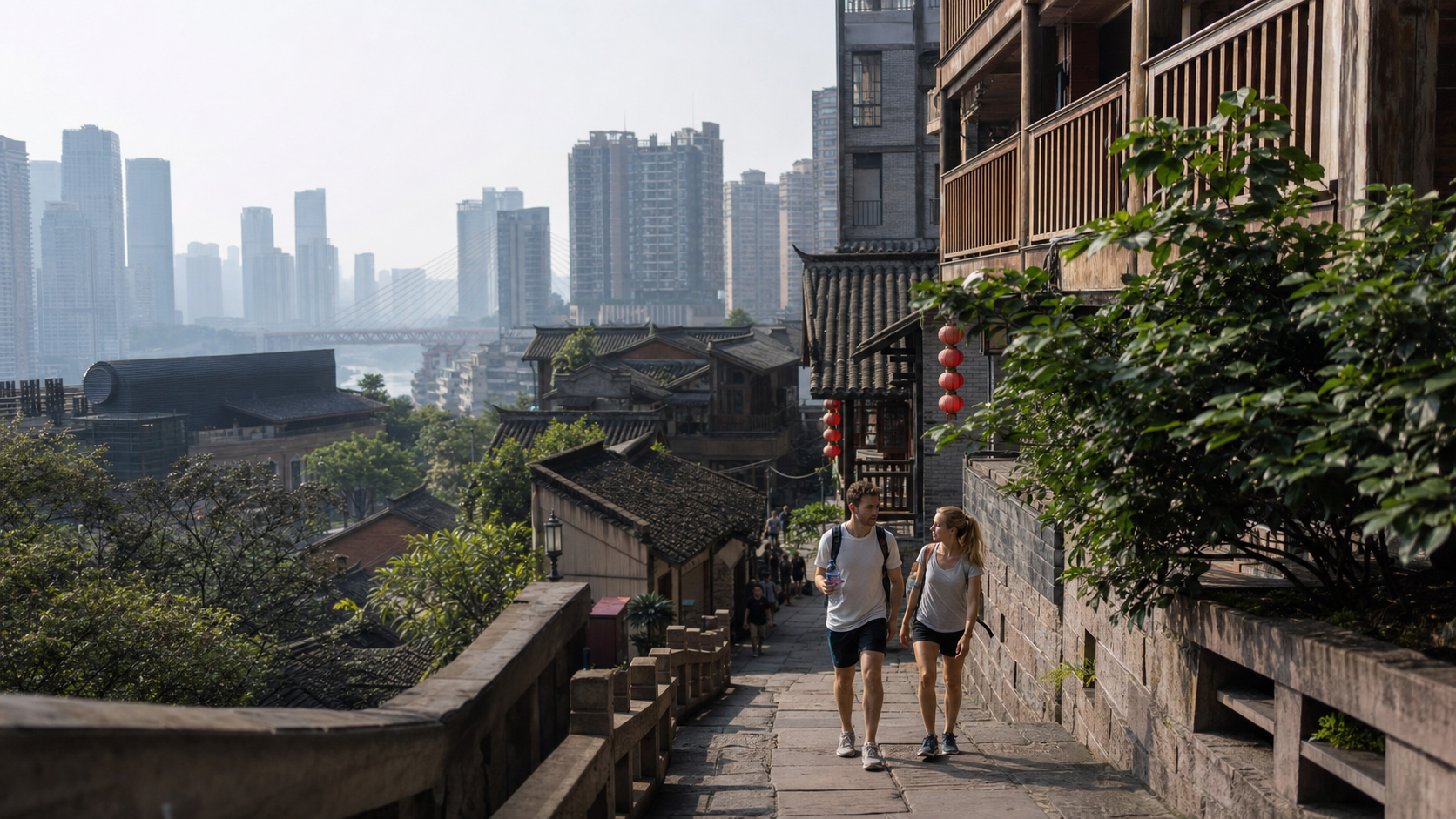
A district report published on 25 February 2024 names Donghua Old Street, Minsheng Street and Wenfeng Street in its account of streetscape improvement. Save 东华古街, 民生街 and 文峰街 as names to locate on the current visitor map. They are useful anchors, rather than a verified continuous walking circuit in that order.
Choose one as your starting area, mark the vehicle meeting point, and make short branches from the main route. At a junction, check where the lane ends before descending a long staircase. This gives you room to explore without making an unfamiliar lower exit your only way back. It also keeps the visit workable if a lane is temporarily closed or a companion prefers less climbing.
Watch how a frontage meets the slope: one entrance can face the street while another level sits below it. Compare door widths, covered thresholds and the spaces between neighbouring buildings. Those details can make an ordinary stretch of lane more interesting than a single decorative photo stop.
The documented improvement work also changes the right language for the place. Baisha has historic fabric and later interventions. A newly repaired wall is not evidence of an untouched town, and a modern shop need not invalidate the older street arrangement around it. Look for dated conservation signs where a building's history matters to you.
Read wartime history through named institutions
The September 2026 official heritage overview identifies wartime arrivals including the National Central Library, educational institutions and industrial enterprises. The important theme is relocation: a river-connected town provided places for learning, administration and production during a period of national upheaval.
For an interpretation-focused visit, choose one institution to investigate properly. Ask which surviving site represents it, whether there is an exhibition, and whether the display has English explanations. A building associated with an institution and an open museum about that institution are different things. If the interior is unavailable, reading an exterior plaque and understanding the surrounding street can still be worthwhile.
Keep your notes specific. Record the original institution's name, the dates mentioned on site and whether the building is original, restored or adapted. Avoid turning a photograph of an old classroom-like room into a claim that a particular historical figure taught there. The strongest souvenir from this part of Baisha may be a clear account of what one place actually did.

AI illustration based on a historical photograph. A narrow Donghua brick-and-timber lane with stone slabs, lanterns, overhead wires and repair materials. Reference published by Sohu / Jiangjin Daily on 2019-11-20, not a capture date; photographer and capture date unknown. Architecture and viewpoint are approximate. Not evidence of current conditions, public access or a navigation route.
Historical reference only; original photographs kept for internal reference, not republished; no reuse license established: Sohu / Jiangjin Daily / Photographer not credited; capture date unknown
Separate film production from visitor access
The district tourism route displayed on 11 September 2026 lists Chongqing Film City in Jiangjin Baisha, exhibition facilities and a former sugar-factory filming area alongside the old town. That wording supports treating them as separate components. It does not establish that a person wandering the old streets can enter every production space.
If film history is your priority, ask for the precise name and entrance of the visitor product. Check whether it is an exhibition, a set visit, a public street used in productions or a working area with restricted access. Ask what happens if filming changes the available route. A ticket photograph showing several buildings is not enough to answer those questions.
Old-town walking remains a useful fallback if a film component is unavailable. Do not build a long journey around seeing a particular production unless an authorised visitor programme explicitly promises it. Respect barriers, staff directions and restrictions on photographing equipment or performers. Looking like a historic street does not make a set a public right of way.
For photographs, keep two labels separate: “Baisha historic street” and “film location in Baisha.” If the exact building is a reconstruction, caption it that way. This small distinction makes a personal travel album more truthful and prevents later readers from mistaking scenic design for surviving architecture.
Notice the working town, including its distilling heritage
A China Daily feature dated 10 September 2019 connects Jiangxiaobai with Baisha and describes the Lvxi distilling tradition. It is useful background to the area's industry. It is not a current factory-tour announcement, and this guide does not infer public access from photographs taken inside a distillery.
If that subject interests you, look for a specifically advertised heritage exhibition or visitor experience and ask what is included. A retail shop, an industrial site and a hosted tasting serve different purposes. Confirm any fee and appointment requirement directly. If you are driving, keep any alcohol tasting out of your own day's activities.
A meal or tea break also provides a sensible pause between the streets and an optional interior. Choose somewhere with a visible menu and a clearly stated price, and ask about ingredients rather than relying on a dish's translated name. There is no need to turn lunch into a search for a supposedly secret establishment. An ordinary business that meets your needs can be part of understanding a town that still works.

AI illustration based on a historical photograph. Uneven mossy steps between a whitewashed wall and a timber dwelling in Baisha. Reference published by Sohu / Jiangjin Daily on 2019-11-20, not a capture date; photographer and capture date unknown. Architecture and viewpoint are approximate. Not evidence of current conditions, public access or a navigation route.
Historical reference only; original photographs kept for internal reference, not republished; no reuse license established: Sohu / Jiangjin Daily / Photographer not credited; capture date unknown
Plan a riverside walk and a dependable return
An iChongqing summer feature from July 2020 described Baisha's stone lanes and promoted riverside activities. Its old ferry fare and water-play suggestions are not a current timetable or a safety assessment. Do not treat a dated photograph of exposed ground as permission to walk on today's river edge.
Choose the day's focus
A manageable visit can have three parts: an orientation walk between a river viewpoint and the old streets, one documented heritage stop, and an unhurried break before returning. Reserve the film component for the remaining time only if its access is confirmed. This sequence is an editorial suggestion, with no promised duration or measured distance.
Choose your priority before leaving Chongqing. Architecture-focused visitors can spend longer comparing street levels and building fronts. History-focused visitors should allow time for an exhibition and translation. Families may prefer a shorter street section with an easy retreat to food and transport. Trying to satisfy all three interests at full depth can create unnecessary transfers and climbing.
The official western Jiangjin route also groups several other towns. Treat that as a regional menu rather than instructions to cover them all in one day. Adding Tanghe or another destination changes the transport requirement. A driver who agrees to a Baisha return trip has not necessarily agreed to an open-ended multi-town circuit.
Arrange a reachable pickup
Compare a direct road transfer with a rail-and-road journey for the actual date, including the final leg into Baisha. Do not select a station solely because its English name appears near the destination on a map. The existing Chongqing railway-stations guide explains the broader naming checks; it does not supply a current Baisha connection.
For a hired vehicle, agree on the drop-off, pickup location, waiting arrangement and any extra stop before setting off. Save the pickup pin and a photograph of the landmark from street level. A scenic riverside point reached on foot may be unsuitable for collecting passengers by car.
For public transport, verify both directions with the current operator. Allow time to reach the departure point from the old streets, not merely time for the main journey. The maps and road-level guide helps with the general problem of meeting a driver at the correct level. Here, the local safeguard is a named, reachable pickup point in Baisha itself.

Original localized observation and planning card; all labels also appear as selectable text below. Observation prompts and planning questions only; no mapped route or current access claim.
Original editorial observation and planning card based on this article; no reference photograph reused. Not a photograph or geographic map.
Read Baisha’s port-town layers
What to look for:
- Compare river, slope and street levels.
- At Donghua, compare timber, masonry and later repairs.
- Read site plaques; distinguish heritage from film sets.
Ask before the trip:
- Which street sections and named sites are open? Check steps and filming limits.
- Where can your vehicle meet you, and how will you return? Verify any ferry separately.
Observation prompts and planning questions only; no mapped route or current access claim.
Keep river access and walking conditions in view
Use open public paths and follow local closures. Skip slippery steps or a descent that would be difficult to reverse. For a companion who needs step-free movement, request a route-specific description covering the drop-off, chosen street section, toilets and pickup. The summer heat and stairs guide offers wider preparation; shade and water proximity do not remove the need to manage exertion.
Residents' doors, drying areas and courtyards are not automatically attractions. Ask before entering or taking close portraits, and keep narrow passages clear. Baisha's historical interest is easier to appreciate when normal life can continue around the visit.
About This Guide
This guide was researched on 1 October 2026 using Jiangjin government material, dated iChongqing reporting and China Daily's industry coverage. Street-reading suggestions and trip structure are original editorial synthesis. No personal visit, interview, tested itinerary or human field review is claimed. Confirm the particular entrances and return arrangements before travel.
Frequently Asked Questions
Q: Which Baisha does this guide cover? A: Jiangjin Baisha Ancient Town, 江津白沙古镇, is in Chongqing. Include Jiangjin in navigation and booking searches to avoid similarly named places.
Q: Is Baisha simply a film set? A: Baisha is a historic Jiangjin port town with wartime, educational and industrial heritage. Official sources list its film-related sites separately, so identify which component you intend to visit.
Q: Can I enter the former sugar-factory filming area? A: Current public access to Baisha's former sugar-factory filming area was not established by this research. Confirm the exact visitor product, entrance, date and filming restrictions with the responsible operator.
Q: Does an old ferry recommendation still apply? A: Baisha ferry recommendations in a July 2020 tourism feature are historical, not current sailing or fare confirmations. Plan the visit without relying on an unverified crossing.
Q: Is the old-town walk suitable for someone avoiding stairs? A: Baisha's chosen street section needs a route-specific check. Ask about gradients, steps, toilets and the distance between drop-off and pickup rather than inferring whole-town accessibility from one level street.
Traveler comments
Share a recent experience or ask a practical question about this guide.