
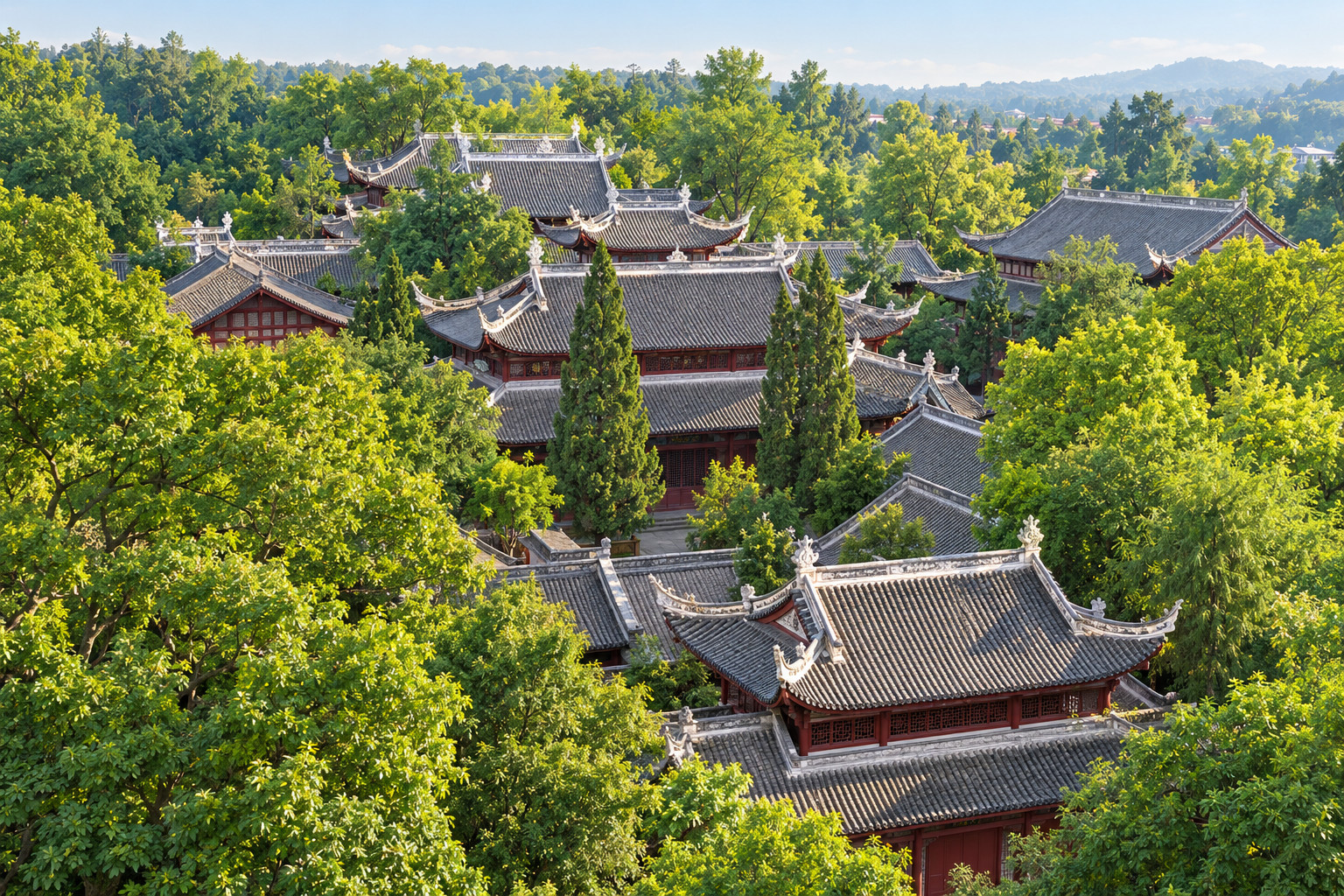
Cover illustration: AI illustration based on historical photo references. A cropped view of the tiled roof ensemble at Shuanggui Hall. The scene and details are approximate, not a current photograph or proof of public access, a public path or an authorized viewpoint.
Historical photo reference only; original not republished; the reference grants no reuse permission: iChongqing / Bridging News / Wu Mengxiong (credited by iChongqing)
This guide contains four explicitly labeled AI scene illustrations from historical photo references and one original localized planning diagram. Photograph capture dates and current access are not established by the page update dates. No independent review is claimed.
Shuanggui Hall in Liangping is a Buddhist temple and architectural destination to visit respectfully in 2026. Chongqing's official history dates its foundation to 1653 under the monk Poshan. Plan a focused visit to the public courtyards and permitted halls, allowing religious activity and current access rules to shape the route.
Save 梁平双桂堂 and 金带街道万竹山 when confirming the destination. English sources may call it Shuanggui Hall, Shuanggui Tang or Shuanggui Temple. Those variations should not distract from its specific location in Liangping, outside central Chongqing's urban temple circuit.
This guide is based on published historical and architectural descriptions read on 1 October 2026. It does not claim a visit, an interview with monastic staff or a current survey of every hall. Opening hours, admissions, ceremonies, collection displays and step-free access remain matters to confirm directly.
Understand the name and foundation
The Chongqing Civil Affairs Bureau's December 2024 account locates Shuanggui Hall on Wanzhu Mountain in Liangping's Jindai subdistrict and dates its founding to 1653. It connects the name with two osmanthus trees and the monk Poshan. The same article includes a miraculous tree-origin story, which should be read as local religious storytelling rather than botanical evidence.
Keep three layers separate: the documented foundation, the traditions explaining the name, and the buildings visible now. A foundation date does not mean every beam, statue and courtyard is unchanged from that year. A legend can be culturally meaningful without being presented as an event independently verified by this guide.
The iChongqing Liangping profile also uses the name Fuguo Temple. When booking a journey, use 双桂堂 alongside the district and the venue's confirmed entrance. Do not rely on the generic English word “temple” or assume every search result using Shuanggui refers to this complex.

AI illustration based on historical photo references. A side arch and surrounding architectural detail at Shuanggui Hall; the main plaque is outside the image. The scene and details are approximate, not a current photograph or proof of public access, a public path or an authorized viewpoint.
Historical photo reference only; original not republished; the reference grants no reuse permission: Chongqing Urban Management Bureau / Photographer not credited
Read the courtyards as a sequence
The municipal historical-gardens article published in July 2022 describes courtyard development, connected passages and a tiled architectural ensemble. The useful visitor question is how these spaces lead from one to another, rather than how quickly you can count all the buildings.
At the entrance, establish the public route and any temporary restrictions. Then look at how a courtyard frames the next hall. Notice the change from an open space to a roofed threshold, and how a passage offers a different view from the central approach. These are observation prompts for accessible public areas, not permission to enter every connecting door.
The 2024 official account names buildings including the Maitreya Hall, Mahavira Hall, ordination hall, Poshan pagoda, Great Compassion Hall and scripture library within the temple's layout. A list of components is not a verified current visitor itinerary. Ask which spaces are open and let that answer determine the sequence.
An architectural visit can be satisfying without access to every interior. A permitted courtyard view may make the roofline, supporting structure and relationship between buildings easier to understand than standing in a crowded doorway.
Pay attention to materials without inventing measurements
The 2022 historical-gardens description points to wood, stone and brick carving, painted decoration and the small-tile roofscape. These are useful themes for looking closely. Choose one or two details you can see comfortably, then relate them to the larger building rather than making a catalogue of everything in the complex.
Look from the visitor side of a barrier. Compare the texture of stone with the treatment of timber, or the scale of a carved detail with the space it occupies. If a feature is labelled, note the name and date before taking a photograph. Do not identify a carving's material, symbolism or age solely from its colour.
Public descriptions do not agree on every measurement and structural count. The English overview, for example, gives details that differ from municipal accounts. This guide does not select a pillar count simply because it sounds precise. For a specialist interest, a current scholarly survey or an explanation from qualified site staff would be more useful than repeating inconsistent tourist text.
Restoration is also part of the story. Differences in surface appearance do not automatically tell you which piece is old or new. Observe carefully and use the venue's interpretation rather than assigning dates by weathering alone.

AI illustration based on historical photo references. A pond, stone bridge and part of a building at Shuanggui Hall; no individual hall is identified. The scene and details are approximate, not a current photograph or proof of public access, a public path or an authorized viewpoint.
Historical photo reference only; original not republished; the reference grants no reuse permission: Chongqing Urban Management Bureau / Photographer not credited
Connect the architecture with teaching and practice
A historical study by Daojian on the Buddhist Academy of China's website, published in 2006, discusses Poshan's work at Shuanggui Hall and the development of a Dharma hall in 1661. Its relevant sections place the temple within a network of teaching and transmission. This adds context to the building names without turning the visit into a claim of specialist religious knowledge.
A hall used for instruction, a space for worship and accommodation for a monastic community can sit within the same complex while serving different purposes. An open gate does not make every function available for tourist inspection. Pay attention to signs, the behaviour of staff and any directions given at arrival.
If a service is taking place, pause before approaching. Ask whether visitors may observe, where to stand and whether photography is permitted. Quiet observation can be appropriate when invited; movement through a ritual space to reach a photo angle is not a reasonable assumption.
You do not need to imitate worship to be respectful. Visitors may choose to learn about the building and its history while leaving devotional participation to those who want it. If you do wish to participate, ask a responsible member of staff about the proper procedure rather than copying an activity you do not understand.
Give worshippers and the fabric of the temple room
The official history records Shuanggui Hall's national Buddhist-temple designation in 1983 and its national heritage listing in 2013. These two strands help explain why visitor behaviour should respect both religious use and physical conservation.
Begin with four simple practices: keep your voice low, leave doorways clear, follow photography restrictions and avoid touching objects or decorations. They are sensible visitor recommendations, not a substitute for the temple's own directions. If the venue asks for a different route or restricts entry, follow that instruction.
Ask before photographing a monk, worshipper or ceremony at close range. Permission to photograph a courtyard does not automatically cover every person or interior. Avoid flash where prohibited and put away a tripod if it obstructs movement or is not allowed.
Do not lean equipment against carvings, climb thresholds or use a shrine as a backdrop for disruptive posing. Keep children close enough to guide them around fragile objects and worship spaces. For incense, offerings or donations, use the arrangements the temple itself identifies; this guide does not require a purchase as a condition of a worthwhile visit.

AI illustration based on historical photo references. A close view of a roof ridge and adjoining tiles at Shuanggui Hall. The scene and details are approximate, not a current photograph or proof of public access, a public path or an authorized viewpoint.
Historical photo reference only; original not republished; the reference grants no reuse permission: Chongqing Urban Management Bureau / Photographer not credited
Treat the garden as part of the architecture
The municipal garden profile presents Shuanggui Hall as a temple garden as well as a building complex. Its 2022 description points to the relationship of courtyards, passages, planting and pools. That is a useful reason to leave time between the halls rather than making every outdoor space a corridor to the next interior.
Consider the view from one permitted resting point. What is framed by the eaves? How does planting change the apparent scale of a courtyard? Where does the built edge meet a garden space? These questions keep the visit attentive without requiring access to a private monastic area.
The two osmanthus trees associated with the name should not become a promise of flowers on a particular day. If flowering is important to you, ask for recent seasonal information rather than relying on an undated autumn image. Do not pick blossoms, shake branches or step into planted areas for a photograph.
Check whether sitting and eating are allowed in the place you choose to pause. Leave ponds and animals alone; a religious association with releasing life is not permission to introduce creatures or food into a water body. Follow current site management rather than performing an activity suggested by an old caption.
Arrange a precise Liangping visit
The official place-name account locates the temple on Wanzhu Mountain in Jindai subdistrict, Liangping. Put 梁平双桂堂 and the venue's entrance pin in your travel note. Confirm where the local vehicle will leave you and meet you afterward; a ticket to Liangping does not resolve the temple connection. Current train departures, local buses and a driving time were not verified for this guide.
Ask the temple which courtyards and halls visitors may enter on your date and whether worship or maintenance changes that route. This question is more useful than asking whether “the whole temple” is open, because access to the complex need not include each interior. If you have an onward train, plan the return around the actual pickup point and the provider's road margin, then allow for station entry.
For mobility needs, request details of steps and thresholds along that permitted route, plus the accessible drop-off, resting places and toilets. The courtyard layout described above does not establish a continuous level surface. A photograph of a ramp is useful evidence for that entrance, but cannot establish access through every hall.
Our railway-stations guide helps with exact station names. If your time is confined to central Chongqing, the separate Luohan Temple guide offers a different urban temple outing; it should not be treated as a substitute description of Shuanggui Hall.

Original visitor-planning card; all labels also appear as selectable text below. Planning checklist only, not a route map or access audit. Follow current temple directions.
Original editorial planning diagram based on this article; not a photograph or geographic map.
Plan a Shuanggui Hall visit
Look from permitted areas:
- See how a courtyard frames a hall.
- Compare timber, stone and roof details.
- Notice planting beside the buildings.
Ask before visiting:
- Which entrance and halls are open?
- Where may I stand and take photos?
- Are steps and the return pickup suitable?
Planning checklist only, not a route map or access audit. Follow current temple directions.
Decide what to add without diluting the temple visit
The iChongqing Liangping profile also discusses district crafts, including bamboo blinds and New Year pictures. That wider cultural context may interest travelers staying in Liangping, but the profile does not establish that a workshop or exhibition is beside the temple or open on your date.
If Liangping bamboo blinds or New Year pictures interest you, look for a venue that explains how they are made, then check its present address and visitor arrangements. Ask whether you will see a working demonstration, an exhibition or retail stock; those are different experiences. A maker's explanation could complement your observations of the temple's timber, carving and painted surfaces, but a souvenir stall alone cannot supply that context.
Keep the temple visit focused on questions its buildings and interpretation can answer. How does a courtyard frame the next hall? Does a label distinguish a building's foundation from later repair? What is the role of the space visitors are allowed to see? Record the available explanation and leave unresolved details unresolved, rather than filling gaps with an unsourced dimension or a literal reading of a legend.
About This Guide
Five pages across four root domains were read on 1 October 2026. Municipal accounts establish the foundation and layout; a Buddhist Academy essay supplies historical teaching context; iChongqing and an English overview provide cross-checks. Conflicting pillar counts, restoration dates and collection-display claims are deliberately not treated as settled facts.
The public guide contains no current admission price, opening time or promise that stored objects are on view. Check those details and the permitted route with the venue. For navigating the regional connection, save the full Chinese name using the maps and navigation guide.
Frequently Asked Questions
Q: Where is Shuanggui Hall? A: Shuanggui Hall is at Wanzhu Mountain in Jindai subdistrict, Liangping, Chongqing. Save 梁平双桂堂 when confirming the entrance and local transport.
Q: How old is Shuanggui Hall? A: Official accounts date its foundation under Poshan to 1653. The complex developed and underwent repairs over time, so that date should not be assigned to every visible component.
Q: Are Shuanggui Hall and Shuanggui Temple different places? A: In this Liangping context, the English names Shuanggui Hall, Shuanggui Tang and Shuanggui Temple refer to 双桂堂. Include the district and Chinese name to avoid confusion in a booking.
Q: Can I photograph inside every hall? A: No general permission was verified. Check Shuanggui Hall's current signs and staff instructions for each interior, and ask before close photographs of worshippers or religious activity.
Q: Can visitors see all the temple's historic objects? A: Published descriptions of Shuanggui Hall's holdings are not confirmation of a current public display. Ask which halls or exhibitions are accessible on your date and accept any conservation or religious-use restrictions.
Traveler comments
Share a recent experience or ask a practical question about this guide.