
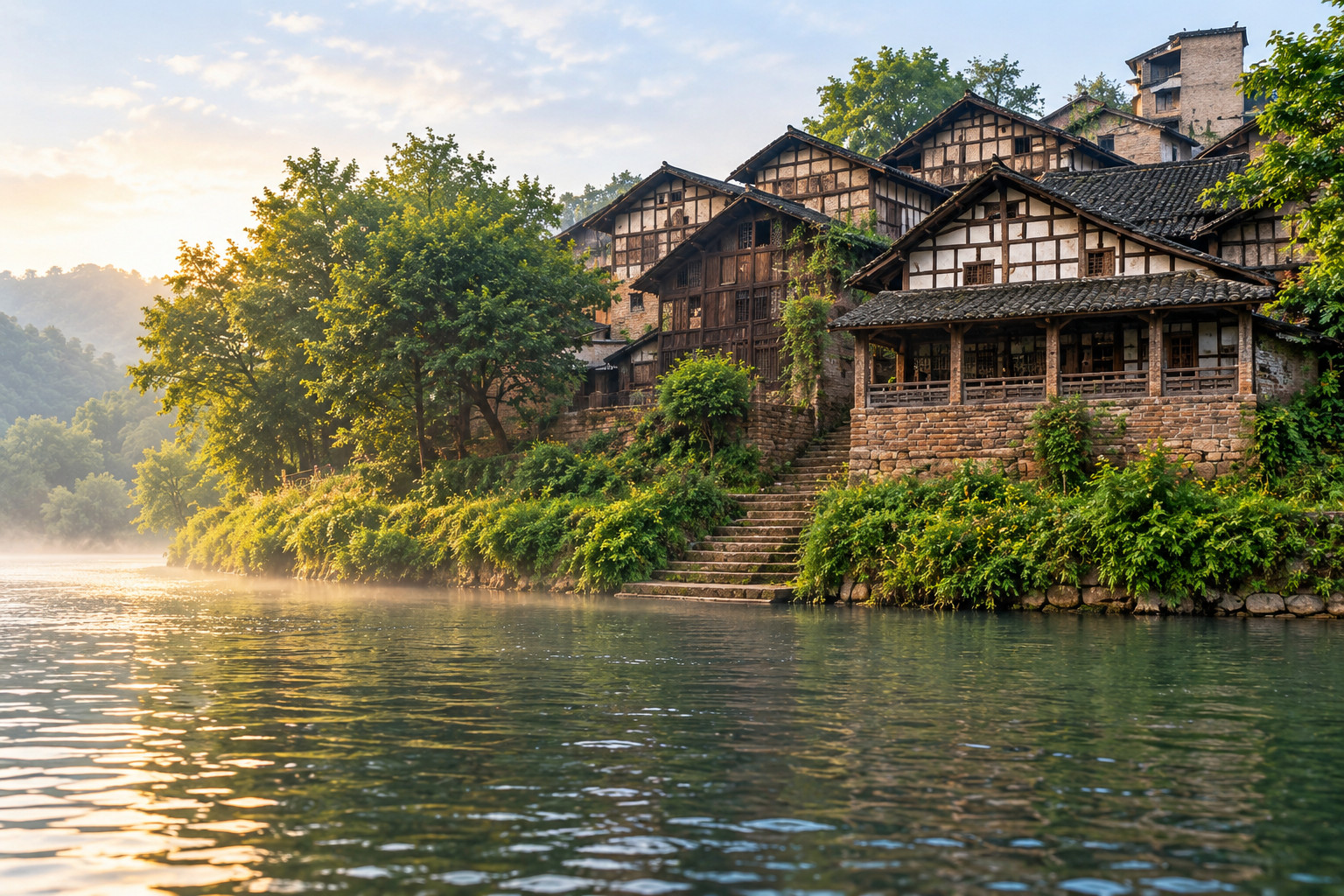
Cover illustration: AI illustration from historical photographic reference. Tanghe riverbank houses, stone steps and water. Reference published 2022-05-07; capture date unknown. Architecture and viewpoint are approximate; not a current photograph, access confirmation or navigation guide.
Historical reference only; source photograph not republished; reuse permission not established: iChongqing / Photographer not credited
Media note: four AI illustrations use historical photographs only as references. Original photographs are not republished and no reuse license or independent rights clearance is claimed. The manor image is Shilongmen Manor, not Tingzhong ancestral hall. Details, viewpoint and layout are approximate; these images do not establish current conditions, opening or routes. No independent editorial, language, image/rights or production review is claimed.
Tanghe Ancient Town in 2026 is a Jiangjin outing for river-linked streets, merchant-era architecture and family institutions. Jiangjin's tourism authority identifies three main heritage components: the old street, Shilongmen Manor and Tingzhong ancestral hall. Start with the street, then add a separate building only after confirming its location, access and return connection.
The destination is 塘河古镇 in 江津区, Jiangjin District, Chongqing. It should not be confused with Fubao in neighboring Sichuan or with a generic search for “Tanghe” elsewhere in China. Use the full Chinese place name in transport messages and compare the district shown on a map before accepting a pin.
This is a source-researched guide to interpreting the town and making practical choices. It is not an account of a personal visit, and it does not promise current admission to every building named in heritage descriptions.
Read the old street from its river connection
The Jiangjin tourism authority's September 2024 introduction describes streets rising in steps from the river landing, with the main street linked to Hengjiezi and Miaoxiangzi. That stepped relationship is the most useful starting point for an architecture-focused visit.
From an open public approach, look at two scales: the street's overall rise and the way individual buildings meet it. A frontage on a slope may have to reconcile several levels within a short distance. Observe how entrances, foundations and roof lines respond, without assuming that every visible element belongs to the same construction period.
If your actual arrival is above the old street, you can read the sequence in reverse. There is no need to descend to the water merely to reproduce a historical account's order. Ask which public paths are open, and keep to them when a flight of steps leads toward a private doorway or restricted bank.
The old landing explains the settlement's relationship with trade; it does not establish a current ferry or sightseeing-boat departure. Book a road arrival unless you have independently confirmed a real water service for your date.

AI illustration from historical photographic reference. Tanghe pale-edged curved gable and adjoining tiled roof. Reference published 2022-05-07; capture date unknown. Architecture and viewpoint are approximate; not a current photograph, access confirmation or navigation guide.
Historical reference only; source photograph not republished; reuse permission not established: iChongqing / Photographer not credited
Follow materials before assigning architectural labels
The district introduction describes stone bases, brick-and-timber walls and a variety of architectural influences. Instead of trying to classify every house at a glance, choose three visible elements to compare: the base at street level, the doorway and the roof edge.
Look at how those elements change from one frontage to the next. A substantial stone base may be especially noticeable where a street rises, while a narrow entry can conceal a deeper interior. Ornamental detail may be concentrated near an entrance rather than spread uniformly across a building. These are observation prompts, not claims about the function of an undocumented house.
Terms such as Huizhou-style or Chinese-Western should be attached to a building only when a reliable panel or source identifies it. A decorative shape alone does not prove where the builder came from. Buildings can combine influences, later alterations and repairs that do not fit a single neat label.
For photographs, take a wider frame before a close detail. That makes it easier to remember which building the carving or window belongs to. Never remove a sign, plant or household object to make the view look older.
Distinguish a boatmen's hall from a family hall
The municipal heritage account dated 12 March 2013 identifies Wangye Temple and Longmenhao, described as a boatmen's gathering place. It also connects Tanghe with trade between the Chongqing, Sichuan and Guizhou regions.
These names offer a way to ask about social organization as well as architecture. Who used a building, and what brought those people together? A shared occupation, religious practice or family lineage creates a different institution, even when the buildings have comparable courtyards and decorated entrances.
Choose one documented feature to investigate rather than making every attractive frontage part of the same merchant story. If a sign identifies an old association, look for the evidence it gives: a name, an inscription, a patron or a former function. Ask a guide to distinguish a recorded fact from a local legend.
The 2013 description is a historical reference, not a current access list. Confirm what remains visitable before leaving the main public street for a named building. Do not use an unmarked household passage as a shortcut to something that appears close on a map.

AI illustration from historical photographic reference. Close study of one Tanghe tiled roof ridge and pale cornice; no named institution is identified. Reference published 2022-05-07; capture date unknown. Architecture and viewpoint are approximate; not a current photograph, access confirmation or navigation guide.
Historical reference only; source photograph not republished; reuse permission not established: iChongqing / Photographer not credited
Choose a manor or ancestral-hall visit
The 2024 district introduction treats Shilongmen Manor as one of Tanghe's three heritage components, distinct from the old street. Do not assume that reaching the old-town parking area places you at the manor entrance.
Decide whether a larger residential complex matches your interests. If it does, confirm the exact pin, today's opening arrangement, any admission requirement and the transfer from the street. Ask how much of the complex is actually accessible; a large historic footprint does not mean every court and room is open to visitors.
When inside an authorized area, use circulation as your theme. How does one court lead to another? Where does a doorway create privacy? Can you tell which spaces were intended for receiving guests and which require explanation from a panel? Avoid assigning those functions confidently from size alone.
If access cannot be confirmed, leave the manor out rather than spending your return margin searching for an entrance. An exterior-only plan can also be reasonable, provided it uses a genuinely public viewpoint and you understand that it is a different experience from visiting the interior.
Give Tingzhong ancestral hall its own identity
The Jiangjin tourism authority identifies 廷重祠, Tingzhong ancestral hall, also called the Sun family ancestral hall, as a late-Qing lineage building. English tourism sources vary in their rendering of its name, so use the Chinese characters to confirm the destination.
If choosing just one additional heritage interior, compare the hall's purpose with that of the manor before deciding. An ancestral hall offers questions about lineage, commemoration and shared ritual space. A manor suggests a different inquiry into domestic organization and estate life. They do not need to be visited as interchangeable large houses.
Look at the relation between the hall, courtyard and any stage or side rooms that are open. Ask which parts survive from earlier construction and which have been repaired. A named foundation date is not a guarantee that all visible finishes are of that age.
Respect any ritual use or household connections. Keep away from restricted rooms and ask before photographing people. If the hall is closed, a family connection to a building is not an invitation for visitors to demand access.

AI illustration from historical photographic reference. Weathered timber gallery and stone footing at Shilongmen Manor; this is not Tingzhong ancestral hall. Reference published 2013-12-05; capture date unknown. Architecture and viewpoint are approximate; not a current photograph, access confirmation or navigation guide.
Historical reference only; source photograph not republished; reuse permission not established: Sina / Chongqing Morning Post / Li Bin (李斌)
Read conservation and present-day life together
A Jiangjin government report displayed as 5 January 2026 discusses inspection of repairs and conservation at Tanghe. The date is one day earlier than the date embedded in the URL. The report supports a simple point: the town is the subject of continuing care and change, rather than a scene untouched by modern work.
A photograph can show old and new materials together. Do not crop every repair out and then describe the whole building as original. Equally, recent conservation does not make the street's historical organization meaningless. Separate two questions: what has survived, and how is it being maintained or adapted?
Follow any current works barriers even if an older image shows a passable route. The report does not establish which exact buildings are under work on your visit date, so ask locally rather than assuming that all repairs are complete or that the whole town is closed.
For an architecture-minded traveler, a well-explained repair can be as revealing as a decorative detail. It shows the practical difficulty of keeping an inhabited heritage place usable.
Keep folk customs and filming claims in proportion
The iChongqing Tanghe profile describes local marriage customs and the town's association with film and television production. These are two different cultural contexts, neither of which guarantees a public performance when you arrive.
A wedding is a private event unless the organizers clearly present it as a visitor activity. Do not join a procession, enter a household or photograph participants closely merely because a tourism page describes the tradition. For a staged demonstration, confirm the actual programme and any photography conditions.
Similarly, a location's use in filming does not mean visitors can enter an active set or that every building is an original film location. If a guide points out a scene, ask which production and which part of the building is documented. Enjoy the town's physical character without turning an uncertain screen association into its whole identity.
A quiet day with no festival can still support a thoughtful architecture visit. Planning around the streets and confirmed heritage access gives you an outing that does not depend on a performance appearing.
Arrange transport around your chosen components
The 4 September 2024 district introduction identifies three heritage components: Tanghe's old street, Shilongmen Manor and Tingzhong ancestral hall. Use their Chinese names, 塘河古镇, 石龙门庄园 and 廷重祠, to build a transport list that includes only places whose access you have checked. Give the list to your driver or use it to investigate local connections, rather than asking for an undefined “Tanghe tour.”
For public transport, confirm the actual arrival terminal and the onward service to the old town, followed by the return. No current timetable was verified for this guide. An old article's drive time from “Chongqing” is not a useful guarantee from your specific hotel, and a journey to Jiangjin alone may leave a substantial local connection unresolved.
Agree on a vehicle pickup point outside restricted or narrow streets. If you are visiting a separate building, check whether the driver waits or whether you need a second booking. Keep the navigation guide and railway-stations guide as broader preparation tools, not local timetables.
For reduced-step planning, ask about the old street's slope and the interiors individually. The district describes stepped streets, and this research did not establish a continuous accessible route through the town and outlying buildings.
End with one clear architectural comparison
Rather than collecting dozens of photographs, choose one contrast to carry away: a commercial frontage and a lineage hall, a stepped public lane and an enclosed court, or old fabric and a clearly identified repair. Write down the correct place names while you can still check the signs.
The Huguang Guild Hall guide provides a separate central-Chongqing comparison for community institutions. Keep its geography distinct from Tanghe. Similar functions or decorative forms do not make two sites interchangeable.
Leave enough time for a seated food stop and the confirmed return. A shorter visit with an understood building is more useful than arriving at a third closed entrance with no reliable way back.

Original planning card; its complete labels also appear as selectable text below. Planning questions only, not a route map or current opening schedule.
Original editorial planning card based on this article; no source photograph reused. Not a geographic map.
Plan a Tanghe architecture visit
Look for relationships:
- Compare riverfront levels and roof lines.
- Read stone bases, timber and tile details.
- Keep the old street, manor and family hall distinct.
Confirm before travel:
- Check each building’s exact location and permission to enter.
- Confirm steps, transfers, pickup and return transport.
Planning questions only, not a route map or current opening schedule.
About This Guide
Sources were accessed on 1 October 2026: Jiangjin tourism and conservation reporting, municipal heritage information and an English tourism profile. Observation prompts and itinerary choices are original editorial synthesis. No on-site visit, human review or current operating confirmation is claimed. Check individual building access and every required transport leg before travel.
Frequently Asked Questions
Q: Which Tanghe does this guide cover? A: It covers 塘河古镇 in Jiangjin District, Chongqing. It does not cover Fubao in Sichuan or another place named Tanghe.
Q: Are the manor and ancestral hall on the old street? A: Official descriptions treat the old street, Shilongmen Manor and Tingzhong ancestral hall as distinct components. Confirm the exact locations and transfers before combining them.
Q: What Chinese name should I use for Tingzhong hall? A: Use 廷重祠, also identified by Jiangjin's tourism authority as the Sun family ancestral hall. English spellings vary.
Q: Can I expect a wedding performance or film set? A: No current public programme was verified. Tanghe's cultural traditions and filming history do not guarantee an event, and private ceremonies require respect and permission.
Q: Is Tanghe suitable for a step-free outing? A: Tanghe's old street is described as rising in steps from the river. Ask about a specific reduced-step route and individual building access rather than assuming the whole visit is accessible.

Traveler comments
Share a recent experience or ask a practical question about this guide.