
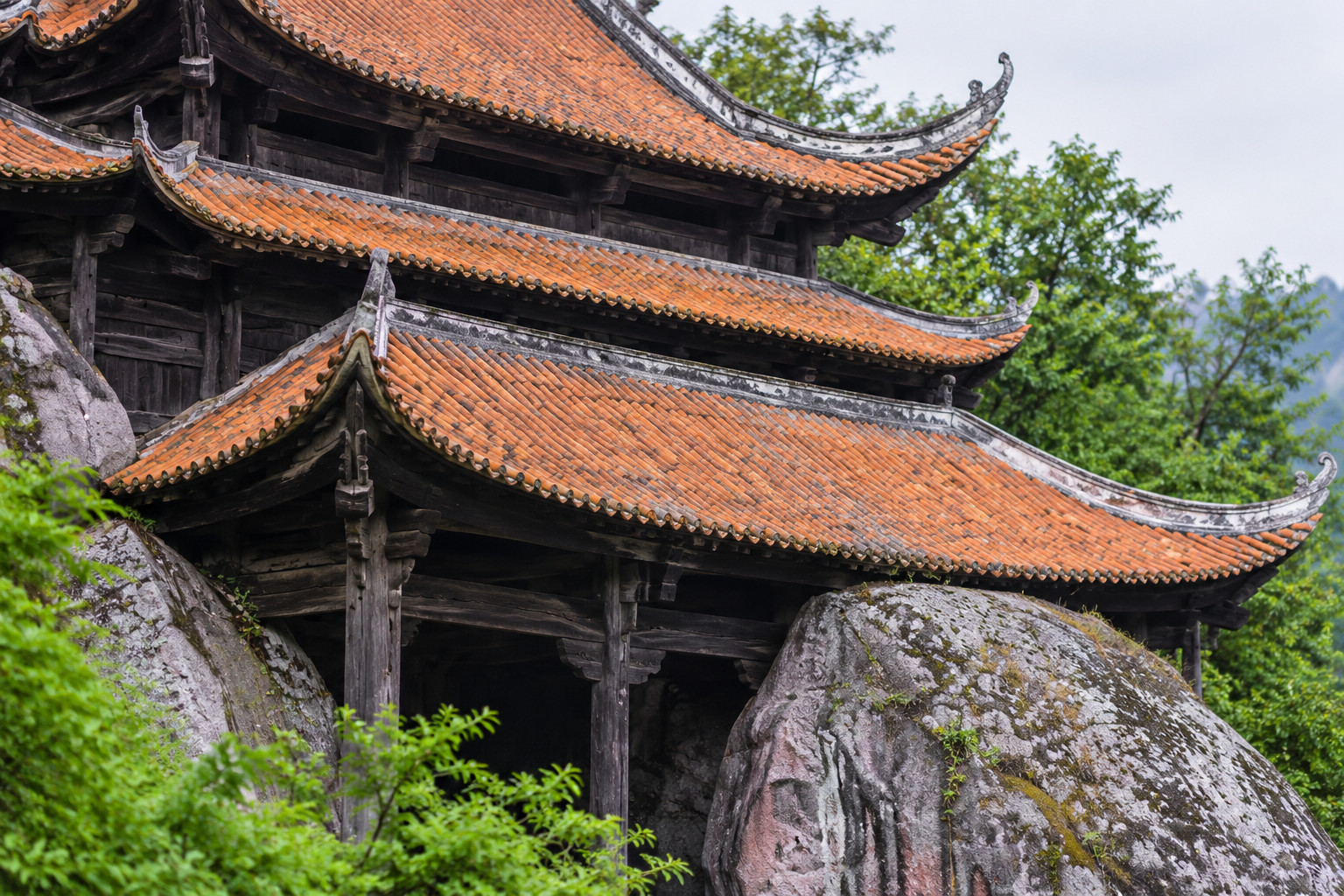
Cover illustration: AI illustration based on a historical photograph. A close view of Erfo Temple roofs and adjacent rock; the reference EXIF records 4 September 2005, while the page was published on 7 May 2024. The pictured temple section is unverified. Scene, terrain and architectural details are approximate; not a current photograph, access confirmation or navigation guide.
Historical reference only; original photograph not republished or licensed for reuse: Chongqing Culture and Tourism Development Commission / Photographer not credited
This guide contains four explicitly labeled AI scene illustrations from historical photo references and one original localized planning diagram. Photograph capture dates and current access are not established by the page update dates. No independent review is claimed.
Laitan Ancient Town in 2026 is a Hechuan heritage visit combining old streets with Buddhist carvings at Erfo Temple. Chongqing's cultural-relics authority dates many lower-temple carvings to 1174–1204. Make the temple's current access your first check, then build a town walk around it, keeping the upper and lower temple sections distinct.
Save 涞滩古镇 for the town and 涞滩二佛寺 for Erfo Temple. The guide's focus is this settlement in Hechuan, not Dazu's separate rock-carving sites or Diaoyu Fortress. If Buddhist sculpture is the reason for your trip, ask specifically about 二佛寺下殿, the lower temple section, before committing to the journey.
This is a source-researched interpretation and planning guide. The sequence is suggested rather than field-tested, and no current ticket price, opening schedule or guaranteed access to a particular carving is claimed.
Understand the town's three linked settings
A Hechuan cultural account dated 30 April 2025 describes three parts of historic Laitan: Erfo Temple and associated remains, the barbican and walled old streets, and the lower landing market. It locates the town on the Qu River's western bank.
Those parts tell different stories. The temple invites attention to religious art and building into rock. The defended entrance and streets raise questions about movement through a settlement. The lower landing connects the town to river commerce. They form an interpretation framework, not a promise of a continuous visitor circuit through every historic area.
On arrival, ask which parts are currently open and how they connect. If the lower temple has a specific entry arrangement, use that as the fixed point and fit the street walk around it. If it is closed, decide honestly whether the town's streets and exterior architecture still justify your trip.
A named landing is not evidence of a current boat service. Avoid adding a river arrival, waterfront descent or unofficial path just to make the three-part history into a physical loop.

AI illustration based on a historical photograph. Laitan fortification: rough stone blocks, arched opening and a simple timber gallery; exact gate name and masonry dates are unverified. Scene, terrain and architectural details are approximate; not a current photograph, access confirmation or navigation guide.
Historical reference only; original photograph not republished or licensed for reuse: PConline Photography Community / Kongying (空影)
Confirm the lower temple, not just “Erfo Temple”
The municipal cultural-relics inventory published in May 2024 locates the rock carvings in Erfo Temple's lower section. The upper and lower temple areas are not interchangeable descriptions of a single room.
Ask two precise questions: is the lower carving area open on the intended day, and what ticket or entrance reaches it? Follow with the amount of climbing or descending required. A listing that says the town is open does not answer either question. Nor does access to an upper hall establish access to the sculpture ensemble below.
The district's 2025 account describes upper buildings on Jiufeng Mountain and lower architecture responding to the rock. Treat that as a reason to investigate the terrain, not as a basis for promising an easy or step-free connection.
If using a guide, explain that your priority is the carvings rather than a quick old-street photo stop. Ask whether interpretation is available in a language you understand and whether the proposed time includes the lower temple. A tour title containing “Laitan” can still allocate its time very differently from the visit you imagined.
Look at the ensemble before individual figures
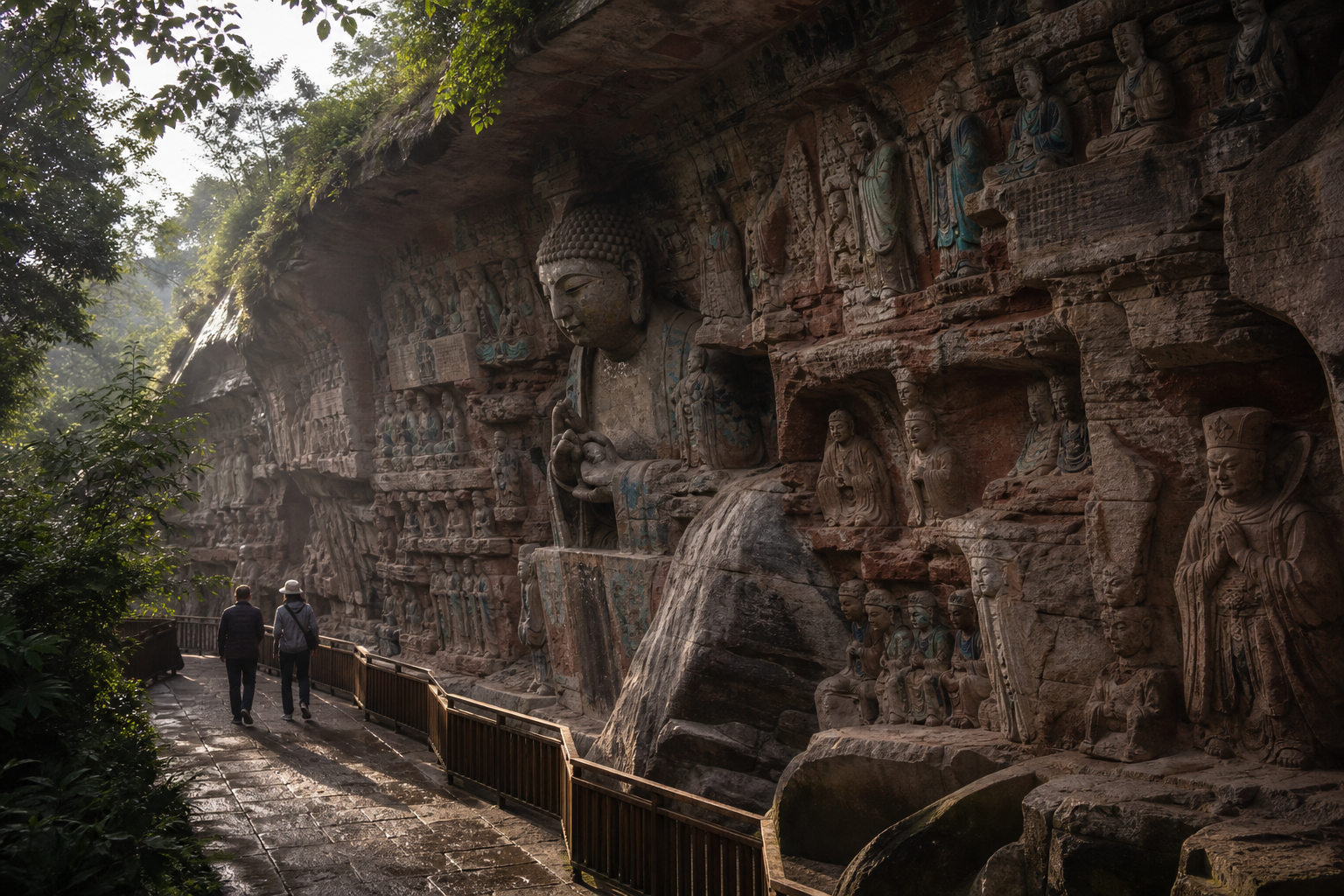
The municipal cultural-relics inventory of 7 May 2024 describes carvings across three rock faces: north, west and south. It identifies a central Shakyamuni figure and surrounding groups that include patriarchs, bodhisattvas and arhats. Begin with that spatial organization instead of trying to identify every face immediately.
From an authorized viewing position, notice the relative scale of the central figure and smaller groups. Ask where your eye is drawn first and how the surrounding images relate to that focus. Then choose one smaller group for closer attention. This two-stage method is more rewarding than rapidly photographing each wall without understanding the composition.
Pay attention to the relationship between rock and built shelter. The carving is not an isolated museum object lifted into a display case. The enclosing architecture, available light and viewing distance affect how you experience the ensemble. Do not move barriers, bring extra lighting or lean into a protected area to improve a photograph.
If interpretation labels use different translations for a figure, retain its Chinese name in your notes. A label photographed with permission can be more useful later than a confident but mistaken identification made from a phone's image-recognition result.

AI illustration based on a historical photograph. Erfo stone entrance portal as exterior context, replacing the unverified lower-carving image. Reliefs and inscriptions are approximate, not an identified Buddhist carving ensemble or verified upper/lower section. Scene, terrain and architectural details are approximate; not a current photograph, access confirmation or navigation guide.
Historical reference only; original photograph not republished or licensed for reuse: PConline Photography Community / Kongying (空影)
Use the carvings to ask a small number of good questions
The heritage authority's 2024 description associates the ensemble with Chan Buddhism and describes many arhats with varied poses and expressions. You do not need a complete history of Buddhism to begin looking attentively.
Choose three observation questions. How do posture and gesture distinguish figures? Which images are grouped, and which are given more space? How does size communicate importance within the composition? These questions concern things you can actually see, rather than asking you to accept an unfamiliar religious explanation uncritically.
For iconographic meaning, use a qualified guide or the site's interpretation. A facial expression alone does not establish a figure's identity, occupation or moral message. Likewise, a vivid story told for visitors should be identified as a story when historical evidence is unclear.
This is also a living religious context. Keep voices low, avoid photographing people in worship without permission, and follow restrictions on flash or cameras wherever posted. Declining a photograph can be the appropriate way to appreciate a place whose purpose extends beyond sightseeing.
Why the numbers differ between sources
The municipal inventory records 42 main niches and 1,613 figures, while the 2025 district cultural essay gives a different total. They also differ on the principal figure's height. This guide uses the specialist inventory when identifying the ensemble, without pretending those published discrepancies have been resolved.
For a visitor, the useful historical point is that the heritage authority dates many carvings to the Southern Song period, especially 1174–1204. That does not date every part of the temple complex or every visible repair. Keep the age of the carvings separate from the founding story of the institution and the age of its present buildings.
Avoid using the trip to verify a superlative such as the largest, oldest or second-largest Buddha. Such claims depend on definitions and measurement choices that a casual visit cannot settle. The arrangement and character of the works are enough to make them worth studying.
The authority also records national-level protection in 2006. That is a Chinese heritage designation. It should not be rewritten as UNESCO World Heritage status or confused with the separate designation of Dazu Rock Carvings.
Give the old streets their own attention
The June 2020 iChongqing report distinguishes Laitan's riverside old-town setting and Ming- and Qing-era houses from nearby regional attractions. Use the street portion of the visit to shift from religious art to the organization of everyday space.
Select one public lane and follow how its frontages meet the ground. Look at thresholds, roof lines and the transition between a public passage and a household entrance. At the fortified approach, consider how a controlled opening shapes movement into the settlement. Stay off historic masonry and do not climb a wall for a more dramatic camera angle.
Residents and businesses need access through the same narrow spaces visitors find attractive. Stand aside while reading a sign or taking a photograph. Ask before entering a courtyard, even if it resembles a heritage exhibit in an online picture.
A short street walk after concentrated temple viewing can be a useful change of pace. It is not an obligation to find every historical feature named in promotional descriptions.

AI illustration based on a historical photograph. A close view of the timber corner facade in Laitan; neither the current business nor a named street is verified. Scene, terrain and architectural details are approximate; not a current photograph, access confirmation or navigation guide.
Historical reference only; original photograph not republished or licensed for reuse: Chongqing Civil Affairs Bureau / Photographer not credited
Keep Laitan separate from Diaoyu and Dazu
The 2020 tourism-broadcast report promoted a two-day product combining several Hechuan experiences. Its old package is useful evidence that the sites were distinct components, but its price and inclusions are not current booking information.
Choose the main purpose of your day. Laitan offers a town-and-temple focus; a fortress visit raises different historical and terrain questions. Trying to fit both around uncertain public transport can reduce the time available for the carvings that motivated the outing. Combine them only after verifying each entrance, transfer and return.
Dazu is another separate journey. Readers comparing the artistic focus can consult the Dazu Rock Carvings guide, but should not infer that a Dazu ticket, tour or pickup also serves Laitan.
If you have limited time, depth at one confirmed site is preferable to collecting two place names while missing the interiors that matter to you.
Arrange the Hechuan connection and the return together
Use two destination pins when planning: your actual Hechuan arrival point and the currently designated Laitan entrance. They are not the same place. This research did not verify a current local-bus timetable, so old fares and station instructions have deliberately been left out.
Before leaving, confirm how the final local leg works in each direction. If a driver is waiting, establish a pickup point that a vehicle can reach without entering narrow heritage streets. If using public transport, identify the return stop and a departure that leaves room for delays. Keep a backup contact or transport option appropriate to your itinerary.
The railway-stations guide explains broader rail-name checks, while the navigation guide helps with precise Chinese pins. Do not treat a fast regional train as evidence of a short overall door-to-door journey.
For mobility planning, ask specifically about the lower temple, not just town paving. Establish steps, handrails, resting places and toilets along the complete route. Shorten the street portion if that preserves enough energy for the confirmed temple access and return.

Original planning card; all labels also appear as selectable text below. Planning questions only. Confirm current access and return transport; this is not a route map.
Original editorial planning diagram based on this article; not a photograph or geographic map.
Separate Laitan checks
Visit plan:
- Old streets and gate: choose a currently open approach.
- Lower Erfo carvings: ask for that section specifically.
Check before leaving:
- Confirm lower-section opening, admission and photography rules.
- Arrange the Hechuan onward connection and return together.
- Check steps, rest stops and the option to shorten the visit.
Planning questions only. Confirm current access and return transport; this is not a route map.
About This Guide
Research was completed on 1 October 2026 using Hechuan government interpretation, the municipal cultural-relics inventory and a dated tourism report. Viewing methods and pacing are editorial suggestions. No field visit, measured route or human verification is claimed. Recheck lower-temple access, transport and photography restrictions for the day you travel.
Frequently Asked Questions
Q: Where are Laitan's main Buddhist rock carvings? A: The municipal heritage authority places the ensemble in the lower section of Erfo Temple, 二佛寺下殿, in Laitan, Hechuan.
Q: Does admission to the old town include the carvings? A: Current ticket inclusions were not verified. Ask specifically about the lower Erfo Temple section before buying any Laitan product.
Q: Are these the Dazu Rock Carvings? A: No. Laitan is in Hechuan and has its own Song-period carving ensemble; Dazu is a separate destination.
Q: How many figures are there? A: The 2024 municipal inventory records 1,613 figures in 42 main niches. Other descriptions use different totals, so this guide does not present all published counts as equivalent.
Q: Is the lower temple accessible without steps? A: A continuous step-free route was not established. Ask Erfo Temple about the full approach, interior circulation and return before arranging the trip.


Traveler comments
Share a recent experience or ask a practical question about this guide.