
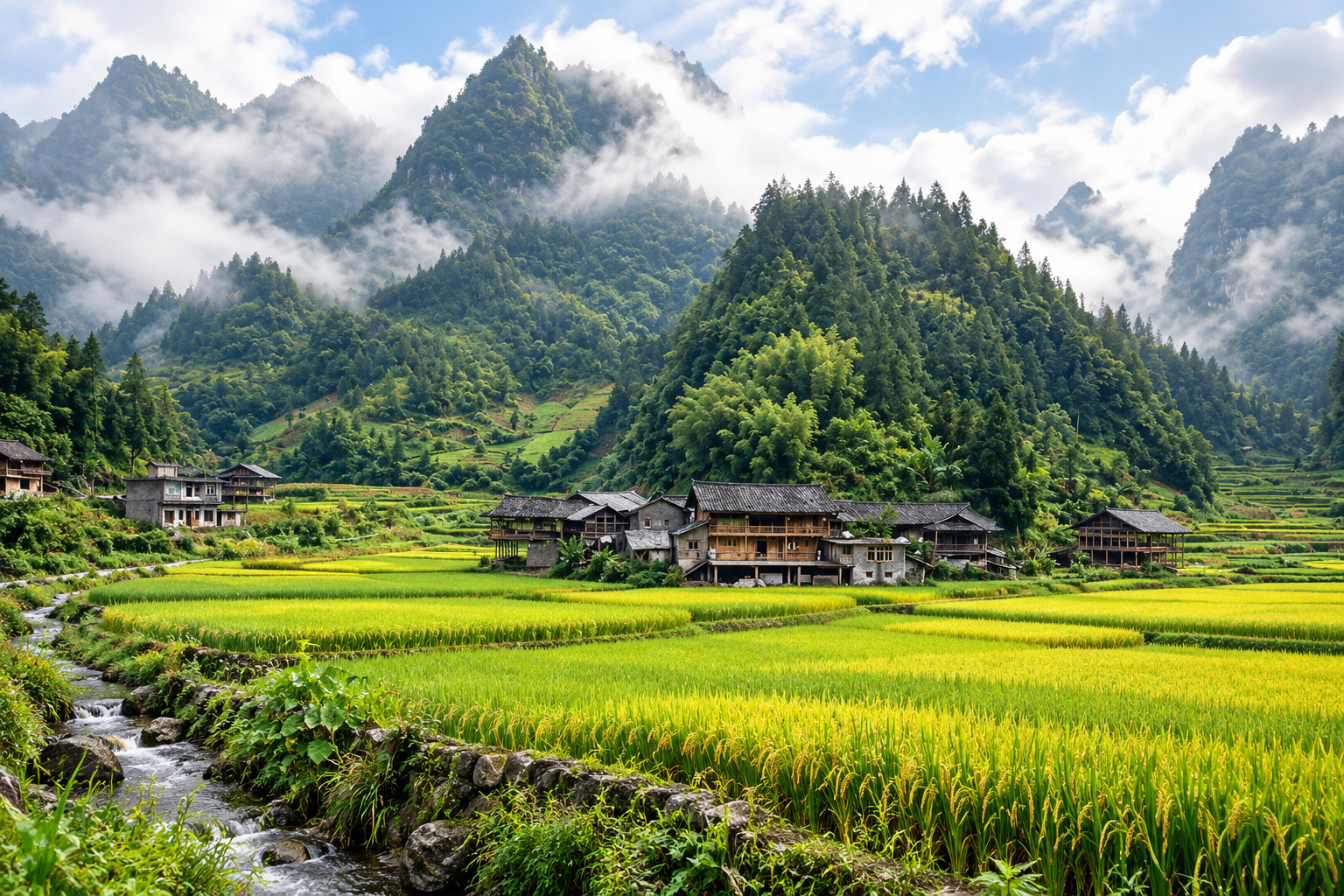
Cover: AI illustration: Qianjiang: Thirteen Tujia Villages valley. Original AI illustration based on historical photographs. Capture dates are unverified unless stated in the source record. Approximate scene, not current conditions, opening hours, routes or an exact documentary record. Qianjiang village views and Youyang dance references are separate places. No Nanxi work-song performance is depicted.
Visual reference: iChongqing / Photographer uncredited; iChongqing
Original AI illustration based on historical photographs. Capture dates are unverified unless stated in the source record. Approximate scene, not current conditions, opening hours, routes or an exact documentary record. Qianjiang village views and Youyang dance references are separate places. No Nanxi work-song performance is depicted.
To experience Tujia music and dance around Chongqing in 2026, choose a named, publicly offered activity and ask who is presenting it. Qianjiang’s cultural authority describes Nanxi work songs with up to 4 vocal parts. That rich tradition, Youyang hand-waving dance and a visitor stage programme should not be treated as interchangeable entertainment.
A respectful visit starts with a precise question: what will take place, where, and under whose invitation? A county’s cultural heritage listing can help you identify a tradition, but it is not a booking confirmation. A film of a festival is not evidence that the same gathering happens whenever a traveler arrives.
This guide focuses on understanding and attending an offered experience. It does not provide a current performance calendar, arrange access to homes or ceremonies, or suggest that residents owe visitors a demonstration. You can learn something worthwhile at a scheduled stage presentation, a cultural centre or a hosted workshop without searching for an encounter described as more “real” because it is less prepared for you.
Name the tradition and the place accurately
The Qianjiang cultural authority’s Nanxi haozi introduction, visibly dated 12 June 2026, locates these work songs in the Nanxi watershed around Qianjiang, Youyang and Pengshui. It associates them with both Tujia and Miao communities, describes more than 20 tune patterns and notes up to 4 vocal parts. Calling every performance there “Tujia dance” would erase important distinctions in both form and attribution.
When you see 南溪号子 on a programme, you are looking at a named work-song tradition. Ask the host how the presented song relates to that tradition and whether the lyrics or the occasion will be explained. Listening for the relationship between a leading voice and answering parts can give you a way into the performance even without understanding the words. Do not assume a recording of a similar-sounding river song has the same name or local history.
摆手舞, commonly described in English as hand-waving dance, is a different kind of cultural practice. The Shenzhen University-hosted heritage research entry for Youyang distinguishes forms connected with ritual, staged presentation, public-square activity and fitness. Those contexts matter. A visitor workshop may teach an adapted sequence, while a community gathering may have a purpose beyond entertaining an audience.
Ask for the name the presenters use, including the Chinese characters and a usable English explanation if available. Ask whether you are watching a particular local version, a stage arrangement or an introductory demonstration. These questions invite the organiser to describe the work on its own terms. They are more informative than asking someone to prove that a performance is ancient or unchanged.
Keep geography equally precise. Qianjiang and Youyang are different destinations within the wider Chongqing municipality. An event advertised in one does not make it part of a walk through central Chongqing. Before adding it to a trip, confirm the exact settlement or venue, the date and how you will get back. If the experience is the reason for the journey, establish its availability before booking dependent transport or accommodation.
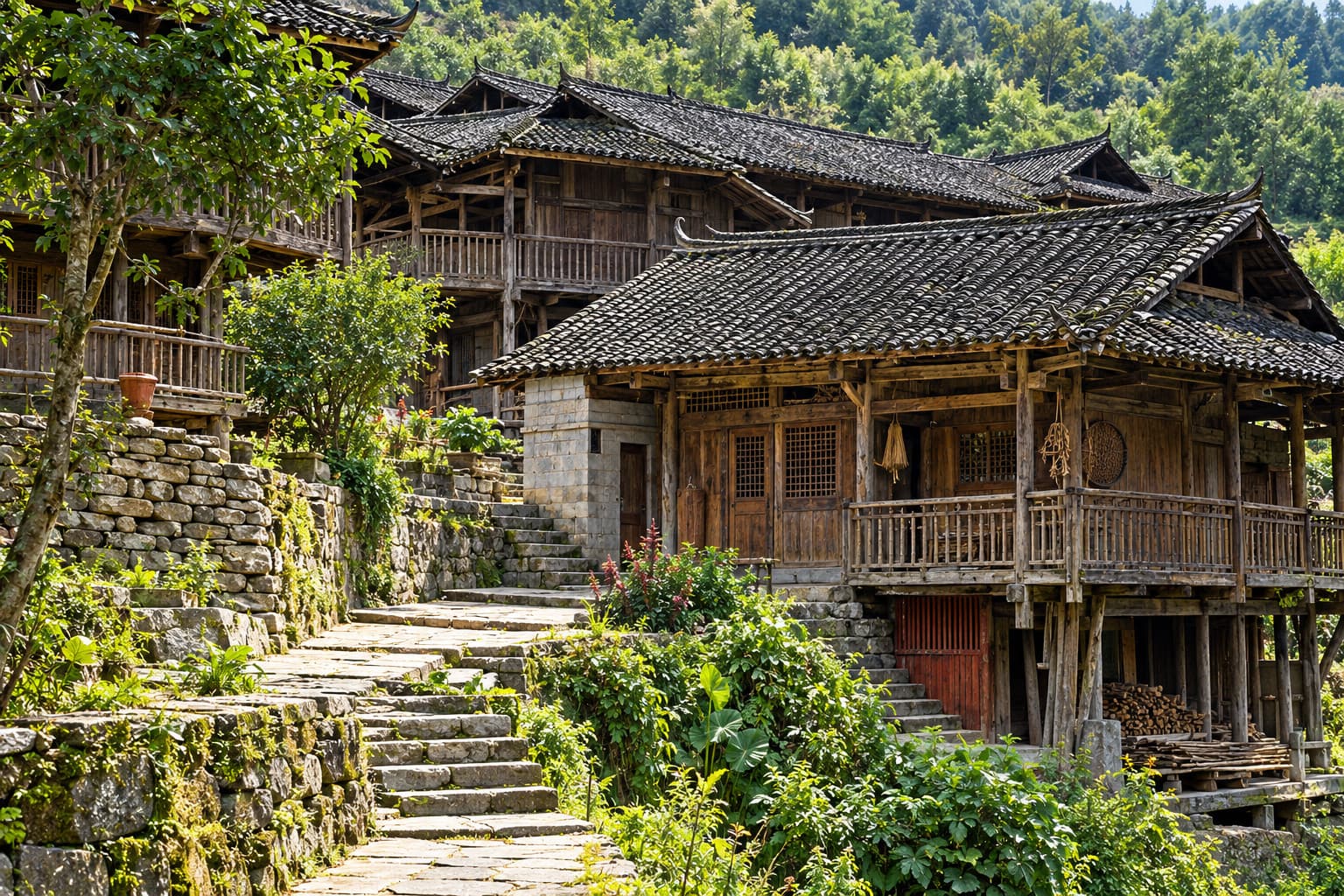
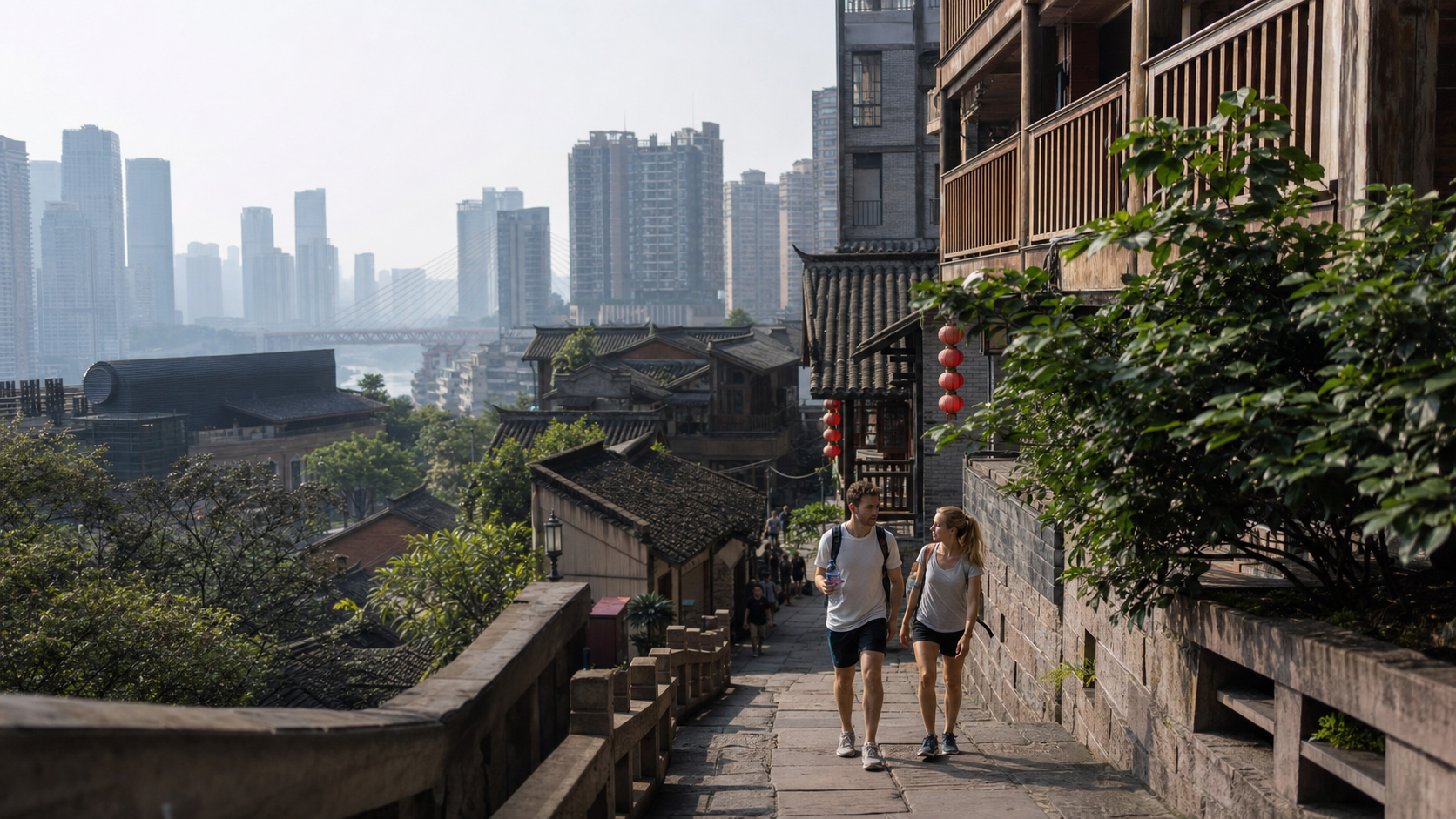
AI illustration: Qianjiang: timber houses and paths. Original AI illustration based on historical photographs. Capture dates are unverified unless stated in the source record. Approximate scene, not current conditions, opening hours, routes or an exact documentary record. Qianjiang village views and Youyang dance references are separate places. No Nanxi work-song performance is depicted.
Visual reference: iChongqing / Photographer uncredited; iChongqing
Choose an offered experience with a clear host
A Xinhua report from 4 March 2021 describes the Thirteen Villages area in Xinjian village, Xiaonanhai town, Qianjiang, as 13 linked hamlets along Banjia Creek. It reports organised music and dance presentations and instances of visitors being invited to join. This is a historical report of tourism activity, not evidence of a daily show or a standing invitation in 2026.
Use such a report as a lead to investigate. A current host should be able to tell you the venue, whether an event is public, what the activity involves and whether advance booking is needed. If a tour seller gives a vague description such as “minority cultural experience,” ask for the actual programme and organiser. A clear answer allows you to choose based on the content rather than on a promotional image.
For a stage performance, confirm the production name and whether an introduction or translation is available. For a workshop, ask who teaches it, what participants will do and whether the activity is appropriate for your group’s mobility and experience. For a festival, check that visitors are welcome in the area you intend to enter and whether some parts are restricted. These are different arrangements and should have different expectations.
Discuss payment and cancellation openly. Ask what the price covers, whether a minimum group is required and what happens if the event changes. Paying an agreed fee for a presented skill recognises the work involved. It does not buy unlimited photography, an invitation into a home or the right to direct performers outside the agreed activity.
Be especially cautious about a plan built around arriving without warning. If no public activity can be confirmed, choose a cultural display or another part of the trip instead. A quiet village is not a failed attraction, and a resident who is occupied with ordinary life is not withholding an experience. Cultural tourism should fit around the hosts’ choices rather than turning those choices into an obstacle to your itinerary.
Leave room for explanation. A workshop that includes discussion of a song’s use or a dance’s local name may give you more to remember than a hurried stop designed mainly for photographs. Ask what you should notice, then listen. You do not have to fill every pause with a question or request a second performance to improve your video.

AI illustration: Youyang: hand-waving dance context. Original AI illustration based on historical photographs. Capture dates are unverified unless stated in the source record. Approximate scene, not current conditions, opening hours, routes or an exact documentary record. Qianjiang village views and Youyang dance references are separate places. No Nanxi work-song performance is depicted.
Visual reference: Source publisher / Photographer uncredited; Youyang County Cultural Tourism authority
Follow the invitation and ask before making images
The Youyang heritage research entry records a stage adaptation presented in 1993 and later public-square and fitness forms. Its account shows why a staged version should not be dismissed simply because it has been adapted. The same entry expressly restricts reuse of its photographs without permission. Access to cultural information and permission to reproduce images are separate matters.
At an event, look for the host’s guidance before moving into the performance area. If audience participation is offered, wait to be invited and follow the demonstrated sequence. Do not pull another visitor or resident into the activity because you think they would make the scene more lively. A group dance can have an order, a leader and a purpose that are not obvious when you first arrive.
Ask before photographing an identifiable person at close range. Permission to watch an event is not necessarily permission for a portrait. If you want to publish the picture, make that intention clear rather than treating a nod toward your phone as unlimited permission. A host’s general photography policy is useful, but it does not remove the need to respect an individual who declines.
Recording sound also deserves care. Ask whether songs may be recorded and shared, whether any section should remain unrecorded, and how the performers want to be credited. A short personal clip and a monetised promotional video are different uses. If you cannot explain what you intend to do with the recording, put the device away and enjoy the performance directly.
Costumes, instruments and ceremonial objects should be treated according to the host’s instructions. Ask before touching or trying anything. A display intended for visitor handling may be clearly marked; another object that looks similar may be personal, fragile or restricted. Do not ask performers to remove or alter clothing for a preferred camera angle, and do not move an object to make a scene look tidier.
Keep children’s privacy in mind. A school or family event is not an invitation to make identifiable images of children for a public travel feed. Do not arrange unscheduled access to classrooms to watch cultural practice. If an institution hosts an authorised visitor activity, follow its rules and the relevant permissions rather than treating the educational setting as a public stage.

AI illustration: Youyang: drum and gong accompaniment. Original AI illustration based on historical photographs. Capture dates are unverified unless stated in the source record. Approximate scene, not current conditions, opening hours, routes or an exact documentary record. Qianjiang village views and Youyang dance references are separate places. No Nanxi work-song performance is depicted.
Visual reference: Source publisher / Photographer uncredited; Youyang County Cultural Tourism authority
Plan the journey and carry the context home
The Chongqing Local Chronicles Office’s 2022 Nanxi work-song account describes leadership and answering voices, oral learning and named people involved in transmission. It is a reminder that a performance sits within people’s lives and learning relationships. Its older counts of practitioners are not used here as a current assessment of the tradition’s condition.
When planning a regional visit, make the transport arrangement as concrete as the event arrangement. Confirm the Chinese address, the meeting point, the expected finish and the return method. Do not assume that a railway station and a rural venue are the same destination. The Chongqing railway-station guide explains the need to distinguish station names; onward regional travel still requires its own current check.
If the performance ends after your comfortable return window, consider an overnight stay or a different activity. That is a planning choice, not a claim that every village has suitable accommodation. Check the property, arrival arrangements and access before committing. Avoid making the host responsible for solving an unplanned late return simply because they welcomed you to the event.
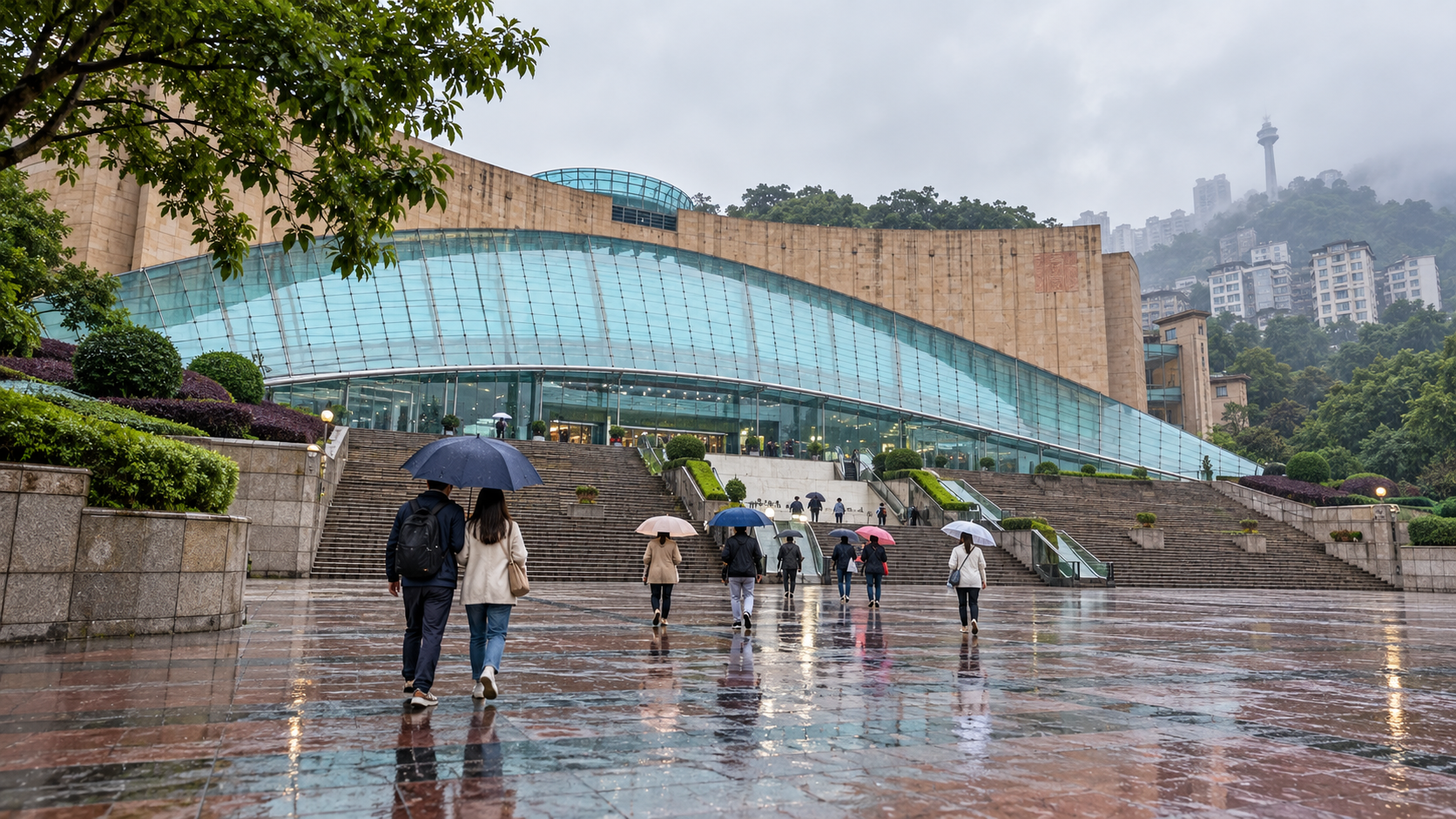
Prepare for ordinary travel needs: weather-appropriate clothing, comfortable footwear, water, a charged phone and an offline record of the destination. Ask about the physical setting if standing, steps or uneven ground would be difficult. A photograph of people dancing tells you little about seating, toilets or a step-free route. The heat and stairs guide offers general Chongqing preparation, while the rainy-day planning guide helps you avoid treating bad-weather outdoor plans as fixed obligations.
Afterwards, keep names with your photographs and notes. Record the actual venue, the date, the activity’s name and any credit requested by the performers. If you are uncertain whether a scene was a workshop, rehearsal or ceremony, describe what you know rather than assigning a dramatic label. Do not translate a brief encounter into a statement about what all Tujia people believe or how every household lives.
If you share an account publicly, distinguish the programme you attended from your own interpretation. You can say which moment interested you without claiming that you witnessed an unchanged remnant of the past. A careful account leaves space for living traditions to vary, adapt and continue beyond the visitor’s frame.
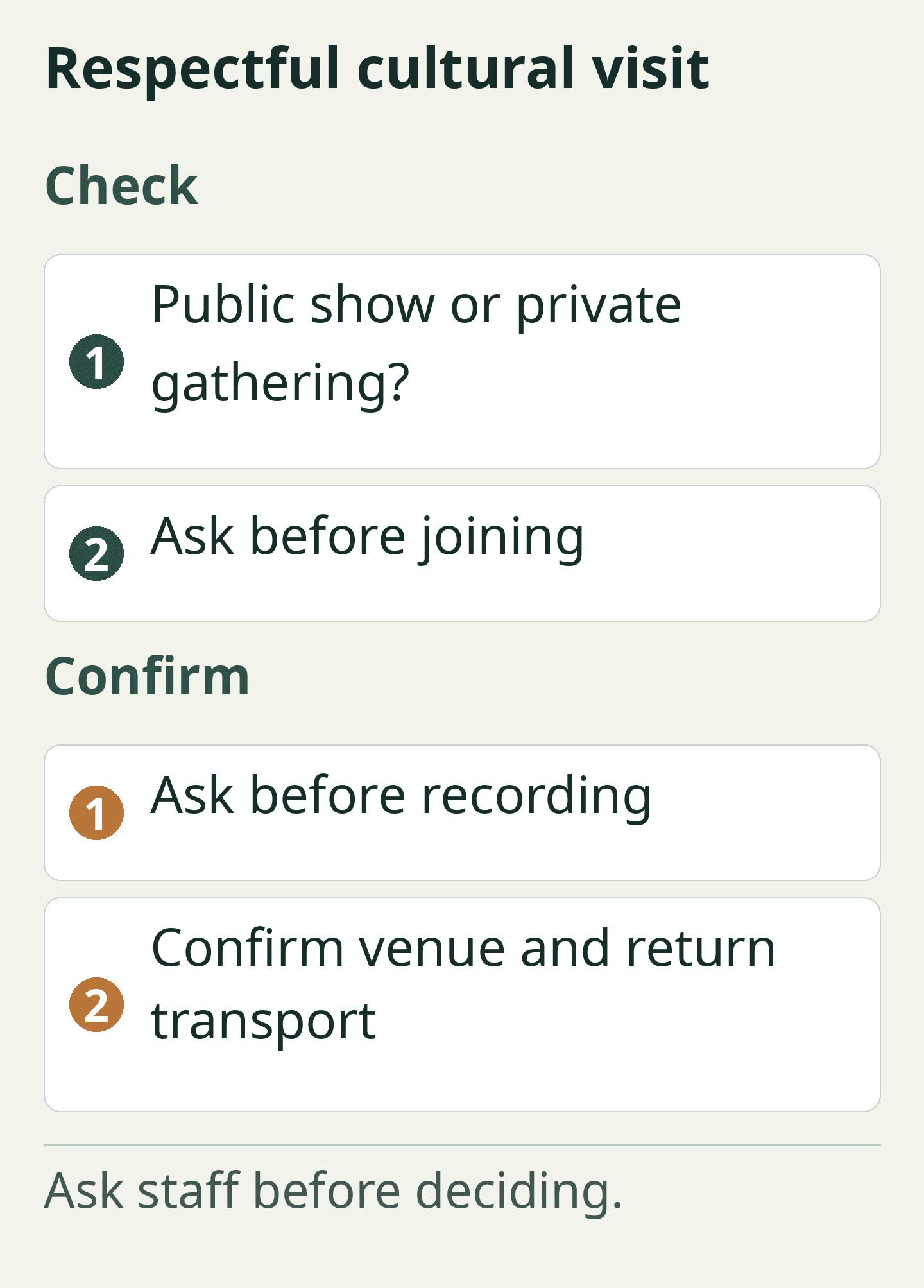
Respectful cultural visit. Ask staff before deciding.
Original editorial checklist
Respectful cultural visit
Check:
- Public show or private gathering?
- Ask before joining
Confirm:
- Ask before recording
- Confirm venue and return transport
Ask staff before deciding.
About This Guide
Research was completed on 1 October 2026 using district cultural material, a university-hosted heritage resource, municipal historical writing and dated reporting. Historical descriptions are not current event listings. No performance attendance, community interview or ongoing access arrangement is claimed. No independent cultural or factual review is claimed. Image permissions and current event information remain unverified.
Frequently Asked Questions
Q: Where can I find Tujia music and dance around Chongqing? A: Qianjiang and Youyang are relevant places to investigate through named cultural venues and current organisers. Confirm an offered event before making a regional journey from central Chongqing.
Q: Are Nanxi work songs exclusively a Tujia tradition? A: Qianjiang’s cultural authority associates Nanxi haozi with both Tujia and Miao communities in the Nanxi watershed. Use the performers’ specific description rather than replacing it with a broad tourism label.
Q: Can visitors join a hand-waving dance? A: Join in Qianjiang or Youyang when the host clearly invites participation and explains the activity. A report of visitors joining a past event does not establish an invitation to every gathering.
Q: May I photograph a cultural performance? A: Ask the Chongqing event organiser about recording rules and obtain appropriate permission for identifiable portraits or publication. A publicly visible performance does not automatically authorise every image use.
Q: Is there a daily show at the Thirteen Villages? A: This guide has not verified a daily schedule for Qianjiang’s Thirteen Villages. The cited 2021 report is a historical tourism account, so check a current named host before travelling.
Traveler comments
Share a recent experience or ask a practical question about this guide.