
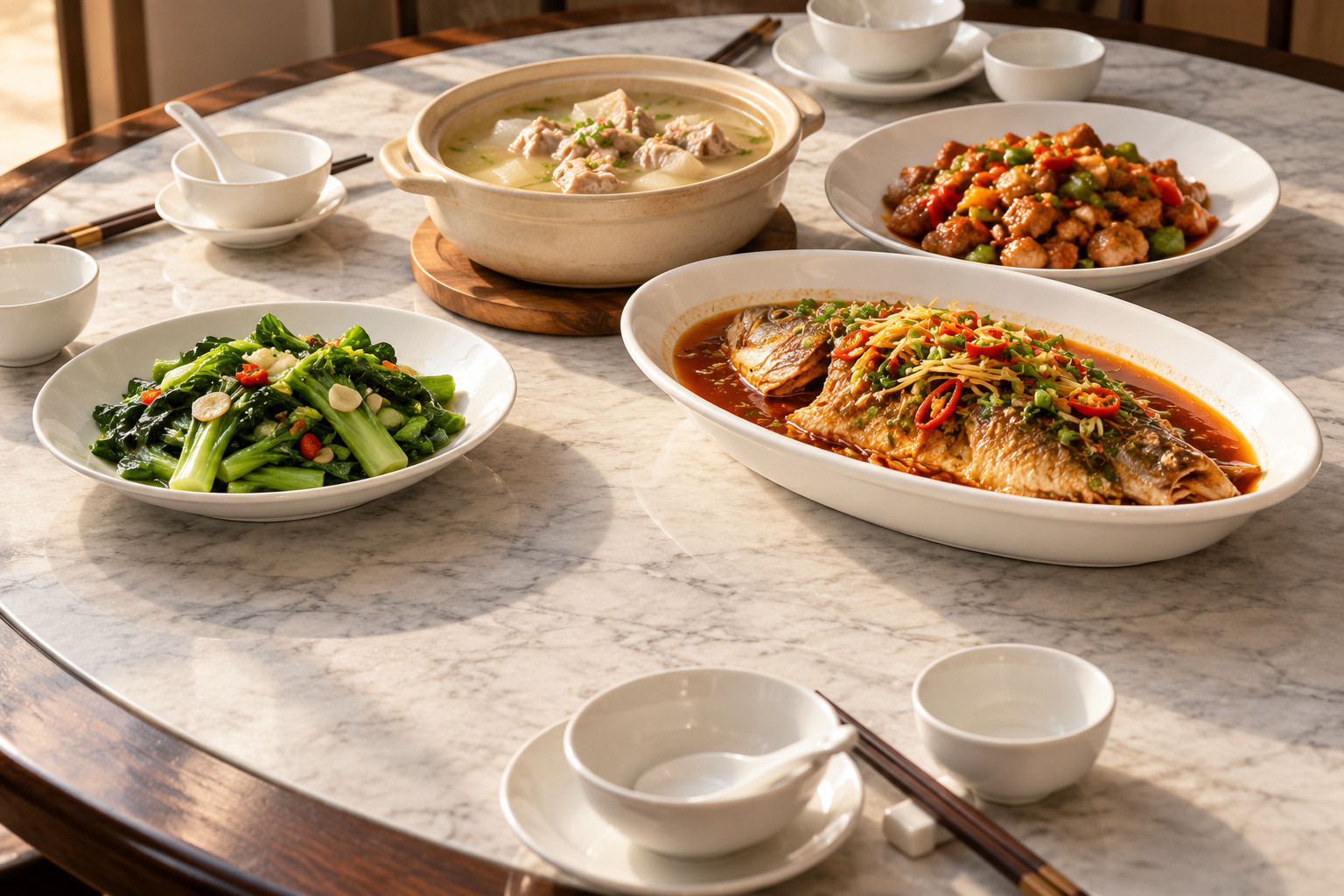
Cover: AI illustration: Shared table with individual bowls. Illustrative dishes, not verified portions or dietary suitability.
Visual reference: iChongqing / Land-sea International News Center
AI illustration: Illustrative dishes, not verified portions or dietary suitability.
For a shared Chongqing meal in 2026, agree on dietary limits and spending first, then confirm each dish’s size, pricing unit and place in the order. Chongqing’s market regulator encourages appropriate portions and smaller dishes. Order in stages when the kitchen allows it, and read the itemised bill before the group settles its share.
Sharing dishes can be an enjoyable way to try different flavours, but it can also hide disagreements. One person may expect a snack, another a full dinner; someone may avoid an ingredient without wanting to discuss it publicly. Set those expectations before the waiter is standing beside the table or several phones are adding food at once.
There is no dependable formula saying that a group of a certain size always needs a fixed number of dishes. A large whole fish, a small cold dish and a plate filled partly with bones or chillies are not interchangeable units. Use the restaurant’s actual portion information and your group’s appetite rather than treating a travel rule of thumb as a kitchen standard.
Agree on the meal before agreeing on the dishes
The Chongqing High-tech Zone market regulator’s March 2025 summary promotes appropriate ordering and discourages businesses from inducing excessive consumption. For travellers, the useful starting point is a meal everyone understands, rather than a long order placed to avoid seeming impolite.
Ask who is hungry now, who already ate, and whether the meal must finish before a booked activity. Agree on a spending range within the group, including drinks and any additional items you choose. You do not need to disclose everyone’s finances to the restaurant; you do need a shared understanding before one person places an expensive order for the table.
Discuss food restrictions separately from flavour preferences. “Less spicy” is a request about taste. An allergy, vegetarian requirement or halal requirement involves ingredients and preparation as well. Let the person affected decide what evidence they need, then communicate the relevant requirements clearly to staff before food is prepared.
Choose who coordinates the order. That person can listen to everyone, record the choices and read them back. The role is especially useful when the table uses a shared QR menu: independent additions can create duplicates without anyone intending to order more food. Confirm who will pay the restaurant and how the group plans to settle among itself later.
If the main problem is choosing food that avoids animal ingredients, use the vegetarian and vegan ordering guide alongside this guide. A shared meal works when everyone has something they can actually eat, not merely when everyone can reach the same plate.

AI illustration: Separate condiment bowls and plates. Illustrative dishes, not verified portions or dietary suitability.
Visual reference: iChongqing / Land-sea International News Center
Read the portion and the pricing unit together
A January 2026 Chongqing Daily report describes individual sets and smaller portions in the local dining market. Its examples show that different serving formats coexist. They do not establish the size, price or availability of a dish at the restaurant where you are sitting.
Ask “这份够几个人分着吃?” meaning “How many people can share this portion?” Treat the answer as a starting estimate, then consider what else you plan to order. A dish suggested for sharing may be an accompaniment rather than the centre of a meal. Ask staff to show the plate or explain the amount if the menu photograph is ambiguous.
Check whether the price is per plate, person, piece or weight. For fish or other weight-priced food, ask which weight unit is used, how the final weight is measured, and whether preparation or accompanying ingredients add to the cost. Have staff show the expected total before confirming. Do not infer the final bill from the largest number printed on a menu board.
For a set described as serving a group, identify the included dishes, their sizes, rice or other staples, drinks and substitutions. A headcount on the set name does not tell you whether every diner will find the contents suitable. If you replace a dish, ask whether the substitution changes the total before accepting it.
Photographing a menu for your own reference can make the final check easier where the restaurant permits it. Preserve the Chinese dish names rather than replacing them with loose descriptions such as “the green vegetable” or “the chicken.” Those descriptions may match several items on a busy order.
Ask about small portions without assuming a fixed discount
Chongqing’s February 2024 reporting on small bowls and half portions describes an effort to reduce waste while offering more flexible meal sizes. Ask what is available today. A small portion may be a separate product rather than exactly half the quantity and half the price of the regular version.
“有小份或者半份吗?” asks whether a small or half portion is available. Follow it with a request to confirm the price and which menu item will appear on the order. If the staff say a dish cannot be reduced, decide whether it deserves space in the meal instead of ordering it automatically.
Start with dishes that serve different purposes: something substantial, vegetables or another accompaniment, and the staple the group wants. That is a way to organise the conversation, not a prescribed menu or nutritional plan. Avoid ordering several visually different dishes that all rely on the same main ingredient if the group wanted variety.
Ask whether adding dishes later is possible and whether the kitchen has a last-order restriction. Staged ordering is useful only if it fits the restaurant’s actual service. If a dish requires advance preparation, decide upfront whether it is important enough to order before seeing the rest of the meal.
Rice can be easy to overlook when a group is focused on photographed dishes. Confirm whether it is included, ordered per bowl or shared, and whether refills cost extra. Apply the same check to tea, drinking water and soft drinks. None of these are assumed complimentary in this guide.

AI illustration: Black casserole beside a small bowl. Illustrative dishes, not verified portions or dietary suitability.
Visual reference: iChongqing / Photographer not credited
Keep one clear order, even when several people use phones
The 2023 Chongqing QR-ordering report describes how online ordering can introduce extra screens and personal-data requests. For a group, there is another practical issue: deciding when the shared basket becomes a submitted order. Ask staff to explain the confirmation step rather than assuming that adding an item has sent it to the kitchen.
Before submission, the coordinating diner should read back the Chinese dish name, quantity, portion size and important instruction. Remove duplicates and check whether drinks were added separately by someone else. Make sure the order belongs to the correct table and branch, particularly if it was opened from a saved link.
If the menu is difficult to use, ask staff to help place the order. Keep any agreed dietary instruction attached to the relevant dish rather than hidden in a general note that could be missed. Do not rely on machine translation alone for a requirement that the kitchen cannot clearly confirm.
When a dish is unavailable, pause before accepting a substitute. A different sauce or cooking method may change whether someone can eat it, and a similarly named dish may have a different price. Confirm both before the replacement is prepared. Record the change in the same order record so it does not become an unexplained extra at billing.
Our payment guide for Chongqing covers payment preparation. For this meal, the priority is a single shared understanding of what the restaurant has accepted, even if the diners will later divide the cost differently.
Share the food without losing track of individual needs
A 2025 Chongqing Daily report reproduced by China Food Safety News describes serving chopsticks and spoons alongside local antiwaste dining practices. Ask for 公筷, serving chopsticks, and 公勺, a serving spoon, when they are not already provided. Keep those utensils with the shared dish rather than switching them into personal use.
Before a diner with a food restriction serves themselves, identify the dish and confirm that it matches the agreed order. Do not assume that a vegetable-looking plate has no animal ingredients, or that removing visible meat changes how it was cooked. If the kitchen is uncertain, let the affected diner choose an alternative.
Place shared dishes so people do not need to lean over hot food or pass heavy bowls across someone’s arms. If there is a rotating tray, wait until other diners have finished serving before moving it. Keep personal belongings away from the food and make room for staff to put down hot dishes safely.
Ask whether a long-awaited dish is still coming before ordering a replacement. A missing plate and a slow plate are different problems. If the group is already full, speak to staff promptly about whether an unprepared item can be cancelled; do not assume that leaving it untouched removes the charge.
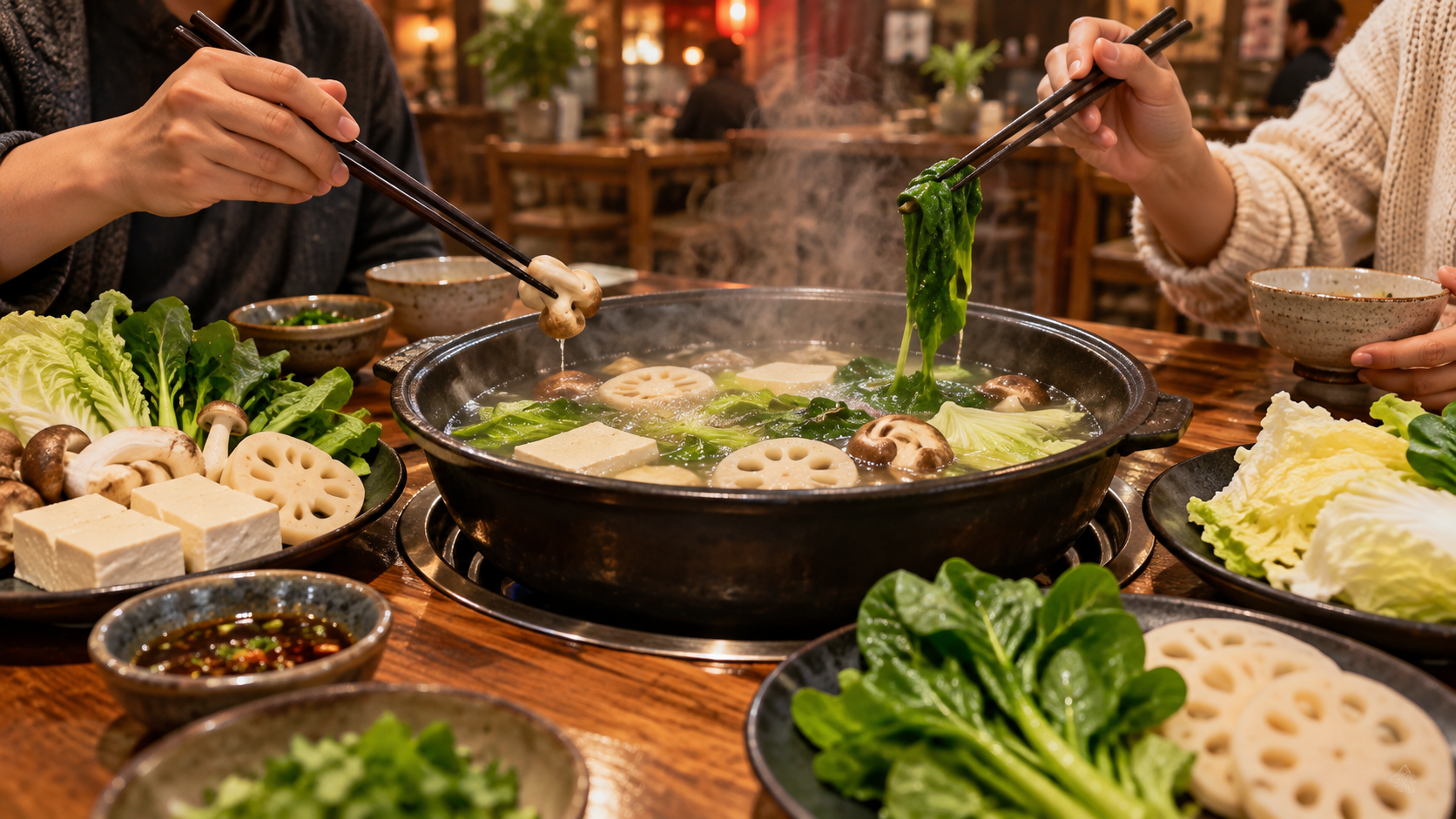
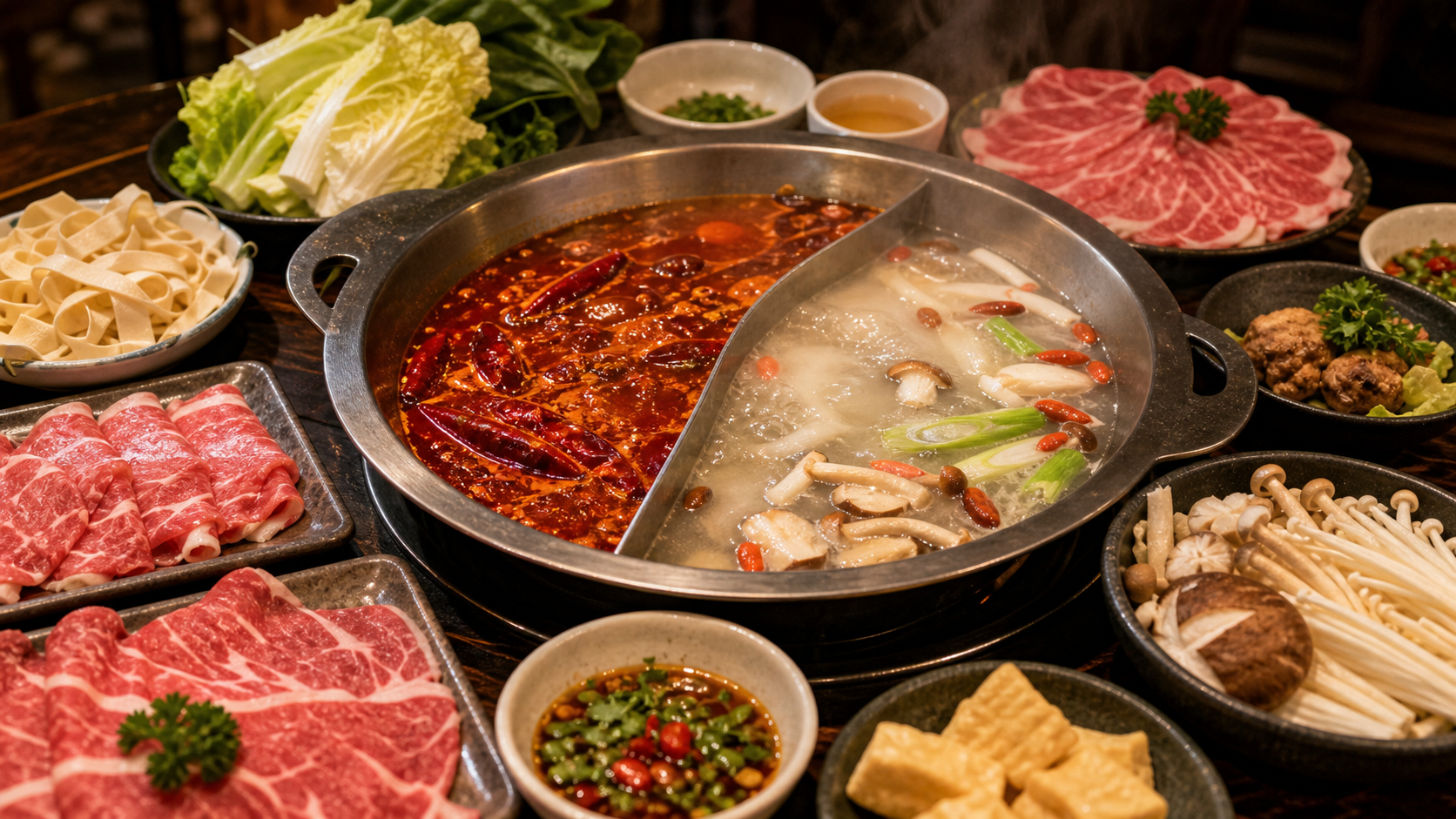
This guide concerns ordinary shared dishes. If the meal uses a communal hotpot, the Chongqing hotpot guide addresses that different cooking format. Do not transfer a hotpot portion rule to a finished stir-fry or a whole-fish dish.

AI illustration: Shared fish dish in red broth. Illustrative dishes, not verified portions or dietary suitability.
Visual reference: iChongqing / Photographer not credited
Read the bill before dividing it among the group
The 2025 dining-practices report describes a Nan’an example where the menu displayed both dish quantities and prices. Use that same distinction when reviewing your own bill: the item, its quantity and its unit price should make sense together. The report is an example of transparent information, not a statement about every restaurant’s menu.
Ask for the itemised bill or clear order screen. Compare it with the accepted order, including later additions and substitutions. Check drinks, staples, containers and any charges discussed before eating. If an item is unfamiliar, ask what it represents rather than assuming a mistake or paying without understanding it.
If the amount differs from what was agreed, calmly show the menu, receipt or message and ask staff to explain. Keep the issue specific: a duplicate dish, an unavailable item still charged, or a pricing unit misunderstood. An exact question is easier to resolve than a broad argument about whether the meal was expensive.
For leftovers, ask about packing and any container charge. The market regulator’s 2025 summary encourages packing, but that does not establish how long food can safely remain in your bag. Do not build a day of sightseeing around carrying food that needs temperature control.
Finally, make the group settlement separate from the restaurant settlement. Confirm the restaurant has received payment, keep the receipt, and record how the diners agreed to divide it. A person who avoided drinks or ate separately for a dietary reason may need a different share from an even split; settle that within the group without delaying the counter.

Shared-meal checklist. Ask staff before deciding.
Original editorial checklist
Shared-meal checklist
Check:
- Portion size
- Pricing unit
Confirm:
- Accepted order
- Itemised bill
Ask staff before deciding.
About This Guide
Prepared from sources read on 1 October 2026. Dated local reporting supports the discussion of portion formats, ordering friction and bill information. The group-management suggestions are editorial advice; no restaurant visit, meal test, current price survey or kitchen audit is claimed.
Frequently Asked Questions
Q: How many shared dishes should a group order in Chongqing? A: Chongqing dishes vary too much for a fixed headcount formula. Ask about the size of each dish, check the group’s appetite and dietary needs, and add more later if the kitchen permits it.
Q: Are half portions available at every Chongqing restaurant? A: No universal availability is established in Chongqing. Ask which dishes have smaller versions and confirm their actual size and price before adding them to the order.
Q: Can everyone at a Chongqing table order through the same QR menu? A: That depends on the Chongqing restaurant’s system. Choose someone to check the shared basket and final submission so several diners do not accidentally duplicate dishes or send conflicting instructions.
Q: How do I ask for serving utensils in Chongqing? A: Ask Chongqing restaurant staff for 公筷, serving chopsticks, or 公勺, a serving spoon. Keep shared utensils separate from personal ones, and confirm any dietary concern directly with the kitchen.
Q: What should I check on a Chongqing restaurant bill? A: Match the Chongqing restaurant’s itemised bill to the dishes, quantities, sizes and substitutions you accepted. Also check drinks, staples and any agreed extra charges before dividing the total among your group.

Traveler comments
Share a recent experience or ask a practical question about this guide.