
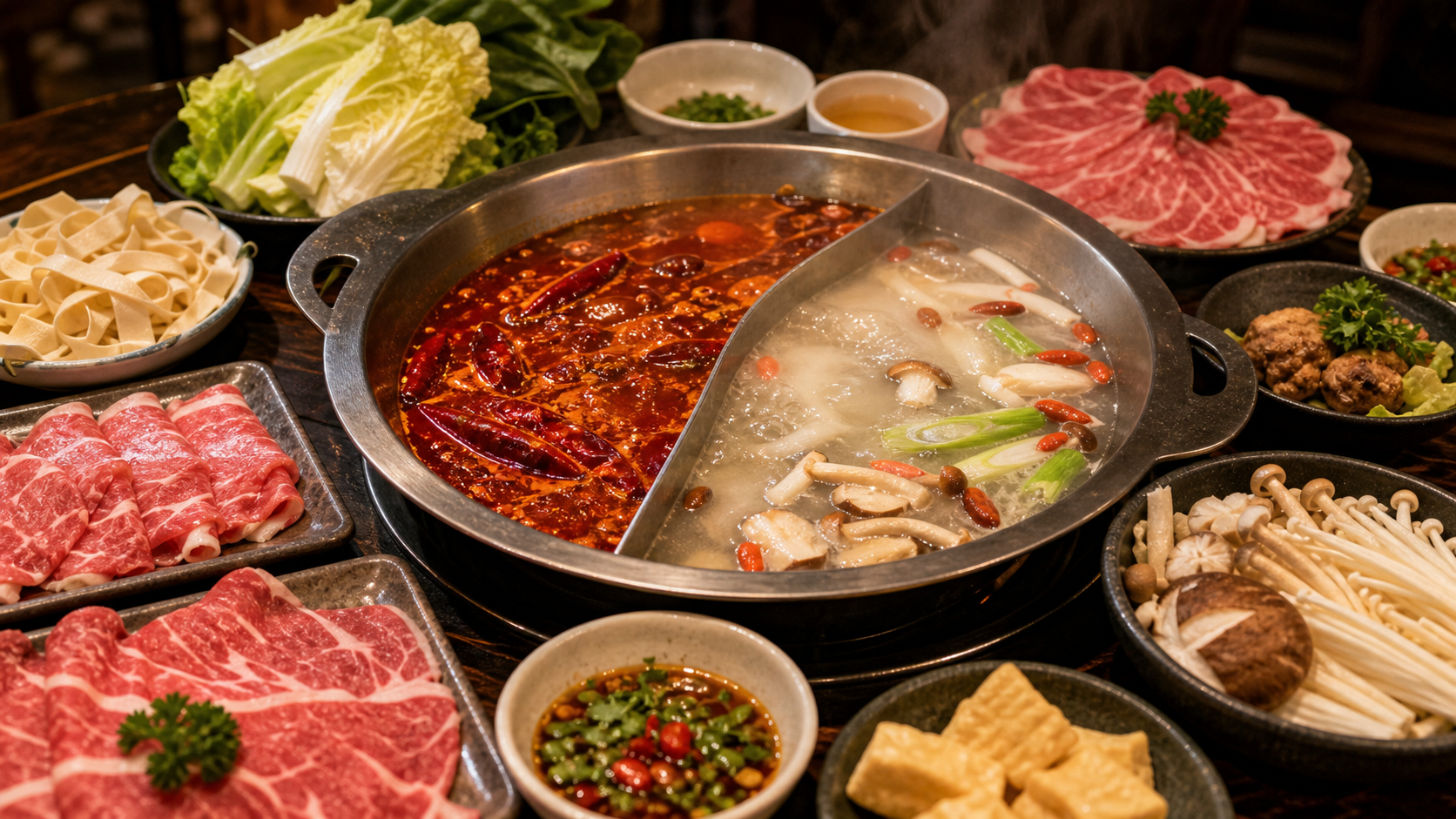
This 2026 Chongqing hotpot survival guide comes down to 3 choices: a divided pot, a mild first round, and ingredients you can identify. Our 2026-09-19 source check also adds one firm safety rule: keep raw-food utensils separate and ask staff how long unfamiliar meat or offal should cook.
This guide explains the pot, the spice, QR ordering, common ingredients, sauce, etiquette, and what to do after the meal. It keeps the focus on travel usefulness, not bravado.

What Makes Chongqing Hotpot Different
Beef tallow, chillies, and Sichuan peppercorn
Chongqing hotpot is usually built around red, oily, spicy broth with chilli, Sichuan peppercorn, and beef tallow. The tallow carries aroma and gives the meal weight. Those three elements are the documented base of the dish rather than a regional variation: Wikipedia's Chongqing hot pot entry traces the format to 1920s wharf food in Jiangbei District, where sellers cooked beef tripe for dock labourers. If you are used to Japanese shabu-shabu, Korean jeongol, Thai suki, or a lighter soup hotpot, do not assume the experience is similar.
What "ma la" actually feels like
The heat is not just chilli heat. Sichuan peppercorn creates the numbing sensation called “ma.” Together, “ma la” means numbing and spicy. The compound behind it is hydroxy-alpha sanshool, and research quoted on the Sichuan pepper page compares the effect to a 50-hertz vibration in the mouth. That is a useful thing to know before you sit down: many visitors can handle chilli better than the numbing feeling, because it changes how the mouth feels rather than how hot it is.
Ordering by QR code at the table
Most hotpot restaurants now put a QR code on the table, and the menu opens in Chinese inside a payment or mini-program app. Two practical consequences follow. First, set up your payment apps before the trip, because a table QR menu is much harder to use on a phone that cannot authenticate. Our Chongqing payment guide covers that setup. Second, photo menus help more than translation apps at speed: point at the picture, hold up fingers for the quantity, and let staff confirm. If the QR flow fails, staff can usually take a paper order.

Choose the Right Pot and Order Slowly
Pot formats at a glance
| Pot format | What you get | Who it suits | Watch out for |
|---|---|---|---|
| Split pot (one red side, one mild side) | Two broths in one vessel; a safe zone for vegetables, tofu, and anyone who reaches a limit | First-time visitors, mixed groups, families | Ingredients cooked on the red side still carry chilli oil into the sauce bowl |
| Nine-grid pot | The classic Chongqing format; divided sections keep different ingredients separate so slower items are not lost | Travelers who want the traditional format and are eating with locals | All sections share the same red broth, so there is no mild refuge |
| Single red broth | The full mala experience in one pot | Repeat visitors who already know their limit | No fallback if one person in the group cannot continue |
| Non-spicy broth base | Mushroom or tomato soup bases exist as alternatives to the red pot | Children, low-spice eaters, upset stomachs | Availability varies by restaurant; confirm before you sit down |
- Pot format
- Split pot (one red side, one mild side)
- What you get
- Two broths in one vessel; a safe zone for vegetables, tofu, and anyone who reaches a limit
- Who it suits
- First-time visitors, mixed groups, families
- Watch out for
- Ingredients cooked on the red side still carry chilli oil into the sauce bowl
- Pot format
- Nine-grid pot
- What you get
- The classic Chongqing format; divided sections keep different ingredients separate so slower items are not lost
- Who it suits
- Travelers who want the traditional format and are eating with locals
- Watch out for
- All sections share the same red broth, so there is no mild refuge
- Pot format
- Single red broth
- What you get
- The full mala experience in one pot
- Who it suits
- Repeat visitors who already know their limit
- Watch out for
- No fallback if one person in the group cannot continue
- Pot format
- Non-spicy broth base
- What you get
- Mushroom or tomato soup bases exist as alternatives to the red pot
- Who it suits
- Children, low-spice eaters, upset stomachs
- Watch out for
- Availability varies by restaurant; confirm before you sit down
The nine-grid format and the non-spicy broth options above are described on China Highlights' Chongqing food page, which calls the nine-grid pot the classic local style. Availability is per restaurant, so treat the table as a vocabulary list, not a guarantee.
The spice words to know
If this is your first time, order a split pot: one spicy red broth and one mild broth. This is not cowardly. It gives you a safe place for vegetables, tofu, mushrooms, and anyone who reaches a spice limit.
Start lower than your ego wants. “Wei la” means mild spice, but Chongqing mild may still be strong. Avoid extra spicy on the first visit. There is no universal numeric spice scale across restaurants, so the words matter more than a number: say mild, ask for a divided pot, and adjust on the second visit rather than the first.
Order less than you think
Order less at the beginning because dishes fill the table quickly; you can always add more. A common first-timer pattern is ordering a full table of plates before anyone has tasted the broth, then discovering half the order sits in the pot too long. Two or three rounds of small orders beats one large one, and it also keeps meat from overcooking while you work through vegetables.

Beginner Ingredients and Adventurous Items
A balanced first order
A balanced first order can include thin-sliced beef or lamb, tofu skin, mushrooms, lotus root, potato slices, leafy greens, tofu puffs, and one local specialty if you feel curious. That mix gives you fast-cooking items and slow-cooking items, which matters because the two need different attention.
Local textures worth trying once
Chongqing hotpot is known for duck intestine, tripe, blood curd, and other textures that locals value; duck intestine, tripe, and pig blood all appear in the standard ingredient list on the Chongqing hot pot reference page. They are worth one plate if you are curious, but they are not ideal if you are already overwhelmed by the broth. Order them as a single shared plate rather than a main component of the meal.
Vegetarian, halal, and allergy questions
Vegetarians need to ask carefully because classic red broth often uses beef tallow. If you avoid pork, offal, or certain animal fats, do not rely on guesses from photos. Choose a restaurant where staff can confirm broth and ingredient details, and ask before the pot is lit rather than after. A mushroom or tomato broth base solves the chilli problem but does not automatically solve the animal-fat question, so those are two separate conversations.

Build the Sauce Bowl
What goes in a Chongqing bowl
| Component | Role in the bowl | Notes for first-timers |
|---|---|---|
| Sesame oil | The base; cools and coats spicy ingredients | This is the single element that makes the red broth manageable |
| Minced garlic | Sharpness and aroma | Raw garlic is common; skip it if you dislike the aftertaste |
| Scallions | Freshness and texture | Low risk, add freely |
| Cilantro | Herbal lift | Skip entirely if you are in the soap-taste camp |
| Oyster sauce or vinegar | Optional salt or acidity | Add one, not both, on a first attempt |
| Extra chilli or dry seasoning | Additional heat | The pot already carries the heat; this is where beginners overshoot |
- Component
- Sesame oil
- Role in the bowl
- The base; cools and coats spicy ingredients
- Notes for first-timers
- This is the single element that makes the red broth manageable
- Component
- Minced garlic
- Role in the bowl
- Sharpness and aroma
- Notes for first-timers
- Raw garlic is common; skip it if you dislike the aftertaste
- Component
- Scallions
- Role in the bowl
- Freshness and texture
- Notes for first-timers
- Low risk, add freely
- Component
- Cilantro
- Role in the bowl
- Herbal lift
- Notes for first-timers
- Skip entirely if you are in the soap-taste camp
- Component
- Oyster sauce or vinegar
- Role in the bowl
- Optional salt or acidity
- Notes for first-timers
- Add one, not both, on a first attempt
- Component
- Extra chilli or dry seasoning
- Role in the bowl
- Additional heat
- Notes for first-timers
- The pot already carries the heat; this is where beginners overshoot
Common mistakes
A common Chongqing sauce starts with sesame oil, garlic, scallions, cilantro, and sometimes oyster sauce or vinegar. This is different from northern sesame paste sauce, which is thicker and sweeter; if you have eaten Beijing-style hotpot, the bowl you are about to build is a different thing.
Do not add too much chilli to the sauce. The pot already has enough heat. If you dislike cilantro or raw garlic, skip them. A simple sesame-oil bowl is better than a complicated sauce you cannot finish. You can also keep two bowls: one plain sesame-oil bowl for red-broth items and one lighter bowl for the mild side.

Table Etiquette and Spice Recovery
A 4-step safety check at the table
Hotpot is active eating: you cook, retrieve, dip, and eat. Use 1 pair of tongs or chopsticks for raw food and a different pair for eating. Keep raw meat plates away from cooked food, let meat, seafood, tripe, and frog cook through, and ask staff for the correct cooking time when you cannot identify an ingredient. The Chongqing market regulator's 2025 hotpot notice gives the same core advice and says to cool food briefly before eating it. At a nine-grid pot, assign slow items to a section you can track instead of relying on memory.
The regional processing standard in force since 2025-02-10 also says restaurants should explain suitable heating times and should not reuse broth base or returned dishes. If food looks spoiled, the pot is not boiling, or staff cannot explain how to cook a risky item, stop and ask rather than guessing. The Chongqing government summary lists 12315 and 12345 for reporting suspected violations.
If it gets too spicy
Too spicy means you stop tasting and mostly endure. Switch to the mild side, eat rice if available, slow down, and drink something non-alcoholic. Do not drink the broth. In Chongqing hotpot, broth is a cooking base, not a soup course. Dairy or a soy-milk drink helps more than cold water, because capsaicin does not rinse away.

What to Do After Hotpot
The walk
After hotpot, take a slow walk if weather allows. The meal is heavy, and a short walk through a commercial street or river area helps. Many locals follow a hotpot night with fruit, yogurt drinks, tea, or simply water. A riverside night walk fits naturally here; the Chongqing night view route guide sets out a sequence that does not add stairs after a heavy meal.
The next morning
The next morning, eat lighter if your stomach feels tired. Chongqing food is a trip-long marathon, not one heroic dinner. If you are following the first-time 3-day itinerary, the day after a hotpot night is a good one to keep flat and short.
If you are eating solo
Recent travelers describe 3 workable routes: ask a regular restaurant for half portions, choose an individual-pot restaurant in a mall, or eat at a standard shared-table venue and order just 2 or 3 dishes first. Solo dining is socially normal; the real constraint is sampling range and waste. Treat the current r/travelchina discussion as practical traveler evidence rather than a promise that every restaurant offers half portions.
Frequently Asked Questions
Q: Is Chongqing hotpot too spicy for foreigners?
A: It can be, but a split pot, mild spice level, and sesame-oil sauce make it manageable.
Q: What should beginners order first?
A: Start with sliced meat, tofu skin, mushrooms, lotus root, potato, leafy greens, and one adventurous local item if you want.
Q: Can vegetarians eat Chongqing hotpot?
A: Sometimes, but classic red broth often uses beef tallow. Ask clearly or choose a place with vegetarian broth options such as mushroom or tomato soup.
Q: Do I drink the hotpot broth?
A: No. Treat it as a cooking base. It is usually too oily, salty, and intense to drink.
Q: Is hotpot good for solo travelers?
A: Yes. Ask for half portions, choose an individual pot, or begin with 2 or 3 dishes at a regular restaurant; availability varies by venue.
About This Guide
This guide was substantively refreshed on 2026-07-27 after reading a current China Highlights food guide, an iChongqing hotpot feature, TravelChinaGuide's city overview, and recent traveler discussion on Reddit. On 2026-08-08 we rebuilt the pot and sauce sections as sourced tables. On 2026-09-19 we read 5 live sources across 4 root domains and added the official raw-utensil, thorough-cooking, no-reuse, measured-ordering, and solo-diner guidance above. Traveler comments remain directional rather than universal evidence. We publish no spice scale and no per-person price because neither is consistent across restaurants. The 6 article visuals are original generated assets, and hotel placement remains intentionally absent from this food-focused guide.



Traveler comments
Share a recent experience or ask a practical question about this guide.