
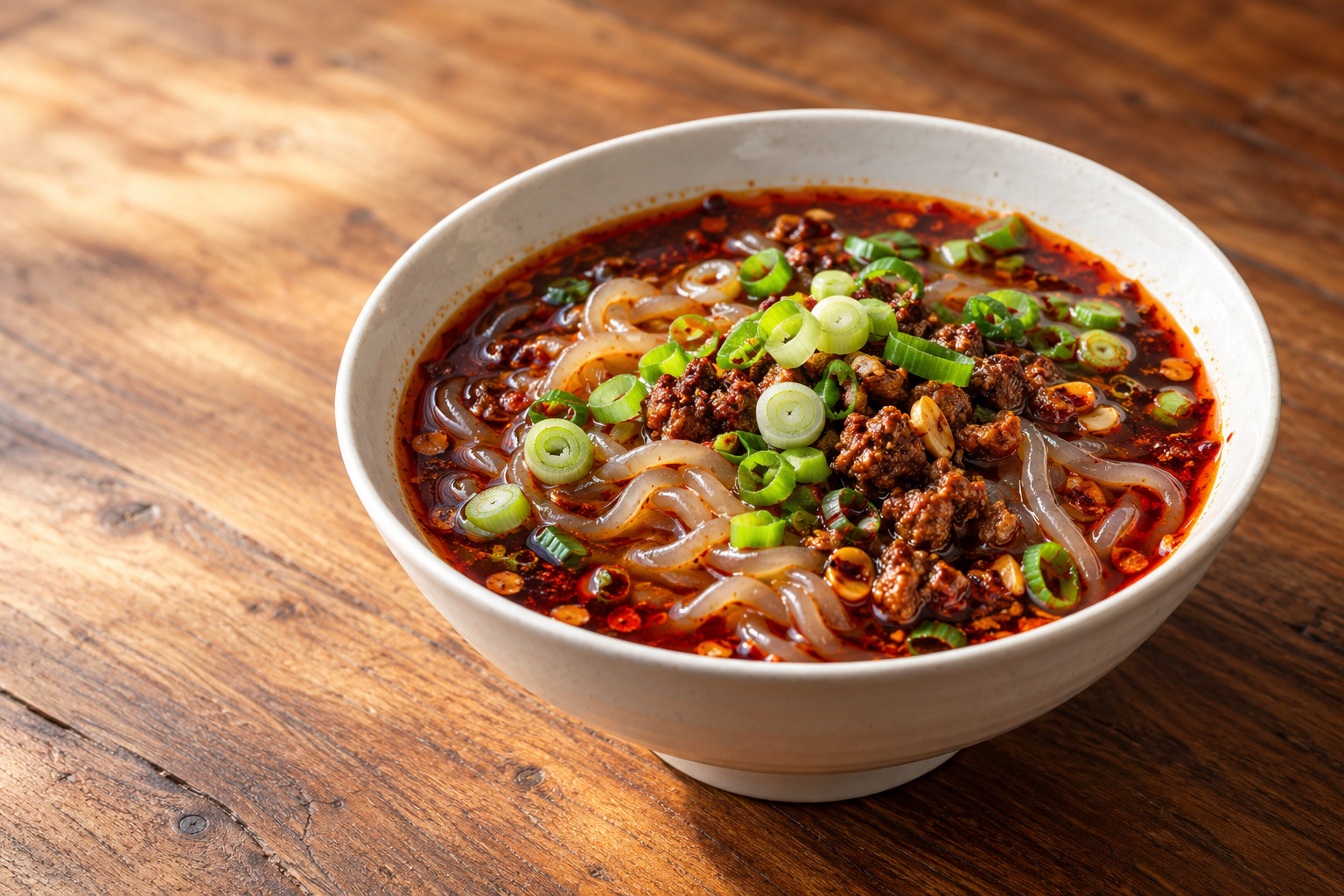
Cover: AI illustration: Translucent starch noodles in red broth. Based on home-recipe references, not a Chongqing stall photo or proof of ingredients or dietary safety.
Visual reference: Omnivore’s Cookbook / Omnivores Cookbook; article author Maggie Zhu
AI illustration: Based on home-recipe references, not a Chongqing stall photo or proof of ingredients or dietary safety.
Chongqing suanlafen in 2026 is a sour-spicy starch-noodle dish, commonly built around sweet-potato noodles rather than wheat xiaomian. The municipal food map identifies sweet-potato starch in local versions. Order the noodles, sourness, chili and toppings separately in your mind: a familiar bowl name does not establish its broth, allergens or suitability for your diet.
Save the Chinese name 酸辣粉 before you approach a counter. “Sour and spicy noodles” is a useful translation, but an English menu may call the same family of dishes glass noodles, vermicelli or even rice noodles. The written Chinese name helps identify the order; it still does not replace asking what a particular kitchen uses.
This is a guide to making that conversation manageable. It does not rank stalls, reproduce a recipe or promise that every bowl can be customised. If an essential ingredient question cannot be answered clearly, choose another dish or business rather than turning uncertainty into reassurance.
Start with the noodle, not the English translation
The Chongqing Planning and Natural Resources Bureau’s November 2025 food map identifies sweet-potato starch with Yuzhong suanlafen and the Leijia version in Shapingba. That is a useful local anchor: the chewy noodle is central to the dish, not merely a substitute for wheat noodles in an otherwise identical bowl.
Look for 红薯粉 or 苕粉 when asking about sweet-potato noodles. Say “这个粉是什么做的?”: what are these noodles made from? If the answer matters for a dietary restriction, ask to see the packet or ingredient information. A broad food-category name does not prove that a manufacturer uses no other starch or that a kitchen keeps different noodles separate.
Freshly made and dried noodles are both discussed in the Chinese-language suanlafen overview. That page has weak sourcing, so it is a terminology cross-check rather than an authority on a stall’s method. Do not judge a bowl’s legitimacy simply because you did not see noodles being made at the entrance.
Choose by what you want to eat. If you want a familiar wheat-noodle texture, use the Chongqing xiaomian ordering guide instead of assuming suanlafen will feel similar. If you enjoy a springier starch noodle, ask what thickness or style the stall currently offers. The same Chinese dish name can still produce a different texture from the bowl you saw online.

AI illustration: Separate bowls of noodles, liquid and seasoning. Based on home-recipe references, not a Chongqing stall photo or proof of ingredients or dietary safety.
Visual reference: Omnivore’s Cookbook / Omnivores Cookbook; article author Maggie Zhu
Separate sourness, chili heat and peppercorn numbness
There are 3 useful flavour questions: how sour, how chili-hot and how numbing? Elaine’s recipe, updated in April 2026, uses vinegar, chili oil and Sichuan pepper as distinct ingredients. That recipe illustrates why simply saying “less spicy” may leave part of your preference unexplained; it does not prove a stall can change a premixed base.
For less chili, ask “少放辣椒” or “少辣”. For less Sichuan pepper, ask “少放花椒”. For less vinegar, ask “少放醋”; for more sourness, “多放一点醋”. Show the sentence you need before the bowl is assembled. These phrases describe your preference, not a standardised heat scale shared by every cook.
If you dislike numbness but enjoy chili, make both points clear. If you want sourness without much heat, ask whether that is possible with the sauce they are using. Staff may explain that the seasoning is already mixed. In that case, decide whether the existing version suits you rather than repeating a request the kitchen cannot fulfil.
Do not add condiments immediately on arrival. Taste a manageable mouthful first and ask which bottle contains what before using it. A dark sauce is not identifiable by colour alone. If a condiment bowl is shared, use the utensil provided and keep your eating chopsticks out of it.
Removing a visible layer of chili oil is not the same as changing a bowl made with chili seasoning. Likewise, taking out a garnish cannot undo an ingredient already stirred through the liquid. When your need is more than taste preference, clarify it before preparation instead of treating table-side adjustments as a reliable solution.
Ask what the toppings and liquid contain
The April 2026 recipe example includes crunchy peanuts or soybeans and pickled vegetables, and discusses meat-topped variations. These examples are a reason to ask questions, not a compulsory ingredient list for all Chongqing suanlafen. A photograph cannot reliably tell you whether a small brown topping is a bean, nut, minced meat or something else.
Point to the menu item you are considering and ask “上面加的是什么?”: what is added on top? If the name includes 杂酱 or 炸酱, ask about the sauce’s ingredients rather than translating it as a harmless generic topping. 牛肉 indicates beef; 肥肠 refers to intestines, and you should confirm the animal and preparation if that matters to you.
Ask separately about the liquid: “汤底是什么?” means “What is the soup base?” The absence of visible meat does not answer whether a stock, fat or seasoning contains animal ingredients. A plain-looking version may still need questions about what goes into the serving bowl before the noodles arrive.
For a preference such as no coriander, “不要香菜” is concise. Show it before ordering and check that the request has been understood. For an allergy, do not substitute this sort of simple omission phrase for an explanation of the ingredient and preparation risk. The kitchen needs to know why the question matters.
Make the portion and extras clear
Point to the size and ask what is included. If the menu separates a basic bowl from meat toppings, confirm the total for your actual selection. Ask whether an extra is included, optional or charged separately before saying yes to it. There is no verified citywide suanlafen price or portion size in this guide.
When ordering for a group, keep each bowl’s requirements attached to that order. A short written list is easier to follow than several diners making overlapping requests. Once the bowls arrive, identify whose is whose before mixing or exchanging them.

AI illustration: Translucent noodle texture over a spoon. Based on home-recipe references, not a Chongqing stall photo or proof of ingredients or dietary safety.
Visual reference: Omnivore’s Cookbook / Omnivores Cookbook; article author Maggie Zhu
Keep ingredient questions separate from dietary assurances
A sweet-potato noodle is not a gluten-free certification for the finished meal. The recipe checked on 1 October 2026 lists seasonings and oils beyond the noodle itself, including soy sauce and peanut and sesame ingredients. A recipe is not the menu of your chosen shop, but it shows why checking the visible strands alone is insufficient.
If you avoid an ingredient for medical reasons, carry a clear written statement in Chinese naming it and explaining that cross-contact matters. Ask staff to check the actual sauce, oil, stock, toppings and preparation equipment. Do not infer safety from “we can leave off the peanuts” if the rest of the preparation remains unknown. If the shop cannot establish what is used, this guide cannot turn the dish into a safe option for you.
Vegetarian and vegan diners should ask about the broth and cooking fat as well as toppings. A request for “no meat on top” addresses that topping, not every ingredient used to season the bowl. See the vegetarian and vegan ordering guide for a fuller way to describe what you avoid.
Halal suitability also needs venue-specific evidence. Chicken or beef in an English translation does not establish sourcing, sauces, equipment or certification. Ask for the information relevant to your own requirements rather than treating the absence of an obvious pork topping as sufficient.
A useful outcome may be choosing a different food. You are not obliged to order because you have reached the front of a queue or because a dish is associated with Chongqing. Thank staff for checking, and decline politely if the answer is unclear. Taste exploration works better when everyone understands what has been ordered.

AI illustration: Broth saucepan beside a seasoning bowl. Based on home-recipe references, not a Chongqing stall photo or proof of ingredients or dietary safety.
Visual reference: Omnivore’s Cookbook / Omnivores Cookbook; article author Maggie Zhu
Choose a convenient bowl and make the whole order understandable
The municipal agriculture report of 12 January 2026 records sweet-potato processing work in Rongchang, including products for suanlafen and hotpot noodles. It is evidence of the wider food-production context, not a list of approved restaurants. Fresh counter service and a packaged retail product need different questions.
At a stall, start with the menu and the person taking orders. Ask whether you should order before sitting, whether there is a collection number and where to wait. Do not obstruct the cooking space while translating a long paragraph. Prepare your essential requests beforehand and keep the conversation focused on the bowl you intend to buy.
For a packaged version, read the preparation directions and the ingredients of each seasoning sachet, not just the large noodle label. A familiar photograph or regional name on the packet is not evidence that it matches the recipe in this article. Check that you have suitable equipment and a permitted place to prepare it before buying it as a hotel-room meal.
Eat seated, and confirm the temperature of anything alongside it
Starch noodles can be awkward to lift from a liquid-filled bowl. Sit somewhere stable if available, keep the bowl away from the table edge and use a spoon to support a manageable portion if that helps. Let very hot food cool to a comfortable temperature. You do not need to copy a fast eating style for a more meaningful experience.
A public traveler discussion read on 1 October 2026 includes a diner surprised by hot sweet dumplings ordered with suanlafen. This is a single anecdote, not a menu promise, but it suggests a useful question: “这个是热的还是冷的?” asks whether something is served hot or cold. Ask it when choosing a drink or dessert rather than assuming a photograph means chilled.
Keep the meal within a route you already want to take. An old recommendation for a specific stall does not establish its present branch, queue, opening time or menu. The Chongqing payment guide can help you prepare before a short counter transaction. Leave the search for a famous name aside if a clearly explained nearby option fits your requirements.

Suanlafen ordering checklist. Ask staff before deciding.
Original editorial checklist
Suanlafen ordering checklist
Check:
- Noodle type
- Broth and toppings
Confirm:
- Dietary requirements
- Confirm before cooking
Ask staff before deciding.
About This Guide
Research was read on 1 October 2026, including municipal food and agriculture material, an original recipe, a limited encyclopedia cross-check and a public traveler discussion. The English text is independently written with AI assistance. No restaurant meal was tasted or tested, and no source establishes a universal price, recipe or dietary certification. The promotional claims in the traveler post were not adopted as restaurant recommendations.
Frequently Asked Questions
Q: What are Chongqing suanlafen noodles made from? A: Chongqing’s municipal food map identifies sweet-potato starch in local suanlafen examples. Ask the chosen shop or check its packet for the actual noodle ingredients rather than treating the regional dish name as a guarantee.
Q: Is suanlafen the same as Chongqing xiaomian? A: Chongqing suanlafen commonly uses starch noodles and a sour-spicy flavour profile, whereas xiaomian is a different noodle order. Confirm the Chinese name 酸辣粉 and the noodle type if an English menu is ambiguous.
Q: Can I order Chongqing suanlafen with less chili and less vinegar? A: Ask before preparation for 少放辣椒 and 少放醋, and mention 花椒 separately if you want less numbing pepper. Chongqing shops may use premixed seasonings, so confirm what they can actually change.
Q: Is Chongqing suanlafen vegetarian or gluten-free? A: Neither status can be inferred from the sweet-potato noodle alone. In Chongqing, verify the actual noodles, sauces, stock, oils, toppings and preparation with the venue; unresolved ingredients or cross-contact remain unresolved.
Q: Does every Chongqing suanlafen bowl contain offal? A: No fixed ingredient list applies to every Chongqing bowl, and different toppings are documented. Ask what the selected item contains, especially if the name includes 肥肠, rather than guessing from a photograph.

Traveler comments
Share a recent experience or ask a practical question about this guide.