
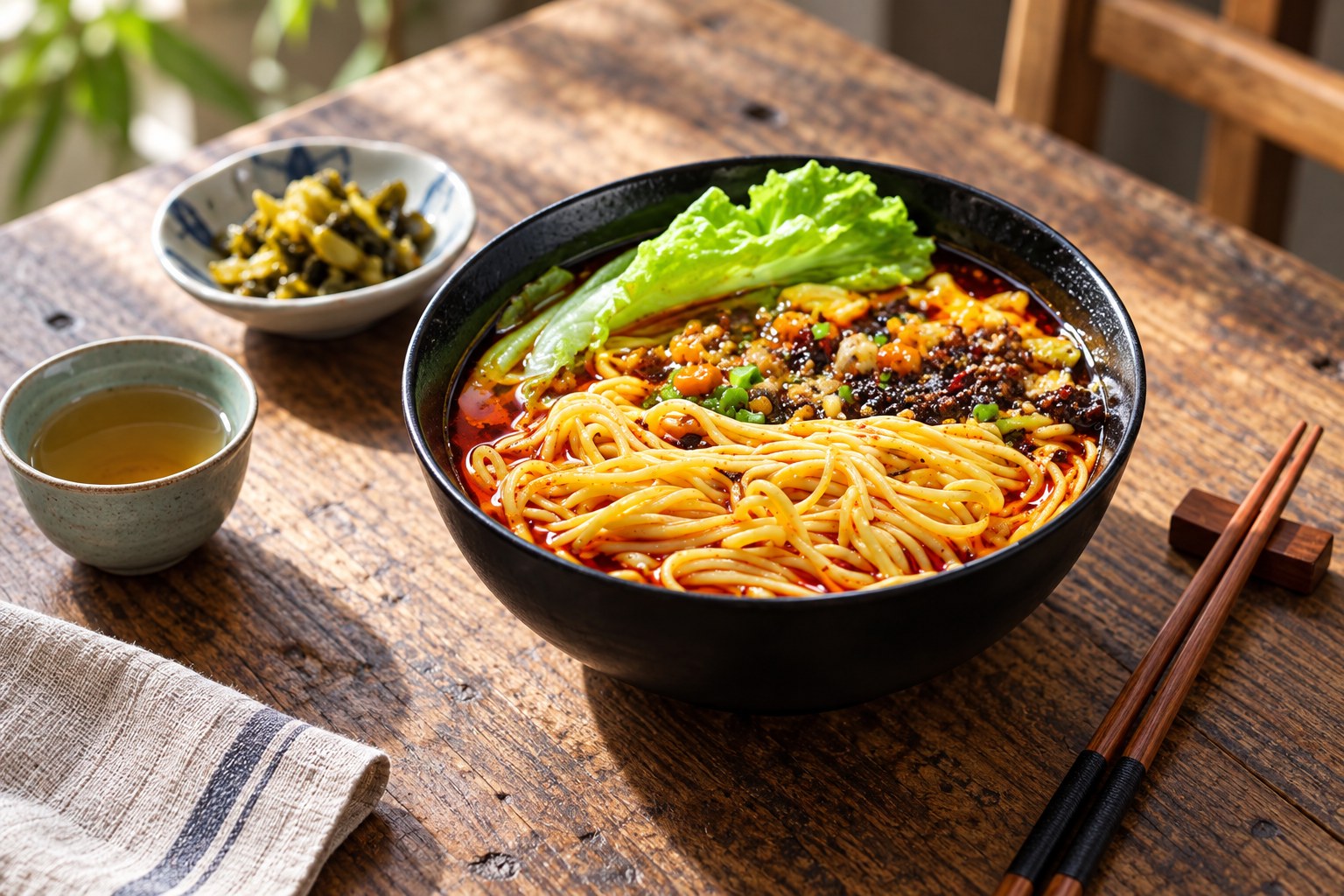
For Chongqing xiaomian in 2026, I would order one bowl by choosing the portion, topping and seasoning separately. There are 2 broad styles: with broth and without broth, as iChongqing explains. Save the Chinese food name, ask about chili and Sichuan pepper individually, and confirm ingredients before assuming a plain-looking bowl suits your diet.
Xiaomian is a useful meal to understand early in a Chongqing trip. It lets you try everyday local food without organizing a shared hotpot table. This guide explains how to read a short menu, communicate a simple order and fit a noodle stop around sightseeing. It is based on published sources reviewed on September 12, 2026; we do not claim a new restaurant inspection.
The cover is an AI food illustration based on a real Chongqing noodle photograph. The four ordering cards are original editorial graphics. They explain choices rather than reproduce a particular restaurant's menu or certify its ingredients.
Understand the Bowl Before Choosing a Shop
The 2 broth styles are a starting point, not a complete menu. iChongqing's food introduction describes noodles with or without broth and a wide range of seasonings and toppings. I would separate three decisions: the noodle serving, what goes on top, and how the sauce is seasoned. A familiar photograph cannot answer all three.
重庆小面 is the useful Chinese search term. A menu may use 小面 for a plain seasoned bowl while listing topped versions separately. Broader discussions of Chongqing noodles use the name for the whole family. If you want a specific topping, point to its written name rather than expecting the English word “noodles” to communicate it.
A small shop can be a perfectly reasonable place to begin, but its appearance is not proof of food quality. A 2026 visitor discussion about meals after hotpot points travelers toward ordinary noodle shops. I would use that as encouragement to explore, then judge the actual counter, menu clarity, seating and ability to answer your questions.

Read Portions and Toppings as Separate Choices
Menus may show 一两, 二两 and 三两. In its January 2025 firsthand account, UnTour Food Tours describes 二两小面 as a medium order. I would start by asking which portion the shop considers small or medium, especially if breakfast is followed by a food walk. The portion label is not the finished weight of the entire bowl, broth and toppings.
| Chinese menu term | What to ask for | What to clarify |
|---|---|---|
| 小面 | Plain seasoned noodles | Cooking fat, broth and garnish |
| 豌豆面 | Noodles with peas | Whether other ingredients are added |
| 豌杂面 | Peas and minced-meat topping | Meat type and sauce ingredients |
| 牛肉面 | Beef-topped noodles | Broth, oil and other seasoning |
- Chinese menu term
- 小面
- What to ask for
- Plain seasoned noodles
- What to clarify
- Cooking fat, broth and garnish
- Chinese menu term
- 豌豆面
- What to ask for
- Noodles with peas
- What to clarify
- Whether other ingredients are added
- Chinese menu term
- 豌杂面
- What to ask for
- Peas and minced-meat topping
- What to clarify
- Meat type and sauce ingredients
- Chinese menu term
- 牛肉面
- What to ask for
- Beef-topped noodles
- What to clarify
- Broth, oil and other seasoning
The UnTour account distinguishes pea noodles from peas with minced meat. Keep those two names separate when ordering. Do not read the visible peas as evidence that the whole bowl is vegetarian, and do not assume a beef topping tells you everything about the cooking fat beneath it.
If you are sharing tastes with a companion, agree on the order before reaching the counter. Two different small orders can help you compare styles, where available, but ask before expecting spare bowls or split portions. Keep the first order simple enough that both you and the cook know exactly what is being requested.
Ask About Chili and Sichuan Pepper Separately
There are 2 seasoning questions worth saving: chili heat and Sichuan pepper. 少放辣椒 means “use less chili,” while 少放花椒 means “use less Sichuan pepper.” I would show both requests if I wanted a gentler introduction. Saying “less spicy” in English leaves room for the cook to reduce one ingredient while keeping the other unchanged.
The municipal description of xiaomian preparation, published in October 2022, explicitly allows chili oil and pepper powder to be omitted. That describes possible preparation, not a promise that every shop will rebuild a premixed sauce. Ask before paying whether the kitchen can change your bowl.
For a stronger request, show 不放辣椒,也不放花椒: “No chili and no Sichuan pepper.” This is a communication aid, not a guarantee of a completely spice-free preparation. If staff cannot confirm the sauce ingredients, choose another dish or another place rather than trying to negotiate after the noodles arrive.
Mix a dry-style bowl gently so seasoning is distributed, then taste before adding anything from the table. A bowl that looks pale at the surface may still have sauce underneath. Keep a child's order separate and explain its seasoning request independently; an adult's comfortable level is not a useful ordering standard for everyone at the table.

Check Ingredients Beyond the Visible Topping
I would ask about 3 layers: topping, broth and cooking fat. The 2022 municipal preparation description lists ingredients that may include lard and peanuts. The presence of greens does not settle what else is in the bowl. This is why “no meat on top” and “no animal ingredients” are different requests.
Useful questions include 有猪油吗? (“Does it contain lard?”), 汤里有肉吗? (“Is there meat in the broth?”), and 有花生或芝麻吗? (“Does it contain peanuts or sesame?”). Show the exact ingredient you need to avoid. A photo of the finished dish cannot reveal a premixed sauce, cooking oil or shared preparation process.
For vegetarian diners, ask about both the liquid and the fat rather than ordering by the word “plain.” For travelers who need halal food, a beef noodle label is not evidence of halal preparation; look for a venue whose practices you can verify directly. If an ingredient restriction is important and communication is uncertain, make another meal choice.
This guide does not certify restaurants or provide an allergy-safe ordering system. A translation card can help start a conversation, but the restaurant must be able to answer it. Read back the response in your translation app and avoid treating a nod as confirmation when several different questions are on the screen.

Confirm the Price and Payment Before the Bowl Is Made
Use 2 checks at the counter: the total for the order and the payment method the shop can accept. I would point to the portion and topping together, then ask 一共多少钱? (“How much altogether?”). Added toppings or a different serving size should be clear before the cook starts, rather than guessed from a photograph on a travel listing.
We do not publish a fixed 2026 noodle price. Older travel accounts are useful for understanding the food, but a price from a different date or shop is not today's bill. Check the actual menu and confirm any extra item. A short, visible order is particularly helpful when several people are buying different bowls.
Prepare payment before joining a busy counter. Our Chongqing payment guide explains setup and backup planning; acceptance at an individual noodle shop still needs confirmation. Keep the amount visible and check the payment result before walking away. Do not assume a nearby stall accepts the same method because the previous one did.
The practical goal is to avoid juggling translation, portion decisions and an unfamiliar payment screen while the meal is being prepared. Save your phrase card offline, keep your phone charged and ask staff where to wait. If there is an order number or receipt, retain it until you have the correct bowl.
Fit One Noodle Stop into Your Existing Route
I would plan 1 flexible meal stop, then let the day's neighborhood determine the shop. iChongqing describes xiaomian at breakfast and other meals, but that does not establish the hours of any individual business. Check a current listing before making a special early or late trip.
If you are sightseeing around the center, combine the meal with our Jiefangbei and Raffles City walk. If you want a longer shared meal instead, use the hotpot guide. These serve different needs; there is no requirement to fit both into the same afternoon.
For families, prioritize a table where everyone can sit and communicate their order comfortably. For a group with different diets, agree on a fallback before splitting up to buy food. For solo travelers, the main advantage is flexibility: choose a bowl, settle the order and continue your route without coordinating a large meal.
Keep photographs secondary to the meal and the people using the shop. Ask before photographing staff or diners closely, avoid blocking the counter, and put your phone away while carrying hot food. A useful memory of Chongqing can be a straightforward breakfast rather than a trip across the city for a heavily edited social-media bowl.

About This Guide
Researched on September 12, 2026 using municipal and local-history material, iChongqing, a firsthand UnTour account, Wikipedia and a recent traveler discussion. The municipal preparation description informs ingredient checks; shop-specific recipes, prices and opening times remain local questions. I would use the cards as prompts for communication, not proof that an order meets a dietary requirement. No restaurant visit or personal tasting is claimed.
Frequently Asked Questions
Q: What is Chongqing xiaomian? A: It is a family of Chongqing noodle dishes, usually based on wheat noodles with seasoning and optional toppings. The two broad styles are with broth and without broth.
Q: What does er liang mean on a noodle menu? A: 二两 is a portion label. A firsthand food-tour account describes it as a medium order; confirm the serving size at your chosen shop rather than treating it as the finished bowl's weight.
Q: Can I order Chongqing noodles without chili? A: Ask for 不放辣椒 and separately mention 花椒 if you also want no Sichuan pepper. Whether the cook can alter the sauce depends on that shop's preparation.
Q: Are plain xiaomian noodles vegetarian or halal? A: Neither follows automatically from the name 小面. Check the topping, broth and cooking fat; beef or vegetable toppings do not establish the preparation of the whole dish.
Q: Should I travel across Chongqing for a famous noodle shop? A: For a first bowl, I would choose a suitable shop along the day's route and confirm its current menu. A Jiefangbei walk or another neighborhood visit can include a noodle stop without a separate cross-city journey.


Traveler comments
Share a recent experience or ask a practical question about this guide.