
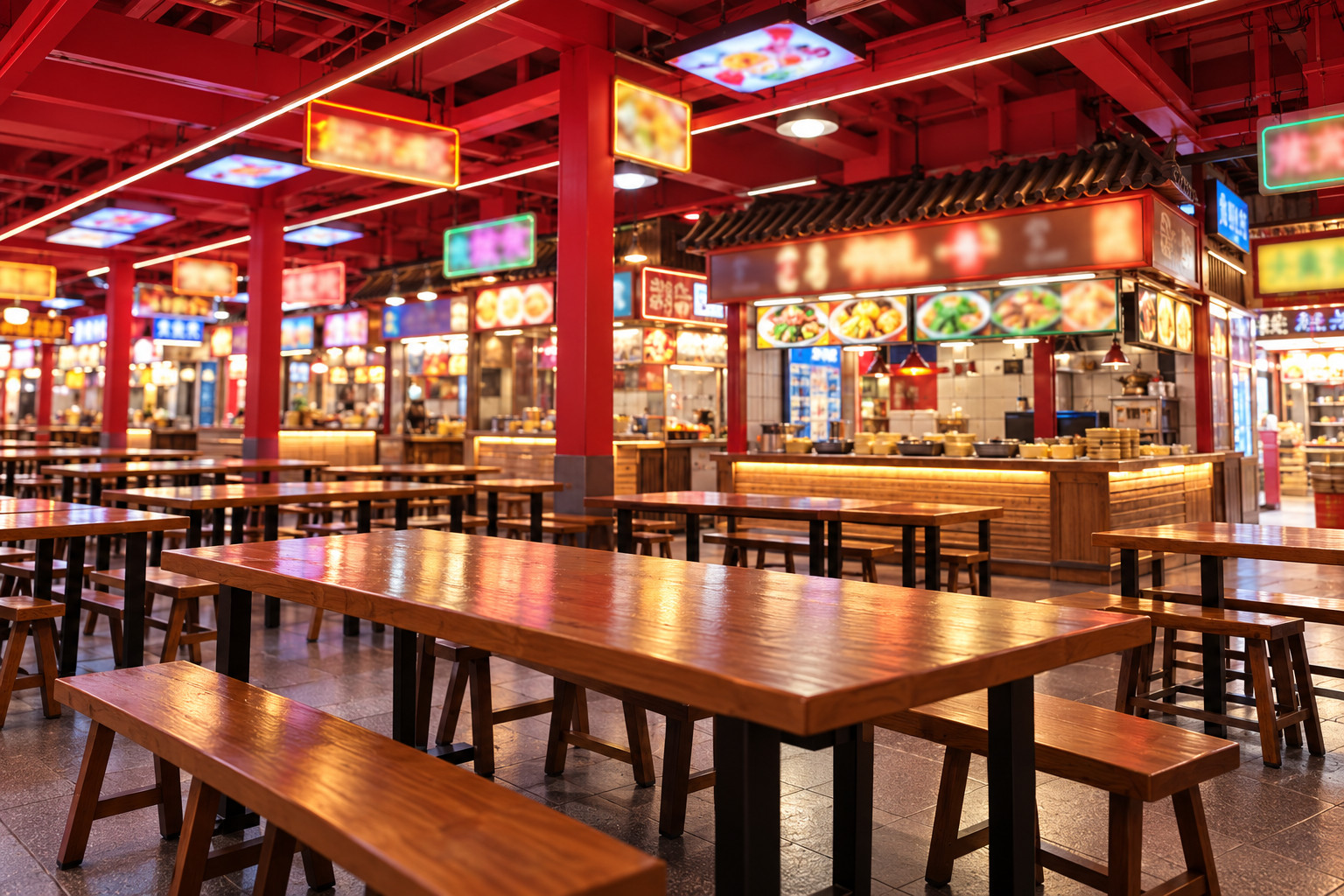
Cover: AI illustration: Dining area and counters. Approximate scene inspired by a historical photograph; not a current photograph or verified service. Historical Bayi-area layout context only; it does not verify present seating, ordering, payment or pickup arrangements, or ingredients and dietary suitability.
Historical visual reference: Journey Rambler / Junpei
Approximate scene inspired by a historical photograph; not a current photograph or verified service. Historical Bayi-area layout context only; it does not verify present seating, ordering, payment or pickup arrangements, or ingredients and dietary suitability.
Ordering in Chongqing food courts in 2026 starts with identifying the counter’s own system: where to order, where to pay, and how to collect the food. Chongqing consumer reporting has documented both QR-code friction and simpler alternatives. Confirm the seating and pickup arrangement before buying several dishes, because a shared dining area does not establish shared service.
A row of food stalls can look reassuringly straightforward until different members of your group walk off with different expectations. One person may receive food immediately, another may hold a collection number, and someone else may be waiting for a table order. Treat each counter as a separate transaction until staff explain otherwise.
This is a workflow guide, rather than a ranking of food halls or a promise that a particular stall will be open. It applies to multi-counter dining areas and helps distinguish them from restaurants inside a shopping centre. A place described in English as a “food court” may still contain individually run sit-down businesses.
Work out the seating arrangement before ordering hot food
A 2022 Yuzhong government response about Bayi Road discusses both the food street and seating outside Gaopin Food Plaza. Its attention to tables, pedestrian space and fire access is a useful reminder that dining space has an operator and boundaries. The document is historical, not a current seating map or operating notice.
Look for the name on the entrance, the counter and the table area. Ask whether the seats are shared among stalls or belong to one restaurant. A table beside an attractive shopfront is not automatically available to customers of every nearby seller. If staff direct you elsewhere, resolve that before you are carrying an uncovered bowl.
For a group, select a visible meeting point within the permitted dining area. Someone who remains seated should keep their own belongings with them rather than using a passport, phone or wallet to reserve a place. Avoid spreading bags over seats that the group does not need, and keep access paths open.
If you cannot find a practical place to sit, decide whether takeaway works before purchasing. Ask what packaging is available and whether it changes the total. Hot liquid, stairs and a crowded circulation route are an awkward combination. Use the Jiefangbei walking guide for the surrounding area, but use the actual venue signs to navigate its dining floor.

AI illustration: Colored upper facade detail. Approximate scene inspired by a historical photograph; not a current photograph or verified service. Historical Bayi-area layout context only; it does not verify present seating, ordering, payment or pickup arrangements, or ingredients and dietary suitability.
Historical visual reference: Journey Rambler / Junpei
Separate ordering, payment and collection
The August 2023 report carrying Chongqing consumer-council advice found that ordering methods differed between restaurants. That evidence does not establish one citywide food-court system. Begin with the staff member at the counter and ask which step comes first rather than scanning every visible code.
Useful Chinese labels are 点餐 for ordering, 收银 for cashier or payment, and 取餐 for collection. Their presence can help you understand the layout, but a familiar word is not proof that every counter follows the same process. Ask “在哪里点餐?” for “Where do I order?” and “在哪里取餐?” for “Where do I collect it?”
Check whether the menu price belongs to one portion, one item, a set or a weight-based selection. A prominently displayed dish photograph may show more food than the listed purchase unit. If you are choosing ingredients by weight, ask the staff to explain the pricing unit and show the chargeable total before cooking or payment.
After paying, confirm what makes the order identifiable: a printed number, an app screen, a buzzer, a verbal call or a table number. These are possible arrangements to check, not services promised by this guide. A successful payment screen proves a payment, not necessarily that the correct dish and modifiers reached the kitchen.
If two people order at separate counters, keep each receipt with its counter name. A similar-looking bowl at the neighbouring stall may have an entirely different order number. Take the extra moment to associate the payment, dish and collection point while you are still in front of the staff member.
Ask for help when a QR menu adds friction
In its December 2024 follow-up, Hualong reported that selected Chongqing restaurant interfaces allowed diners to skip or decline certain personal-information prompts and continue ordering. The finding was about the businesses and screens checked then; it is not a guarantee about your phone, today’s app version or a different stall.
If a menu will not load, show staff the problem and ask for help ordering. “可以帮我点餐吗?” means “Can you help me place the order?” If the first screen asks for a phone number or membership, look for a clearly labelled guest or skip choice, or ask whether it is necessary for the meal. Avoid repeatedly granting permissions just to get past unfamiliar screens.
Check that the menu belongs to the correct branch and counter. If it asks for dine-in or takeaway, select the intended option before submitting. Where a table number is used, compare it with the physical table. An attractive menu opened from a saved link can still describe the wrong branch.
Do not confuse a scan used to pay a merchant with a scan used to create a kitchen order. Ask the seller to confirm receipt of both where needed. If a payment appears pending or unsuccessful, ask staff to check before trying again; otherwise you may create duplicate payments or orders.
The separate Chongqing payment guide covers preparation for payment methods. Here, the goal is to leave the counter knowing exactly what was ordered and what to do next.

AI illustration: Food counter and metal pots. Approximate scene inspired by a historical photograph; not a current photograph or verified service. Historical Bayi-area layout context only; it does not verify present seating, ordering, payment or pickup arrangements, or ingredients and dietary suitability.
Historical visual reference: Journey Rambler / Junpei
Make the dish and portion decision before the kitchen starts
Chongqing’s February 2024 report on smaller portions describes small bowls, half portions and individual meals. It supports asking about size; it does not prove that every dish has a small version. Ask “有小份吗?” for “Is there a small portion?” and confirm the price of the version actually selected.
Point to the dish and state any important request in a short sentence. For less chilli, ask whether the dish can be made with less chilli before ordering. A dish already prepared in a seasoned broth or sauce may not be adjustable. Do not interpret a smile or a quick nod as a reliable answer about an ingredient that matters to you.
If you have an allergy or a strict dietary requirement, ask about the dish’s ingredients, cooking medium, sauces and shared equipment. This guide cannot establish any stall’s suitability. If the staff cannot explain or verify the preparation, choose another meal rather than relying on a picture or dish name. The vegetarian and vegan ordering guide helps with the different questions needed for plant-based food.
A set meal deserves a separate check: identify the included staple, side dish and drink, then distinguish optional additions. If a display shows several possible accompaniments, ask which are included in the price you selected. A larger photograph should not decide the order for you.
For several people, begin with what the group is ready to eat rather than buying at every counter simultaneously. That is an editorial suggestion for reducing confusion and waste, not a standard serving formula. You can decide whether to add more once you have seen the portions and checked the remaining queue.
Keep the collection process visible and understandable
The 2024 privacy follow-up shows how many steps can sit between opening a menu and completing payment. Once your order is submitted, do not assume that another part of the process is automatic. Ask staff to indicate where to wait and what will tell you the meal is ready.
If there is a collection number, save it before leaving the counter. A screenshot can be useful if the app loses its connection, but avoid capturing someone else’s receipt. If numbers are called aloud and you may not recognise yours, show the order to staff and ask how to check its progress without obstructing the pickup area.
Stand where you can see the relevant counter while leaving room for people collecting finished food. Do not assume a crowd marks the ordering queue: it may be a waiting area for already-paid orders. Ask before joining a line, especially if carrying a tray would make it difficult to step out again.
At collection, match the receipt or screen to the dish, portion and any agreed adjustment. If something seems wrong, ask before carrying it away. For a group order, identify which bowl belongs to which person before adding sauces or passing food around. This is particularly important where the orders differ for dietary reasons.

AI illustration: Fruit counter and seating. Approximate scene inspired by a historical photograph; not a current photograph or verified service. Historical Bayi-area layout context only; it does not verify present seating, ordering, payment or pickup arrangements, or ingredients and dietary suitability.
Historical visual reference: Journey Rambler / Junpei
Close the meal and check what was charged
The 2025 Chongqing regulator’s work summary encourages suitable portions and packing leftovers. Ask the counter about its own containers, fees and collection process rather than treating a broad antiwaste message as a promise of a specific service.
Before leaving, check any unresolved payment and make sure every submitted order has been collected or dealt with by staff. If the seller says a dish is unavailable after payment, ask how the refund will be recorded. Keep the receipt and refund message until the adjustment appears through the original payment channel. A verbal assurance is harder to trace later.
Follow the venue’s instructions for tray return and waste sorting. Do not leave bowls at another seller’s counter merely because it is closer to the exit. Check beneath the table and beside the chair for bags, phones and umbrellas while the group is still together.
If the food court is part of a larger shopping trip, leave with a written venue name rather than relying on memory of its decoration. This helps if you need to retrieve an item or query a charge. The Guanyinqiao shopping guide explains the wider district, while receipts preserve the particular business you used.
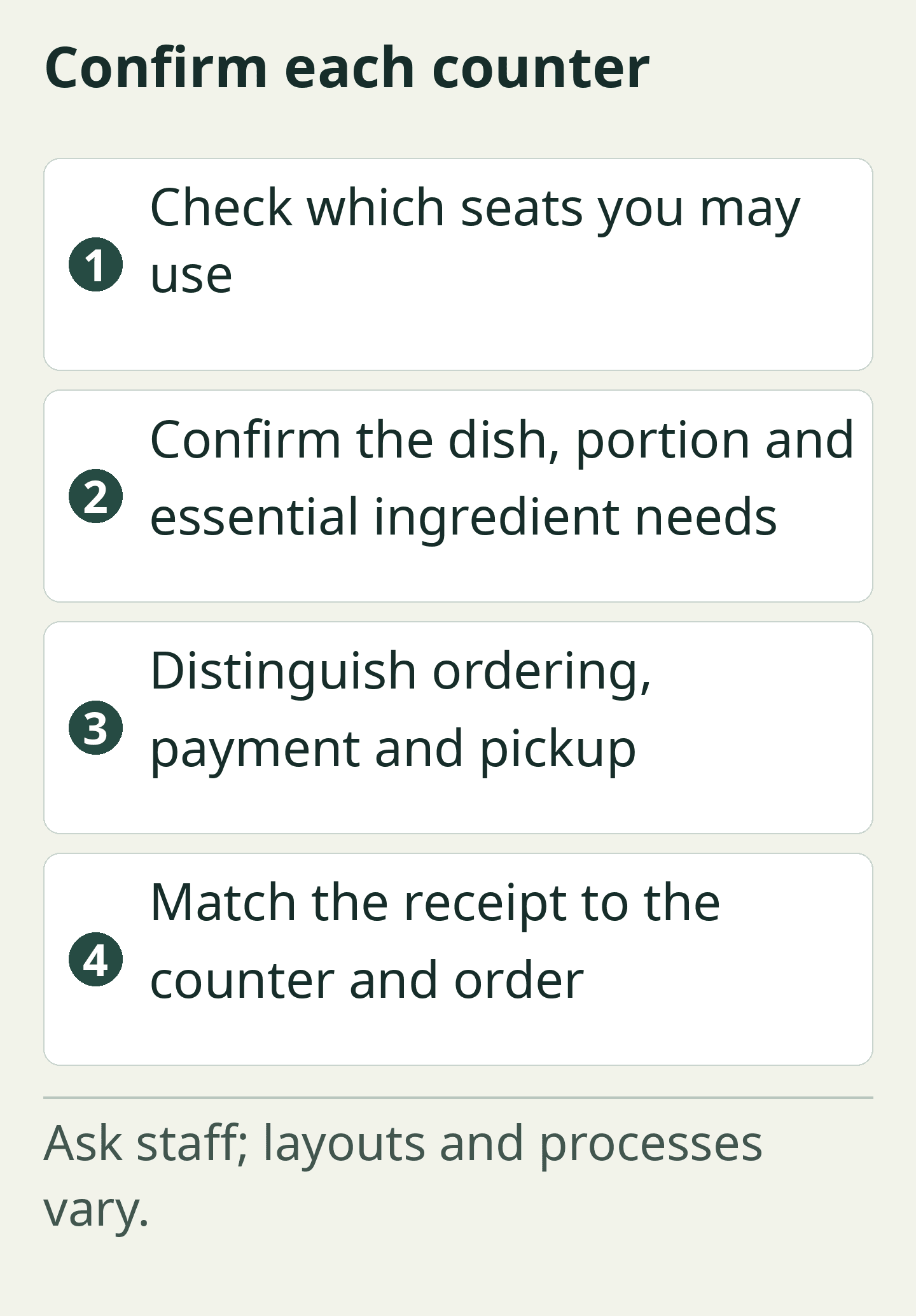
Original editorial planning card; the complete text is also provided below.
Original editorial diagram
Confirm each counter
- Check which seats you may use
- Confirm the dish, portion and essential ingredient needs
- Distinguish ordering, payment and pickup
- Match the receipt to the counter and order
Ask staff; layouts and processes vary.
About This Guide
Research checked on 1 October 2026 includes government material, local consumer reporting and public travel discussions. Historical venue descriptions help explain the questions to ask; they do not establish current stall operations. No meal was purchased and no food-court service or dietary claim was tested for this guide.
Frequently Asked Questions
Q: Do Chongqing food-court counters all share the same payment system? A: Do not assume so in Chongqing. Ask the counter whether you order and pay there, through its menu, or at another cashier, and keep the receipt tied to that specific seller.
Q: Can I sit anywhere in a Chongqing food court? A: Confirm whether the Chongqing seating area is communal or belongs to a particular restaurant. Buy food after establishing a permitted, practical place to eat, and keep pedestrian routes clear.
Q: What if a Chongqing QR menu will not accept my phone details? A: Ask the Chongqing counter staff to help place the order and look for a clearly labelled guest or skip option. Historical local reporting describes alternative flows, but availability depends on the current business and interface.
Q: How do I know my Chongqing food-court order is ready? A: Ask the Chongqing seller whether to follow a number, app screen, buzzer, verbal call or table service. Keep the order identifier and confirm the collection point before leaving the counter.
Q: Does a small portion in Chongqing always cost half the regular price? A: No fixed relationship is established for Chongqing food courts. Confirm the actual size and price on the counter’s current menu; small bowls, half portions and set meals can be different products.


Traveler comments
Share a recent experience or ask a practical question about this guide.