
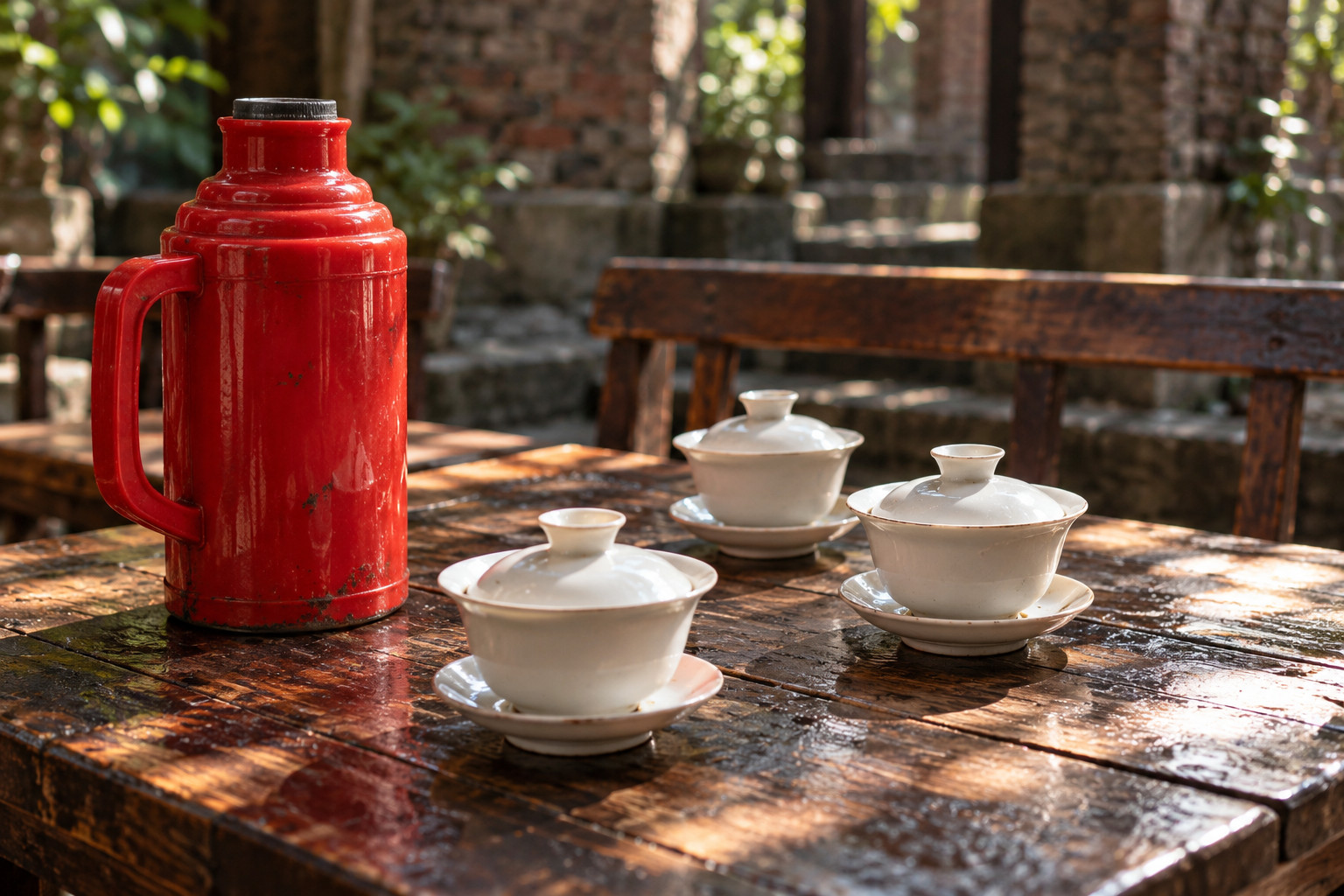
Cover: AI illustration: Lidded tea bowls and a red thermos. Illustrative tea objects; service and etiquette vary by venue.
Visual reference: iChongqing / Photographer not credited
AI illustration: Illustrative tea objects; service and etiquette vary by venue.
Ordering tea in Chongqing in 2026 starts with the service format: a personal gaiwan, a shared pot or a tea-and-performance visit. The municipal tourism portal describes Daqi’s combined tea and show model, while older Jiaotong reporting describes everyday social tea drinking. Confirm the charge, included water and seating terms before choosing your tea.
You do not need to perform an elaborate ceremony to enjoy a teahouse. The more useful skills are recognising what has been put on the table, asking for help without embarrassment and distinguishing another water infusion from another paid order.
This guide explains those questions across different settings. Jiaotong and Daqi are examples of different experiences, not interchangeable offers or the beginning of a cross-city tea crawl. No current menu, unlimited-refill promise or performance timetable is established here.
Choose between a tea break and a programmed experience
The municipal report dated 1 September 2026 describes Daqi Teahouse, 大旗茶馆, at Chaotianmen·Chengli as a place combining gaiwan tea with performances. That is a different purchase from simply sitting down with a drink. Ask whether the displayed amount is admission, tea, a particular seat or a package.
If your purpose is a quiet conversation, ask about performances and amplified sound before paying. If the performance is the reason you came, ask for today’s programme and whether your selected ticket or tea order includes it. A large room in an article photograph does not establish a good view from every table.
At a neighbourhood teahouse, begin with staff rather than an empty-looking chair. A table may belong to an existing group or have an order in progress. “这里可以坐吗?” asks whether you can sit here. State your group size and whether you want individual tea or a shared pot, then let staff explain the available arrangement.
Think about how long you actually want to stay. A rest before another appointment requires different planning from an afternoon of tea and conversation. Do not buy a timed experience without understanding when your session starts, whether re-entry is allowed and when you need to leave.
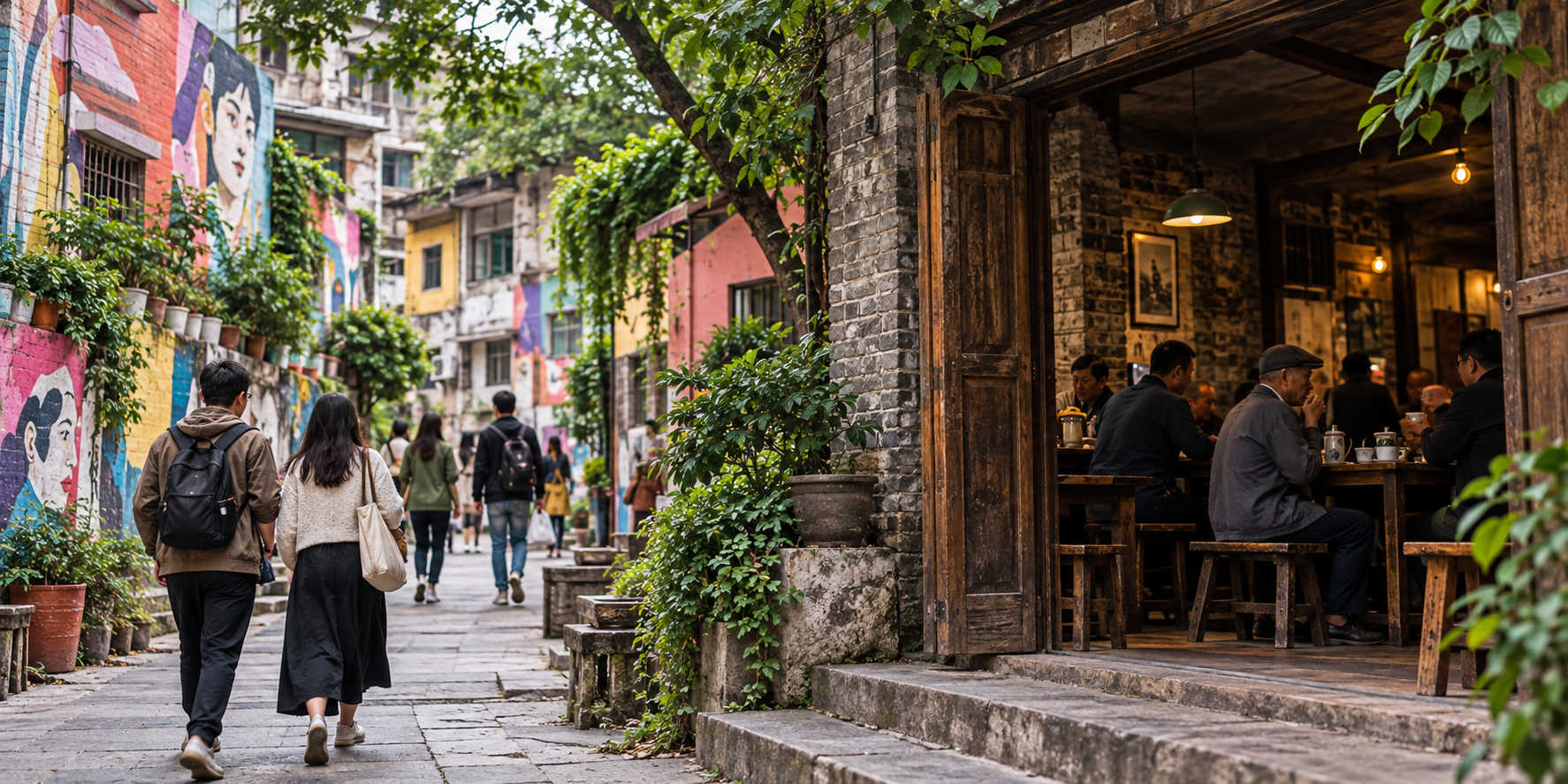
For a Huangjueping outing, use the separate Jiaotong Teahouse and graffiti-street guide. Its route context is more useful than trying to combine distant teahouses merely to compare their furniture.

AI illustration: Empty bamboo chairs beside a tea table. Illustrative tea objects; service and etiquette vary by venue.
Visual reference: iChongqing / Wang Huan
Understand the gaiwan before lifting it
A gaiwan, 盖碗, has 3 parts: bowl, lid and saucer. The equipment overview explains that it can be used to drink from directly or to decant tea into another vessel. The correct action depends on the service in front of you; a covered bowl is not automatically a communal teapot.
If each guest receives a bowl with leaves in it, ask whether it is your drinking vessel. If a small brewing bowl arrives with several cups and a pitcher, ask the server to demonstrate the sequence. “请示范一下怎么喝” means “Please show me how to drink it.” Demonstration is preferable to copying a fast pouring motion you have seen online.
Keep the bowl on the table if it feels too hot or awkward to hold. Ask for a cup or staff assistance. Do not grip hot porcelain to prove you understand the custom. Move bags and phones away from the pouring area, and give the person handling the kettle space to work.
The lid can help hold floating leaves away from the drinking edge, but you do not need to master that immediately. Let the tea cool to a comfortable temperature and ask about the way this particular bowl is intended to be used. A teaspoon or separate cup, when available, may suit you better.
If the teaware looks unusually decorative, do not assume it is a souvenir included in your payment. Tea, equipment for use and retail teaware are separate things to clarify. Leave the set as the venue provides it unless staff invite you to handle or rearrange it.
Read the price as a service agreement, not a universal tea tariff
An iChongqing visit published in August 2019 described paying first at Jiaotong. Its old price is not a current quote. The enduring lesson is to understand the order before settling into a long visit, rather than assuming all teahouses charge in the same way.
Point to a specific tea and ask “这个怎么收费?”: how is this charged? Follow with “按人还是按壶?” to ask whether the charge is per person or per pot. If you are sharing, make the number of drinkers clear. A pot price does not by itself answer whether additional cups, seats or a minimum order apply.
Ask “还有其他费用吗?” for any other charges. At a performance venue, clarify the admission and seating terms; at a tasting, clarify the number of teas and whether changing leaves starts another paid selection. At a room-based visit, ask about any time limit. These are questions to ask, not claims that every venue uses all of these charges.
Choose from a menu or written quote you understand. An expensive tea name can be unfamiliar without being deceptive, but you should know what you are ordering. If a server suggests an upgrade, ask for its total before agreeing. There is no need to purchase a premium leaf to justify occupying an ordinary tea seat that you have paid for.
For payment preparation, see the Chongqing payment guide. Keep the menu or receipt until you understand the bill, especially when tea, food and entertainment are separate lines.

AI illustration: Gaiwan bowl, lid and saucer. Illustrative tea objects; service and etiquette vary by venue.
Visual reference: iChongqing / Event organizer, via iChongqing
Separate adding water from replacing the tea leaves
The gaiwan reference, checked on 1 October 2026, describes repeat infusions as part of using the vessel. That explains what can happen to the leaves; it does not establish what a business includes in the price. “Refill” can obscure the difference between water added to existing leaves and a fresh tea order.
Ask “可以加热水吗?” for more hot water, and “加水收费吗?” to ask whether adding water costs extra. If you want different leaves, say so explicitly and request the price before the staff replace them. A newly filled bowl is not necessarily the same transaction as a top-up.
If a thermos is placed near your table, ask whether it is for your use and let staff show how it opens. Do not lift another group’s kettle or reach across their cups. Hold off if the vessel feels unstable, and ask for assistance rather than pouring over someone’s lap or phone.
Tea strength changes as leaves remain in water and as more water is added. If your drink tastes stronger than you enjoy, ask how the server suggests adjusting it. “淡一点” asks for a lighter taste. This is a preference request, not a precise brewing ratio or a guarantee about caffeine.
For ingredients, a familiar translated name may not explain a blend. Ask what is in flower, fruit or mixed teas and whether sugar has been added. If avoiding a particular ingredient matters, show it in writing and confirm the actual product. Do not treat a pale colour, floral aroma or the word “tea” as a complete ingredient list.

AI illustration: Small clear cups of amber tea. Illustrative tea objects; service and etiquette vary by venue.
Visual reference: iChongqing / Event organizer, via iChongqing
Use words instead of relying on secret signals
The 2019 Jiaotong account describes a lid-related signal for a customer temporarily leaving their seat. It is a historical observation at a particular teahouse. It should not become a rule that visitors put random objects on tea lids or expect every server to interpret them alike.
If you need to step away, tell staff: “我一会儿回来,请先别收” means “I will be back shortly; please do not clear this yet.” Ask whether keeping the seat is acceptable and take valuables with you. A teacup is not a secure way to reserve belongings, and a busy venue may need to explain its own seating arrangement.
A plain “谢谢”, thank you, is sufficient when someone serves your tea. You do not need to imitate hand gestures without knowing their context. Likewise, ask for service politely rather than banging a lid on a bowl or calling across a room. Watch how staff approach tables and choose a moment when they are not carrying hot water.
Respect other customers’ activities. People talking, reading or playing a game have not agreed to appear in your travel film. Ask before close photographs, avoid recording private conversations and do not move their cups for a composition. If they decline, photograph your own tea instead.
Shared space also means keeping belongings within your seating area. Leave aisles clear for kettles and trays, keep calls brief and follow the venue’s rules on food and smoking. If the conditions do not suit you, ask whether another seat is available or choose a different stop; you do not have to stay to make the visit feel culturally complete.
Verify the day’s programme before building a route around it
Dated sources can disagree without either being a useful timetable today. The September 2026 municipal Daqi report describes four performances, while a June 2026 Our Wander account lists a different set of times. Treat both as evidence that performances are part of the experience, then ask the venue for your actual date.
Confirm the exact branch, session, seat and inclusions before making a special journey. Ask what happens if a programme changes and whether your payment is refundable. Do not arrive just before a time copied from a travel blog and assume the whole experience can fit between transport connections.
If you are choosing a simple tea break instead, reduce the planning: select a venue already near your route, clarify the price and give yourself time to enjoy the drink. The Jiefangbei–Raffles City walking guide gives central-city context for a Chaotianmen visit without establishing a teahouse booking or performance schedule.
Before leaving, ask “需要现在结账吗?” if you are unsure whether anything remains to pay. Check extras against what you ordered, return borrowed equipment and take your belongings. If you enjoyed a particular tea, ask for its written name; that is more useful for your next order than describing it as “the tea in the blue bowl.”

Tea-service questions. Ask staff before deciding.
Original editorial checklist
Tea-service questions
Check:
- Price unit
- Refill terms
Confirm:
- Safe hot-water help
- Photo permission
Ask staff before deciding.
About This Guide
Sources were read on 1 October 2026. This AI-assisted original guide combines local reporting, an equipment reference and a dated traveler account; it does not claim an editorial visit or tested service. Charging, water, seating and performance questions are practical prompts. Prices, schedules, ingredient blends and staff assistance must be confirmed with the chosen venue. No independent review is claimed.
Frequently Asked Questions
Q: What is a gaiwan in a Chongqing teahouse? A: A gaiwan is a lidded bowl with a saucer, used to infuse or drink tea. In Chongqing, ask whether your particular service is for direct drinking or pouring into separate cups before handling it.
Q: Are hot-water refills free in Chongqing? A: This guide does not establish a citywide free-refill rule for Chongqing. Ask whether adding water is included and distinguish it from replacing the leaves or ordering a different tea.
Q: Do Chongqing teahouses charge per person or per pot? A: Confirm the model at your chosen Chongqing venue before sitting down for a long visit. Ask about the selected tea, group size, seating, time limits and any entertainment included in the total.
Q: Must I learn special hand signals to drink tea? A: No special performance is required for a Chongqing tea visit. Use a polite thank-you and ask staff directly about refills or keeping your seat rather than assuming a lid gesture is universally understood.
Q: Can I rely on published Daqi Teahouse show times? A: Check the programme for your date at Daqi’s Chaotianmen location. The 2026 municipal report and a traveler account list different performance details, so neither is a dependable live timetable.


Traveler comments
Share a recent experience or ask a practical question about this guide.