

Cover: AI illustration: Aquatic-market counter inspired by Xisan Street. Original AI illustrations based on historical photographs; exact capture dates are unknown for the market and breakfast references. The riverside reference was taken on 26 April 2026. Scenes are approximate, not current conditions or evidence of dialect, pronunciation, a verified book title or permission to record people.
Visual reference: iChongqing / Liu Qiufeng (刘秋枫), source CQCB via iChongqing
Original AI illustrations based on historical photographs; exact capture dates are unknown for the market and breakfast references. The riverside reference was taken on 26 April 2026. Scenes are approximate, not current conditions or evidence of dialect, pronunciation, a verified book title or permission to record people.
Chongqing dialect for visitors in 2026 is most useful as a listening aid: recognise agreement, comfort and encouragement, then confirm practical details clearly. A 2025 Chongqing Morning News essay illustrates why repeating 要得 in every situation can misfire. Start with meaning and context; local pronunciation needs listening practice rather than imitation from English spelling.
You do not need to perform a local accent to travel politely. The immediate benefit of recognising a phrase is that an exchange becomes less mysterious. Someone may be agreeing to your suggestion, describing something as comfortable or encouraging a performer. Understanding that function is more useful than inserting an unfamiliar expression into every conversation.
The Chinese characters below are lookup handles. They help you find a word in a dictionary, show it to someone who is willing to explain it, or match it to a caption. This article does not provide a certified Chongqing pronunciation system. It also does not assume that every person you meet uses the same vocabulary, speaks at the same speed or wants to give an impromptu language lesson.
Learn how a word works before copying its sound
A Chongqing Morning News essay published on 4 June 2025 describes a newcomer who used 要得 as a catch-all answer, including where it did not answer the question. The writer’s example is valuable because it highlights a real learning problem: recognising a frequently heard word is not the same as knowing when to use it. It is an individual account, not a description of all newcomers or all Chongqing speakers.
The CQ-Pedia dictionary explicitly gives agreement or consent among the meanings of 要得. For a visitor, that makes agreement and acceptance useful contexts in which to recognise the phrase. Listen for what has just been proposed. Has someone suggested a meeting point, asked whether an arrangement works or offered a simple choice? The surrounding question supplies the meaning. Do not use an affirmative-sounding response when you have not understood the offer, especially if a purchase or a change of destination is involved.
Imagine that you point to a dish and a server replies with a phrase you recognise. That response may acknowledge your selection, but it does not automatically establish the ingredients, portion, price or spice level. If one of those details matters, ask about it separately. A useful habit is to point to the item and the written price again before confirming the order. The dialect word is a clue to the exchange, not a substitute for the details.
You may also encounter 晓得 in local speech and writing. The same essay uses it in contexts involving knowing or understanding. Pay attention to the surrounding sentence, including a negative or a question. Hearing the recognisable part does not tell you whether the speaker knows the answer, is asking whether you know, or is saying they do not know. If the response concerns your route, show the destination instead of guessing from a familiar syllable.
For your own replies, a short phrase you already know can be enough. There is no obligation to answer local speech with local speech. If you are unsure, use a translation screen or ask for the question to be written. The point is successful communication, not passing as someone who grew up in the city.

AI illustration: Breakfast counter inspired by Chaotianmen. Original AI illustrations based on historical photographs; exact capture dates are unknown for the market and breakfast references. The riverside reference was taken on 26 April 2026. Scenes are approximate, not current conditions or evidence of dialect, pronunciation, a verified book title or permission to record people.
Visual reference: iChongqing / Liu Qiufeng (刘秋枫), source CQCB via iChongqing
Recognise comfort, appreciation and encouragement
The People’s Daily Overseas Edition report of 30 September 2023 explains 巴适 with the sense of comfort and uses the longer expression 巴适得很. In travel conversation, understanding that positive feeling is a sensible starting point. It is not a technical assessment of a hotel, dish or service, and it does not mean that another person will share the same preference.
If someone describes a place or experience with 巴适, look at the context. They may be enjoying a meal, a comfortable seat or a pleasant moment. You can respond to the shared situation without trying to turn the word into a rigid English equivalent. Describing a place as comfortable also does not tell you whether it has facilities you need. Ask directly about the feature rather than treating a warm expression as a specification.
A China National Radio language programme introduced by Chongqing Daily on 24 November 2024 connects 安逸 with comfort, 巴适 with positive appreciation and 雄起 with encouragement. These associations offer a small listening vocabulary. They are not a rule that the words can replace each other in every sentence.
雄起 is particularly useful to recognise in an encouraging or cheering context. It is different in purpose from agreeing to an order. If you hear it in a public performance or sporting setting, observe what the speaker is responding to. That gives you more information than a transliteration alone. You can join a clearly welcoming audience response when you understand the situation, but there is no need to try it on a busy employee as a novelty greeting.
Use compliments sincerely and sparingly. If you enjoyed a meal, a simple thank-you and a clear positive comment are enough. Avoid expecting extra food, a discount or special access because you attempted a local phrase. The language is part of everyday life, not a code that unlocks privileges.
It is also worth resisting personality shortcuts. A phrasebook cannot tell you that people from a city are always loud, humorous, direct or hospitable. Conversations vary with the individual, their task and the setting. If someone speaks briefly while handling a queue, concentrate on the information rather than reading their character from the accent or volume.

AI illustration: Liangjianghui path under Dongshuimen Bridge. Original AI illustrations based on historical photographs; exact capture dates are unknown for the market and breakfast references. The riverside reference was taken on 26 April 2026. Scenes are approximate, not current conditions or evidence of dialect, pronunciation, a verified book title or permission to record people.
Visual reference: iChongqing / Xie Zhiqiang
Use pronunciation resources without mixing notation systems
The independent CQ-Pedia teaching page, read for this guide, separates initials, finals and tones and displays 4 numbered tone forms using “ma” as an example. Its tone marks belong to that site’s presentation system. Do not assume that a familiar-looking accent mark has the same function as the one you learned for Standard Mandarin.
That distinction matters when a travel blog supplies an English approximation. English spelling depends on the reader’s accent and cannot reliably carry Chinese consonants, vowels and tone together. Adding a confident-looking spelling would make this guide easier to skim while creating a false sense of precision. The safer approach here is to retain the Chinese text and send pronunciation study to a resource that explains its own notation.
CQ-Pedia describes itself as a personally edited resource and acknowledges that corrections may be needed. Use it as a learning lead rather than as a promise that every speaker will pronounce every entry identically. If you compare resources, check whether they are describing Chongqing urban speech, a broader Sichuan variety or Standard Mandarin readings of the characters. Those are different tasks even when the written word looks familiar.
For a short visit, choose an expression because you understand when it is used. Find a recording or a willing speaker, listen to the whole phrase and notice the context. If you want to record a person helping you, ask first and explain whether the recording is for private practice. A service interaction should not become a recording session without the other person’s agreement.
You can ask a willing helper to repeat a phrase, then ask what a suitable response would be. This makes the exercise practical: meaning, situation and reply stay together. If the person offers a different word from the one in your notes, treat that as a useful variation to investigate. Do not argue that an online list proves their ordinary usage is wrong.
Avoid accent games involving insults, teasing labels or lines taken from comedy without their context. A joke among friends does not necessarily work with strangers. For travel, it is more valuable to recognise a basic answer and ask a clear follow-up than to collect a long list of colourful expressions you cannot use safely.
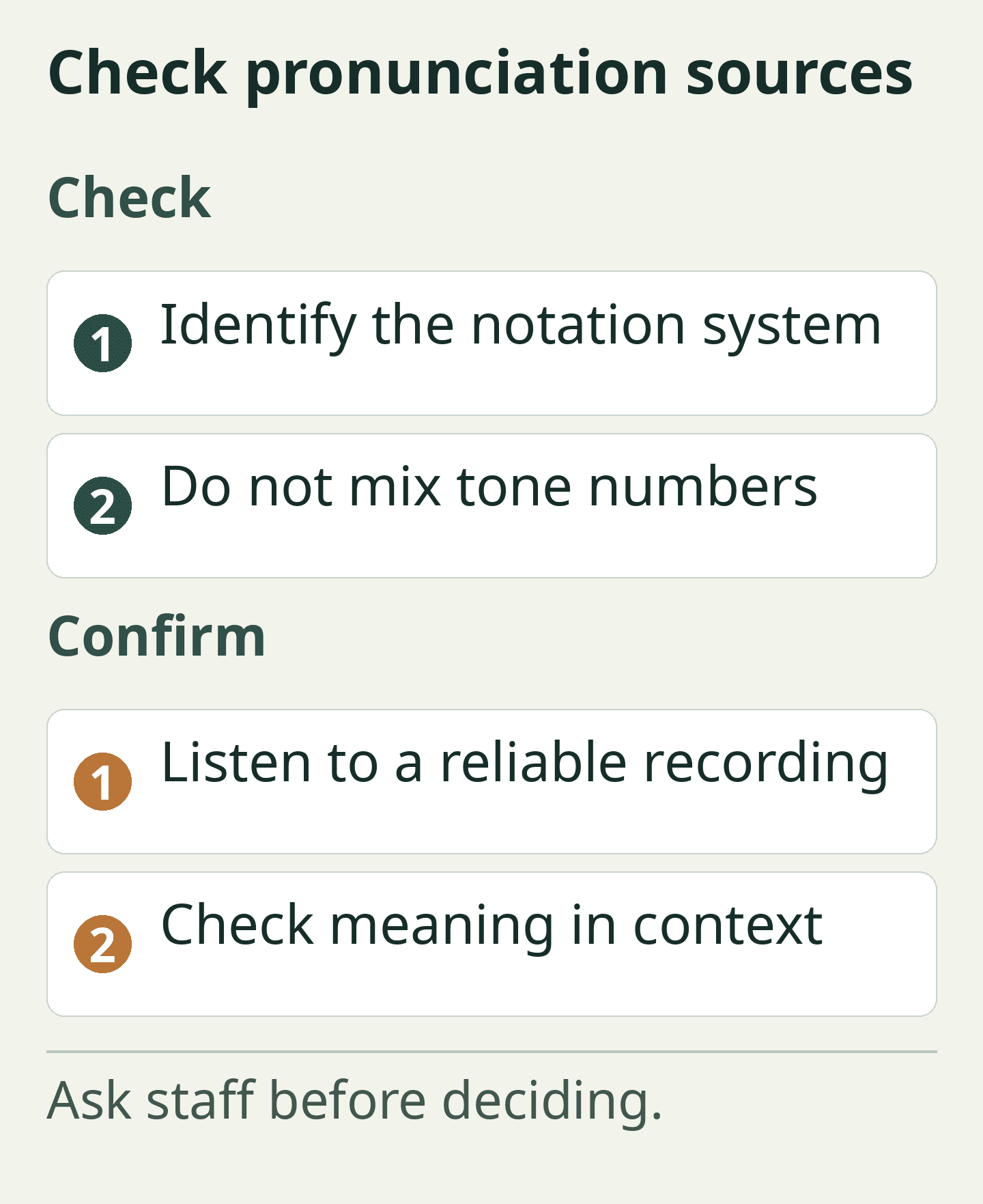
Check pronunciation sources. Ask staff before deciding.
Original editorial checklist
Check pronunciation sources
Check:
- Identify the notation system
- Do not mix tone numbers
Confirm:
- Listen to a reliable recording
- Check meaning in context
Ask staff before deciding.
Make essential travel exchanges explicit
The 2024 radio-programme introduction also illustrates repeated words in directions, including phrases about turning, slopes and steps. That is a reminder to listen for the action and destination, not simply the part you recognise. In Chongqing, the road-level navigation guide is a useful companion because a verbal direction still has to match the physical level and entrance you need.
When asking for help, begin with a precise Chinese destination copied from the place’s own listing or your booking. Show the full name rather than an English nickname. If the person points, look at the actual path and ask whether it is the entrance you need. Do not infer that the nearest staircase is the intended route. If stairs are difficult for you, explain that requirement clearly before following the suggestion.
For a conversation that is moving too quickly, these are straightforward Standard Mandarin requests rather than Chongqing dialect: 请说慢一点 means “please speak a little more slowly,” and 请写下来 means “please write it down.” You can show the written sentence without claiming local pronunciation. Keep the request short so the person can respond to the practical need.
At a food counter, distinguish preference from essential information. A friendly reaction to a dish does not establish an ingredient list. Show the food or ingredient name in writing when it matters, and wait for a definite answer from someone who can check. The xiaomian ordering guide and hotpot guide provide more context for those exchanges than a dialect phrase can supply.
For prices and transport, use visible confirmation. Ask the seller to show the amount, or show the driver the complete destination on your screen. Read the result together before proceeding. A nod, a smile or a phrase you partly understand is not enough to settle a consequential detail. This approach is useful whether the other person is speaking local dialect, Standard Mandarin or English.
Keep curiosity separate from the service you are requesting. If the person has time and seems interested, ask about a word after the practical matter is settled. If they are busy, thank them and move on. Successful communication can be modest: you understood an answer, clarified the uncertain part and respected the other person’s time.

Confirm essential details. Ask staff before deciding.
Original editorial checklist
Confirm essential details
Check:
- Show the written destination
- Confirm numbers in writing
Confirm:
- Repeat the agreed time
- Use a translation tool if needed
Ask staff before deciding.
About This Guide
Sources were read on 1 October 2026. This is a research-based recognition guide using local published examples and a teaching-resource reference, with original practical scenarios. It does not claim an interview, field recording or native-speaker pronunciation review. Pronunciation certification and localization review remain outstanding; no local phonetic transcription or audio is presented as verified. No independent review is claimed.
Frequently Asked Questions
Q: Do I need Chongqing dialect to visit the city? A: A short Chongqing trip does not require performing a local accent. Written destinations, clear questions and confirmation of practical details are more useful than repeating unfamiliar slang.
Q: Can I use 要得 as the answer to everything? A: No. A 2025 Chongqing Morning News example specifically shows how using 要得 as a universal reply can miss the meaning of the question.
Q: What does 巴适 mean in Chongqing? A: Published reporting explains 巴适 in terms of comfort or positive appreciation. Its precise sense in a Chongqing conversation depends on what the speaker is describing.
Q: Is 雄起 a normal reply when ordering food? A: The Chongqing Daily language-programme introduction associates 雄起 with encouragement. Confirm an order clearly rather than substituting a cheering expression for agreement.
Q: Where can I begin learning Chongqing pronunciation? A: CQ-Pedia provides a Chongqing teaching page with its own notation and tone examples. Read its explanations and seek contextual listening practice; the spellings in a general Mandarin resource should not be assumed to represent local speech.

Traveler comments
Share a recent experience or ask a practical question about this guide.