
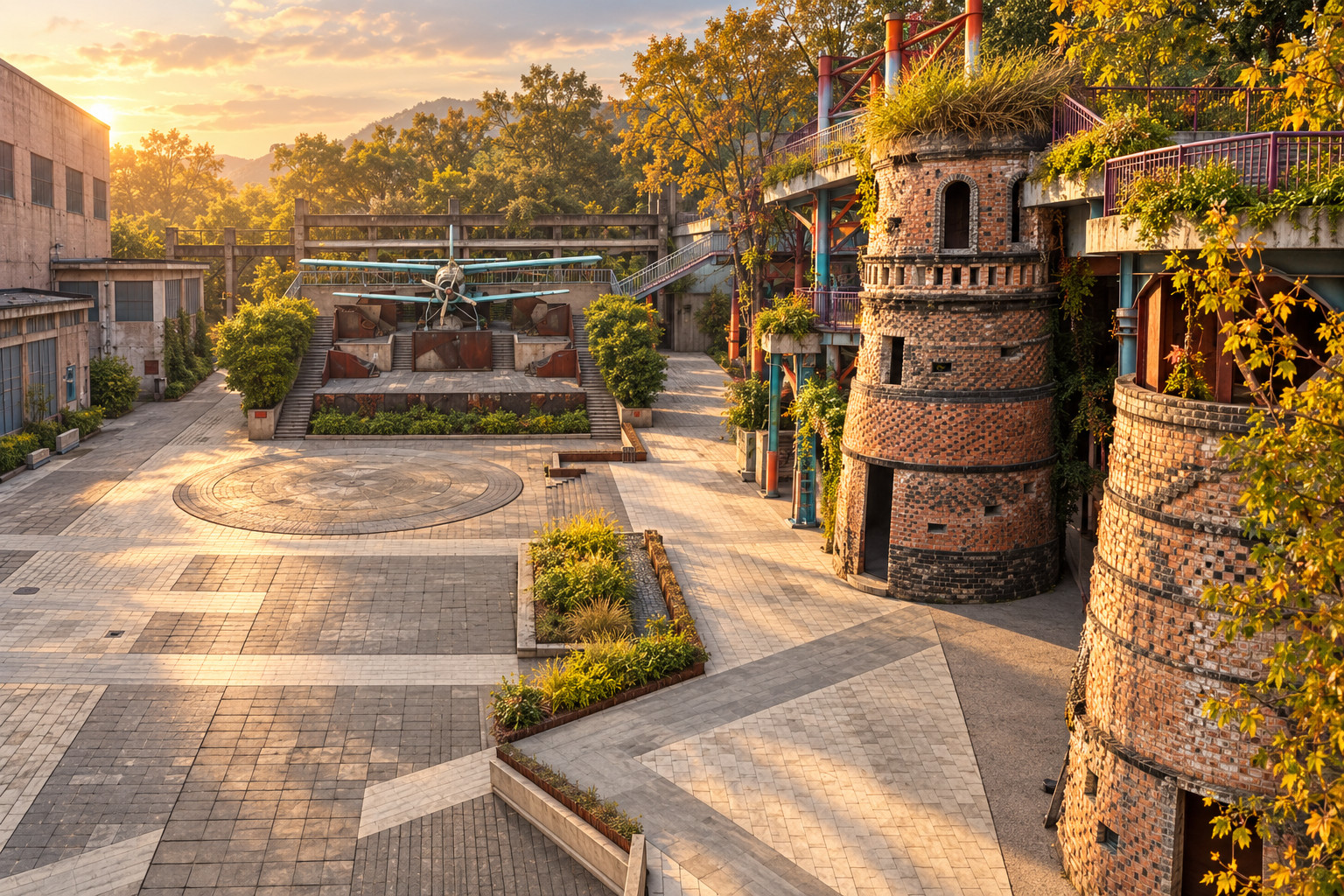
Cover illustration: AI illustration based on a historical photo reference. Factory-heritage courtyard and brick towers at Chongqing Industrial Museum. Approximate historical scene; not a current photograph, access or authorized-viewpoint guarantee. Reference photographed 21 December 2021.
Historical photo reference only; original not republished; the reference grants no reuse permission: Xinhua / 王全超
AI illustration based on a historical photo reference. Approximate historical scene; not a current photograph, access or authorized-viewpoint guarantee.
Chongqing Industrial Museum in 2026 is a visit to machinery, former workshops and the city’s manufacturing history. Chongqing’s archives identify 3 linked parts: the main history exhibition, Steel Soul hall and industrial heritage park. Choose an industrial question to follow through them, and check each part’s admission arrangements before travelling to Dadukou.
Save 重庆工业博物馆 and 大渡口区义渡路999号. This is the former Chongqing Iron and Steel site, often called Chonggang in local material. It is a different kind of museum afternoon from browsing paintings downtown: the retained industrial setting matters as much as the objects displayed inside it.
You do not need to understand engineering to make sense of the visit. Start with something visible: how a machine transfers power, why factories moved inland, or how a household product connects with the city that manufactured it. Then use the labels to develop that question, rather than trying to memorise an entire industrial timeline.
Read the factory setting before the display cases
The Chongqing Municipal Archives’ account of 28 May 2026 locates the museum at 999 Yidu Road and explains that it occupies the former section-steel plant. It dates the museum’s opening to 28 September 2019; a contemporary local notice distinguishes the opening ceremony that day from public admission beginning on 29 September. The factory fabric is therefore part of what you came to see, not simply a large building chosen to house a collection.
At arrival, look at the relationship between the surviving structures, open ground and exhibition entrances. Ask which buildings retain their original function in the interpretation and which spaces have been adapted for visitors. Industrial heritage becomes easier to read when you distinguish the historic workplace from later lighting, signage and public art.
Do not infer a production process from size alone. A large cylinder, wheel or foundation can suggest a function that is wrong. Find the object label or an explanatory drawing before telling a child what it did. If the technical translation is unclear, retain the original Chinese name alongside your notes so you can check it later.
Photograph the overall arrangement from permitted public paths, then take a detail view if photography is allowed. The wide view records scale; the detail may show joints, worn surfaces or a maker’s plate. Neither requires climbing onto equipment or crossing a protective barrier.
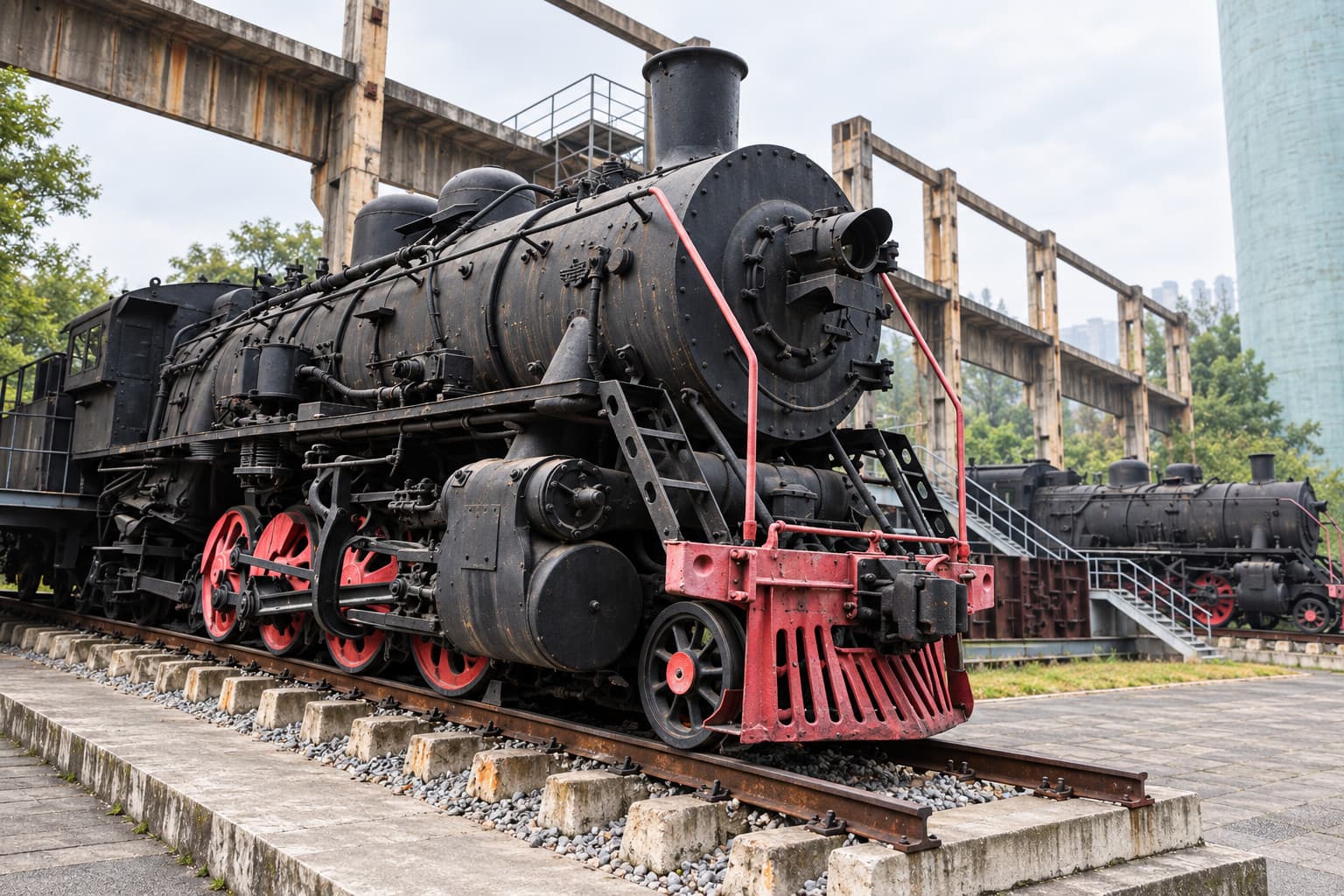
AI illustration based on a historical photo reference. Preserved black steam locomotive with red wheels and a concrete factory frame. Approximate historical scene; not a current photograph, access or authorized-viewpoint guarantee. Reference photographed 21 December 2021.
Historical photo reference only; original not republished; the reference grants no reuse permission: Xinhua / 王全超
Use the steam engine to follow power into production
The municipal opening report of 29 September 2019 identifies a British-made horizontal steam engine dating to 1905 and rated at 8,000 horsepower. It is an effective anchor for the visit because it raises a direct question: what work did that power make possible?
Look for the explanation of how power reached the rolling equipment. Separate the machine that supplied motion from the machinery that shaped steel. A railway rail is a finished product; the engine is part of the system that helped manufacture it. Making that distinction prevents the exhibit becoming merely a photograph of an enormous object.
The dated opening report describes trial rail production in 1950 and the replacement of steam power by electric power in 1985. A later archives account discusses a heavy-rail milestone in 1952. These are differently described events, so this guide does not reduce them to a single claim about the first rail ever produced. Read the on-site timeline’s exact wording if that history is central to your interest.
For a child, compare visible human scale with the engine’s scale and ask what support work such equipment would require. For an engineering enthusiast, look for the maker, power rating and operating history on the official label. Avoid treating corroded appearance as proof that every visible surface dates to the original installation; preservation and relocation can change how an object looks.

AI illustration based on a historical photo reference. Stationary horizontal steam engine under its canopy; not a locomotive. Approximate historical scene; not a current photograph, access or authorized-viewpoint guarantee. Reference published 27 September 2024; capture date unconfirmed.
Historical photo reference only; original not republished; the reference grants no reuse permission: iChongqing / Chen Zhan
Follow people and relocation through Steel Soul
The 2026 archives feature explains that Steel Soul occupies a former workshop and retains historic foundations. It connects the site with the westward movement of industrial equipment in 1938. Begin this section by finding the exhibition’s route map or chronology, then ask what had to move along with the machinery.
Heavy industry depended on workers, technical knowledge, power, transport and materials. A machine did not become productive merely because it arrived in a new city. Read displays about the people involved alongside the equipment records. Where a label discusses wartime conditions, distinguish documentary objects, later testimony and reconstructed scenes.
This is a history exhibition, so some galleries may contain difficult material about conflict and loss. Families should ask staff about the content before entering with a child who is sensitive to those subjects. It is reasonable to choose the manufacturing story and everyday products while shortening a section that the group cannot engage with comfortably.
A September 2024 iChongqing report records a former employee describing several generations of his family working at the plant. That reported testimony is a reminder to look for work and community as well as technology. It is not an interview conducted for this guide, and no personal contact with former workers is implied.
If you purchase interpretation, ask what the guide actually covers. A technical machinery tour, a general history introduction and a school activity may share a venue but serve different audiences. Check the language, meeting point and included galleries before paying.
Look beyond steel in the main history hall
Chongqing’s July 2026 cultural visitor feature describes collections covering more than 130 years of industrial development since the city opened to foreign trade. Use the main hall to place the steelworks within that wider story instead of assuming the entire museum concerns a single industry.
Choose a familiar manufactured object and read its label closely. Who made it? Who bought or used it? Which part of production happened locally? A finished vehicle or household item can make a large economic story more approachable than a wall of dates. Do not assume that every component of a Chongqing-branded product was manufactured at this steelworks.
The secondary museum overview on Wikipedia includes photographs of textile machinery and a Jialing motorcycle alongside the steam engine. Those images help demonstrate the range of subject matter, but they are not a live inventory. If a specific vehicle is your reason for coming, verify that it remains on display.
Read a product as evidence of daily life as well as industrial output. Consider how it changed travel, work or household routines. An older visitor may recognise an object that a younger family member does not; allow that difference to start a conversation, while keeping personal memories separate from what the exhibition establishes.

AI illustration based on a historical photo reference. Historic green flat-front Shancheng truck in a former factory hall. Approximate historical scene; not a current photograph, access or authorized-viewpoint guarantee. Reference photographed 25 September 2024.
Historical photo reference only; original not republished; the reference grants no reuse permission: Xinhua / 肖潇
Check hall access before relying on a general museum listing
The municipal visitor feature dated 22 July 2026 lists Tuesday to Sunday opening, 09:00–17:00, with last admission at 16:30 and Monday closure except public holidays. Recheck this pattern for your date, particularly if travelling during a holiday or aiming to enter late in the afternoon.
Ask about the main hall, Steel Soul and the outdoor park individually. A general statement that a museum is free does not establish that every special hall, guided activity or temporary exhibition is included. The 2019 opening report described trial-period arrangements and anticipated different treatment for Steel Soul afterward. Those historic terms should not become a present-day price claim.
This research did not establish the current foreign-passport booking procedure or a reliable all-in tariff for every component. Ask the museum which official booking channel applies, whether a reservation is required and which identification is accepted. Save a confirmation that names the actual venue and admission product.
The same care applies to access needs. Ask about continuous step-free travel between the arrival point, selected galleries and toilets. A repurposed industrial building may have very different visitor routes from the original work routes, and a photograph of a broad courtyard does not prove accessible entry into the hall beyond it.
Do not leave the major exhibition until the end merely because the grounds still appear open. Last admission and the time at which staff begin clearing galleries may differ. Confirm which parts you can realistically visit after arrival and choose the most important one first.

Original editorial planning diagram based on this article; not a photograph or geographic map. Use current official information; this card is not a route map.
Original editorial planning diagram based on this article; not a photograph or geographic map.
Plan a museum visit
Choose your focus:
- Machinery: Compare the stationary engine with the locomotive.
- Industry: Look at the truck and reused factory structures.
Confirm before leaving:
- Entry: Confirm opening, booking and exhibition access.
- Comfort: Ask about steps, weather cover and the return journey.
Use current official information; this card is not a route map.
Make Dadukou the destination, rather than an extra stop
The archives’ 2026 site description anchors the museum at Yidu Road in Dadukou. Use that address when requesting a car or checking a public-transport itinerary. A result for an industrial park, company office or another similarly named museum is not sufficient.
No current door-to-door journey time is promised here. Search from your actual starting point, inspect the final walking segment and confirm the return before leaving. If changing between rail and bus, check the destination stop as well as the route number. Our metro guide and taxi and ride-hailing guide cover those broader transport decisions.
Keep the museum visit coherent. Combining it with several distant attractions can turn an industrial-history outing into a series of transfers. If you want another cultural stop afterward, decide once you know how much energy remains and what is actually open. The rainy-day planning guide offers alternatives without requiring every indoor venue to fit into the same day.
The heritage park contains outdoor space, so weather still matters. Bring appropriate sun or rain protection and use public visitor paths. Historic rail tracks, machinery and workshop edges are exhibits or protected fabric, not playground equipment. Leave enough attention for the return journey rather than exhausting everyone on a final circuit of the grounds.
About This Guide
This is AI-generated text based on the cited sources. It does not report an author visit or independent human editorial review.
Research was completed on 1 October 2026 using Chongqing government and archives material, reported visitor context and a secondary museum overview. No factory visit, technical inspection or interview is claimed. Current access decisions should be checked against the museum, using the municipal visitor listing as a dated starting point.
Frequently Asked Questions
Q: What is Chongqing Industrial Museum about? A: Chongqing Industrial Museum combines a broad industrial-history exhibition, Steel Soul hall and an industrial heritage park at the former Chonggang factory site in Dadukou. Machinery, manufacturing and the people who built the city’s industries are central to the visit.
Q: Where is Chongqing Industrial Museum? A: Chongqing Industrial Museum is listed at 999 Yidu Road, Dadukou District. Save 重庆工业博物馆 and 大渡口区义渡路999号 together when checking the arrival point and return transport.
Q: What is the large steam engine at Chongqing Industrial Museum? A: Chongqing Industrial Museum displays a British-made 1905 horizontal steam engine rated at 8,000 horsepower. The municipal opening report links it with rail production and records its replacement by electric power in 1985.
Q: Is every part of Chongqing Industrial Museum free? A: A general Chongqing Industrial Museum listing does not establish the current price or inclusion of every hall, activity and temporary exhibition. Confirm the main hall, Steel Soul and park arrangements separately before relying on an all-inclusive assumption.
Q: When does Chongqing Industrial Museum open? A: The municipal July 2026 guide lists Chongqing Industrial Museum as open Tuesday to Sunday, 09:00–17:00, with last admission at 16:30. Monday and public-holiday arrangements should be refreshed for the intended visit date.


Traveler comments
Share a recent experience or ask a practical question about this guide.