
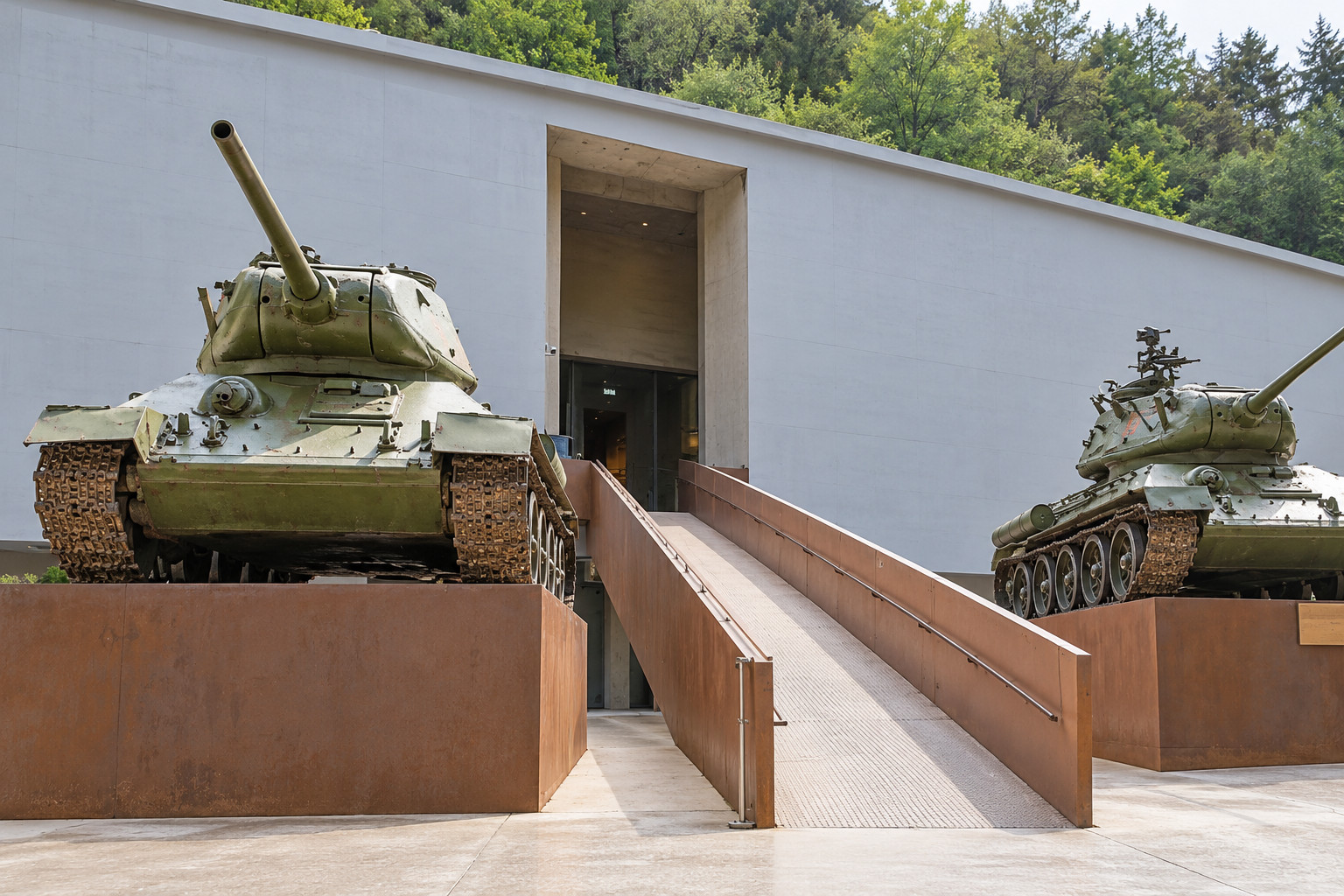
Chongqing Jianchuan Museum in 2026 is easier to enjoy as a focused gallery visit than a race through its entire collection. The operator now describes 11 themed museums in the Fujiagou cave complex. Choose a historical theme, check the ticket’s venue scope, and distinguish this site from the separate Haijiang museum.
Save 重庆建川博物馆 and 谢家湾付家沟1号. The cave-based museum sits in the Xiejiawan area of Jiulongpo, beneath the Egongyan Bridge setting described by the operator. A search for Jianchuan can also return institutions elsewhere, including the large museum cluster in Sichuan. Confirm the city and address before making a booking.
This guide is for visitors interested in the cave galleries, industrial history and everyday life. It does not assume that a broader ticket or a longer list of exhibitions produces a richer visit. A coherent selection leaves time to understand unfamiliar objects and to take a break when the subject matter becomes demanding.
Choose the cave museum before choosing a ticket
The operator’s current introduction, read on 1 October 2026, identifies the main Chongqing museum at Fujiagou and lists the Haijiang museum separately at 7 Jiubin Road. That separation is the first useful planning fact: the cave galleries and the riverside naval attraction are related venues, not interchangeable map pins.
When comparing booking products, look for the full Chinese name. A photograph of the naval vessel numbered 166 points toward the Haijiang offering. A cave entrance or arsenal exhibit may point toward the main museum, but a photograph alone is not enough to establish what a ticket includes. Read the venue names and inclusion list.
For a history-focused visit, begin by deciding whether the cave museum itself is your destination. Add another venue if you actively want its subject matter and have checked the transfer and opening window. Do not let a modest-looking price difference decide the shape of the day before you understand the additional visit.
Keep the booking confirmation in a form you can show staff. It should identify the site, date and admission type. If a platform translates the title awkwardly, save the Chinese title as well. Ask the seller to clarify an ambiguous bundle before purchase, especially when a product combines a museum, vessel or other experience.
Editorial planning card. The selectable text below contains the same labels and advice. Verify arrangements for your visit.
Choose your venue
- Cave museum: Save 重庆建川博物馆 and 谢家湾付家沟1号.
- Haijiang: Separate venue at 九滨路7号. Check the ticket’s venue names.
- Choose themes: Start with the arsenal; pair rationing with Chongqing Story if they interest you.
- Before booking: Confirm open galleries, concessions and foreign-passport entry rules.
These addresses identify venues. Confirm current access and the final walking segment.
Use the arsenal galleries to understand the site itself
The museum introduction describes 51 surviving caves at the wider site and says the former No. 1 Arsenal exhibition occupies 3 connected caves. These figures describe the historic setting and a particular exhibition; they do not mean that a ticket lets you enter every cave.
The operator connects the site with the westward relocation of Hanyang Arsenal and wartime manufacturing in Chongqing. This makes the arsenal section a logical opening for visitors who want to understand why the museum is here. Look for a timeline that distinguishes the original factory, its relocation and the later museum interpretation.
Pay attention to the difference between the preserved space, displayed objects and reconstructed production scenes. A reconstruction can help explain work in an unfamiliar environment, but it should not be mistaken for a room left untouched since wartime. Read labels that identify replicas or interpretive installations rather than inferring authenticity from subdued lighting and old-looking surfaces.
Focus on labour and conditions as well as equipment. What did the location protect? What difficulties did workers face? Which materials had to be brought in, and how did the city support the factory? These questions provide an interpretive route without requiring technical knowledge of weapons.
Follow the managed visitor circuit and stay out of closed passages. A visible cave opening is not an invitation to explore. Ask staff which galleries are accessible that day, and accept barriers as the boundary of the visit rather than searching for a route around them.
Pair ration coupons with the Chongqing Story gallery
The operator’s ration-ticket gallery page explains that coupons for planned supplies of daily necessities developed in the mid-1950s and faded from use in the early 1990s. This is an approachable subject for visitors interested in how families bought food, clothing and household goods.
Instead of photographing a whole case, choose a coupon whose label you can read or translate. Identify what it could be used for, its date and the issuing authority. Then ask how it differs from money or a modern retail voucher. Do not assume that a coupon’s printed number represents a price; it may refer to a quantity or entitlement.
The adjacent idea for a focused visit is the Chongqing Story gallery. Its operator description links river commerce with boatmen, haulers, dockside food and local speech. The value for a traveller is the connection between everyday objects and the river city outside, rather than another sequence of distant national events.
These themes can work together: one asks how households obtained necessities, while the other asks how work and trade shaped local culture. Let labels supply the historical facts and use your own questions to connect them. Avoid assigning a single object to every family’s experience; collections preserve particular examples, not a complete account of everyone’s life.
If travelling with relatives who recognise the objects, invite their memories without presenting those memories as verified museum facts. A family conversation can enrich the outing while allowing the displayed evidence and personal recollection to remain distinct.

AI illustration: Ration-ticket gallery corridor and glass cases. Original AI illustration based on the linked reference photographs. Buildings, spatial relationships and exhibits are approximate. This is not a documentary photograph or evidence of current opening, access or accessibility. Gallery context only; individual coupons and label text are not authenticated.
Private visual reference: Sichuan Anren Jianchuan Cultural Industry Development Co., Ltd. operator (Publication: unknown; Capture: unknown).
Read the collection count as a dated snapshot
A July 2019 iChongqing report described the first phase as 8 themed museums in 24 former production caves and discussed planned expansion. The current operator introduction lists 11 themed museums. The earlier count is useful history, but it should not become today’s ticket promise.
Use the current gallery board to choose a short thematic route. Someone interested in city-making might connect the arsenal, Chongqing Story and the exhibition about migrant workers and urbanisation. Someone interested in domestic customs might focus on rationing and marriage traditions. Ask staff which galleries are open and whether the suggested sequence requires retracing the route.
A gallery’s title tells you its broad subject, not the detail or emotional tone of every display. Wartime material may be difficult for some visitors. Families can ask about graphic content and choose a different section without feeling that the visit has failed. A museum cluster permits selection; it does not create an obligation to finish every room.
When reading translated labels, separate the object’s identification from the museum’s wider interpretation. If you want to research a subject further, note the title, date and provenance of a particular item where photography or note-taking is allowed. That is a firmer starting point than remembering an isolated claim from a translated display.

AI illustration: Wooden-boat installation in Chongqing Story gallery. Original AI illustration based on the linked reference photographs. Buildings, spatial relationships and exhibits are approximate. This is not a documentary photograph or evidence of current opening, access or accessibility. Museum interpretation with a projected river scene, not an untouched historical dockside.
Private visual reference: Sichuan Anren Jianchuan Cultural Industry Development Co., Ltd. operator (Publication: unknown; Capture: unknown).
Check the Chinese tariff and ask about concessions
The operator’s Chinese ticket page, read on 1 October 2026, lists RMB 50 for the main museum, valid on the day of issue. It separately lists Haijiang admission and an RMB 70 combined ticket. Treat these as the operator’s online tariff at the research date; check the exact product and conditions before paying.
The Chinese ticket page, read on 1 October 2026, lists the main museum’s hours as 09:00–17:30, with last entry at 17:00. A late arrival still needs enough time for the galleries you want. Buying a ticket near the cutoff is not evidence that a satisfactory visit fits before closing.
Concession information needs particular care. The English ticket page and the Chinese page have different age thresholds and child rules. This guide therefore does not promise a discount or free admission based on the conflicting English page, whose publication date is not shown. Ask the main museum which current rule applies and what documentation an overseas visitor must show.
The Chinese guide also lists paid interpretation. Before arranging it, confirm the language and the galleries covered; a tariff does not prove that an English-speaking guide is available. Ask how long the visit is expected to take and whether the guide can adapt to the subject your group has chosen.
For online purchase, verify foreign-passport acceptance and how the code is used at entry. Do not assume that the procedure for a domestic identity card applies unchanged. The payment guide explains broader payment preparation, but the museum must resolve its own ticket requirements.
Match notices to the correct venue and date
A Jiulongpo government page dated 22 June 2026 carries a temporary-closure notice under a broad Jianchuan headline. Reading the actual notice image shows that it concerned a particular Haijiang exhibition from 22 to 26 June, with separate arrangements for vessel 166. It is not evidence that the Fujiagou cave museum is currently closed.
This is a useful example of how to check any future notice: read the institution name on the announcement, the affected gallery, the dates and the scope. A search-result title can omit the distinction that matters to your itinerary. Conversely, a museum’s normal opening-hours page does not override a newer notice affecting the date you plan to visit.
For arrival, use the exact main-museum destination and inspect the final walking segment. No present-day metro-exit route or fixed walking time is certified in this guide. The road-level navigation guide explains why a pin beneath a bridge or beside a hillside can require more care than a straight-line distance suggests.
Ask about stairs, thresholds and rest points if anyone has limited mobility or is uncomfortable in enclosed spaces. The existence of connected caves does not establish a continuous accessible route. Agree on a return meeting point before the visit and keep the taxi and ride-hailing guide available if your group decides to leave earlier than planned.

AI illustration: Museum industrial-street reconstruction. Original AI illustration based on the linked reference photographs. Buildings, spatial relationships and exhibits are approximate. This is not a documentary photograph or evidence of current opening, access or accessibility. Museum reconstruction, not a verified cave-to-cave public connection or an untouched historic street.
Private visual reference: Chongqing Daily (source credited by Sohu article) (Publication: 2021-03-12T17:00:00; Capture: unknown).
About This Guide
This article was researched on 1 October 2026 from operator pages, dated reporting and the actual image of a local-government-hosted notice. It does not claim an on-site visit or a conversation with museum staff. The operator’s Chinese ticket guide should be refreshed before travel, especially for concessions and combined products.
Frequently Asked Questions
Q: Is Chongqing Jianchuan Museum the same as the Haijiang museum? A: Chongqing Jianchuan Museum’s cave galleries are at Fujiagou in Xiejiawan, while the operator lists the separate Haijiang museum at 7 Jiubin Road. Check which venue or combination your ticket names.
Q: How much is Chongqing Jianchuan Museum admission? A: Chongqing Jianchuan Museum’s Chinese ticket page listed RMB 50 for main-museum admission when read on 1 October 2026. The page also listed an RMB 70 combined product with Haijiang, whose inclusions and current conditions should be checked before purchase.
Q: How many galleries does Chongqing Jianchuan Museum have? A: Chongqing Jianchuan Museum’s current operator introduction describes 11 themed museums. Older reports refer to an 8-museum first phase, so use the current gallery board for what is open during your visit.
Q: Which Jianchuan galleries suit a focused visit? A: At Chongqing Jianchuan Museum, the former arsenal galleries explain the cave site, while the ration-ticket and Chongqing Story galleries connect history with everyday life. Choose the combination that matches your interests and ask about difficult content when visiting with children.
Q: Can foreign visitors rely on the English concession rules? A: Chongqing Jianchuan Museum’s English and Chinese ticket pages differ on child and older-visitor eligibility. Ask the main museum to confirm the current rule and acceptable overseas documentation before relying on discounted or free entry.
Traveler comments
Share a recent experience or ask a practical question about this guide.