
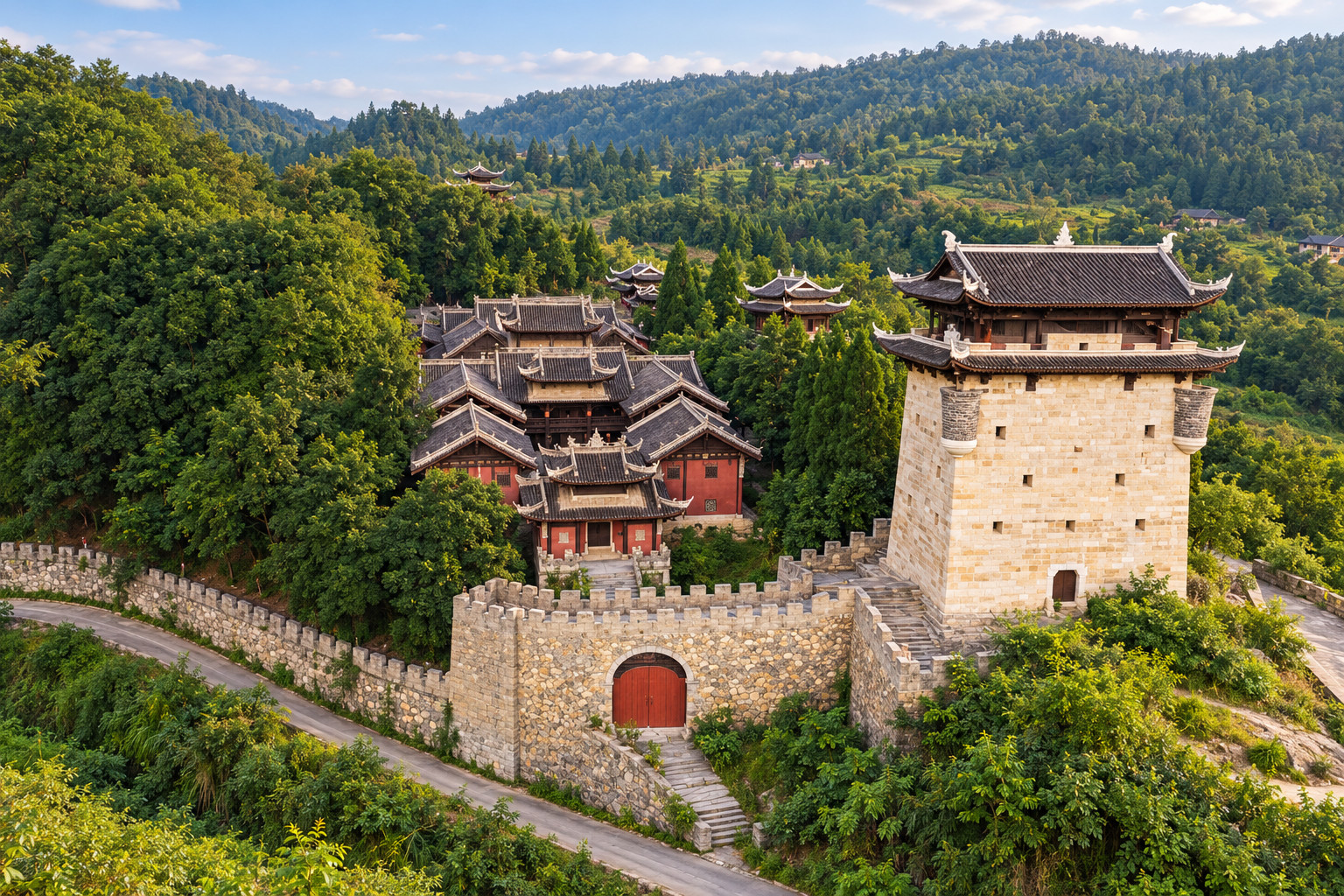
Cover illustration: AI-generated architectural illustration informed by a historical Chiyou Jiuli City photograph. The exact feature name is unverified; building details and viewpoint are approximate. This depicts a modern cultural attraction, not unchanged ancient fabric or current access.
AI illustration created with OpenAI image generation. Reference: Wang Quanchao / Xinhua’s walled-ensemble photograph, source-dated 6 July 2019. No reuse license established; protected photograph used internally as reference and not republished.
These five AI-generated architectural illustrations are informed by historical photographs of Chiyou Jiuli City in Pengshui. Details, object arrangements and viewpoints are approximate. No exact sub-building name, carved motif, public camera position, current access, performance or lighting is established by these images.
Chiyou Jiuli City in 2026 is a modern cultural attraction in Pengshui, rather than an unchanged ancient village. The Japanese consulate's tourism overview dates its opening to 2015. Visit for the architectural composition and the cultural stories presented there, while checking which areas and programmes are actually available on your date.
Save 蚩尤九黎城 with Pengshui, Chongqing. English listings may use Chiyou Jiuli City or Chiyou Jiuli Palace. Confirm the county as well as the name: social and travel-platform feeds can mix similarly themed places or attach unrelated nearby recommendations.
The visit suggested here is a selective architectural and interpretive walk. It is not a firsthand report, an endorsement of every historical claim on a display or a promise of a performance. A clear expectation matters more than deciding in advance that a purpose-built attraction is either inherently convincing or inherently worthless.
Start with what the place is trying to show
The Consulate-General of Japan's February 2021 overview describes a Miao cultural theme park, opened in 2015, with cultural interpretation around its main square. That places the visitor experience in the present era, even when the architecture refers to older forms and the stories reach far into the past.
Separate three questions. When was this complex built? What architectural or cultural traditions does it reference? What evidence supports a particular historical story? Those questions can have different answers, and none needs to be hidden for the visit to be worthwhile.
Chiyou is presented here as an ancestral figure associated with Miao traditions. Treat myth, remembrance and documented history as distinct kinds of explanation. Avoid turning a guide's short narrative into a literal, universally accepted account of the ancestry of every Miao community.
The tourism group's April 2025 company profile identifies Jiuli Tourism Holding Group and lists Chiyou Jiuli City among its attractions. This is an organized visitor destination. Understanding that context helps you judge its exhibitions and performances on their own terms.

AI-generated gate-ensemble illustration based on a historical photograph of Chiyou Jiuli City. It is not independently identified here as a particular one of the Nine Gates. Roof details, blank plaques and viewpoint are illustrative, not a record of inscriptions or present access.
AI illustration created with OpenAI image generation. Reference: Wang Quanchao / Xinhua’s gate-front photograph, source-dated 6 July 2019. The original protected photograph is internal reference-only and is not republished.
Choose three architectural anchors
The public Ctrip attraction description names the Nine Gates, Jiuli Palace and Jiuli Divine Pillar among the complex's features. Use those as three potential anchors, subject to actual access, rather than trying to complete every name in a promotional list.
At the gates, look at repetition and difference. How does a sequence of openings frame the next part of the visit? What changes in roof form, material or decoration as your viewpoint moves? These are prompts for observation, not claims about a required walking order through all nine structures.
At the palace ensemble, look for the relationship between raised buildings, rooflines and the slope. From a permitted position, compare the whole composition with one nearby detail. You do not need to reach a high point to notice how overlapping buildings create depth.
At a carved pillar or decorated surface, look for a label that names the subject. Ask what a particular figure or motif represents rather than assigning meaning from appearance. A caption or guide's explanation is preferable to treating unfamiliar ornament as a generic symbol of “mystery.”
A visitor interested chiefly in contemporary design may find this approach rewarding. Someone whose priority is archaeological remains or continuously occupied historic streets should recognize that Jiuli offers a different kind of encounter before making the journey.
Check closures before building the route
When read on 1 October 2026, the Ctrip listing displayed a notice that some areas were temporarily closed. The exact boundary and current operator status were not independently verified. This is a reason to check, not a basis for saying the entire attraction is closed or every planned section is available.
Ask the attraction which of your three chosen anchors can be reached, which interiors are open and whether any connecting route is affected. A general answer that the park is operating may leave the main purpose of your visit unresolved. If a particular hall matters to you, name it explicitly.
Read visitor reviews as questions to investigate. The public page includes 2026 praise for architectural detail as well as reports of closed areas and disappointment with the purpose-built character. Those experiences need not cancel one another out; visitors can have different dates, routes and expectations.
Do not build a route from a review's taxi fare, a photograph of an open door or a listing's nearby recommendation block. During research, that block included places outside the region. Keep your itinerary attached to verified Pengshui locations and the attraction's current instructions.

AI-generated pond-side architectural context informed by a historical Chiyou Jiuli City photograph. The exact building name is unverified, so this is not labelled a Jiuli Palace facade. Details and viewpoint are approximate, with no claim about current interior access.
AI illustration created with OpenAI image generation. Reference: Chen Lobo’s Chiyou Jiuli City photograph, provider-dated 27 September 2025, time zone unverified. Its Wulong prefix is not adopted: the attraction is in Pengshui. All-rights-reserved original is not republished.
Decide whether daylight or evening serves your interest
Think of two different aims: reading details and seeing the architectural composition under lighting. A daylight visit may suit a detail-focused approach; an evening visit should depend on the attraction confirming the actual lighting, access and programme for your date. This is an editorial choice, not a promise about conditions.
A night photograph does not establish that a performance takes place at the same time. Similarly, a daytime ticket does not automatically authorize remaining for a separately managed evening product. Ask about the ticket window, re-entry and any change in accessible areas.
Be careful with older posts advertising free evening entry. This guide did not verify a current operator policy that makes all night visits free. Nor does it reuse a summer promotion as a year-round offer. Compare the exact dated product rather than assembling a price from several differently dated sources.
If you intend to stay through a transition from day to evening, settle food, rest and the return vehicle first. Waiting for a lighting effect is less appealing when the group has no comfortable pause or a tight onward connection. Leaving after a satisfying shorter visit is a reasonable choice.
Make performances an informed option
The attraction's public descriptions mention cultural performance and ceremonial themes. They do not establish a programme for every day of 2026. Ask for the actual show name, venue, start and finish, inclusion in your ticket and cancellation arrangement before making it the centre of the visit.
Distinguish a scheduled visitor performance from a ceremony or community occasion. If an event is taking place, follow instructions about where to stand and whether photography is permitted. Being a ticket holder does not make every participant available for close-up photographs.
When a demonstration involves skilled or risky acts, observe from the designated area and do not imitate it. Ask whether audience participation is invited, what it involves and whether there is a charge. You can decline without turning the exchange into a judgement about the tradition itself.
For cultural interpretation, one precise question can be more valuable than a broad request to explain “Miao culture.” Ask about a named instrument, costume element, craft technique or story actually presented that day. If the answer is uncertain, leave it uncertain rather than supplying an attractive explanation of your own.

AI-generated architectural overview informed by a historical aerial of Chiyou Jiuli City. Court details, object arrangements and viewpoint are approximate. This is not a verified close-up of a named pillar or carving, a ceremony, a navigation map or a public camera position.
AI illustration created with OpenAI image generation. Reference: Wang Quanchao / Xinhua’s circular-court photograph, source-dated 6 July 2019. No reuse license established; reference original is not republished.
Keep the physical visit proportionate
Start with one short, confirmed section that everyone can manage, then add another if conditions and energy allow. Ask about the actual stairs and paths between the entrance, square and chosen buildings. A broad family-travel label does not describe the whole route.
For a visitor using a mobility aid, the useful question is not simply whether Jiuli is “accessible.” Ask about vehicle drop-off, entry thresholds, route gradients, toilets, resting areas and a way to leave without retracing a difficult section. Request information for the places you plan to use.
Our heat and stairs guide gives general preparation advice. At Jiuli, use the current weather and local route information to decide how much to attempt. Avoid turning the wish for a particular elevated photograph into pressure on a slower member of the group.
If stairs, closures or tiredness limit the walk, change the emphasis. Spend longer looking at the architectural composition from a permitted lower viewpoint, or choose one open interpretive space. The point is to understand something about the destination, not prove that you completed every level.
Ask practical questions around food and photographs
If a meal, tasting or costume experience is offered, establish what is included and the total charge before joining. A themed package name is not an ingredient list, and a food described as local is not automatically suitable for a dietary requirement.
For food, ask about two things separately: the main ingredients and the stock, oil or sauces used in preparation. Our vegetarian and vegan ordering guide can help with wording. It does not certify any Jiuli venue, and this guide does not make a named restaurant recommendation.
For portraits or costume rental, clarify the duration, deposit, number of photographs and whether digital files or editing cost extra. Ask before photographing other customers or staff. If a costume is offered to tourists, describe the particular experience rather than presenting yourself as documenting every community's dress or daily life.
Architecture can provide a useful alternative subject. Photograph a whole ensemble, then a detail, while avoiding queues and restricted areas. Keep the distinction between your own visit, a hired portrait and an illustrative image clear when you share the result.
Plan Pengshui transport around the chosen finish
Before committing to an evening visit, confirm two journeys: getting from your Pengshui arrival point or accommodation to Jiuli, and returning after the part you care about finishes. A short-looking distance on a map does not establish a late vehicle supply or current fare.
Save the exact attraction name and pickup location in Chinese. The corporate address on the tourism-group website belongs to its office in Jiangbei; it is not the Chiyou Jiuli City entrance. Check the destination pin against the venue, not a generic company search result.
Avoid combining Jiuli with a tightly timed water activity solely because both appear in a Pengshui package. A delayed river return, changing room stop or closed section can undermine the evening plan. Choose a primary purpose and let any second activity fit around confirmed transport.
If you want another architectural setting closer to the central city on a different day, the Huguang Guild Hall guide covers a separate historical institution. It is a different context, not a substitute explanation for Jiuli or Miao traditions.
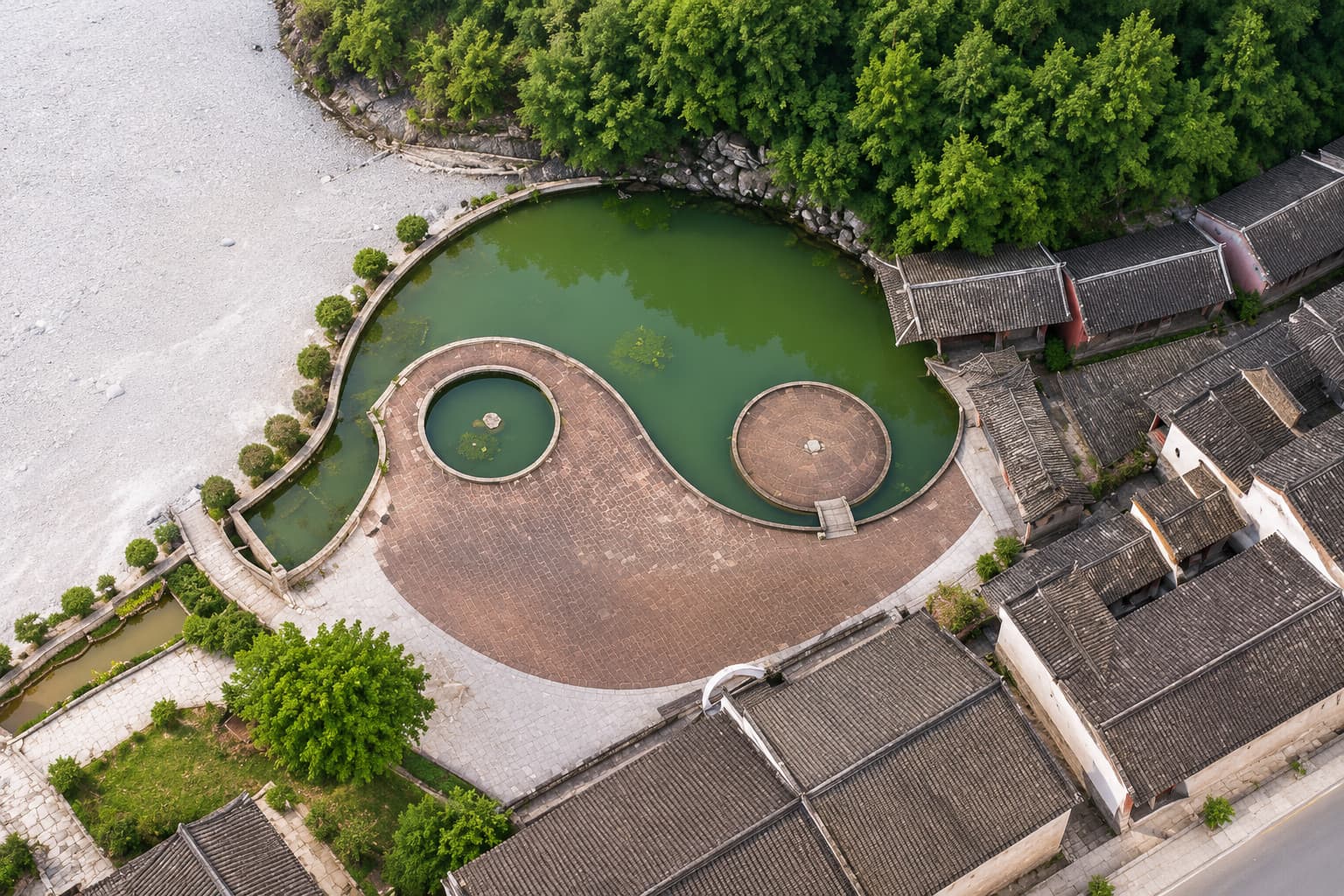
AI-generated pond-and-court composition informed by a historical Chiyou Jiuli City aerial. Geometry and viewpoint are approximate. This daylight overview does not establish a named feature, current public access, an evening programme or a permitted photography position.
AI illustration created with OpenAI image generation. Reference: Wang Quanchao / Xinhua’s pond-and-court photograph, source-dated 6 July 2019. The protected source photograph remains internal reference-only and is not republished.
About This Guide
Research completed on 1 October 2026 included a dated Japanese consular overview, the tourism-group company profile and public Ctrip descriptions and 2026 reviews. Modern construction, cultural interpretation and unresolved operational notices were kept separate. No firsthand visit, interview, current performance confirmation or accessibility audit is claimed. No independent review is claimed.
Frequently Asked Questions
Q: Is Chiyou Jiuli City an ancient village? A: The Japanese consulate's overview describes a cultural theme park opened in 2015. Its architecture and interpretation refer to older traditions, but that does not make the present complex an unchanged ancient settlement.
Q: What should I focus on during a short visit? A: Consider three architectural anchors: the Nine Gates, Jiuli Palace and a clearly identified carved pillar or detail. Confirm access and choose a route appropriate for the group.
Q: Is night entry free? A: A current operator policy was not verified. Check the specific Chiyou Jiuli product and date rather than relying on older free-evening posts or expired promotions.
Q: Are all areas open? A: The Ctrip page read on 1 October 2026 carried a partial-area closure notice. Ask the operator which buildings, interiors and connecting paths are available before planning around a particular feature.
Q: Will there be a cultural show when I arrive? A: Confirm the programme, date, venue and ticket inclusion directly. General descriptions of performances or annual traditions do not establish a show at your arrival time.
Traveler comments
Share a recent experience or ask a practical question about this guide.