
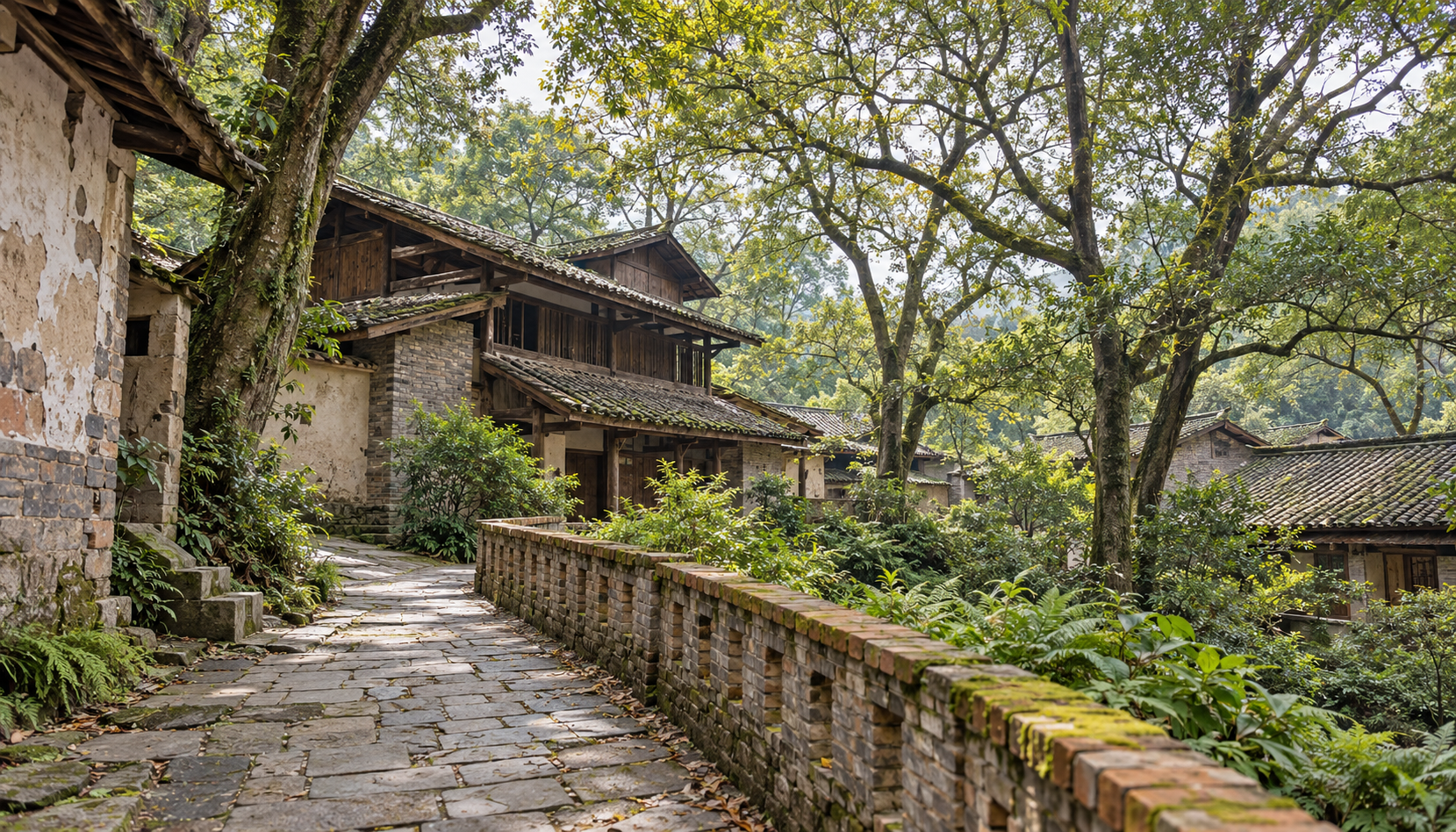
Jingangbei (金刚碑) rewards a slower kind of Chongqing outing: look at how a stairway meets a wall, how tiled roofs fit the slope, and how mature trees share space with houses. Choose it for a short heritage walk with a tea break. For a mountain hike, allow a separate plan for Jinyun Mountain; visiting this riverside quarter does not mean you have visited the mountain’s summit attractions.
AI illustration adapted from 金刚碑古村落.jpg, photographed by 重庆轨交18 on 4 February 2022; source and adaptation: CC BY-SA 4.0. Viewpoint, lighting and scene details were changed. Geometry and architecture are approximate; not a current photograph, route map or confirmation of access. No photographer endorsement is implied.
Understand the place before you walk
The quarter lies in Beibei, beneath Jinyun Mountain and beside the Jialing River. Its growth was tied to coal from the hills and river transport during the Qing period. This working landscape gives the stone lanes more meaning than a collection of picturesque storefronts. The People’s Daily Overseas Edition report supports this geographic and commercial background.
Jingangbei is a restored heritage-and-leisure destination. Major works in the late 2010s preserved the street pattern and reused buildings while adding visitor businesses. Chongqing Daily’s 22 September 2026 report describes the continuing mix of heritage, leisure and small businesses. China Tourism News on 28 September also records Mid-Autumn night-time activities involving Jingangbei. Those are dated reports of visitor activity, not a promise of today’s programme, a particular shop’s opening or a bathing facility’s availability. Do not assume that every attractive surface is untouched historic fabric, or that an old-looking building is a museum you can enter.

Timber balcony and tiled eaves in tree shade. AI illustration adapted from 金刚碑古村落.jpg, photographed by 重庆轨交18 on 4 February 2022; source and adaptation: CC BY-SA 4.0. Viewpoint, lighting and scene details were changed. Geometry and architecture are approximate; not a current photograph, route map or confirmation of access. No photographer endorsement is implied.
A flexible 90–150-minute visit
This is an editorial time allowance for an unhurried visit, not a measured route or an official tour. Add travel time from your starting point and extra time for a meal. Follow the entrance signs and staff directions in effect that day.
- At arrival, photograph the visitor map and identify the exit, toilets and your return pickup point. Ask which paths are open before committing to a loop.
- Spend the first part of the walk on the stone lanes. Compare broad walking slabs, narrow steps, retaining walls and the way doorways sit at different levels. A short distance may still involve several changes of height.
- Pause around the shaded water-and-tree landscape. Look from established paths rather than moving onto roots or stream stones for a photograph.
- If the signed route is open and conditions are good, add a river view. Otherwise, stay within the streets; the river is an optional extension, not a reason to cross a barrier.
- Finish with tea or a meal, then return with enough daylight and battery for the onward journey. Treat a booked soak or overnight stay as a separate activity.

The diagram is a decision sequence, not a geographic map. It does not establish distances, path connections, gradients or step-free access.
Stonework: read the slopes, not just the shopfronts
The most useful way to explore is to slow down at changes in level. Notice where stairs narrow, where a wall holds back the hillside, and where a doorway opens directly onto a landing. Look up at the timber and roofline, then back down before walking: uneven paving deserves more attention than a phone screen. For photography, wait beside the route for a gap rather than standing in the centre of a narrow flight.

Stone steps, landing and doorway. AI illustration adapted from 金刚碑古村落.jpg, photographed by 重庆轨交18 on 4 February 2022; source and adaptation: CC BY-SA 4.0. Viewpoint, lighting and scene details were changed. Geometry and architecture are approximate; not a current photograph, route map or confirmation of access. No photographer endorsement is implied.
Trees and water are part of the heritage
Allow some of the visit for looking at the relationship between vegetation and buildings. Shade, a sloping bank and a small watercourse can change the experience of a lane without adding another attraction to a checklist. As an editorial conservation precaution, keep off roots, do not hang belongings on branches and leave bark and stonework untouched. Look from an established path instead of moving into planted or stream-side ground for a photograph.

Trees, fern-lined stream and buildings. AI illustration adapted from 金刚碑古村落.jpg, photographed by 重庆轨交18 on 4 February 2022; source and adaptation: CC BY-SA 4.0. Viewpoint, lighting and scene details were changed. Geometry and architecture are approximate; not a current photograph, route map or confirmation of access. No photographer endorsement is implied.
The Jialing River is an optional final view
The river explains why this small settlement once mattered for moving goods. Xinhua’s March 2023 photographic report records both the village and its riverside setting. Use that as historical visual context, not evidence that a particular bank or access point is open today. Stay on permitted paths and viewing areas. If rain, high water, slippery ground or a closure changes the plan, skip the bank; do not descend exposed mud or rock just to reproduce an online photograph.
Arrival, costs and the checks that matter
Save the Chinese destination 金刚碑历史文化街区, 北碚区 in your map app and confirm the entrance it selects. From central Chongqing, compare a rail journey toward Beibei plus a local connection with a direct car journey using live routing. This guide does not verify a current bus number, station exit, fare or last departure. Arrange the return leg before entering, especially if you plan to leave after dark.
No current, authoritative all-in tariff or daily opening schedule was verified for this guide. Check entry conditions, any reservation requirement and the specific service you want on the day. Budget separately for transport, parking if relevant, food, drinks, paid experiences, bathing and accommodation. A heritage walk does not automatically include a hot-spring facility; ask about that operator’s admission, time slot, towel provision and cancellation rules before paying.
Wear footwear with grip and bring rain protection that leaves one hand free. If you use a wheelchair, mobility aid or pushchair, ask the operator about the actual accessible entrance and route, not just whether the destination is “accessible.” Stone steps and uneven paving make a blanket step-free promise inappropriate. During heavy rain or a local weather warning, choose a different activity rather than forcing this walk.
Pair it carefully
For a relaxed Beibei day, choose one additional stop, such as Chongqing Natural History Museum or a separately planned Jinyun Mountain visit, after checking its own access and hours. Leave room for the transfer and lunch. Jingangbei works best as a place to look closely, rather than a compulsory stop between several distant sights.
Five checks before you commit to the outing
These are planning questions, not a verified list of services. Use them when comparing a simple walk with a visit that includes a paid experience.
- Which entrance does your map mean? Save the Chinese name and compare the selected entrance with any instructions supplied by the business you have booked. A pin for accommodation or bathing may not be the arrival point you want for the heritage streets. Keep a screenshot of the agreed pickup location so that the return does not depend on explaining an unfamiliar lane to a driver.
- What exactly does a quoted price cover? Ask whether it is admission to a particular facility, a time-limited bathing session or a package containing other services. Check what is excluded, and whether the booking is for one person or a group. This guide does not infer a whole-quarter ticket from an individual product listing.
- Can your group use the route you intend? Describe the mobility need rather than asking a general question about accessibility. Ask about steps between the arrival point, the chosen stop and the toilets. If you cannot verify that route, choose a shorter visit with an agreed turnaround point.
- What is the fallback for rain or a closure? Keep the river view optional and allow the tea break to replace further walking. If conditions make the stone lanes unsuitable, change the destination. Do not treat a prepaid extra as a reason to cross a barrier or continue into unsafe weather.
- How will you leave? Check a return connection before beginning the walk, keep enough phone battery for navigation, and confirm any car waiting charge before agreeing to it. A destination photograph or an old travel post does not establish a current pickup bay, available vehicle or last departure.
Original desk research was checked on 4 October 2026 UTC; core sources and this copy were rechecked on 5 October 2026 UTC. Historical sources establish context, while operational details must be reconfirmed for your travel date. No personal visit or human review is claimed.
Frequently asked questions
Q: How long should I allow at Jingangbei?
A: Allow roughly 90–150 minutes for the walk and a short break, plus transport. This is a planning suggestion, not an official route duration; add time for meals, bathing or accommodation.
Q: Is entry free?
A: A current authoritative entry tariff was not verified. Confirm admission and reservation requirements before travelling, and budget separately for transport, refreshments, hot springs and other paid services.
Q: What should I put into a Chinese map app?
A: Search for 金刚碑历史文化街区 in 北碚区, then verify the selected visitor entrance and return pickup point. Use live routing for your departure location rather than an old bus itinerary.
Q: Can I visit in rain or with a pushchair?
A: Uneven stones, slopes and steps require caution. Avoid the walk in heavy rain or warnings, and ask about a genuinely usable route for your mobility needs before arrival.
Q: Are the old buildings all original, and are hot springs included?
A: The quarter has undergone substantial restoration and adaptive reuse. Do not assume every surface is original, every building is public, or a walk includes admission to a bathing business.

Traveler comments
Share a recent experience or ask a practical question about this guide.