
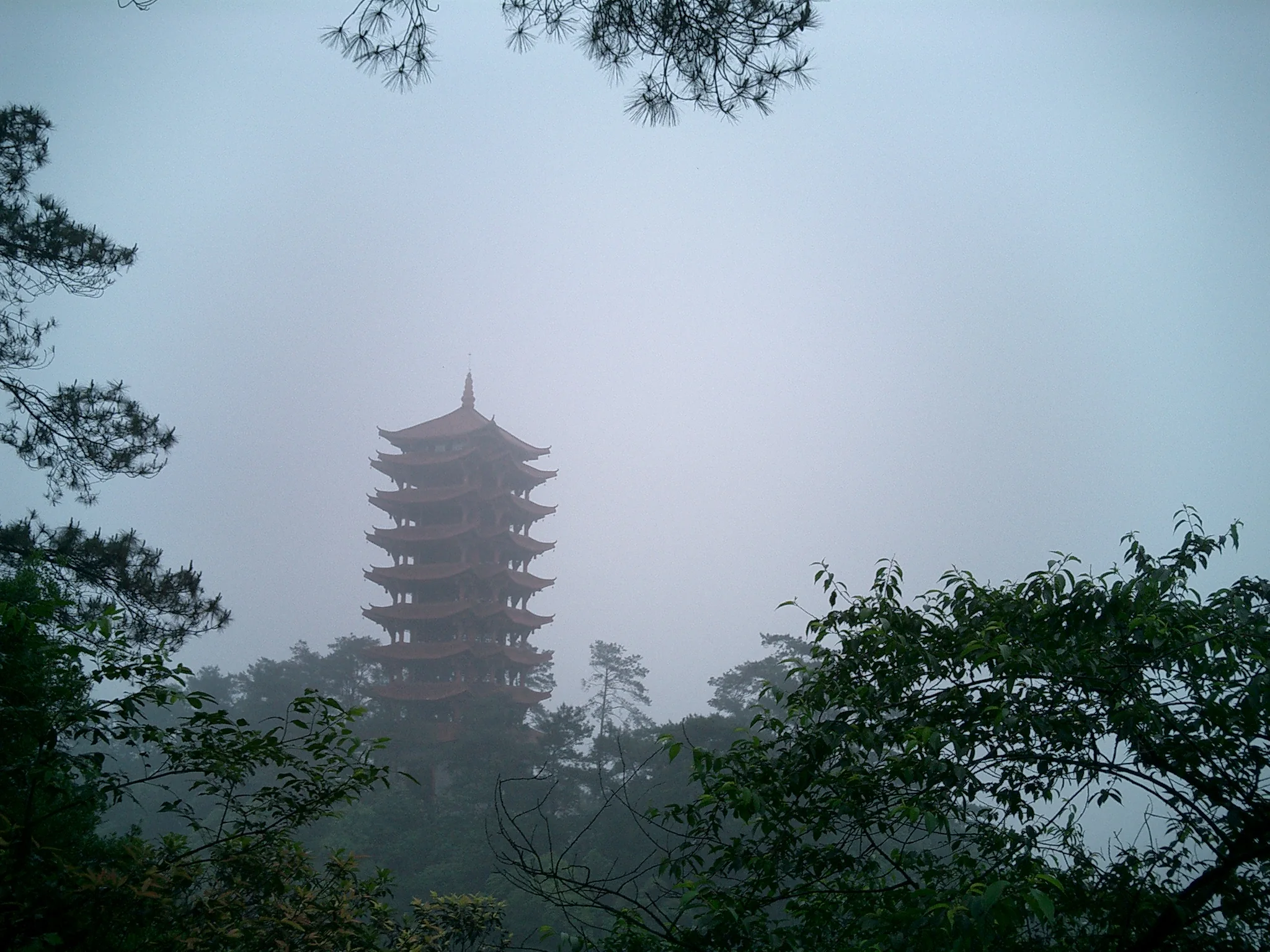

Cover image: A pagoda in Jinyun Mountain's wooded setting, photographed on 22 May 2005. This historical image predates the 2022 wildfire and does not document the reserve's current vegetation or restoration. Creator: Seasonsinthesun; Source: Jinyun Mountain.JPG; License: CC BY-SA 4.0; Changes: Resized and converted to WebP; full composition retained.
Jinyun Mountain is a forest-focused Chongqing day trip in 2026 for travelers who want walking, temple heritage and a slower pace. Allow 1 flexible day rather than squeezing it between downtown attractions. Chongqing’s forestry authority identifies this Beibei-side landscape as a protected subtropical forest; choose an open visitor route and confirm the descent arrangements before climbing.
Decide what kind of Jinyun day you want
There are 2 sensible starting points for planning: a shorter scenic-area visit with limited walking, or a longer mountain walk for which the climb is the main activity. Our recommendation for a first visit is the shorter version, with permission to extend it after checking the map, weather and your energy. A cableway option does not remove the need to understand the paths beyond it.
The municipal government’s June 2026 reserve profile distinguishes the protected mountain environment from its surrounding scenic area. It names Daihu Lake, Lion Peak and Incense Burner Peak among the landscape features. The reserve itself crosses several districts; a large protected-area outline on your phone is not an invitation to walk anywhere inside it.
Choose Jinyun if trees, a temple stop and the walk itself sound appealing even without a clear summit panorama. Reconsider if your priority is a tightly timed city sightseeing circuit, a step-free excursion, or an assured cloud-sea photograph. The point is to trade itinerary density for time outdoors, rather than replace one crowded checklist with another.
Get the destination and the entrance right
Save these names together: 缙云山, Jinyun Mountain; 北碚, Beibei; and 缙云山景区, Jinyun Mountain Scenic Area. Adding Chongqing and Beibei helps keep your search focused on this mountain. Do not book transport from an English place name alone when the result’s district is unclear.
The Beibei tourism directory dated June 16, 2026 lists the scenic area at No. 27 Jinyun Road, Beibei, and gives its visitor inquiry number as 023-68347130. That is an official address reference, not proof that every map pin is an appropriate vehicle drop-off. Ask whether you need the scenic entrance, a lower cableway station, or a particular open trailhead.
An independent transport guide describes the approach through Line 6 and Beibei, followed by onward transport. It also distinguishes the cableway station from the scenic entrance. We have not verified its bus numbers, walking minutes or fares against a current operator notice, so those details are deliberately omitted here. Use it for orientation, then confirm the actual connection in a live map or with the visitor service.
Before leaving your accommodation, save 2 pins: where you will arrive and where you expect to be collected afterward. Send the exact arrival pin to a driver rather than just the mountain name. If using public transport, resolve the last connection before boarding the first one. The Chongqing maps and road-level guide explains why destination entrances matter as much as place names.

Jinyun Mountain ecological parking lot in Beibei, shown in a China News Service report published on 18 November 2020; frame at 00:36. This is a historical transport-facility view, not the scenic entrance or confirmation of current parking services. Creator: 中国新闻网; Source: 2020年11月18日 配色超美!重庆首个彩色户外停车场投入使用.webm; License: CC BY 3.0; Changes: Still extracted at 00:36; resized and converted to WebP; full composition and publisher/editor marks retained; no audio reused. The exact filming date is unknown.
Tickets, cableway checks and the return journey
The June 16, 2026 district directory lists scenic admission at CNY 12 and opening hours of 09:00–17:00. These are dated official baseline figures, re-read for this guide on October 1, 2026. They are not a confirmation that the site is open on your travel date, and they should not be interpreted as the cost or hours of a cableway package.
Ask 3 separate questions before committing: is the scenic area open, is your intended access facility operating, and what time must you begin the return? Also confirm the last entry, last descent and any inspection or weather restrictions. The directory lists concessions, but it does not establish how every concession applies to foreign passports or overseas student documents. Have the ticket desk confirm eligibility before budgeting a discount.

Jinyun Mountain's entrance, photographed on 4 February 2022 according to the source EXIF. The historical health-code signage and barriers shown here are not a statement of today's entry requirements or ropeway operation. Creator: 重庆轨交18; Source: 缙云山 大门.jpg; License: CC BY-SA 4.0; Changes: Resized and converted to WebP; full composition retained.
Weather-dependent service changes are documented. An official notice dated June 17, 2026 announced suspension of the Jinyun ropeway from 18:00 that day, with reopening to be announced separately. It also named Chengjiang ferry and the Xinbeiquan Park sightseeing elevator. These are specific facilities, not a notice closing every Jinyun visitor path. The archived notice does not prove any service is still closed today; equally, an earlier reopening cannot establish current operation. An April operator notice supplies inquiry number 023-68225888 and the WeChat channels 北碚发布 and 缙云山北温泉旅游度假区 as starting points for a fresh check.
Our planning preference is to return through the same confirmed access point unless you have checked the alternative exit and transport in advance. Do not rely on an unverified downhill shortcut if the cableway closes. If staff cannot confirm a workable descent arrangement, choose a shorter open walk or postpone the mountain visit.
Build a flexible day around one main walk
Use this 3-part sequence as an editorial planning framework, not a timed route or a claim that every stop connects directly. The current visitor map and staff instructions should determine the actual walking order.
Start with access and a manageable section
On arrival, photograph the map and the posted return information. Ask which path suits your group’s walking ability and whether any section is closed. Start with a section you can reverse without difficulty. Leave the ambitious climb as an option rather than treating a summit as the price of a successful day.
Keep your first rest stop early enough to assess how the group is doing. If wet steps, visibility or fatigue make the walk less comfortable than expected, shorten it there. A modest forest walk can meet the purpose of the trip without a summit photograph.
Choose one main landscape or heritage stop
Pick a priority: a temple visit, an approved viewpoint route, or a lakeside walk. Ask whether another stop genuinely fits the same open route before adding it. The official reserve profile is useful for identifying named sights, but it is not a turn-by-turn walking map.
Avoid treating names collected from different travel posts as a ready-made loop. Posts can begin from different trailheads or assume a level of fitness your group does not share. A route that works as someone’s exercise session may be a poor fit for a visitor carrying a camera bag and relying on a scheduled return.
Finish the mountain before adding another attraction
Set a personal turnaround point that leaves comfortable time for the confirmed descent. Do not use a posted closing time as your target arrival at the exit. Keep food and onward sightseeing flexible until you are off the mountain.
If you still want a second stop, decide after checking your energy and the day’s remaining opening arrangements. For a separate indoor nature outing, the Chongqing Natural History Museum guide covers the Beibei museum. It is an alternative plan to evaluate, not an automatic addition to every mountain day.
Look closely at forest, temple and lake
Jinyun rewards a slower kind of attention. Rather than counting viewpoints, notice the different leaf shapes, canopy layers and changes between built visitor spaces and forest. The reserve was established in 1979, according to the municipal forestry profile, which helps explain why conservation is central to the landscape’s identity.
Jinyun Temple, 缙云寺, provides a cultural focus alongside the walking. The municipal forestry profile dates the Buddhist foundation to the first Jingping year of the Liu Song, corresponding to 423 CE. Treat that date as the institution’s historical origin, not a claim that all visible structures survive unchanged from that period. Follow current signs concerning worship spaces and photography, and let religious activity take precedence over a photo composition.
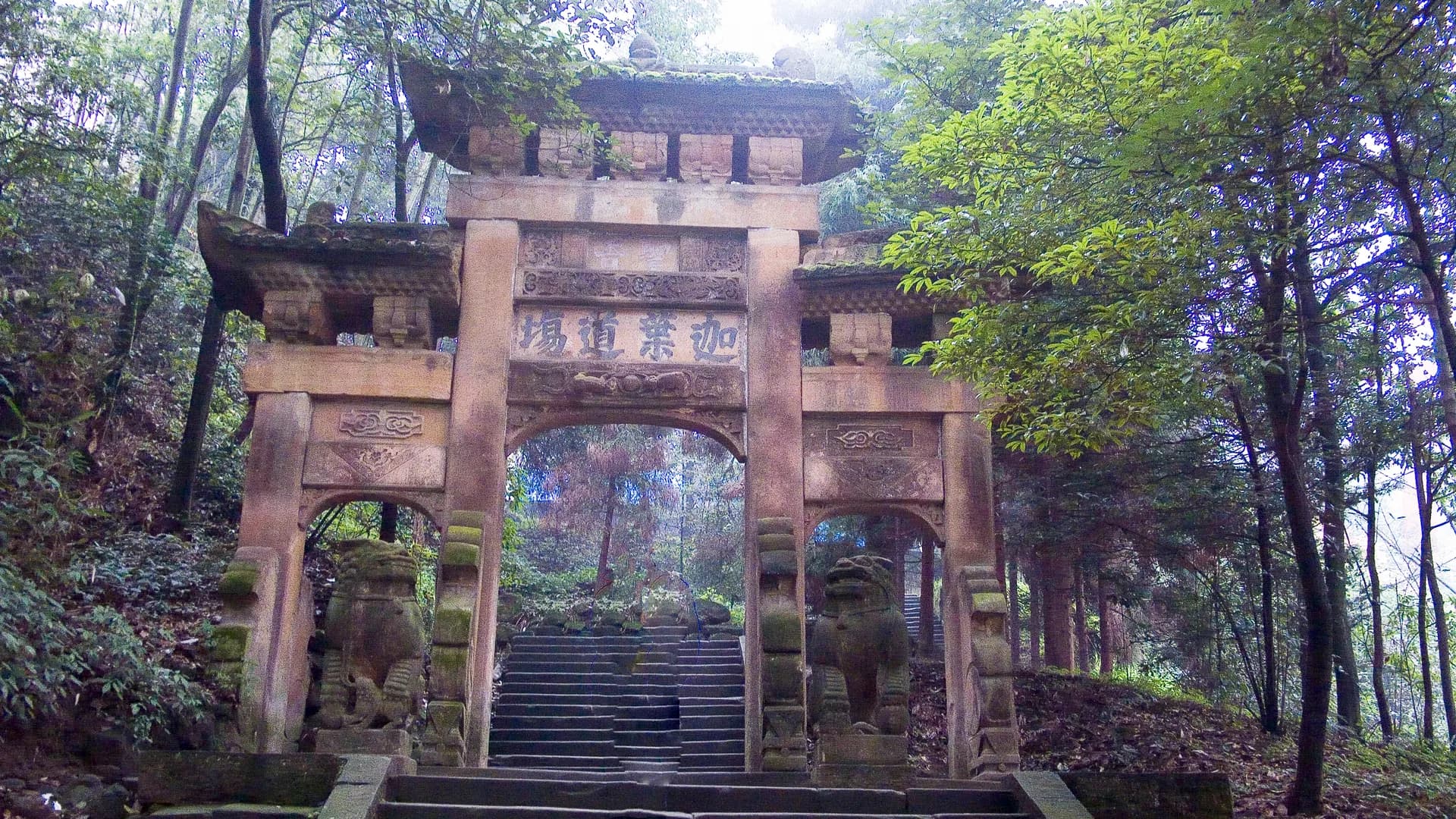
The stone arch and wooded steps at Jinyun Temple, photographed on 6 January 2007. This historical image predates the 2022 wildfire and does not establish current vegetation or path access. Creator: Urga; Retained embedded credit: renyi / @任小熊; Source: 縉雲山牌坊; License: CC BY-SA 3.0; Changes: Proportionally resized and converted to WebP; full composition retained. If displayed with rounded corners, that display is an adaptation. Adapted photographic material remains CC BY-SA 3.0.
Daihu, 黛湖, brings a different perspective. An August 2026 China News Service report carried by iChongqing describes the lake’s creation in 1931, later environmental pressures and restoration beginning in 2019. It also describes a shoreline trail. Confirm which lakeside access is currently open before building your day around it.
The same report records a wildfire on Jinyun Mountain in summer 2022 and subsequent post-disaster rehabilitation. That later forest recovery is distinct from the lake restoration begun in 2019. Do not read present-day greenery as proof that the entire mountain is untouched, wholly recovered or freely accessible. Keep to permitted paths, carry litter out, and avoid disturbing planting for a clearer photograph. Our recommendation is to observe the lake from approved access rather than plan recreation in the water.
Pack for walking and keep a weather alternative
Prepare 2 versions of the day: an open-route mountain visit and a shorter or indoor alternative. Check the mountain forecast, fire-risk restrictions and official access notices rather than relying on conditions outside your city hotel. Respect current fire-control instructions and avoid smoking or open flame in forest areas. This is precautionary visitor advice, not a claim that a blanket closure is active. The June 2026 facility suspension illustrates why a scenic-area opening does not guarantee a working ropeway, ferry or elevator.
Bring footwear you trust on steps, drinking water, a light layer, rain protection and a charged phone with backup power. Save the names and return pin offline. Carry a snack if a delayed meal would cause problems for your group; this guide does not promise a particular restaurant, menu or trading schedule on the mountain.
For children or visitors with limited stamina, ask about the complete route, including the descent. For anyone using a wheelchair or walking aid, seek specific answers about steps, gradients, surfaces, accessible toilets and boarding arrangements. The presence of a cableway does not establish a continuous accessible route. We have not inspected those facilities and do not label this trip step-free.

The Lion Peak marker and adjoining rocky surface at Jinyun Mountain, photographed on 11 April 2008 according to the original EXIF. This historical detail does not certify current barriers, route access or accessibility. Creator: Huaijuliu; Source: LionPeak.JPG; License: CC BY 3.0; Changes: Resized and converted to WebP; full composition retained.
If an official closure or warning affects your intended route, change the plan. Do not follow other walkers around a barrier. In ordinary open conditions, turn back before tiredness makes a familiar path difficult. Our heat and stairs guide has additional planning advice for pacing a Chongqing walking day.
About This Guide
This guide was researched on October 1, 2026 using 6 source domains, including the Beibei tourism directory and Chongqing municipal forestry material. It is a desk-researched editorial guide, not an account of an onsite visit. The suggested sequence and packing choices are our planning recommendations; they are not measured walking times or statements of current trail availability.
The research covered the wildfire/restoration account, the forestry profile and the June facility suspension notice. Before travel, recheck entrance arrangements, ropeway operation, onward transport, fire-risk restrictions and weather notices.
Frequently Asked Questions
Q: Is Jinyun Mountain a practical day trip from Chongqing? A: It can suit a flexible 1-day nature outing focused on Beibei. Confirm your arrival point and return transport before adding a long walk or another attraction.
Q: How much does Jinyun Mountain cost? A: Beibei’s official directory dated June 16, 2026 lists scenic admission at CNY 12. Reconfirm the current price and any separate cableway charge before traveling.
Q: Does the Jinyun cableway take me all the way to a summit? A: The independent access guide describes the cableway as reaching the scenic entrance, with walking afterward. Ask the operator what route is open and suitable for your group rather than assuming a step-free summit visit.
Q: Can I visit Jinyun Temple and Daihu Lake on the same trip? A: Both are associated with the Jinyun visitor landscape, but this guide does not verify a current connecting route. Choose 1 priority, then ask staff whether the other stop fits your available time and access arrangements.
Q: Is Jinyun Mountain suitable when the weather is poor? A: Check weather, fire-risk and facility notices before leaving for Beibei. Heavy rain caused a dated ropeway suspension in June 2026; that historical notice does not establish today’s status. Choose an approved shorter route or indoor alternative if your intended access is unavailable.
Traveler comments
Share a recent experience or ask a practical question about this guide.