
AI disclosure: Prepared with AI using cited sources and automatic editorial checks. No on-site visit or human review is claimed. Historical photographs are attributed real images; the labelled editorial diagrams are programmatically drawn planning aids.

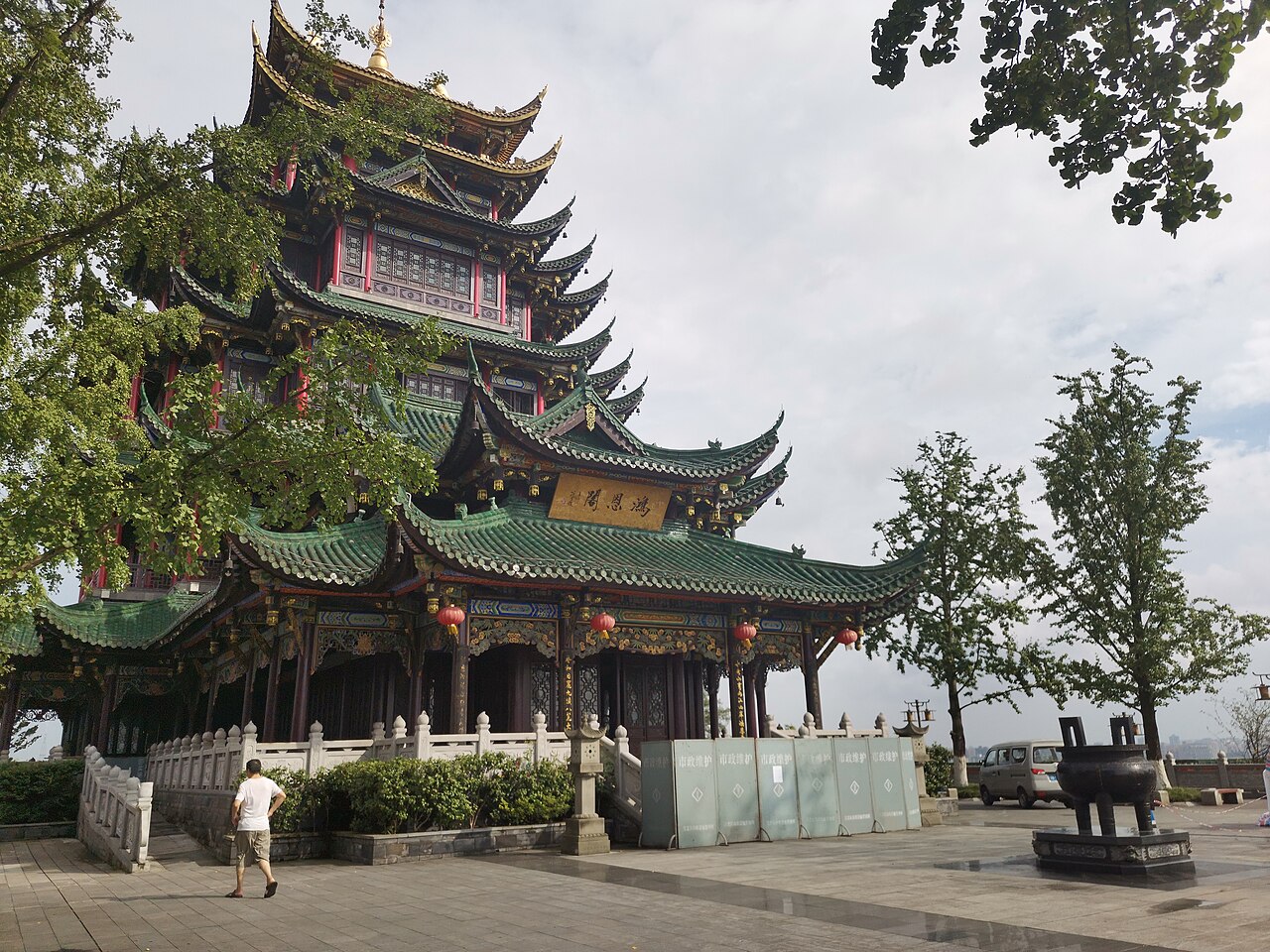
Hong’en Pavilion (鸿恩阁), photographed 18 July 2020. This historical exterior image does not verify current interior or upper-floor access. The source frame includes the clipped roof top, temporary screening and a vehicle.
Photo: HMGiovanniV. Work: Hong'en Pavillion, Jiangbei, Chongqing on July 2020.jpg. Capture date: 18 July 2020, 16:55:35. License: CC BY-SA 4.0. Source. Changes: Commons-served full-frame 1280px downsample; copied byte-for-byte, with no local crop, retouch, compositing or scene changes.
Hong’en Temple Park in 2026 is a hill-park outing whose entrance choice matters as much as the skyline photograph. Amap identifies East Gate 1, while Chongqing’s urban-management reporting names Hongding Road as the main route toward Hong’en Pavilion. Choose your approach deliberately and verify pavilion access before committing to an evening climb.
Save 鸿恩寺森林公园 for the park and 鸿恩阁 for the pavilion. They are related destinations, but a pin for the hilltop landmark is not a vehicle drop-off point. Give a driver the entrance you intend to use, rather than expecting the park name alone to produce a suitable walking route.
This guide is for choosing a manageable park visit, including the red-wall setting and elevated city views. It does not establish a religious-service schedule, access to every pavilion floor or a nightly lighting programme. The name “Temple Park” should not become a promise about activities inside the landmark building.
Name East Gate 1 when arranging the approach
The live Amap place listing, checked on 1 October 2026, identifies 鸿恩寺森林公园(东1门) at 鸿恩路181-28号. Save that exact place rather than typing an approximate English gate name. The listing establishes a navigable entrance identity, not a tested walking time to the pavilion.
A public visitor account dated 30 October 2023 favours East Gate 1 over the South Gate for a less demanding approach, with another account on the page describing a switch away from the south side. Treat this as useful directional experience, not an accessibility audit. The source does not justify promising a completely downhill or step-free outing.
Before setting off, compare the arrival point with the actual route you want to walk. A metro journey that appears convenient may leave you below a substantial climb. A vehicle to a named gate may reduce that burden, but still leaves the park’s internal terrain to negotiate. Choose based on the least mobile person in the group, not simply the lowest transport fare.
Current map labelling and older articles also differ on the administrative district. The map now labels the gate under Liangjiang New Area, while older park coverage uses Jiangbei. Keep the exact Chinese park and gate names as your stable navigation anchors instead of treating an older district label as proof that a map result is wrong.
Follow Hongding Road through the park
A 17 February 2023 report hosted by Chongqing’s urban-management authority identifies 鸿顶路, Hongding Road, as the park’s main route. It connects 桂花榜 with 鸿顶云霞 and continues to 鸿恩阁. These names give you useful checkpoints to ask for once inside.
The same report describes a resurfaced asphalt route with a running strip. That makes the named main road a more defensible planning anchor than an unspecified “shortcut” in a social-media caption. However, a surfaced road can still slope, and a running strip does not establish wheelchair suitability. Ask staff about the present route condition and any closures.
At the first clear map or junction, locate your entry gate and the pavilion together. Decide how you will return before continuing uphill. If the route suggested by a phone differs from the signed public path, follow the park’s signs and ask for clarification. A map may suggest stairs or service access that is unsuitable for your group.
There is no need to reach the pavilion before enjoying the park. Use the tree-lined road as part of the outing, and pause when the group needs it. Let faster walkers stay within sight rather than making everyone chase the person with the most energy. A shared route works better when nobody feels obliged to hide fatigue.
Where a route branches, take a photograph of the sign if permitted and note the direction you came from. That small habit makes a familiar return easier, especially if the outbound walk happens in daylight and the return is later. Do not rely on a vague memory that every downhill path must lead back to your entrance.
Choose the South Gate when the climb is part of the plan
The 2023 visitor report describes the South Gate approach as considerably more stair-heavy than East Gate 1. That can be a valid choice for someone who wants a climb or is deliberately approaching the library side of the park. It is a poor surprise for someone expecting a gentle evening stroll.
Do not choose an entrance merely because a journey planner makes it the nearest endpoint to your starting station. Inspect the final pedestrian route and ask what the climb involves. Distance and effort are different questions. A short stair route may feel more demanding than a longer surfaced path, particularly in warm weather or with a child who needs carrying.
The local-authority-hosted Hongding Road report says the main road also connects with the Hong’ensi library. That is useful orientation, but it does not establish the library’s current opening hours or visitor requirements. Check those separately if reading or an indoor break is an essential part of the plan.
If you reach an entrance and the terrain is unsuitable, change the plan before everyone is committed to the climb. Confirm a different gate and arrange a legal public pickup rather than following an improvised hillside shortcut. Our taxi and ride-hailing guide can help with communicating a precise replacement destination.
For visitors with limited mobility, no complete step-free route has been verified here. Ask about the full chain from the gate to the desired viewpoint and back, including slopes, steps, toilets and rest places. “Easier entrance” should never be read as “accessible throughout.”
Separate the pavilion photograph from upper-floor access
A March 2022 report on the municipal urban-management site locates the red walls and green glazed tiles outside Hong’en Pavilion. Its views toward Guanyinqiao, Beibin Road, Shimen Bridge and Huahuiyuan are described after ascending the pavilion; those directions are not verified here as a ground-level panorama. The exterior red-wall setting can be considered separately from any upper-level visit.
Start with the scene available from authorised ground-level areas. Notice how the wall, roofline and trees frame the city rather than trying to reproduce a photograph taken from an unknown floor. A photograph online may have been made with a long lens, during unusual weather or from a place now closed to visitors.
Ask staff whether the pavilion interior or upper levels are open, whether separate entry arrangements apply and which document is needed if identification is requested. This research did not settle those current rules. Do not assume that free park entry means unrestricted access to every building within it.

A smaller pavilion identified in the source as 洪恩亭, photographed 14 October 2011. It is distinct from the tall 鸿恩阁 shown on the cover. The historical source spelling is retained without claiming a current official name.
Photo: Nyx Ning. Work: 洪恩寺公园-洪恩亭 - panoramio.jpg. Capture date: Taken on 14 October 2011; EXIF data generation 10:04, 14 October 2011. License: CC BY-SA 3.0. Source. Changes: Commons-served full-frame 1280px downsample; copied byte-for-byte, with no local crop, retouch, compositing or scene changes.
Respect the shared space around the red walls. Avoid blocking steps for a portrait, climbing onto structures or asking other visitors to move out of a public area for a prolonged shoot. A simple photograph taken from the permitted path is more useful as a travel memory than a staged scene that depends on ignoring the site’s rules.
Visibility also matters. Haze, rain and cloud can change what is visible beyond the pavilion, while a closer architectural photograph may still work. Treat the skyline as a weather-dependent possibility, and let the park visit remain worthwhile if distant buildings disappear into the atmosphere.

The architecture identified by the source as Hongyun Gate (source title: 洪运门), photographed 14 October 2011. This photograph does not identify East Gate 1 or verify the South Gate, present drop-off arrangements, escalator operation or a step-free route.
Photo: Nyx Ning. Work: 洪恩寺公园-洪运门 - panoramio.jpg. Capture date: Taken on 14 October 2011; EXIF data generation 10:15, 14 October 2011. License: CC BY-SA 3.0. Source. Changes: Commons-served full-frame 1280px downsample; copied byte-for-byte, with no local crop, retouch, compositing or scene changes.
Make evening a separate decision
The Meet99 park guide lists seasonal hours, while the dated visitor accounts describe differing lighting and entry experiences. Neither establishes a dependable 2026 timetable for the park, pavilion and lights together. Confirm all of those separately if illumination is the main reason for coming.
Ask when the entrance you intend to use closes, when visitors must leave the pavilion area and which return paths remain open. A building’s lights can remain visible after its interior closes, and an open park does not mean every route is appropriate after dark. Do not plan the descent around an assumed lighting time copied from an old post.
Walk the return route while there is still useful daylight if you are unfamiliar with the park. Note the signed junctions, the gate and a practical public pickup point. If the path becomes wet, poorly lit or difficult for your group, leave earlier rather than extending the visit for a hoped-for photograph.
Carry sufficient phone charge to contact your transport and show the destination. A phone light is not a reason to venture onto unlit shortcuts. Stay on open, signed paths and keep children close near steps and edges. The heat and stairs guide provides broader comfort planning for the physical side of a Chongqing outing.
If the pavilion lighting is unavailable, choose whether to enjoy the remaining daylight or leave. The visit does not need to become a prolonged wait for an unconfirmed event. Our night-view route guide can help you compare other kinds of evening outing without assuming every viewpoint operates alike.

Original park-planning decision aid. Confirm the gate, full-route terrain, signed return, pavilion access and evening arrangements separately. It is not a park map or an accessible-route guarantee.
Original project diagram, programmatically rendered with AI assistance on 2 October 2026. No third-party photograph is used. No open reuse license is stated. New rendering; source-bound planning guidance, not a site map, official interface or current service guarantee.
Notice seasonal planting without promising a flower display
A February 2025 urban-management update describes improvements in the park’s Taohua Island area and landscape work along Hong’en Road. A separate 2025 spring-flower feature includes a captioned Hong’ensi plum-blossom photograph. These are dated evidence of the park’s planting and development, not a bloom forecast for another year.
Choose a visit for the park as a whole, with seasonal flowers as a possible addition. A picture taken at peak bloom does not show how the same route looks after rain or outside the flowering period. If a particular display is central to your plans, check recent official photographs and notices, including their actual capture dates.
Keep to paths around planted areas. Do not step into beds or bend branches to improve a photograph. The park is used for ordinary walking and exercise as well as sightseeing, so leave room for other people to pass and avoid setting equipment across a narrow route.
A shorter visit can be a sensible outcome. You might walk the named main road, reach the exterior pavilion setting and return by the route you know, without adding every scenic corner. Measure the day by whether the group enjoyed the walk and understood its terrain, rather than by how many online photo positions were copied.

The 桂花记 inscription and landscaped setting, photographed 12 December 2011. 桂花记 is not the 桂花榜 route checkpoint named earlier. This historical image is not evidence of current flowering.
Photo: Nyx Ning. Work: 洪恩寺公园-桂花记 - panoramio.jpg. Capture date: Taken on 12 December 2011; EXIF data generation 11:45, 12 December 2011. License: CC BY-SA 3.0. Source. Changes: Commons-served full-frame 1280px downsample; copied byte-for-byte, with no local crop, retouch, compositing or scene changes.
About This Guide
This guide was researched on 1 October 2026 using local-authority material, a live gate listing and dated public visitor reports. No route was walked or measured for this article. The municipal Hongding Road account grounds the named path, while present-day access and evening arrangements still need checking at the park.
Frequently Asked Questions
Q: Which entrance should I use for Hong’en Temple Park? A: Hong’en Temple Park’s East Gate 1, 鸿恩寺森林公园(东1门), is map-verified at 鸿恩路181-28号 and is favoured over the stair-heavy South Gate in dated visitor accounts. Confirm the current route; this is not a guarantee of step-free access.
Q: What is the named main path toward Hong’en Pavilion? A: At Hong’en Temple Park, the municipal urban-management report identifies Hongding Road, 鸿顶路, linking 桂花榜 through 鸿顶云霞 toward 鸿恩阁. Follow current park signs and ask staff about closures or changes.
Q: Can I enter the upper floors of Hong’en Pavilion? A: Current upper-floor access at Hong’en Pavilion was not verified for this guide. Ask park staff about opening, identification and any separate entry requirements before making those floors essential to your visit.
Q: What time do the lights come on at Hong’en Temple Park? A: A dependable current lighting timetable for Hong’en Temple Park was not established; published visitor accounts differ. Check the park, pavilion and exit arrangements for your date instead of relying on an old illumination time.
Q: Is Hong’en Temple Park suitable for a wheelchair or stroller? A: Hong’en Temple Park is hilly, and no continuous step-free gate-to-viewpoint route was verified. Ask about the full route, gradients and facilities; a surfaced section of Hongding Road does not prove the whole visit is accessible.
Traveler comments
Share a recent experience or ask a practical question about this guide.