
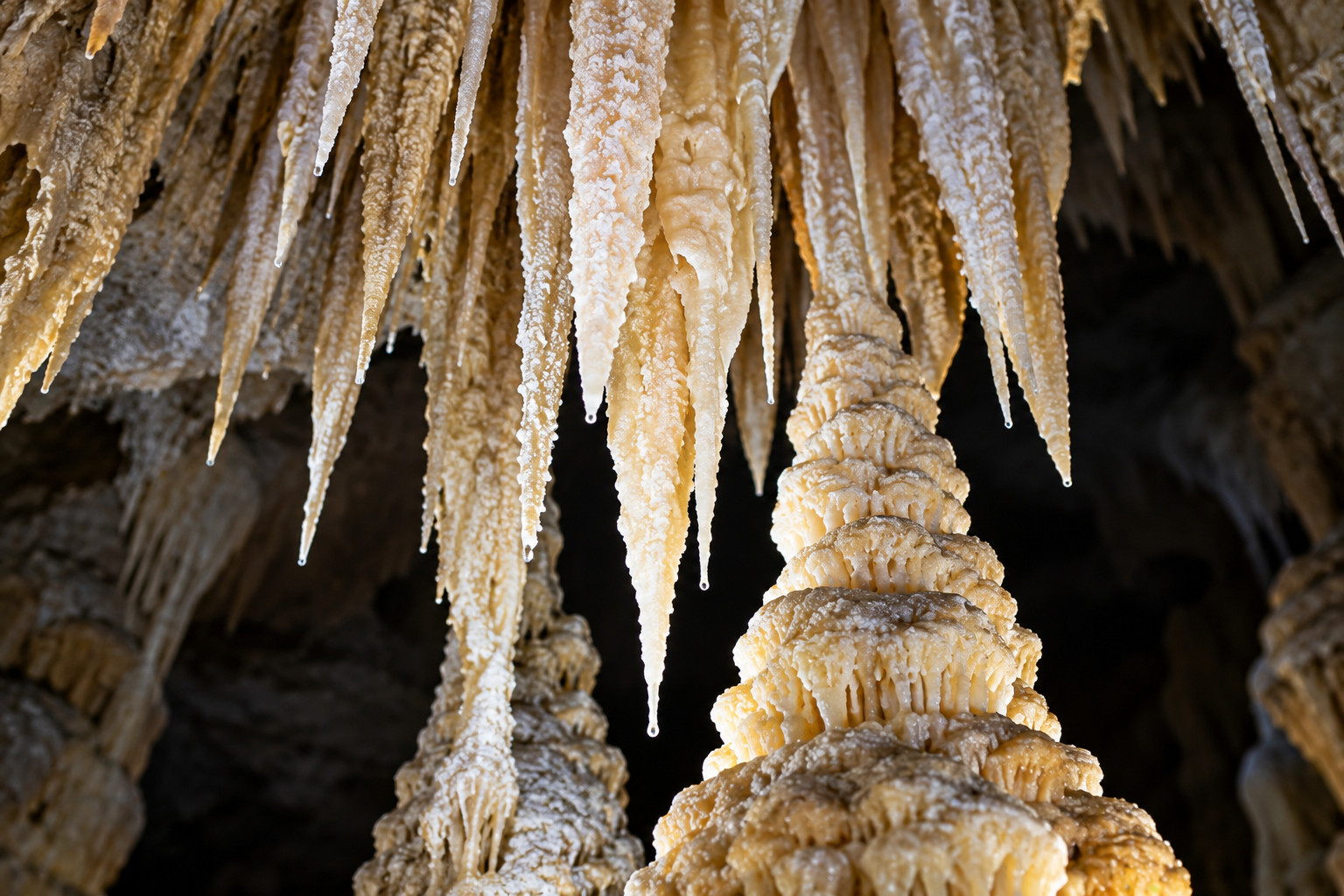
Cover illustration: AI illustration based on a historical photograph. Xueyu Cave chamber with pale hanging and rising formations under artificial lamps. Scene, terrain and architectural details are approximate; not a current photograph, access confirmation or navigation guide.
Historical reference only; original photograph not republished or licensed for reuse: Fengdu County Government / Photographer not credited
This guide contains four explicitly labeled AI scene illustrations from historical photo references and one original localized planning diagram. Photograph capture dates and current access are not established by the page update dates. No independent review is claimed.
Xueyu Cave in Fengdu is a geology-focused choice for 2026, with pale formations and an enclosed visitor experience rather than a folklore itinerary. Fengdu’s tourism authority dates its cave-science base to 2003. Before travelling, confirm the open route, stair requirements and return transport; historic cave dimensions do not establish today’s walking distance.
Search for 丰都雪玉洞, and keep the characters on your phone. “Snow Jade Cave,” “Snowy Jade Cave” and “Xueyu Cave” refer to the same destination in this guide. Xueyu Mountain is a different search result, and a general Fengdu excursion may focus on other attractions without entering the cave.
The practical choice is whether the people in your group enjoy looking closely at formations and can manage the operator’s current route. A cave can be interesting without a long list of record-breaking claims. Careful observation, a manageable pace and a confirmed ride back will contribute more to the visit than a rushed collection of photographs.
Know what makes this cave distinctive
The Fengdu county tourism profile, displayed as dated 6 January 2026, describes the pale appearance behind the name Xueyu. It attributes whiteness to about 80 percent of the formations it discusses and records science and observation designations in 2003. Those are useful clues to the cave’s identity; they are not a guarantee that every chamber will look white under visitor lighting.
Start with the relationship between the names and what you can actually see. Xue means snow and yu means jade. Here they describe appearance, not a promise of ice, gemstones or a snow attraction. The setting is a natural cave with a managed tourist presentation. Colour in promotional photographs can also be affected by artificial lighting, exposure and editing.
Ask whether the interpretation explains the formations or mainly supplies imaginative names. Both approaches can be enjoyable, but a family interested in geology may want more than the outline of a mythical figure. Read a geological label first, then compare its explanation with the shape in front of you. Do not touch a formation to test its texture or to improve a photograph.
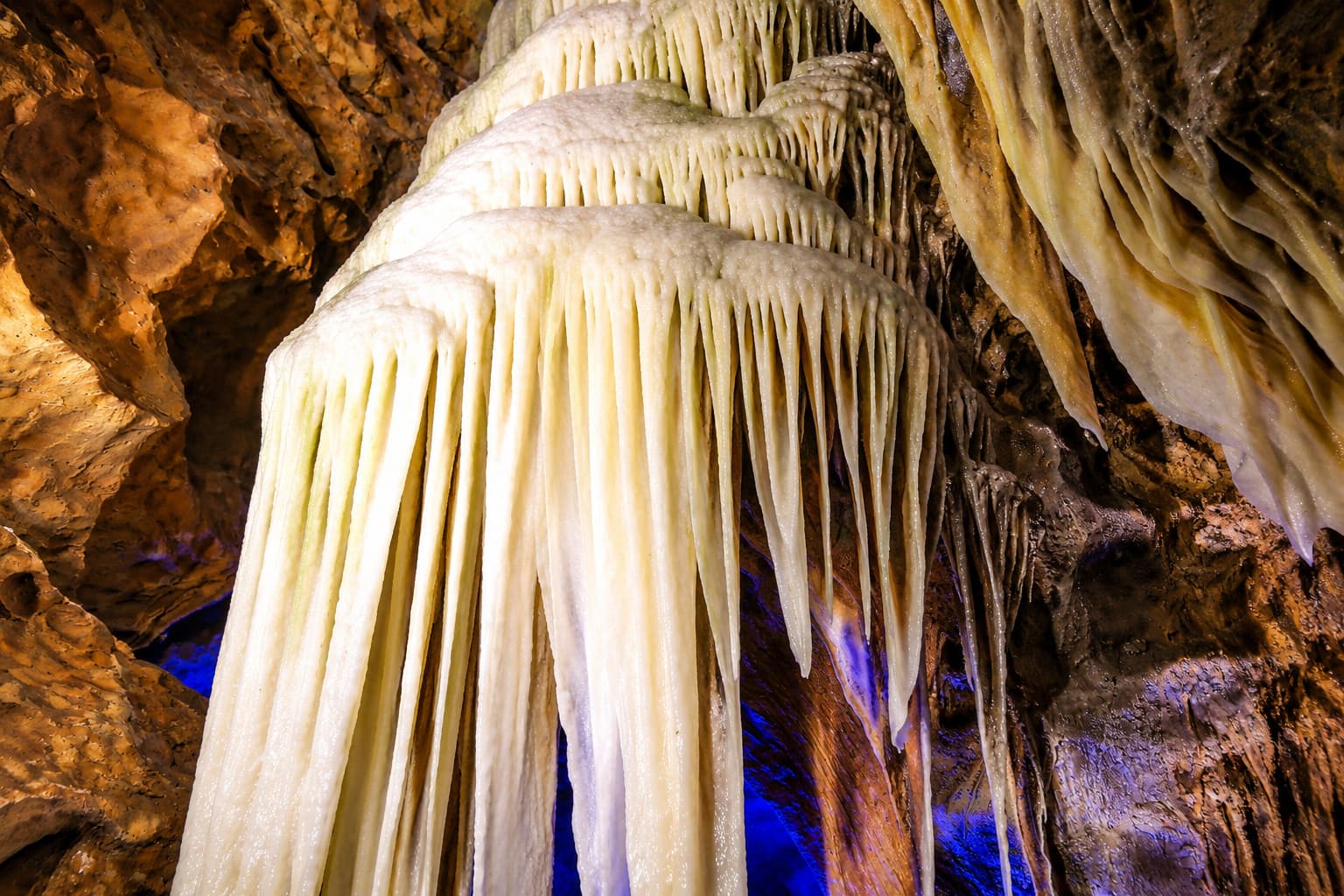
AI illustration based on a historical photograph. Pale draped cave formation under artificial white and blue lighting. Scene, terrain and architectural details are approximate; not a current photograph, access confirmation or navigation guide.
Historical reference only; original photograph not republished or licensed for reuse: Fengdu County Government / Photographer not credited
Turn the formations into a looking exercise
An iChongqing feature published in July 2022 locates Xueyu Cave on the rock wall of Longhe Canyon and names flag, shield, soda-straw and coral-like formations. Use those as prompts to notice differences, not as a checklist that requires every named feature to be accessible during your visit.
At a suitable stopping place, compare a thin feature with a broad one. Look at edges, branching shapes, spaces between formations and the way light changes their appearance. A guide can help distinguish the descriptive nickname from the geological term. If you are unsure which named object a sign identifies, ask before writing a caption. Similar-looking formations elsewhere in the cave should not automatically receive the same name.
For children, choose an observation question rather than a collecting task. Can they find something that looks like a curtain and something that looks like a straw? Which features are hanging and which rise from the floor? They can sketch shapes or describe them afterward without leaving the walkway or reaching over a barrier. This gives the visit a purpose even when a scientific explanation is not available in their language.
Avoid turning promotional growth-rate claims into a lesson. A number repeated in travel copy may refer to a particular measurement, feature or interval, and the meaning can be lost in translation. Ask for the source behind an unusual claim. It is fine to leave the cave understanding that its formations are varied and delicate without repeating a dramatic rate you cannot verify.
Read cave dimensions carefully
The Wikipedia overview checked in October 2026 describes Xueyu as a cave extending over 3 levels, with a total length of 1,644 metres. Its underlying references include much older material. These figures describe the cave in reference sources, not a verified visitor walk, a stair count or the section open on the day you arrive.
That distinction matters when booking for someone with limited stamina. A route can be shorter than the cave yet involve more effort than its length suggests. Ask about continuous flights of steps, changes in level, handrails, surfaces and places to rest. Ask whether the entrance and exit are at the same location and whether any extra transfer is needed afterward. None of those answers can be derived from a single total-length figure.
A photograph of a wide walkway also cannot establish that the whole route is accessible. It may omit a narrow section or staircase. If a wheelchair, walking aid or stroller is involved, describe the actual need to the operator rather than asking whether the cave is generally “easy.” Request current information for the entire planned route, including the approach outside the cave.
Consider the least mobile person first. If the route cannot be confirmed as suitable, separate the group’s activities or choose another outing. Carrying someone through an uncertain route should not be the backup plan. Our family-travel guide can help organise breaks and expectations, but it is not an accessibility audit of Xueyu.

AI illustration based on a historical photograph. Terraced cave surfaces with colored artificial lighting; no current visitor route is verified. Scene, terrain and architectural details are approximate; not a current photograph, access confirmation or navigation guide.
Historical reference only; original photograph not republished or licensed for reuse: Fengdu County Government / Photographer not credited
Confirm the visit product and the last mile
Fengdu’s 2026 official profile confirms the attraction’s identity and its science role, but it does not provide a current visitor timetable in the material reviewed here. Current entry prices, last admission, guide arrangements and local departures therefore need a separate check before purchase.
Ask what the advertised ticket actually covers. Is it cave entry, a guided departure or a broader excursion with transport? Does a group have to wait for a guide? Is there interpretation in a language you understand? If a seller includes other Fengdu attractions, ask how much of the day is allocated to Xueyu and whether the cave remains included when weather or transport changes the programme.
For independent travel, confirm the final approach and the return together. A reservation to Fengdu does not by itself deliver you to the cave entrance. Ask for the exact pickup point, the Chinese destination name and the return meeting place. Keep the driver’s or provider’s agreed contact details, and establish what happens if the visitor route takes longer than expected.
When planning by rail, use the current booking service for the actual station and departure. Then allow for the separately confirmed road transfer instead of treating the train’s arrival as the attraction’s arrival time. The railway-station guide explains station-name checks. No bus number, train duration or ride-hailing availability for Xueyu is asserted here.
Carry an offline copy of the ticket and the meeting point. If the ticket form expects an identity-document number, ask the provider how your foreign passport is handled before paying. A successful booking screen is useful, but you still need to know how admission is validated at the entrance.
Photograph the cave without changing it
Xinhua’s July 2019 photo report provides a dated record of Xueyu’s interior and names the photographer, Liu Chan. Such images help you understand what the place has looked like. They do not show today’s route conditions, and public visibility does not give permission to republish the photographs.
For your own visit, ask about photography rules at the entrance. Follow any restrictions on flash, tripods or video. Choose a place where stopping will not block a narrow path, and let a moving group pass before framing a longer shot. Keep equipment and hands inside the permitted visitor area. Never lean on a formation, cross a barrier or reposition an object to clear the composition.
A useful photograph can show the relationship between a formation and the walkway, with people included incidentally as scale where appropriate. Another can isolate a permitted detail. There is no need to saturate the colours until the image resembles a different cave. A truthful caption might name Xueyu Cave, describe the visible shape and give your capture date without guessing the formation’s age.
Allow time simply to look. A dim scene that is difficult to photograph may still be rewarding to observe. If photography becomes the whole purpose of the stop, it is easy to miss the smaller details that distinguish the cave from another underground attraction.
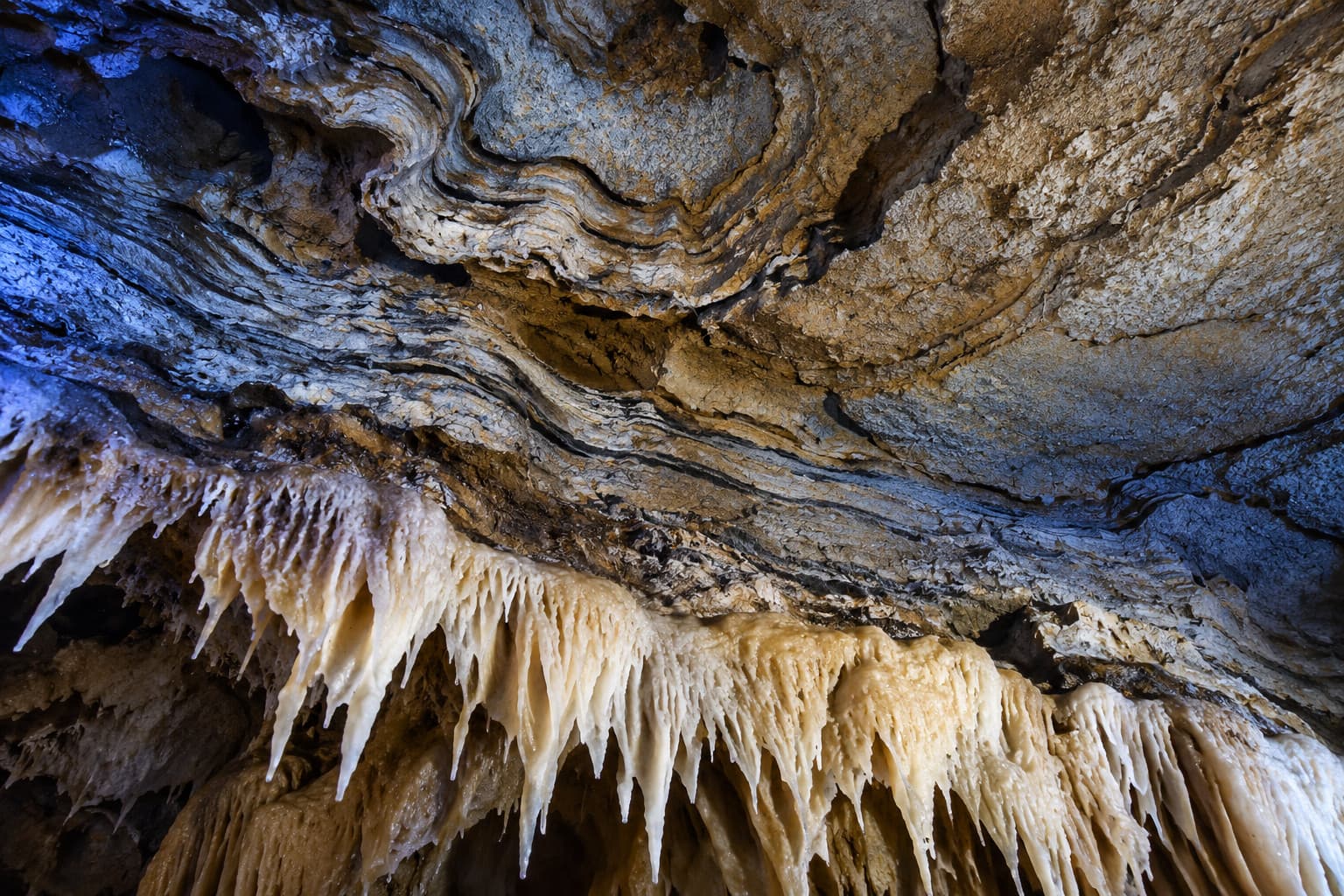
AI illustration based on a historical photograph. Rock ceiling and pale formations reconstructed from a photograph captured on 2019-07-03; blue light is artificial. Scene, terrain and architectural details are approximate; not a current photograph, access confirmation or navigation guide.
Historical reference only; original photograph not republished or licensed for reuse: Xinhua / Liu Chan / Xinhua
Choose a cave day rather than a crowded checklist
The 2022 Fengdu feature discusses Xueyu alongside several different Fengdu destinations. Their appearance in the same article is not evidence that they share an entrance or can be combined casually. Decide whether your day’s main interest is cave formations, folklore, mountain scenery or a broader introduction to the county.
If Xueyu is the priority, make it the firm part of the plan and add another stop after the transfer arrangements are clear. Leave space for a meal and a pause outside. After an enclosed visit, some travellers prefer an unhurried break to another scheduled attraction. For a cruise excursion, use the ship’s confirmed return requirement when deciding whether an independent detour is practical.
Pack for the actual route and forecast. Shoes with grip, a removable layer and a small bag are sensible choices for a cave outing; they are not evidence of a specific indoor temperature or a known slippery section. If heavy rain or a closure notice affects the approach, follow the operator’s current advice rather than assuming an underground attraction is weather-proof.
For a fallback in the urban area, the rainy-day planning guide offers a different kind of day. Keep that decision separate from the ticket you buy for Fengdu. An alternative is useful when it reduces uncertainty rather than adding another long transfer.

Original editorial planning diagram based on this article; not a photograph or geographic map. Planning checklist only; not a route map or current operating guarantee.
Original editorial planning diagram based on this article; not a photograph or geographic map.
Plan a Xueyu Cave visit
Choose your scope:
- Ask about steps and walking demands.
- Bring suitable footwear and a light layer.
- Look without touching the formations.
Confirm before leaving:
- Recheck weather and current access.
- Arrange pickup and the return journey.
- Confirm fees and cancellation terms.
Planning checklist only; not a route map or current operating guarantee.
About This Guide
Sources were read on 1 October 2026: Fengdu’s tourism profile, regional reporting, a cave reference overview and dated Xinhua captions. No author visit, interviewed guide, completed walk or human editorial review is claimed. Cave length is distinguished from the open visitor route. Operating hours, ticket terms, transport and complete mobility access remain visit-date checks.
Frequently Asked Questions
Q: Is Xueyu Cave the same place as Fengdu Ghost City? A: No. Xueyu Cave, 雪玉洞, is the natural-cave attraction discussed here; Fengdu Ghost City is a different destination. Check that an excursion explicitly includes cave entry rather than assuming every Fengdu tour visits it.
Q: How far do visitors walk inside Xueyu Cave? A: A current visitor-route distance was not verified. The often-cited 1,644 metres describes the cave’s overall reference length, so ask the operator for the distance and level changes on the route open for your date.
Q: Is Xueyu Cave suitable for a wheelchair or stroller? A: Complete step-free access at Xueyu Cave was not established. Describe your needs and ask about the outside approach, stairs, lifts, narrow sections and exit arrangements before booking.
Q: Why is it called Snow Jade Cave? A: Fengdu’s tourism authority links the Xueyu name to the pale, snow-like and jade-like appearance of its formations. It is a cave-viewing destination, not a promise of natural ice or gemstones.
Q: Can I combine Xueyu Cave with another Fengdu attraction? A: A combination involving Xueyu Cave may work if the current admission windows and transfers fit, but the destinations are separate visits. Confirm the cave route, return meeting point and onward transport before adding another stop, especially when returning to a cruise ship or train.
Traveler comments
Share a recent experience or ask a practical question about this guide.