
AI disclosure: This guide was generated with AI from the cited sources. It is not a record of a personal visit or independent human verification. The editorial diagrams were created programmatically; the historical photographs are source-attributed photographs, not AI-synthesized scenes.

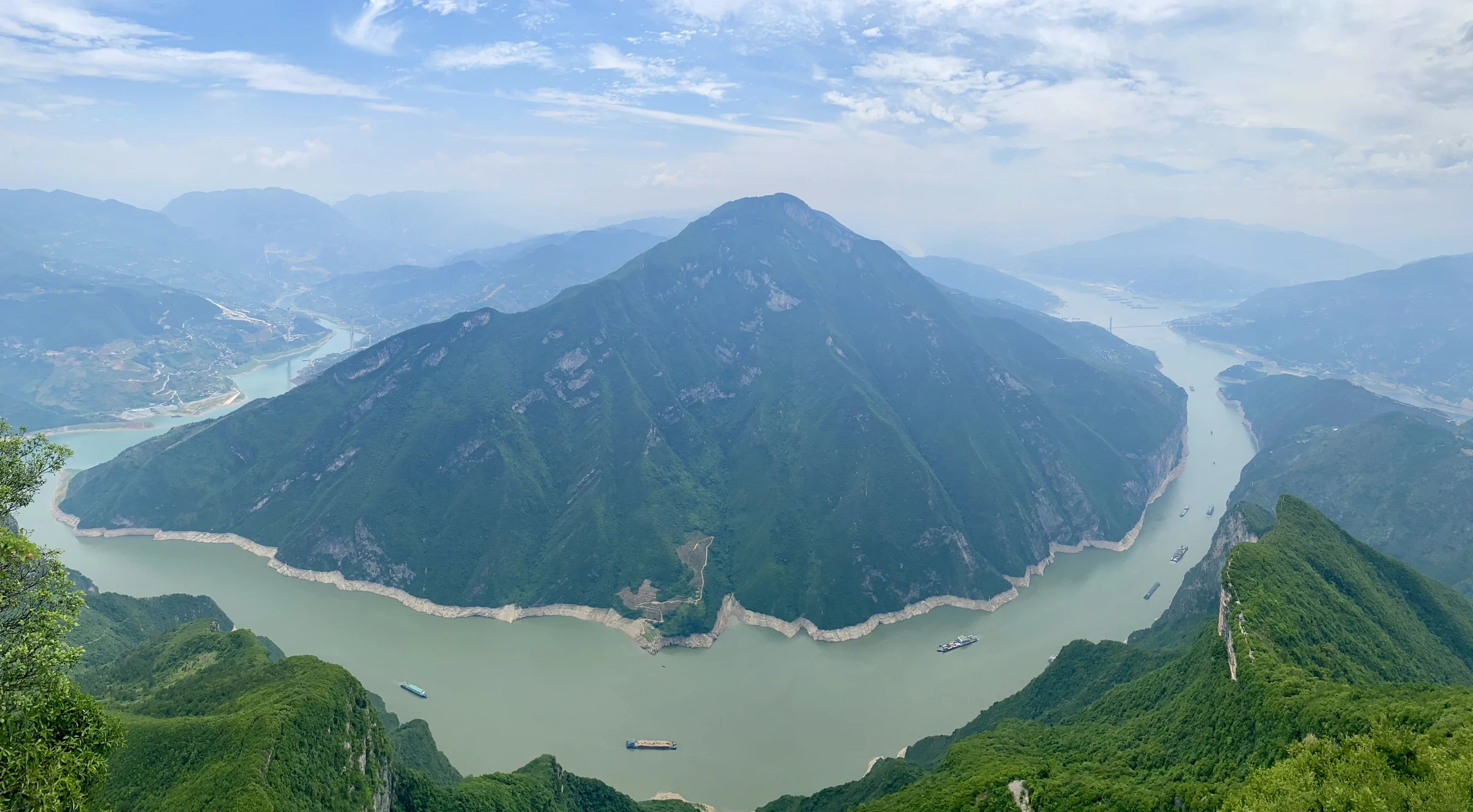
Panorama from Three Gorges Summit in Fengjie, photographed on 9 June 2024. This landscape view does not document the current ascent or viewing-platform facilities. Creator: Zhaojundong; Source: File:重庆奉节-三峡之巅 Peak of the Three Gorges.jpg; License: CC BY-SA 4.0; Recorded capture date: 2024-06-09 14:13:11; Changes: EXIF-based auto-orientation; proportional full-frame downsize without enlargement; WebP re-encoding; embedded metadata stripped. No crop, generative fill, scene retouch, recolouring, added caption, or removal of original date imprint. If adapted, retain the applicable ShareAlike license.
Three Gorges Summit in 2026 needs a route decision before a photography plan. The attraction operator places the viewpoint on Chijia Mountain at 1,388 metres. Separate a transport-assisted visit from the longer hiking approach, confirm the permitted direction of travel, and arrange the descent before entering an uphill-only section.
The Chinese name is 三峡之巅, often rendered as Sanxia Zhidian or the Summit of the Three Gorges. It is in the Fengjie area above Kuimen and Qutang Gorge. A destination pin labelled with the summit does not identify the correct entrance for every ticket.
This guide was researched from operator and government material, not an editorial ascent. It deliberately avoids an estimated completion time that could be mistaken for a personal fitness assessment. The evidence supports useful planning distinctions; it does not establish that every vehicle, cableway or hiking gate is operating today.
Decide whether the journey or the viewpoint is your priority
The operator's scenic-area description locates the high point on Chijia Mountain and gives an elevation of 1,388 metres. That is an elevation above sea level, not the amount of ascent from whichever entrance you choose.
Begin with 2 possible aims. A viewpoint-led visit prioritises reaching the approved viewing area through the currently available transport arrangements. A hike-led visit prioritises the ascent itself, with the summit as one part of the journey. Ask the operator to describe each product in terms of entry location, walking requirement and exit rather than comparing titles alone.

A glass-floored viewing platform in the Three Gorges Summit area, photographed on 20 February 2021. The facilities and visitors shown are historical; the image does not establish present access, capacity or safety conditions. Creator: anonimerce @ Mapillary.com; Source: File:Three Gorges viewpoint Baidicheng - Mapillary (s3cNepA5TQPqLixTGUR8ev).jpg; License: CC BY-SA 4.0; Recorded capture date: 2021-02-20; Changes: Full source composition retained; auto-orientation, WebP encoding and metadata stripping only, with no enlargement. Existing source watermark/face blur retained; no new blur, dehazing, geometry change, retouch or AI image synthesis. If adapted, retain the applicable ShareAlike license.
If a companion wants the view but not a long ascent, do not assume that both aims can be reconciled by buying the same ticket and separating midway. Establish where the routes actually meet, whether the meeting point is accessible to both parties, and how each will leave. If that cannot be confirmed, choose a simpler shared plan.
Treat entrances as different products, not interchangeable map pins
The operator's reservation notice of 30 April 2025 separates the main scenic-area arrangements from the hiking route and names 2 hiking inspection points: 赤甲楼, Chijialou, and 水井湾, Shuijingwan. This gives you specific terms to use when clarifying a booking.
Before arranging a transfer, ask which point accepts your ticket, where a car may drop you, and whether the booking includes internal transport. A driver taking you to the scenic area's general reception point may have completed the agreed journey while still leaving you at the wrong start for a hike.
Write the Chinese entrance name next to the map pin and keep the seller's confirmation. If an agent offers to change your start, check whether the new route has the same admission conditions and leads to the same exit. An entrance farther uphill could change the experience; an entrance lower down could change the exertion. This guide does not supply an unverified road-by-road approach or a promise that public vehicles reach every gate.
Earlier gate cutoffs matter more than the closing headline
The April 2025 operator notice listed a noon cutoff at Chijialou and a 13:00 cutoff at Shuijingwan, earlier than the advertised overall closing time. These are dated examples of a crucial distinction: the park's closing hour does not tell you how late a long ascent may start.
Confirm the current cutoff for your exact entrance, then build the outward transport around that time. Include the process of finding reception, presenting documents and dealing with a booking problem; arriving in Fengjie before a cutoff is not the same as being admitted at the trail gate.
Avoid planning to negotiate an exception after arriving late. If your outward connection is uncertain, compare the transport-assisted option or move the visit. Admission staff may restrict entry for reasons that a booking screenshot does not capture, including conditions along the route. Ask for the current notice, and make the change while you still have transport choices.
An uphill-only route changes the meaning of turning back
The same 30 April 2025 notice expressly prohibited reversing or returning along the hiking ascent. For this destination, generic advice to “walk until tired, then retrace your steps” could conflict with the published visitor system.
Before entering, ask how someone leaves if they cannot continue and where staffed assistance or authorised exit options are located. Do not assume every stair junction is an exit, or that a road visible below is reachable by an approved path. A useful plan names the person or contact you should approach, rather than relying on the hope of walking against the flow.
If your party becomes uncomfortable or conditions change, stop at a safe permitted place and follow staff guidance. Do not cross barriers or improvise a downhill shortcut. The practical decision point is often before the controlled section: choose the route whose walking and exit arrangements the group can accept, instead of discovering the one-way rule deep into an ascent.
Arrange the descent as carefully as the ascent
The 2025 reservation notice listed sightseeing vehicles and a cableway separately. It does not follow that every hiking ticket includes both, or that their final departures coincide. Ask what takes you from your intended finishing point to the place where you can continue the journey.
Draw a 3-stage chain in your own notes: summit area, internal descent or transfer, and onward pickup. For each stage, record who provides it and what happens if you miss the planned connection. If the seller cannot explain where a vehicle ends, resolve that before paying.
A hired car waiting at your original hiking entrance may be impractical if visitors must exit elsewhere. Give the driver the confirmed finish point, and agree how to handle a change. Do not calculate the entire visit from a road map's driving time to the summit pin: that figure cannot include ticket processing, queues, walking or internal transport.
Keep a return option that works without staying for a sunset photograph. The desire for a particular light should not determine whether you can leave the mountain through an authorised route.
Weather is a decision input, not a promised visual effect
The operator's description presents cloud, light and a river panorama as part of the attraction's scenery. Such descriptions are not forecasts. At 1,388 metres, the question for a viewpoint-led visit is whether the conditions permit the view and the route you have chosen, not whether a promotional image looks appealing.
Check the forecast relevant to the mountain and the attraction's own notices shortly before travel. Ask whether reduced visibility, rain or other conditions affect the walking route, viewpoint or mechanical transport. Follow closures and on-site instructions. This article provides no threshold for deciding that a particular wind speed or weather event is safe.
Choose a fallback that matches your reason for visiting. A person interested in gorge geography may prefer a lower-level cultural visit on another route; a person set on the ascent may prefer another date. Do not assume conditions at Fengjie town establish conditions at the summit, and do not enter a closed area because a photograph suggests the clouds might soon clear.

A high view from the Three Gorges Summit area, photographed on 20 February 2021. The natural haze is retained; this is a landscape view, not an ascent-route photograph or a current weather report. Creator: anonimerce @ Mapillary.com; Source: File:Baidicheng view Fengjie - Mapillary (ZsSRPZW9wVqEzptb5peJrY).jpg; License: CC BY-SA 4.0; Recorded capture date: 2021-02-20; Changes: Full source composition retained; auto-orientation, WebP encoding and metadata stripping only, with no enlargement. Existing source watermark/face blur retained; no new blur, dehazing, geometry change, retouch or AI image synthesis. If adapted, retain the applicable ShareAlike license.
A hiking event does not describe every ordinary visit
A CQNEWS report dated 1 July 2026, credited to Fengjie Release, described a summer hiking season linking Baidi, the “66 bends”, Chijia Mountain and Kuimen viewpoints. The report also described event support and collectible medals.
That is evidence of a particular organised tourism product, not proof that an unregistered visitor receives the same support or reward on any date. If the event is what interests you, confirm whether registration remains open, which route it uses and which services are included. Avoid choosing a hike because an old video shows a staffed rest point without checking whether it belongs to an event day.
The “66 bends” name is a route identifier in that coverage; it is not a fitness grade. A catchy label cannot tell you the stair condition, congestion, exposure or effort relevant to your group. Ask for a current route description and compare it with your own experience, rather than treating an achievement badge as a suitability assessment.
Read booking rules by date and document type
The Fengjie county notice dated 24 April 2025 required a 3-hour lead for same-day reservations. The operator's later April notice gave 1 hour. This change is why the guide directs you to the current date-specific booking process rather than publishing either interval as a permanent rule.
The notices identify official channels including the Baidi/Qutang mini-program and the Fengjie Tourism account. Their identity-document wording does not fully establish the foreign-passport workflow. Before arranging a time-sensitive arrival, ask which channel accepts your passport and how the booking is checked at the chosen gate.
Inspect the actual product name, walking category and included transport. Read cancellation conditions before payment, particularly if poor weather would remove the main reason for your trip. A ticket for Baidi/Qutang is not automatically a summit or hiking reservation merely because the same organisation advertises them together.

A Baidicheng–Qutang cliffside walkway and scenic-area sign, photographed on 9 February 2024. This is not identified as the summit ascent or a summit viewing platform. Creator: Liuxingy; Source: File:白帝城·瞿塘峡景区标牌与栈道.jpg; License: CC BY-SA 4.0; Recorded capture date: 2024-02-09 12:15:33; Changes: EXIF-based auto-orientation; proportional full-frame downsize without enlargement; WebP re-encoding; embedded metadata stripped. No crop, generative fill, scene retouch, recolouring, added caption, or removal of original date imprint. If adapted, retain the applicable ShareAlike license.
Set a group plan that survives imperfect conditions
Agree on 3 priorities before leaving: the experience you want, the route everyone is prepared for, and the latest feasible exit that preserves onward travel. This is editorial planning advice, not a suggested timetable. It is meant to make a decision easier if the day changes.
For general preparation, the heat and stairs guide offers broader questions about pacing and carrying essentials. It does not certify this route's difficulty. The railway-stations guide helps with departure-station names, while the navigation guide explains precise pickup pins.
For a companion using mobility equipment, ask about the full transport-assisted chain, including boarding, remaining steps, toilets and return. The presence of a sightseeing vehicle or cableway is not enough to establish continuous step-free access. If the operator cannot answer the route-specific questions, avoid presenting the outing to that person as an accessible option.
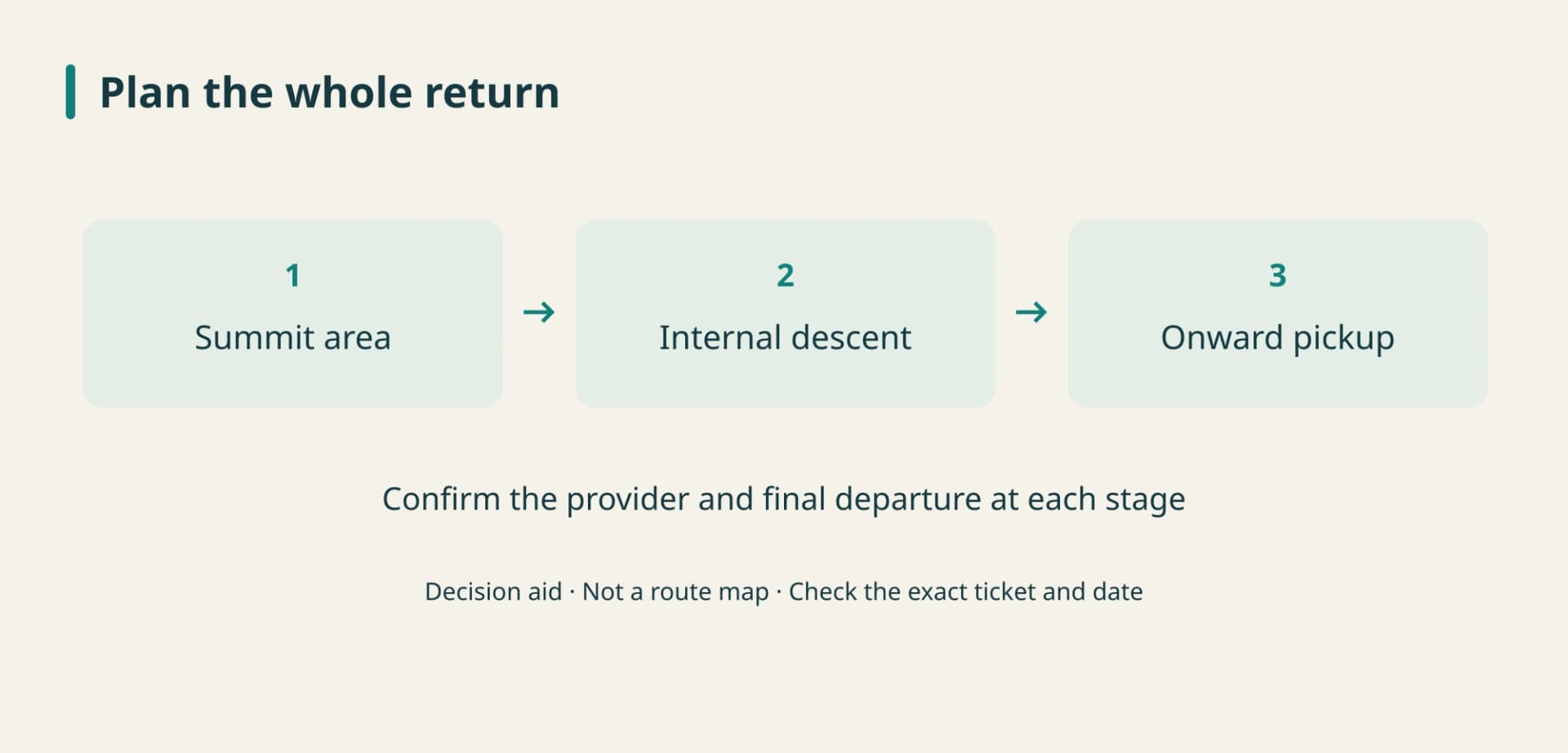
Plan the full return through the summit area, internal descent and onward pickup. This editorial checklist supplies no route geometry, service promise or timetable. Creator: Original editorial diagram; Source: Original editorial diagram; License: No separate public reuse license has been assigned; Recorded capture date: Not a photograph; Changes: Original programmatic SVG layout rendered to WebP; no photographic reference or image synthesis
About This Guide
Research was completed on 1 October 2026 using the scenic-area operator, Fengjie county notices and 2026 local reporting. The 2025 operational details remain explicitly dated. No summit ascent, measured walking time or human field review is claimed. Confirm the current hiking direction, gate cutoffs, mechanical transport and booking process before travel.
Frequently Asked Questions
Q: Is 1,388 metres the amount I have to climb? A: No. It is the elevation stated for Three Gorges Summit. Your actual ascent depends on the entrance and product you select.
Q: Can I start hiking any time before the park closes? A: Do not assume so. The April 2025 notice gave earlier cutoffs for Chijialou and Shuijingwan; obtain the current entrance-specific times.
Q: Can I walk down the same route if I become tired? A: The 30 April 2025 notice made the ascent uphill-only and prohibited reversing. Confirm current rules and staff-directed exit arrangements before entering.
Q: Does a ticket include both a sightseeing vehicle and cableway? A: That depends on the exact product. Ask how you reach the summit area and how you leave, including any separately charged stages.
Q: Will I get the event medal and support described online? A: Not necessarily. The July 2026 report described an organised hiking season; check current registration, inclusions and operating dates rather than assuming they apply to every visit.
Traveler comments
Share a recent experience or ask a practical question about this guide.