
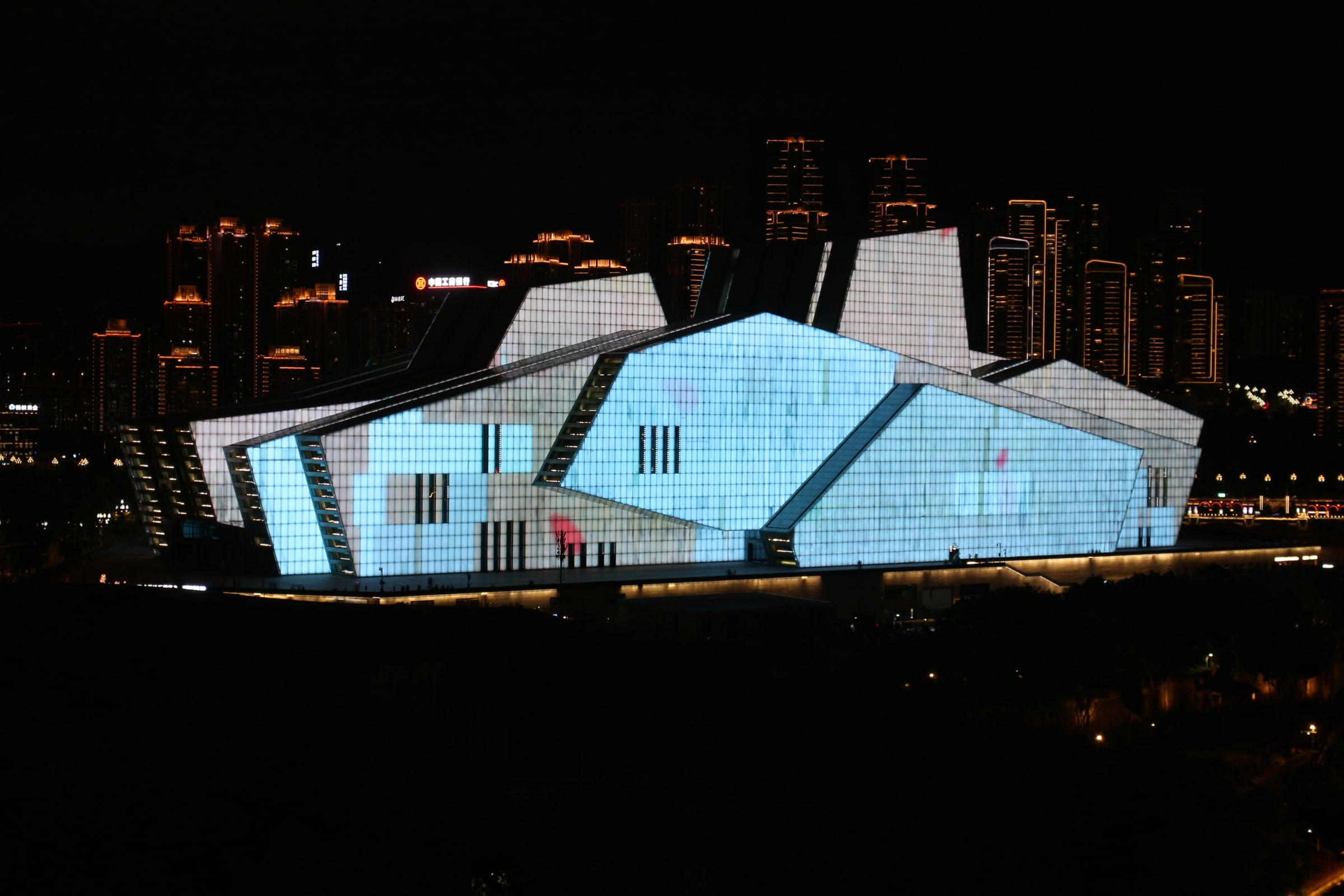
Chongqing Grand Theatre in 2026 needs two separate checks: whether your chosen performance is going ahead, and how ticket holders should enter. The operator published alternative access instructions after an August ring-road restriction. Confirm the current event and approach before buying, then treat architectural sightseeing as optional rather than assuming free access around the building.
Cover: The illuminated Chongqing Grand Theatre on 7 May 2026. This historical night view predates the August ring-road works and does not establish present access or guarantee an illumination schedule. Photograph by Suicasmo, 2026-05-07, CC0-1.0. Resized and JPEG-compressed for the web; full composition retained. Building: Chongqing Grand Theatre, designed by gmp (Meinhard von Gerkan and Nikolaus Goetze, with Klaus Lenz), with ECADI.
The theatre can be a reason to spend an evening with music, dance or drama, rather than another stop in a riverfront photo circuit. That distinction matters during temporary access changes: a ticketed performance may have an organized arrival arrangement that does not apply to a casual visitor.
This guide explains the decisions to make and the evidence available. It does not confirm a particular performance, sell tickets, promise a public interior tour or provide a newly surveyed walking route.
Begin with the dated access restriction
The Liangjiang New Area government explanation bears the date 10 August 2026. It identifies the controlled section as 重庆大剧院环道, the theatre ring road, and states that ordinary vehicles and pedestrians are excluded during emergency works. Lifting the restriction is subject to a separate notice.
No lifting notice was verified in the source search for this guide. That is a limit of the research, not proof that every arrangement remains unchanged. Before traveling, obtain current instructions from the theatre or relevant authority and follow the signs and staff at the actual site.
Keep the scope precise. The notice concerns the ring road; it does not itself establish closure of the entire theatre building or the whole Jiangbeizui riverbank. Equally, an open performance listing does not mean visitors can walk anywhere around the building. The safe planning boundary is the specific approach approved for your event.
Do not enter a barriered section, follow construction vehicles or improvise a shortcut through a work area. If the marked approach is unavailable or unclear, ask staff for an authorized alternative. A photograph taken before the works is not evidence that its camera position remains accessible.

An oblique exterior view of the theatre on 22 July 2024. The forecourt and any doors visible in this historical image are not instructions for an entrance to use today. Photograph by HoweyYuan, 2024-07-22, CC-BY-SA-4.0. Resized and JPEG-compressed for the web; full composition retained. Building: Chongqing Grand Theatre, designed by gmp (Meinhard von Gerkan and Nikolaus Goetze, with Klaus Lenz), with ECADI.
Distinguish a performance ticket from a sightseeing visit
Think of two different plans: attending a named show, and looking at the building. A ticket should identify a performance, date, time, hall and seat or admission category. It should not be interpreted as permission to enter every foyer, terrace or other part of the complex.
The architect's project record describes two principal halls and an exhibition space between their foyers. That is useful architectural context, not a current public-access policy. This research did not verify a regular interior-tour schedule or a general sightseeing ticket.
If you mainly want architecture photographs, ask which public viewpoints are currently permitted before making a dedicated journey. If the answer cannot be established, keep that stop optional. There is no need to force a circuit around the theatre to appreciate its role in the skyline.
If you want a performance, plan from the official event listing outward. Start with the production you genuinely want to see, then check its terms and arrival arrangements. Do not buy an unfamiliar show merely because the building looks appealing in photographs.
Choose a show you can follow comfortably
Check three pieces of information separately: the performance language, any surtitles or other language support, and the approximate running time. A venue's international profile does not establish English-language support for every production.
An instrumental concert or dance performance may suit a visitor who does not speak Mandarin, depending on their interests. A dialogue-heavy play may require more language knowledge. These are audience choices, not claims that a particular production is available or that visual storytelling removes every language barrier.
Read the actual listing through the theatre's official channels. The official theatre-group page provides a ticketing entry and consultation information. Confirm that the event is at 重庆大剧院, with the exact hall shown, rather than another Chongqing venue with a similar English description.
For children, check the event's age or height policy and whether every attendee needs a seat. Do not assume a family group can share tickets or enter because another show at the same venue allowed it. For sensory or mobility needs, ask about that production's conditions and the current approach before buying.
Check the purchase conditions before paying
Make two decisions before payment: whether the performance suits you, and whether you can complete the purchase and entry process with your available identity document and phone setup. A convenient listing is not useful if its ticket-retrieval method does not work for your situation.
Ask what name and document details are required, whether a foreign passport is supported, how the ticket is delivered and what must be shown at entry. This guide has not tested a foreign-passport checkout for a specific performance. Do not treat a general China travel payment guide as proof that every ticketing platform accepts the same method.
Read the event-specific refund, exchange, late-arrival and cancellation wording. These conditions may differ by production or sales channel. Save the confirmed order and the official instructions, while remembering that a saved image may not substitute for a live ticket credential where the operator says otherwise.
The official contact page lists 023-61863166 and 023-61863199, with consultation hours of 09:30–17:00 when checked. Those are published contact hours, not a claim that the theatre is open for sightseeing throughout that period. Confirm any unresolved entry question before committing to a non-changeable booking.

A river-facing view of the theatre against the city skyline on 22 July 2024. The photographed river level, vegetation and nearby vehicles are historical details, not evidence of present access or transport arrangements. Photograph by HoweyYuan, 2024-07-22, CC-BY-SA-4.0. Resized and JPEG-compressed for the web; full composition retained. Building: Chongqing Grand Theatre, designed by gmp (Meinhard von Gerkan and Nikolaus Goetze, with Klaus Lenz), with ECADI.
Use the operator's access plan as a dated starting point
The theatre's verified-account notice of 14 August 2026 describes alternative access during the works, including a signed approach from Line 6's Grand Theatre station and performance shuttle arrangements. It is evidence that the operator provided event access instructions, not permission to cross the closed ring road.
The same notice ties the shuttle to same-day tickets for the large or medium hall. It accepts a paper ticket or the actual mini-program electronic ticket and says screenshots are not accepted for that service. These conditions belong to the dated shuttle announcement; they should not be generalized into the admission policy for every future event.
A later operator notice dated 19 August names a signed riverside approach from Grand Theatre station Exit 1 to Gate 1. It is another dated performance-access instruction, not confirmation that the same route or the earlier shuttle arrangements apply to an October visit.
Before your performance, ask whether that plan still applies. Confirm the exact pickup or pedestrian meeting point, the service window, eligibility and the entrance staff expect you to use. If instructions have changed, use the newer official version. This guide deliberately does not reproduce August's estimated walking time or shuttle stops as a guaranteed October timetable.
For a car or taxi, use the operator's current permitted drop-off point rather than placing a destination pin at the centre of the theatre. The navigation guide explains the difference between finding a building and finding the usable arrival point.
Build the evening around arrival and the return
Use three planning anchors: the admission time on your event instructions, a flexible meal, and the journey home. Allow margin for a revised approach, ticket collection or staff checks. The actual amount depends on the performance and current access arrangement, so no universal arrival buffer is promised here.
Keep dinner away from the last possible arrival moment. If the restaurant, transport and theatre all need to work precisely on time, the plan has little room for a change. A meal before traveling or a flexible option afterward can remove that pressure.
Check the return arrangement independently. Do not assume a pre-show shuttle implies an unrestricted late-night sightseeing service. The August operator notice describes performance-related transport, so confirm the post-show service for your actual event. Also check the last useful public-transport connection from the return stop you expect to use.
Our metro guide and taxi guide cover general travel setup. They do not override temporary local signs or the theatre's latest instructions. Save your accommodation address and keep enough battery to communicate if the return plan changes.

The theatre facade and door area on 22 July 2024. The visible door label and forecourt predate the August 2026 works; do not use this image to choose a present-day entrance or route. Photograph by HoweyYuan, 2024-07-22, CC-BY-SA-4.0. Resized and JPEG-compressed for the web; full composition retained. Building: Chongqing Grand Theatre, designed by gmp (Meinhard von Gerkan and Nikolaus Goetze, with Klaus Lenz), with ECADI.
Look at the building without inventing access
The architect's account dates construction to 2005–2009 and describes a glass form supported by a stone platform. You can use that contrast as a way of understanding the building from any currently permitted viewpoint: the heavier base and the changing appearance of the angled glass above it.
Look for how the surfaces catch light rather than expecting an identical image at every hour. The architecture account discusses light and reflections, but it is not a lighting schedule. Neither the design description nor a night photograph guarantees that a particular illumination will be operating during your visit.
If you enter for a performance, notice the public areas on your permitted route. Do not take a design diagram's connected spaces as an invitation to explore backstage or closed foyers. Follow the event's photography rules, especially inside the hall; this guide does not grant recording permission.
The photographs accompanying this guide are intended to explain the building, not to reconstruct a current pedestrian route. A May 2026 cover still predates the later road works. Keeping the capture date visible allows it to be useful without making a false claim about access.
Know when to change the plan
Change the outing if one essential part cannot be confirmed: the show, the ticket's suitability or the permitted approach. A general venue page and an old photograph cannot fill those gaps. The district notice makes staff direction and traffic signs important, so leave room to act on them.
If a production is cancelled or moved, use the instructions from the official sales channel handling your order. Do not assume another event at the theatre has the same outcome. A change affecting scenery vehicles, for example, should not be expanded into an unsupported statement that all performances have stopped.
For an architecture-only visit, postponing the close-up portion is reasonable when current public access is unclear. For a ticketed performance with confirmed event access, focus on that event and leave an unscheduled riverfront walk for another time. That keeps the purpose of the visit clear without turning a temporary restriction into either an invitation or a blanket closure claim.

The theatre and Jiangbeizui skyline across the river on 18 February 2024, photographed from a location the source identifies as Chaoqian Road in Yuzhong. The exposed shore, water level and boat are historical details and do not establish a currently permitted walking route. Photograph by メイド理世, 2024-02-18, CC-BY-SA-4.0. Resized and JPEG-compressed for the web; full composition retained. Building: Chongqing Grand Theatre, designed by gmp (Meinhard von Gerkan and Nikolaus Goetze, with Klaus Lenz), with ECADI.
About This Guide
Prepared with AI from the architect, theatre-group page, verified operator announcement and district-government material opened on 1 October 2026 UTC. Government and operator access sources, including the later 19 August notice and recent operator posts, were rechecked on 2 October 2026 UTC (3 October in Chongqing). No site visit or human review is claimed. Current show status, ticket terms, document acceptance, entrance and access arrangements require final confirmation. No verified lifting notice was found; that negative search is not proof of a continuing whole-site closure.
Frequently Asked Questions
Q: Does the ring-road notice mean Chongqing Grand Theatre is completely closed? A: The 10 August 2026 government text identifies the theatre ring road. It does not establish that the whole building or entire Jiangbeizui riverbank is closed; check your specific performance and permitted approach.
Q: Can I walk around the theatre without a performance ticket? A: Do not assume a full circuit is available. Confirm which public areas are currently open and obey barriers and staff; the dated performance-access plan is not a general sightseeing pass.
Q: Is the performance shuttle available to all tourists? A: The operator's 14 August notice links it to same-day large- or medium-hall performance tickets. Confirm current eligibility, pickup point and service times for your event.
Q: Will a show have English subtitles or surtitles? A: Check the exact production. Chongqing Grand Theatre's venue profile does not establish language support for every show.
Q: Can I use an old photograph to choose an entrance? A: No. The planned cover was photographed in May 2026, before the August works, and the body candidates are older. Use current official entry instructions rather than treating visible doors or paths in a photograph as available today.
Traveler comments
Share a recent experience or ask a practical question about this guide.