
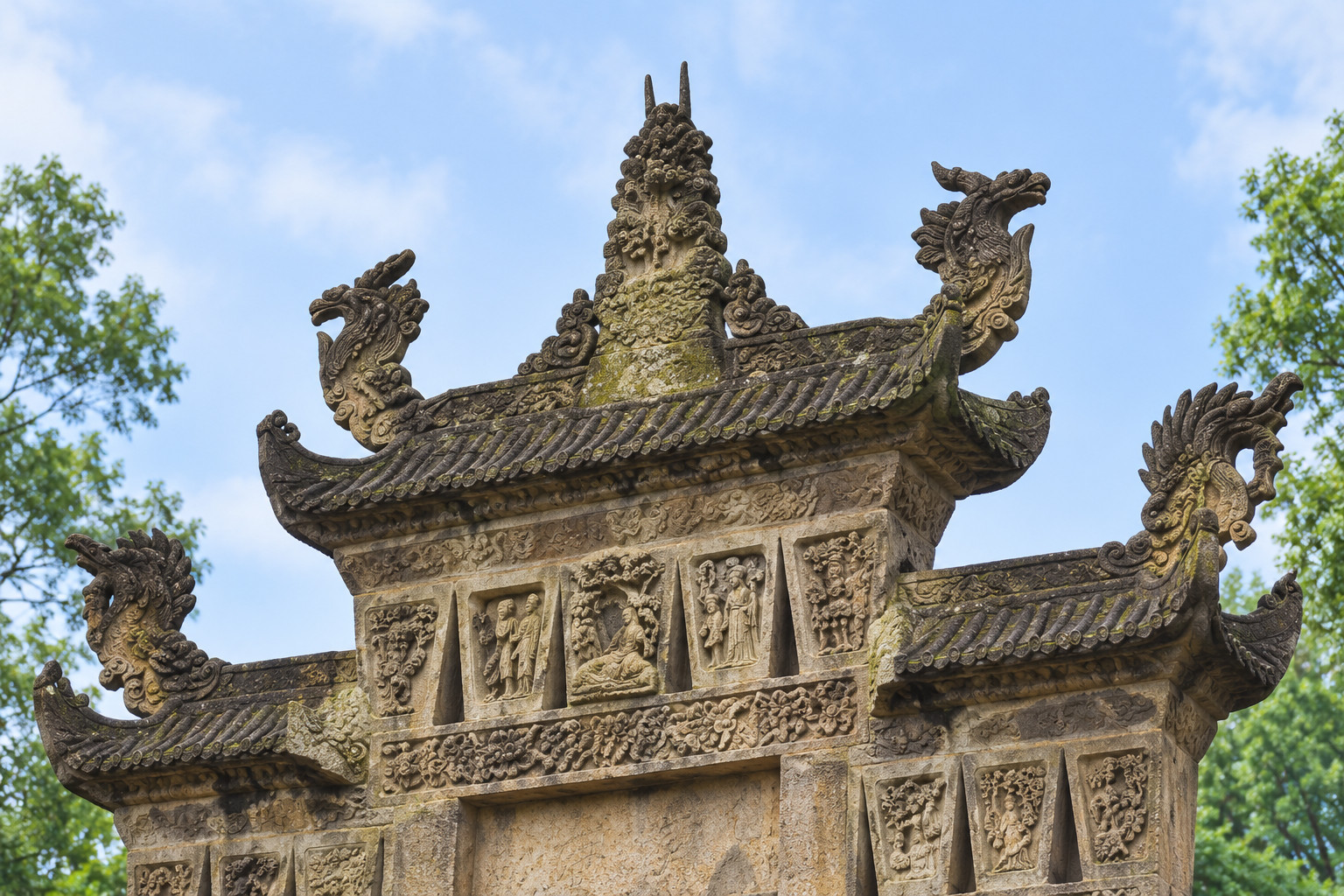
Cover illustration: AI illustration based on a historical photo reference. Upper carved roof detail of a historical stone cultural gate at Zhaomushan; not the complete gate or an inscription transcription. Approximate historical scene; not a current photograph, access or authorized-viewpoint guarantee. Flowers and vegetation do not establish species, blooming season or current conditions. Reference album published 11 April 2015; later additions possible; capture date unknown.
Historical photo reference only; original not republished; the reference grants no reuse permission: PConline / 雅忆
AI illustration based on a historical photo reference. Approximate historical scene; not a current photograph, access or authorized-viewpoint guarantee. Flowers and vegetation do not establish species, blooming season or current conditions.
For a Zhaomushan Forest Park walk in 2026, choose your entrance and return point before choosing a summit. Chongqing’s Civil Affairs Bureau describes five landscape zones and a hillside stair route with more than 80 metres of elevation change. This is a flexible northern-city park outing, with routes that deserve more thought than a broad map pin.
Save 照母山森林公园 as the destination. “Zhaomushan” also names a wider urban area, so a taxi request or search result can refer to offices or housing rather than a park gate. Save the entrance you actually intend to use, together with a photograph of its public sign when you arrive.
The useful question is what you want from the walk: trees and a short retreat, the park’s filial-culture landscape, or a longer climb. You do not need to collect every named feature. A satisfying visit can turn around at a clearly identified junction, leaving enough energy to reach transport comfortably.
Read the hill before committing to a circuit
The Civil Affairs Bureau’s May 2024 account describes an east–west hill range and dates construction of the forest park to 2001. Its account lists five themed areas and 38 features. Those figures describe the developed landscape, not a required walking checklist.
At the entrance, find the current public map and identify where you are in relation to your intended exit. Compare the Chinese names on the map with those saved on your phone. English spellings can differ, particularly for smaller pavilions and paths. A recognisable photograph of the map can be more useful than a list of transliterations.
Choose a route shape before you start. An out-and-back is easier to shorten because you have already seen the return path. A circuit adds variety but needs a confirmed connection. A walk ending at a different gate can be useful when transport works at both ends, yet it should not depend on a path that an old online account merely appears to show.
Keep your first destination modest. Reach it, check how the group feels, and then decide whether to extend. At junctions, notice the path you came from as well as the one ahead. That habit matters when several leafy branches look similar on the way back.
Match the arrival point to the walk
Trip.com’s park listing, read on 1 October 2026, gives the address as 88 Jinkai Avenue West Section. That is useful for identifying the park, but it is not a substitute for an entrance-specific route. Its free-entry label also does not establish that every gate, facility or path is accessible that day.
A traveler’s account dated January 2022 describes an approach from Happiness Square, also translated as Xingfu Square, on Line 5. The writer emphasises uphill walking. Use that as evidence that the journey can involve an approach beyond the station, rather than copying an old distance or assuming the current exit arrangement is identical.
For a metro journey, compare the station-to-gate pedestrian route before boarding. Look for crossings and the correct side of the hill, not just the straight-line distance. If the route is unclear, ask station staff to help identify the park entrance on a map. Our Chongqing metro guide covers the wider system; the last section still needs a current local check.
For a taxi arrival, send the chosen gate name in Chinese and ask where stopping is permitted. Keep the return pickup outside the pedestrian walking area. Agree on a visible public meeting point rather than asking a driver to find a moving phone pin somewhere inside the park.
Choose culture or climbing as your main thread
The 2024 municipal account links the park’s name and design with stories of Feng Shixing caring for his mother. It also acknowledges different historical explanations for the place name. Treat the story as the park’s cultural interpretation, rather than evidence that every structure is a surviving building from that period.
Zhaomushan Villa, 照母山庄, is described as a building created around that narrative. If it is your priority, use it as the anchor for a cultural walk: read the public panels, observe the courtyard forms from permitted areas, and notice how the theme is expressed in architectural details. A closed interior does not justify entering through another doorway.
For a climbing-focused visit, the important warning is the Xiaodao, 孝道, stair route. The authority describes more than 80 metres of height difference. That is elevation change, not a count of steps and not the total ascent of every possible route. Anyone who needs a gentle outing should inspect the entrance map and ask which paths avoid that staircase.
You can appreciate the same landscape without following the same line through it. Let companions who prefer a shorter route choose their own turnaround, with a shared public meeting point. Avoid splitting a group simply because someone assumes all paths rejoin higher up.

AI illustration based on a historical photo reference. White undulating garden wall, vase-shaped doorway and stone paving. Approximate historical scene; not a current photograph, access or authorized-viewpoint guarantee. Flowers and vegetation do not establish species, blooming season or current conditions. Reference album published 11 April 2015; later additions possible; capture date unknown.
Historical photo reference only; original not republished; the reference grants no reuse permission: PConline / 雅忆
Let the season change the subject
The 20 January 2026 local bloom report describes an unusually early overlap of red plum and wintersweet at Zhaomushan. It quotes a park landscaping administrator on how that winter’s conditions affected flowering. The useful lesson is that a flowering calendar is approximate, even when the trees themselves are well established.
If flowers are your main reason to travel, look for photographs with an explicit recent capture date and the correct park name. A newly resurfaced social post may contain an older photograph. A gallery about several Chongqing parks may also place a different park’s image beside a Zhaomushan paragraph. Check captions rather than assuming every blossom photograph belongs here.
For an ordinary forest walk, choose the conditions you will enjoy rather than chasing a promised seasonal colour. Consider heat, rain, visibility and the amount of daylight available for your return. Carry water and weather protection before entering; do not make the plan depend on finding a particular stall from a past traveler’s account.
In wet conditions, shorten the route if the surface or steps feel insecure. Take photographs from a stable stopping place instead of stepping backward while looking at a screen. The heat and stairs guide offers broader planning advice, but your decision at the next slope matters more than a generic description of the park as easy.

AI illustration based on a historical photo reference. Pink flowering grove, timber picnic table and stone path in a historical Zhaomushan scene. Approximate historical scene; not a current photograph, access or authorized-viewpoint guarantee. Flowers and vegetation do not establish species, blooming season or current conditions. Reference album published 11 April 2015; later additions possible; capture date unknown.
Historical photo reference only; original not republished; the reference grants no reuse permission: PConline / 雅忆
Keep daylight and access separate from city convenience
A 2018 Sichuan Fine Arts Institute lecture record uses Zhaomushan as a landscape-lighting case study and discusses ecological limits on illumination. It is design history, not a timetable. It gives no basis for assuming every forest path is brightly lit after dark.
For a first visit, plan to finish the unfamiliar walking portion while you can still read the terrain. The fact that buildings are visible beyond the trees does not tell you which exit is nearest or whether the descent is straightforward. A phone torch can help with an unexpected delay, but it should not be the reason to attempt a route you have not checked.
Read notices at the actual entrance. If access is restricted for weather, fire prevention or maintenance, choose another permitted activity instead of looking for an informal way around the closure. This research did not establish a current park-wide opening schedule or a complete step-free circuit as of 1 October 2026.
For mobility needs, ask a precise question: can the chosen entrance, destination and return be completed without stairs? Also ask about resting points and toilet access along that particular route. “Forest park” and “family outing” do not answer those questions. A short visit near an accessible entrance can still be worthwhile when a longer route would be uncomfortable.

AI illustration based on a historical photo reference. Thatched timber resting pavilion beside wooded stone paths. Approximate historical scene; not a current photograph, access or authorized-viewpoint guarantee. Flowers and vegetation do not establish species, blooming season or current conditions. Reference album published 11 April 2015; later additions possible; capture date unknown.
Historical photo reference only; original not republished; the reference grants no reuse permission: PConline / 雅忆
Finish with a reliable exit
The 2022 public walking account is useful for its repeated emphasis on hills and walking, not as a current map. Before leaving the entrance area, decide what will trigger your return: declining daylight, worsening weather, a tired companion or reaching the destination you selected. Finishing early is a valid result.
On the return, check the Chinese gate name before ordering a vehicle. If you emerge somewhere different, stop in a safe public place and establish the road level first. Do not keep walking toward a car marker when a barrier or steep slope separates you. The maps and road-levels guide explains this recurring Chongqing navigation problem.
Keep any meal afterward flexible. You can choose somewhere on the confirmed journey back rather than adding another park across northern Chongqing because both look close at city-map scale. If you are carrying shopping or luggage, leave the forest walk for a time when your hands are free.
For photographs, include the path as well as the greenery. A frame that shows the actual slope is more useful to a future visitor than a tightly cropped pavilion. Keep entrances clear, avoid making other walkers the subject without asking, and leave vegetation and cultural features as you found them.

Original editorial planning diagram based on this article; not a photograph or geographic map. Use current official information; this card is not a route map.
Original editorial planning diagram based on this article; not a photograph or geographic map.
Plan a forest-park walk
Choose your focus:
- Effort: Choose a walk that fits your time and energy.
- Rest: Plan breaks and carry drinking water.
Confirm before leaving:
- Conditions: Check weather, closures and slippery paths.
- Return: Confirm the exit and transport before walking.
Use current official information; this card is not a route map.
About This Guide
This is AI-generated text based on the cited sources. It does not report an author visit or independent human editorial review.
This guide was researched on 1 October 2026 using municipal history, a university design record, local reporting and public travel material. It is a desk-researched route-selection guide, not a report of a personal visit. Suggested choices are editorial advice; gate status, restrictions, facilities and the exact return journey need checking for your date.
Frequently Asked Questions
Q: Is Zhaomushan suitable for a short walk? A: Zhaomushan can be approached as a short out-and-back rather than a full circuit. Choose a confirmed entrance and a modest destination, and remember that the Xiaodao stair route has more than 80 metres of elevation change in the municipal description.
Q: Which metro station should I use for Zhaomushan? A: A January 2022 traveler account uses Xingfu Square, also called Happiness Square, on Line 5 to approach Zhaomushan. Check the current station-to-gate route before travelling because this guide has not verified a specific exit or walking time.
Q: Is Zhaomushan Villa an ancient building? A: Chongqing’s Civil Affairs Bureau describes Zhaomushan Villa as a cultural building interpreting the Feng Shixing story. Read it as part of the park’s filial-culture landscape rather than assuming its present fabric dates from the story.
Q: When will the flowers be in bloom? A: A January 2026 report recorded unusually early flowering at Zhaomushan Forest Park. Check recent, clearly dated local photographs for your visit; that episode does not establish a fixed annual peak.
Q: Can I count on a fully lit evening circuit? A: No complete illuminated circuit or current lighting schedule was verified for Zhaomushan on 1 October 2026. For an unfamiliar route, plan to reach your selected exit before darkness makes navigation harder.

Traveler comments
Share a recent experience or ask a practical question about this guide.