
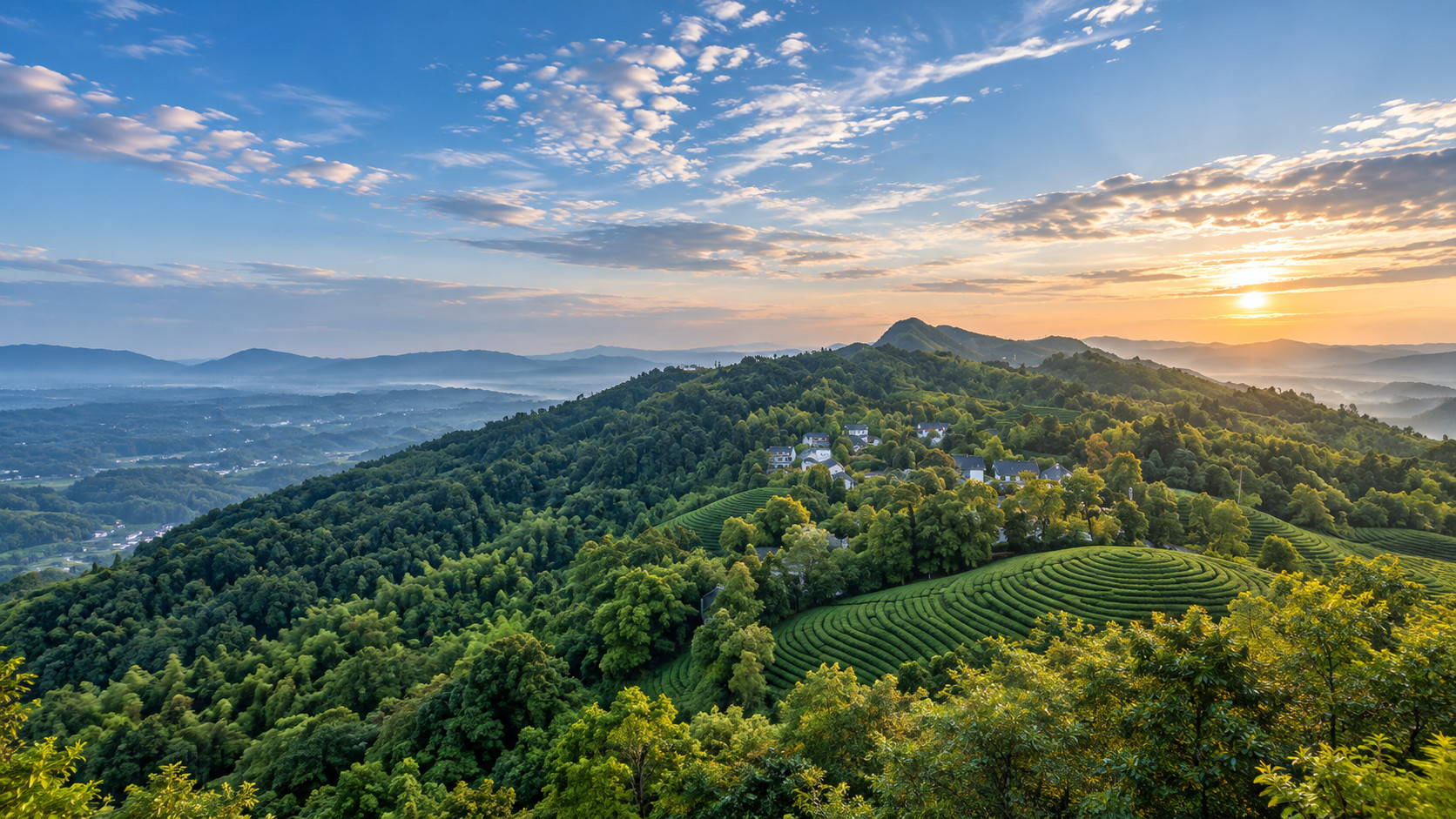
Cover illustration: AI illustration based on a historical photograph. Wuxing Tea Garden: curved tea rows and a wooded ridge. Scene, terrain and architectural details are approximate; not a current photograph, access confirmation or navigation guide.
Historical reference only; original photograph not republished or licensed for reuse: Yongchuan District Government / Ma Yong (马勇)
This guide contains four explicitly labeled AI scene illustrations from historical photo references and one original localized planning diagram. Photograph capture dates and current access are not established by the page update dates. No independent review is claimed.
Yongchuan Tea Mountain and Bamboo Sea in 2026 is easier to plan by choosing one main landscape first. The district's official profile names tea gardens, bamboo areas and cultural sites across the destination. Pick a tea-focused or bamboo-focused outing, then confirm the open sector, transport stops and return arrangement.
The name to save is 永川茶山竹海, Yongchuan Chashan Zhuhai. Adding Yongchuan helps distinguish it from other Chinese destinations described as a tea mountain or bamboo sea. Keep the full Chinese name when asking about transport or comparing an accommodation's claimed location.
This guide is a selection tool, not a promise that all the named places currently connect in one walk. The available sources establish the landscape and several points of interest. They do not establish a complete current route, an accessible circuit or a live tea-picking programme for your travel date.
Choose the tea or bamboo landscape that interests you
For a tea-focused visit, the appeal is the arrangement of the cultivated landscape: rows, slopes, edges and the relationship between growing areas and visitor space. For a bamboo-focused visit, the subject is different: trunks, canopy and how the path passes through the grove. Give one of these interests priority before adding more stops.
The Yongchuan government profile, dated 20 January 2026, names Guishan Tea Garden and Jinpen Bamboo Sea among the destination's attractions. Use those names to ask about a suitable open section. They are not evidence that every path in those areas is currently accessible or that a single transport ticket covers them all.
A mixed visit can work if the operator confirms the connection and your group has enough time. Otherwise, spending longer in one sector is a coherent choice. A satisfying tea landscape visit does not require reaching a summit, entering every bamboo area and finding every film-related landmark in the same day.
When comparing photographs, pay attention to their subjects rather than their intensity of green. A tea-garden panorama can help you decide what you want to see; it cannot establish that the photograph's viewpoint is public, step-free or close to a particular shuttle stop.

AI illustration based on a historical photograph. Cultivated tea hedges beside woodland; not permission to enter a working field. Scene, terrain and architectural details are approximate; not a current photograph, access confirmation or navigation guide.
Historical reference only; original photograph not republished or licensed for reuse: Yongchuan District Government / Ma Yong (马勇)
Separate scenic access from a tea activity
Seeing a tea garden, picking leaves, watching processing and tasting tea are four different experiences. The official profile mentions tea-related activities, but this guide has not verified their dates, booking method, languages or present availability. Do not buy general scenic admission on the assumption that a hands-on session is included.
If tea is your main reason for going, ask a provider what will actually happen on your date. Will there be a hosted activity or access to a landscape? Is it a demonstration, a tasting, or participation? Are any materials included, and are there restrictions on which cultivated areas visitors may enter?
Do not step between tea rows for a photograph or pick leaves without permission. A landscape can be visually open while remaining someone's working crop. Use designated visitor areas and ask where photography is appropriate. Watching from an approved edge may give a clearer understanding of the garden than trying to imitate a promotional image.
Seasonal appearance and agricultural work should also remain separate from a general travel promise. A dated photograph of picking does not prove picking will take place during your visit. If a particular activity cannot be confirmed, decide whether seeing the landscape alone is enough reason to make the journey.
Treat the film connection as context
Both the government profile and iChongqing's destination page associate the destination with the film House of Flying Daggers. That gives film-minded visitors another way to approach the bamboo scenery. It does not establish access to an exact camera position or an unchanged set.
If the film location matters to you, ask which officially identified area is currently open and how it fits your chosen route. A general bamboo photograph may convey the atmosphere without depicting the precise filming location. Captions should make that difference clear.
Keep the visit grounded in the landscape that is there. Do not expect actors, costumes, demonstrations or a film exhibition unless a current programme specifically offers them. A landscape's role in a film is a historical association, not an entertainment schedule.
The same restraint helps with photography. Stay on permitted paths and take a view that works from where visitors may stand. Do not recreate a dramatic film composition by climbing bamboo, moving barriers or entering an unmarked side route. The location remains a real managed environment beyond its screen image.

AI illustration based on a historical photograph. Forested ridge context; the distant pavilion and summit are not named, and no exact filming spot is identified. Scene, terrain and architectural details are approximate; not a current photograph, access confirmation or navigation guide.
Historical reference only; original photograph not republished or licensed for reuse: iChongqing / Photographer not credited
Approach tea purchases and meals without assumptions
A scenic tea destination can make every nearby package of leaves seem like a direct product of the garden in front of you. Ask where the tea was grown, when it was produced, what the package contains and how it should be stored. A seller should be able to distinguish a regional product from one grown at a particular site.
If tasting is offered, establish the price and purchase expectations before sitting down. Compare the actual package and quantity you would buy, not just a name translated into English. The souvenir-shopping guide provides broader questions about provenance and what to check before transporting goods onward.
The official destination description also mentions tea- and bamboo-related dishes. That does not establish today's menu at any individual business. Ask about ingredients and preparation if you have dietary requirements; a dish named after tea or bamboo does not establish that it is meat-free or suitable for an allergy.
Keep purchases separate from the reason for the trip. A landscape visit can be worthwhile without a shopping stop, and a tasting should not force you to rush toward the final transfer. Leave enough time to understand what you are buying or simply enjoy the scenery and move on.
Plan around the transfer centre and current forest access
The Yongchuan profile dated 20 January 2026 describes self-driving or using scenic transport from a transfer centre. It does not supply a current timetable or establish which stops are served on your date. Before travelling, ask where you should arrive, whether your selected sector requires an internal transfer and how you return from it.
Write down three points: the arrival location, the place where you begin walking and the collection point afterward. If these are different, identify the connecting service and whether it is included in your product. A broad attraction pin may not mark the place a car can drop you.
Ask whether the transfer runs to a schedule or another operating arrangement, what the last return is and what happens if your chosen path is unavailable. Do not assume you can walk along a vehicle road to replace a missed connection. Request the authorised option from staff.
For rail travel, use the exact station on the booking and arrange the onward journey from that station. The site's railway-station guide is background for handling station names and transfers. This article does not provide an unverified direct bus from a station to the tea gardens.

AI illustration based on a historical photograph. A bamboo-lined asphalt road; pedestrian permission and current road access are unverified. Scene, terrain and architectural details are approximate; not a current photograph, access confirmation or navigation guide.
Historical reference only; original photograph not republished or licensed for reuse: iChongqing / Photographer not credited
Confirm forest access before heading uphill
The opening status of a wooded destination can change, and a general all-day label is not sufficient evidence for your date. During this research, the Ctrip page displayed broad opening wording, while other sources contained different hours and historical closure information. This guide does not reconcile that conflict by choosing the most convenient version.
A report dated 23 August 2024 described a forest-fire-risk closure at Tea Mountain and Bamboo Sea. That is a historical example of access being restricted, not an assertion that the 2024 closure still applies. Current forest access and any restrictions must be confirmed through the destination's current notices.
Ask two questions: is the destination receiving visitors, and is the particular sector you want open? If the answer changes after you book, follow the current restriction. A hotel reservation, a railway ticket or a saved scenic map is not permission to enter a closed forest area.
Do not treat cooler-looking vegetation as a weather forecast. Check the forecast relevant to Yongchuan and the operator's advice. Fire restrictions, rain-related access limits and maintenance decisions are operational matters; they cannot be established from a photograph of a pleasant day.
Choose a walk your whole group can finish
A sector-based plan gives you a useful question for staff: “Which currently open route fits this group's walking capacity and gets us back to our confirmed transport?” That is more practical than asking whether the entire attraction is easy. A broad scenic area can contain several kinds of terrain.
Check the steps, slopes, surfaces, rest opportunities and route length for the actual choice. If travelling with a wheelchair or stroller, request a continuous route description, including transitions from transport. An accessible entrance or an electric vehicle does not by itself establish an accessible visit beyond it.
Keep the planned finish visible. Decide where to pause, when to turn back if the route permits it, and how to recognise the return stop. This is a planning exercise with the current map, not an invitation to reverse a one-way path or create a shortcut across planted areas.
Carry what you need for the confirmed outing and use the heat and stairs guide for wider comfort planning. If someone is tiring, ask about an authorised shorter option. The goal is to enjoy a chosen landscape, rather than finish an itinerary assembled from every photograph you found.

Original planning card; all labels also appear as selectable text below. Planning questions only. Confirm current access and return transport; this is not a route map.
Original editorial planning diagram based on this article; not a photograph or geographic map.
Choose your tea-and-bamboo visit
Choose one priority:
- Tea views: ask which tea-garden sector and viewpoint are open.
- Bamboo: confirm the permitted route, surfaces and steps.
- Hosted tea activity: verify the dated session, booking and inclusions.
Check before leaving:
- Check forest access and any restrictions for your date.
- Confirm internal transfers, finish point and return transport.
Planning questions only. Confirm current access and return transport; this is not a route map.
About This Guide
This guide was prepared through automated research on 1 October 2026, using Yongchuan's official profile, iChongqing, Ctrip and a dated historical closure report. No firsthand visit or independent human review is claimed. Present forest access, internal transfers and hosted activities remain unconfirmed. No independent image or rights review is claimed.
Frequently Asked Questions
Q: What Chinese name should I use for the destination? A: Use 永川茶山竹海, adding Yongchuan to distinguish it from other tea and bamboo landscapes in China.
Q: Can I cover all the tea gardens and bamboo areas in one visit? A: This guide does not verify a complete itinerary connecting all sectors of Yongchuan Tea Mountain and Bamboo Sea. Choose one priority sector, then ask the operator which additions fit its current route and transport arrangements.
Q: Is tea picking included with scenic access? A: That has not been established. Ask for the specific Yongchuan session, date, booking terms and inclusions rather than assuming access to working tea plants.
Q: Does the House of Flying Daggers connection identify an open filming spot? A: It establishes a historical association with Chashan Zhuhai. Current access to an identified filming area still needs checking, and a bamboo image need not show an exact camera position.
Q: Is the destination open all day throughout the year? A: Broad platform wording does not establish year-round opening at Yongchuan Tea Mountain and Bamboo Sea. Confirm current forest access, the chosen sector and its return transport, since historical closures and conflicting hours appear in the sources.
Traveler comments
Share a recent experience or ask a practical question about this guide.