
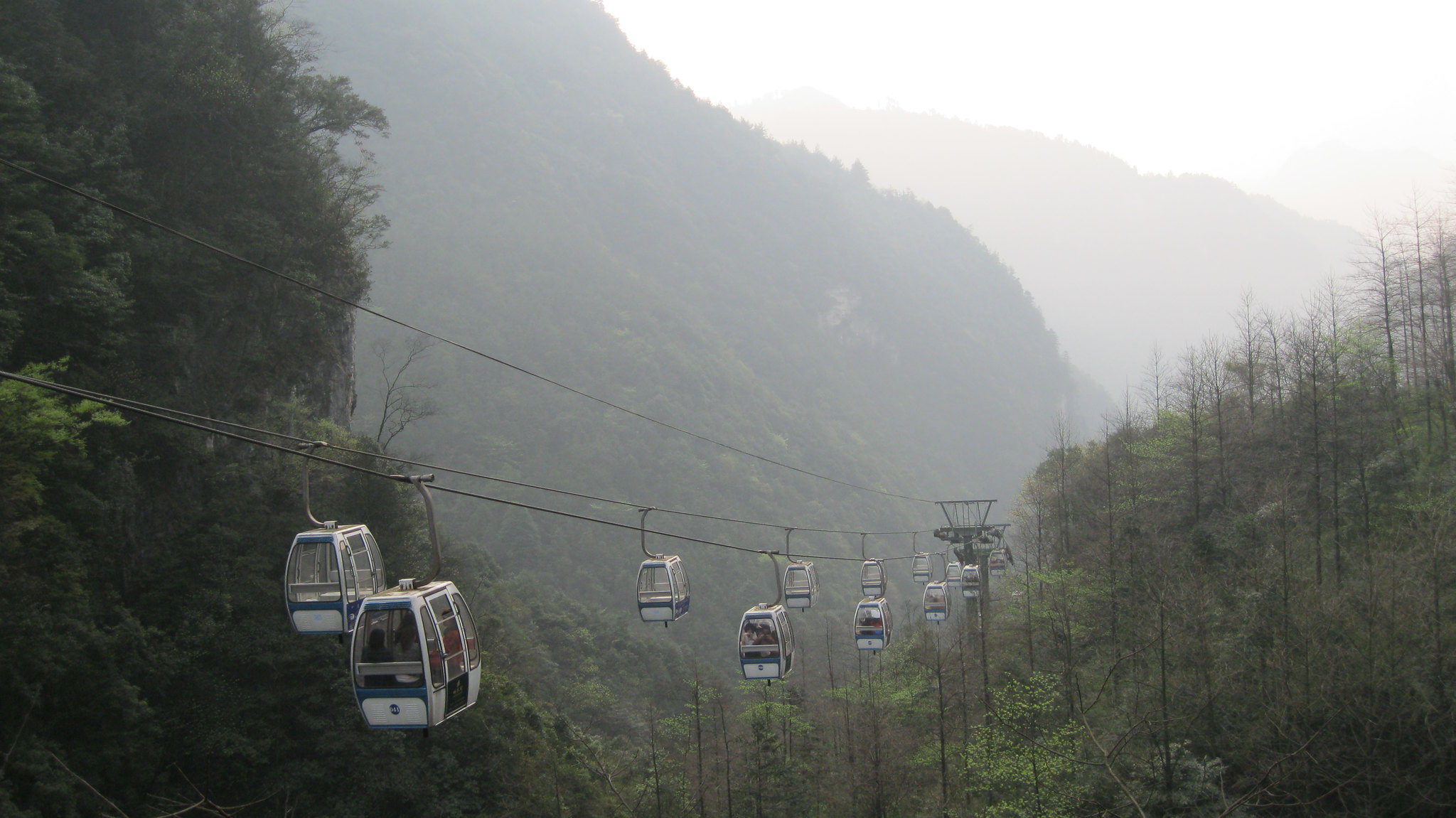
Cover photograph: Cable cars above the forested valley at Black Valley, Wansheng. The photographer dates this image to 9 March 2013; the time zone is not stated.
Photo: IMG_0768 · Yang Yungui / Flickr · CC BY 2.0. Unmodified Flickr 2048-pixel rendition; no local edits.
These five historical photographs illustrate Black Valley scenery. They do not verify today's route, cable-car operation, access or safety. No exact bridge, waterfall or gate identity is established; the walkway is not identified as Qian-Yu Bridge or South Gate.
Black Valley in Wansheng needs an entrance-to-exit plan in 2026, especially if you intend to walk through the gorge. Chongqing’s tourism authority describes a scenic area 13 kilometres long. That figure is not your required walking distance: confirm the open route, usable transport sections and final pickup before entering.
Save 黑山谷, Heishangu, along with 万盛, Wansheng. “Black Mountain Valley,” “Black Valley” and “Heishan Valley” appear in English guides. The municipal attraction page places it in Heishan Town within Wansheng’s economic development area.
This is a desk-researched guide to route decisions. It does not claim that the editor walked the gorge or inspected its bridges. It also does not present the entire advertised scenic length as a trail that every visitor can or must complete.
Decide whether a through-gorge outing suits your group
The main reason to consider Black Valley is the combination of a narrow landscape, water, forest and constructed visitor paths. The municipal description identifies a 13-kilometre scenic area with waterfalls, floating bridges and Chongqing–Guizhou gorge scenery. That overall scale makes the particular open route and transport combination worth checking; it is not a prescribed walking distance. This is a different outing from looking at one viewpoint beside a vehicle stop.
For a through-walk, you commit to making progress towards an exit. That can be satisfying for people who enjoy a journey through changing scenery, but it requires more planning than an open-ended park visit where you can leave by the same gate whenever you wish.
Ask two questions before comparing ticket prices: can everyone manage the current mandatory walking section, and is the end-of-route transport suitable? If the answers are uncertain, seek an operator-approved shorter option rather than assuming you can turn around anywhere.
Do not turn a park’s high scenic rating into a claim of universal accessibility. A well-known attraction can still involve steps, narrow passages, different surfaces and transport dependencies. The actual route and the people travelling matter more than the rating.

River and vegetated gorge wall at Black Valley, Wansheng. The photographer dates this image to 9 March 2013; the time zone is not stated.
Photo: IMG_0895 · Yang Yungui / Flickr · CC BY 2.0. Unmodified Flickr 2048-pixel rendition; no local edits.
The south-to-north idea is a starting question
TravelChinaGuide’s January 2026 page says the southern area is higher than the northern area and suggests starting from the south. That supports a route-planning preference, not an unconditional instruction to enter a particular gate on every date.
Before departure, ask whether the normal through-route is open and which direction the operator recommends today. Confirm whether you need to begin at a visitor centre before reaching the gate. A South Gate pin and a ticketing or transfer centre can serve different functions.
The published recommendation also does not mean the walk is continuously downhill or free of stairs. Descending can be demanding for some travellers, and a route described as energy-saving may still be unsuitable for an individual’s knees, balance or comfort with heights.
Use the preference to frame a practical request: “We want to reduce climbing and finish at our confirmed pickup. Which entrance and transport combination should we use?” The answer should connect your needs with the current operation, rather than merely repeat a popular itinerary.
Break the transport into separate components
There are at least three transport categories to clarify in addition to the walk: an external transfer between access points, an internal sightseeing vehicle, and a cable-car product. Commercial guides list these separately. A ticket described broadly as “with transport” may not include every category you expect.
For each component, identify where it starts and ends. Does it bring you from the visitor centre to the entrance, replace a particular section within the scenic area, or help you return to the place where you parked? Those are different jobs.
Then ask about operating status and the last service you need. If one component is unavailable, what is the operator-approved alternative and how much additional walking does it require? Do not assume that buying a cable-car ticket makes the entire gorge route accessible.
Write the confirmed sequence in plain language before entering: arrival point, gate, walking section, optional vehicle, exit, return pickup. If you cannot describe how these connect, the plan is not ready simply because all the tickets are in a phone wallet.
The 13-kilometre figure needs careful interpretation
The tourism authority gives 13 kilometres as the scenic area’s overall length. It does not define a mandatory pedestrian distance for the route you will take. Combining that figure with another guide’s vehicle distance and subtracting them can create a precise-looking but unsupported walking estimate.
Ask the operator for two current figures instead: the unavoidable walking distance and the walking time normally allowed for the route appropriate to your party. Treat the time as guidance, with room for rest, photography and queues, rather than a deadline every visitor should meet.
Also ask about the character of that walking. Distance alone cannot tell you whether there are long stair sections, narrow boardwalks or moving bridge surfaces. A short section that is difficult for one person may matter more than several kilometres of easier ground.
For a group with children or people who tire unpredictably, clarify where assistance or an early exit is available. This research did not verify a rescue service arrangement, intermediate public exit or step-free alternative, so none is promised here.

Small woodland waterfall and pool at Black Valley, Wansheng. The photographer dates this image to 9 March 2013; the time zone is not stated.
Photo: IMG_0878 · Yang Yungui / Flickr · CC BY 2.0. Unmodified Flickr 2048-pixel rendition; no local edits.
Arrange the return before leaving your starting point
A linear visit creates a simple but consequential problem: your car or luggage may be at the opposite end. Solve that before the walking begins. Do not assume there will be an available shuttle, taxi or informal lift at the exit when you arrive.
For a driver arrangement, confirm two locations in Chinese: drop-off and pickup. Add the side of the road or an identifiable public meeting point when the operator provides one. The phrase “Black Valley entrance” is too vague when there are several access points and transport stops.
For self-driving, ask which approved service returns visitors to the parking area and when it finishes. Check whether its ticket is separate from the internal sightseeing vehicle. If the service stops before you expect to finish, change the plan rather than relying on an unverified walk along the road.
For an organised group, clarify whether the vehicle follows the route and meets you at the other end. Keep the organiser’s contact details available offline. If some people choose a different activity, agree where they will rejoin without assuming all tickets finish at the same place.
Recheck direct transport rather than repeat an old “no bus” claim
Some guides state that there is no direct transport from Chongqing. That is too broad to repeat without checking. Wansheng’s local transport reporting from June 2025 announced a customised service linking the Black Valley area with Chongqing Sigongli.
The report names stops including the South Gate area, the North Gate bus stop and the Bajiao visitor centre. It also says capacity can change with demand and points readers to the Yuke Xing, 愉客行, booking channel. This is evidence that such a service was announced, not confirmation of an available seat or departure today.
For your date, check the actual service listing and its complete stop name. A bus labelled “Black Valley” may use a particular roadside pickup rather than the gate where your walking route ends. Save the stop description, direction and current departure information together.
If a direct service is unavailable, compare a connection through Wansheng with a pre-arranged car. This guide provides no current fare or timetable because neither was verified for the visit date. An attractive older schedule should not be the foundation of a fixed onward train connection.
Read bridges and boardwalks as part of the route
A firsthand account of an October 2019 visit includes photographs labelled with the South Gate, cable car, bridge and gorge features. It is useful evidence of the kinds of route elements visitors encountered, while remaining a dated account.
At any narrow or moving passage, follow the operator’s current instructions and let others pass. Stop for photographs where there is space, rather than using the middle of a bridge as a prolonged filming position. Keep bags manageable and avoid obstructing handrails.
Do not translate a photograph of someone touching opposite gorge walls into a recommended activity. Stay on the designated path. Equally, a travel page mentioning rafting, camping or other recreation does not establish permission to do those things independently inside the scenic area.
For people uneasy on moving bridges or beside drops, ask to see a current route description before paying. Do not minimise that concern with a generic “family-friendly” label. A suitable alternative is one the operator confirms, not an improvised bypass around a barrier.

Riverside walkway and wooded gorge at Black Valley, Wansheng. The photographer dates this image to 9 March 2013; the time zone is not stated.
Photo: IMG_0919 · Yang Yungui / Flickr · CC BY 2.0. Unmodified Flickr 2048-pixel rendition; no local edits.
Weather changes both enjoyment and route decisions
A forested gorge does not eliminate weather exposure. Check local warnings and the attraction’s notices before travelling, then look at current instructions again on arrival. This research did not verify a fixed annual closure season or a threshold at which every route closes.
Keep two plans: the confirmed through-route in suitable conditions, and a different activity or postponement if the operator restricts access. A partial closure may affect the route’s exit or transport logic as well as remove a viewpoint, so ask how the complete journey changes.
Do not seek an unstaffed stream or gorge nearby as a substitute for a closed scenic path. Avoid entering the water or crossing barriers for a photograph. The existence of a waterfall in a tourist image does not make the surrounding area a swimming place.
Pack according to the walking route and forecast you have checked. Useful preparations include suitable footwear, a manageable rain layer and protection for a phone. Do not rely on unverified rental equipment, storage, food outlets or mobile reception at every point.
Keep the budget and document checks practical
Before purchase, list the components your route requires and compare the total for that exact combination. Check admission, any internal vehicle, cable car and the return transfer separately. A bundled product may be convenient, but its name alone does not describe the route it supports.
Ask what document to bring and how a foreign passport is handled for the selected booking method. Check the terms for children or other concession categories with the provider; do not assume a discount linked to a particular identity document transfers automatically.
The municipal page dated 4 June 2026 publishes the attraction inquiry number 023-48279999. A useful inquiry includes the date, party size, desired gate direction and any limitation that affects walking or bridge use.
For preparation, the taxi and ride-hailing guide helps with pickup clarity. The heat and stairs guide covers pacing, and the Wulong guide provides a comparison if you are choosing between regional nature outings rather than attempting both in one rushed day.

Water cascading over moss-covered rocks at Black Valley, Wansheng. The photographer dates this image to 9 March 2013; the time zone is not stated.
Photo: IMG_0883 · Yang Yungui / Flickr · CC BY 2.0. Unmodified Flickr 2048-pixel rendition; no local edits.
About This Guide
Researched on 1 October 2026 from municipal tourism information, local transport reporting, commercial guides and a dated firsthand walking account. This automated guide claims no site visit or human review. Current gate direction, services and walking requirements remain operator checks. The cover and four body images in this guide are five historical photographs with recorded source, attribution and CC BY 2.0 licence evidence. No independent review of the full translation or native-speaker review is claimed.
Frequently Asked Questions
Q: Should I enter Black Valley at the south gate? A: A travel guide recommends Black Valley’s higher south side as a starting point, but confirm the current open route and transport sequence with the operator before choosing a gate.
Q: Do I have to walk all 13 kilometres? A: The 13-kilometre municipal figure describes Black Valley’s scenic-area length. Ask for the compulsory walking distance of your specific open route rather than assuming that number is your walk.
Q: Will an internal sightseeing-vehicle ticket return me to my car? A: Not necessarily. Black Valley’s internal service and external return transfer are different components; confirm their endpoints and ticket coverage separately.
Q: Is there a direct bus from Chongqing? A: Local reporting announced a Sigongli–Black Valley-area customised service in June 2025. Check the current date-specific listing and exact stop; this guide does not confirm today’s operation.
Q: Is the route suitable for someone who dislikes moving bridges? A: Ask for a current description and an operator-approved alternative before buying. This guide does not certify a bridge-free or step-free route through Black Valley.
Traveler comments
Share a recent experience or ask a practical question about this guide.